(a new emerging technology)


                 Gourav Pal
                MSIT/12/002
     Technology Management
   What is 3D printing?
   General Principle
   Additive Process
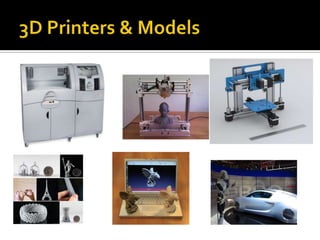
   3D Printers
   Videos
   Resources
   For methods of applying a 2-D image on a 3-D
    surface

   Additive manufacturing or 3D printing is a
    process of making a three-dimensional solid
    object of virtually any shape from a digital
    model.     3D printing is achieved using
    an additive process, where successive layers
    of material are laid down in different shapes.
   Additive Manufacturing: The term additive
    manufacturing refers to technologies that
    create objects through a sequential layering
    process. Objects that are manufactured
    additively can be used anywhere throughout
    the product life cycle,
   Modeling
   Printing
   Finishing
   Modeling:
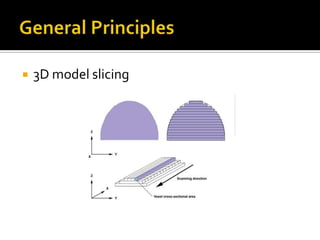
        Additive manufacturing takes virtual
    blueprints from computer aided design (CAD)
    or animation modeling software and "slices"
    them into digital cross-sections for the
    machine to successively use as a guideline for
    printing.
   Printing:
       To perform a print, the machine reads the
    design and lays down successive layers of liquid,
    powder, or sheet material to build the model
    from a series of cross sections. These layers,
    which correspond to the virtual cross sections
    from the CAD model, are joined together or
    automatically fused to create the final shape.
    The primary advantage of this technique is its
    ability to create almost any shape or geometric
    feature.
   Finishing :
        Though the printer-produced resolution is
    sufficient for many applications, printing a
    slightly oversized version of the desired
    object in standard resolution, and then
    removing material with a higher-resolution
    subtractive process can achieve a higher-
    resolution
   3D model slicing
   Several different 3D printing processes have
    been invented since the late 1970s. The
    printers were originally large, expensive, and
    highly limited in what they could produce.

   A number of additive processes are now
    available. They differ in the way layers are
    deposited to create parts and in the materials
    that can be used. Some methods melt or
    soften material to produce the layers.
   Some of the methods…

•   Selective laser sintering
•   Fused deposition modeling
•   Stereo lithography(optical fabrication)
   Each method has its own advantages and
    drawbacks, and some companies consequently offer a
    choice between powder and polymer for the material
    from which the object is built. The main
    considerations in choosing a machine are generally
    speed, cost of the 3D printer, cost of the printed
    prototype, and cost and choice of materials and color
    capabilities

   Printers that work directly with metals are expensive.
    In some cases, however, less expensive printers can be
    used to make a mould, which is then used to make
    metal parts.
   Watch the video
   http://news.noahraford.com/?p=1495

   http://en.wikipedia.org/wiki/3D_printing

   news.discovery.com/human/tags/3d-
    printing.html

   http://dsc.discovery.com/tv-
    shows/mythbusters/videos/how-3d-printers-
    work.htm
3 d – printing

3 d – printing

  • 1.
    (a new emergingtechnology) Gourav Pal MSIT/12/002 Technology Management
  • 2.
    What is 3D printing?  General Principle  Additive Process  3D Printers  Videos  Resources
  • 3.
    For methods of applying a 2-D image on a 3-D surface  Additive manufacturing or 3D printing is a process of making a three-dimensional solid object of virtually any shape from a digital model. 3D printing is achieved using an additive process, where successive layers of material are laid down in different shapes.
  • 4.
    Additive Manufacturing: The term additive manufacturing refers to technologies that create objects through a sequential layering process. Objects that are manufactured additively can be used anywhere throughout the product life cycle,
  • 5.
    Modeling  Printing  Finishing
  • 6.
    Modeling: Additive manufacturing takes virtual blueprints from computer aided design (CAD) or animation modeling software and "slices" them into digital cross-sections for the machine to successively use as a guideline for printing.
  • 7.
    Printing: To perform a print, the machine reads the design and lays down successive layers of liquid, powder, or sheet material to build the model from a series of cross sections. These layers, which correspond to the virtual cross sections from the CAD model, are joined together or automatically fused to create the final shape. The primary advantage of this technique is its ability to create almost any shape or geometric feature.
  • 8.
    Finishing : Though the printer-produced resolution is sufficient for many applications, printing a slightly oversized version of the desired object in standard resolution, and then removing material with a higher-resolution subtractive process can achieve a higher- resolution
  • 9.
    3D model slicing
  • 10.
    Several different 3D printing processes have been invented since the late 1970s. The printers were originally large, expensive, and highly limited in what they could produce.  A number of additive processes are now available. They differ in the way layers are deposited to create parts and in the materials that can be used. Some methods melt or soften material to produce the layers.
  • 11.
    Some of the methods… • Selective laser sintering • Fused deposition modeling • Stereo lithography(optical fabrication)
  • 12.
    Each method has its own advantages and drawbacks, and some companies consequently offer a choice between powder and polymer for the material from which the object is built. The main considerations in choosing a machine are generally speed, cost of the 3D printer, cost of the printed prototype, and cost and choice of materials and color capabilities  Printers that work directly with metals are expensive. In some cases, however, less expensive printers can be used to make a mould, which is then used to make metal parts.
  • 14.
    Watch the video
  • 15.
    http://news.noahraford.com/?p=1495  http://en.wikipedia.org/wiki/3D_printing  news.discovery.com/human/tags/3d- printing.html  http://dsc.discovery.com/tv- shows/mythbusters/videos/how-3d-printers- work.htm