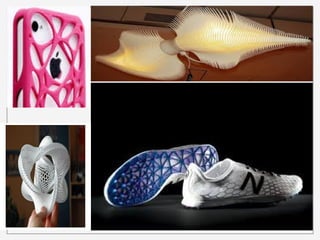
3D Printing 
Varun Luthra & Vipul Sharma 
CSE-5D 
ITM University
Introduction 
3D printing is a form of additive manufacturing technology where a three 
dimensional object is created by laying down successive layers of material. 
It is also known as rapid prototyping, is a mechanized method whereby 3D 
objects are quickly made on a reasonably sized machine connected to a 
computer containing blueprints for the object. 
3D Printers are machines that produce physical 3D models from digital data by 
printing layer by layer. It can make physical models of objects either designed 
with a CAD program or scanned with a 3D Scanner. 
The basic principles include materials cartridges, flexibility of output, and 
translation of code into a visible pattern.
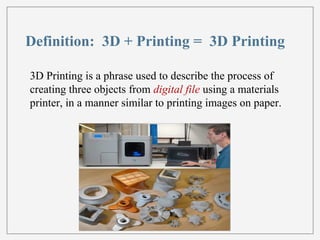
Definition: 3D + Printing = 3D Printing 
3D Printing is a phrase used to describe the process of 
creating three objects from digital file using a materials 
printer, in a manner similar to printing images on paper.
Printing Process 
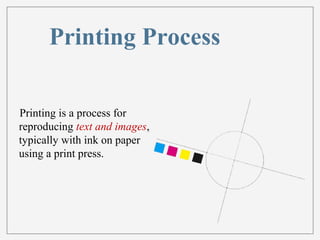
Printing is a process for 
reproducing text and images, 
typically with ink on paper 
using a print press.
History of 3D Printing 
• The technology for printing physical 3D objects from digital data 
was first developed by Charles Hull in 1984. He named the 
technique as Stereo lithography and obtained a patent for the 
technique in 1986. 
• While Stereo lithography systems had become popular by the end of 
1980s, other similar technologies such as Fused Deposition 
Modeling (FDM) and Selective Laser Sintering (SLS) were 
introduced.
Different Methods 
Selective Laser Sintering (SLS) 
Stereo Lithography 
Fused Deposition Modeling (FDM) 
Laminated Object Manufacturing
SLS Method 
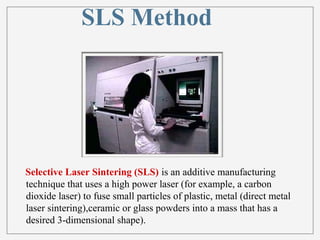
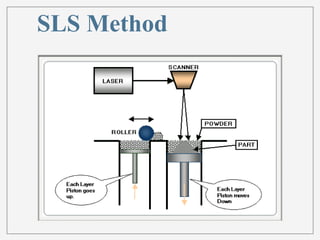
Selective Laser Sintering (SLS) is an additive manufacturing 
technique that uses a high power laser (for example, a carbon 
dioxide laser) to fuse small particles of plastic, metal (direct metal 
laser sintering),ceramic or glass powders into a mass that has a 
desired 3-dimensional shape).
SLS Method
Stereo Lithography 
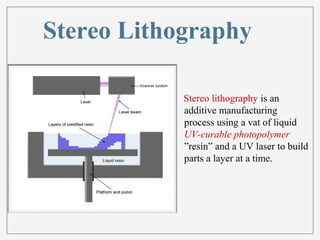
Stereo lithography is an 
additive manufacturing 
process using a vat of liquid 
UV-curable photopolymer 
”resin” and a UV laser to build 
parts a layer at a time.
Fused Deposition Modeling 
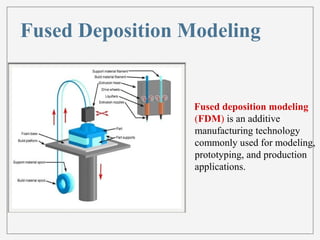
Fused deposition modeling 
(FDM) is an additive 
manufacturing technology 
commonly used for modeling, 
prototyping, and production 
applications.
Laminated Object 
Manufacturing 
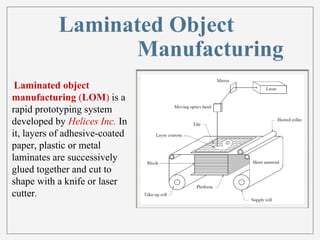
Laminated object 
manufacturing (LOM) is a 
rapid prototyping system 
developed by Helices Inc. In 
it, layers of adhesive-coated 
paper, plastic or metal 
laminates are successively 
glued together and cut to 
shape with a knife or laser 
cutter.
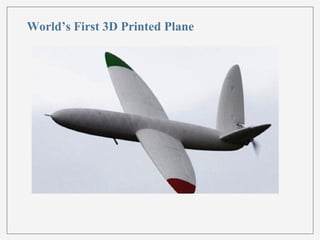
World’s First 3D Printed Plane
3D Printing Capabilities 
As anticipated, this modern technology has smoothed the path for numerous new 
possibilities in various fields. The list below details the advantages of 3D printing in 
certain fields. 
1.In Medical Field, Surgeons are using 3d printing machines to print body parts for 
reference before complex surgeries. Other machines are used to construct bone grafts 
for patients who have suffered traumatic injuries. 
2.Architects need to create mockups of their designs. 3D printing allows them to 
come up with these mockups in a short period of time and with a higher degree of 
accuracy. 
3.3D printing allows artists to create objects that would be incredibly difficult, 
costly, or time intensive using traditional processes.
Success 
Stories 
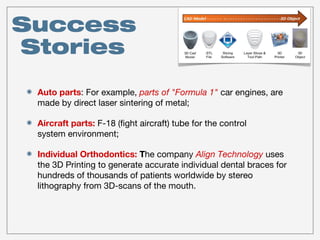
Auto parts: For example, parts of "Formula 1" car engines, are 
made by direct laser sintering of metal; 
Aircraft parts: F-18 (fight aircraft) tube for the control 
system environment; 
Individual Orthodontics: The company Align Technology uses 
the 3D Printing to generate accurate individual dental braces for 
hundreds of thousands of patients worldwide by stereo 
lithography from 3D-scans of the mouth.
Success Stories 
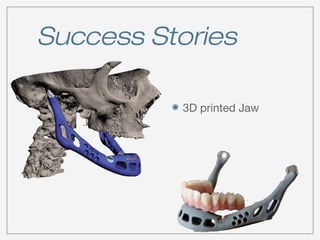
3D printed Jaw
Conclusion 
Relatively New Technology. 
No restrictions on industry. 
Significant decrease in product development cycle and costs. 
Full effects on business and society still not know. 
Resistance to change.
Thank You!!

3D Printing

  • 1.
    3D Printing VarunLuthra & Vipul Sharma CSE-5D ITM University
  • 2.
    Introduction 3D printingis a form of additive manufacturing technology where a three dimensional object is created by laying down successive layers of material. It is also known as rapid prototyping, is a mechanized method whereby 3D objects are quickly made on a reasonably sized machine connected to a computer containing blueprints for the object. 3D Printers are machines that produce physical 3D models from digital data by printing layer by layer. It can make physical models of objects either designed with a CAD program or scanned with a 3D Scanner. The basic principles include materials cartridges, flexibility of output, and translation of code into a visible pattern.
  • 3.
    Definition: 3D +Printing = 3D Printing 3D Printing is a phrase used to describe the process of creating three objects from digital file using a materials printer, in a manner similar to printing images on paper.
  • 4.
    Printing Process Printingis a process for reproducing text and images, typically with ink on paper using a print press.
  • 5.
    History of 3DPrinting • The technology for printing physical 3D objects from digital data was first developed by Charles Hull in 1984. He named the technique as Stereo lithography and obtained a patent for the technique in 1986. • While Stereo lithography systems had become popular by the end of 1980s, other similar technologies such as Fused Deposition Modeling (FDM) and Selective Laser Sintering (SLS) were introduced.
  • 6.
    Different Methods SelectiveLaser Sintering (SLS) Stereo Lithography Fused Deposition Modeling (FDM) Laminated Object Manufacturing
  • 7.
    SLS Method SelectiveLaser Sintering (SLS) is an additive manufacturing technique that uses a high power laser (for example, a carbon dioxide laser) to fuse small particles of plastic, metal (direct metal laser sintering),ceramic or glass powders into a mass that has a desired 3-dimensional shape).
  • 8.
  • 9.
    Stereo Lithography Stereolithography is an additive manufacturing process using a vat of liquid UV-curable photopolymer ”resin” and a UV laser to build parts a layer at a time.
  • 10.
    Fused Deposition Modeling Fused deposition modeling (FDM) is an additive manufacturing technology commonly used for modeling, prototyping, and production applications.
  • 11.
    Laminated Object Manufacturing Laminated object manufacturing (LOM) is a rapid prototyping system developed by Helices Inc. In it, layers of adhesive-coated paper, plastic or metal laminates are successively glued together and cut to shape with a knife or laser cutter.
  • 12.
    World’s First 3DPrinted Plane
  • 13.
    3D Printing Capabilities As anticipated, this modern technology has smoothed the path for numerous new possibilities in various fields. The list below details the advantages of 3D printing in certain fields. 1.In Medical Field, Surgeons are using 3d printing machines to print body parts for reference before complex surgeries. Other machines are used to construct bone grafts for patients who have suffered traumatic injuries. 2.Architects need to create mockups of their designs. 3D printing allows them to come up with these mockups in a short period of time and with a higher degree of accuracy. 3.3D printing allows artists to create objects that would be incredibly difficult, costly, or time intensive using traditional processes.
  • 14.
    Success Stories Autoparts: For example, parts of "Formula 1" car engines, are made by direct laser sintering of metal; Aircraft parts: F-18 (fight aircraft) tube for the control system environment; Individual Orthodontics: The company Align Technology uses the 3D Printing to generate accurate individual dental braces for hundreds of thousands of patients worldwide by stereo lithography from 3D-scans of the mouth.
  • 15.
    Success Stories 3Dprinted Jaw
  • 17.
    Conclusion Relatively NewTechnology. No restrictions on industry. Significant decrease in product development cycle and costs. Full effects on business and society still not know. Resistance to change.
  • 18.