• A 3D printing technology, which is also referred as digital
fabrication technology is a scientific evolution in
manufacuturing engineering, developed by the scientists in
order to minimise the effort in development of the products.
• The creation of a 3D printed object is achieved using additive
processes.
• 3D printing or Additive manufacturing technology is a process
of making three-dimensional solid object layer-by-layer using a
HISTORY OF 3D PRINTING
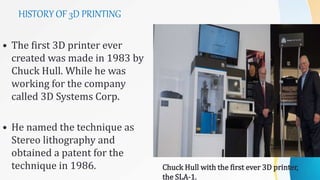
• The first 3D printer ever
created was made in 1983 by
Chuck Hull. While he was
working for the company
called 3D Systems Corp.
• He named the technique as
Stereo lithography and
obtained a patent for the
technique in 1986. Chuck Hull with the first ever 3D printer,
the SLA-1.
• By the end of 1980s, other similar technologies such as
Fused Deposition Modeling (FDM) and Selective Laser
Sintering (SLS) were introduced.
• In 1993, Massachusetts Institute of Technology (MIT) patented
another technology, named "3 Dimensional Printing
techniques".
• In 2002, a 3D printed miniature human kidney was created,
again at the Wake Forest Institute for Regenerative Medicine.
Materials Used For 3d Printing Technology in Manufacturing Industry
• The 3D Printing technology has evolved immensely since its early
days. The technology has not only developed in terms of the
machine but also in terms of the materials used to manufacture
products.
• Today, the materials used in 3D printing are rapidly growing and
the material manufactures are developing new types of materials
that cater to different industrial requirements.
• We now see materials like concrete, bio inks, and even food as a
We will take a look at the some of these materials used
in 3D Printing.
• Metal 3D printing Material : Metal 3D printing technology gain
many attentions in aerospace, automobile, medical application
and manufacturing industry because the advantages existing by
this process.
• Polymer 3D Printing Materials :
1. Acrylonitrile Butadiene Styrene is one of the most popular
materials used in 3D printing. The reason for its wide use is
due to its easy availability, strength properties, widely used in
industries and is available at affordable prices.
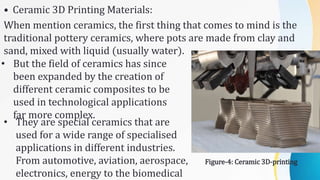
• Ceramic 3D Printing Materials:
When mention ceramics, the first thing that comes to mind is the
traditional pottery ceramics, where pots are made from clay and
sand, mixed with liquid (usually water).
Figure-4: Ceramic 3D-printing
• But the field of ceramics has since
been expanded by the creation of
different ceramic composites to be
used in technological applications
far more complex.
• They are special ceramics that are
used for a wide range of specialised
applications in different industries.
From automotive, aviation, aerospace,
electronics, energy to the biomedical
• Concrete 3D Printing Materials:
Concrete is a complex material used in 3D printing but is now
being developed at a large scale.
One of the most prominent projects is announced by the UAE
government called as the Dubai 3D Printing Strategy.
• Composite 3D Printing Materials:
 Composites can be segregated as basic or general-purpose
composites and industrial composites.
 Industrial composite materials used in 3D printing refer to
complex and special purpose materials like carbon fibre and
fibreglass which improve the durability and strength of the
• Specials materials:
The examples of special materials are:
Food
3D printing technology can process and produce the desired
shape and geometry by using food materials like the chocolate,
meat, candy, pizza, spaghetti, sauce and so on.
Lunar dust
3D printing process has the capability to directly produce multi-
layered parts out of lunar dust, which has potential applicability
to future moon colonization.
Textile
With 3D printing technology, jewellery and clothing industry will
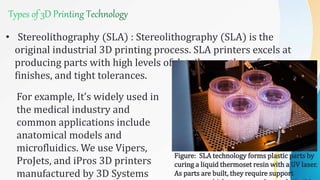
• Stereolithography (SLA) : Stereolithography (SLA) is the
original industrial 3D printing process. SLA printers excels at
producing parts with high levels of detail, smooth surface
finishes, and tight tolerances.
Figure: SLA technology forms plastic parts by
curing a liquid thermoset resin with a UV laser.
As parts are built, they require support
For example, It’s widely used in
the medical industry and
common applications include
anatomical models and
microfluidics. We use Vipers,
ProJets, and iPros 3D printers
manufactured by 3D Systems
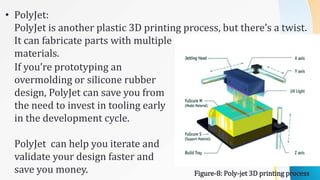
• PolyJet:
PolyJet is another plastic 3D printing process, but there’s a twist.
It can fabricate parts with multiple properties such as colors and
materials.
Figure-8: Poly-jet 3D printing process
If you’re prototyping an
overmolding or silicone rubber
design, PolyJet can save you from
the need to invest in tooling early
in the development cycle.
PolyJet can help you iterate and
validate your design faster and
save you money.
• Selective Laser Sintering (SLS):
Selective laser sintering (SLS) melts together nylon-based
powders into solid plastic.
Since SLS parts are made from real thermoplastic material, they
are durable, suitable for functional testing, and can support living
hinges and snap-fits.
• Multi Jet Fusion (MJF):
 Similar to SLS, Multi Jet Fusion also builds functional parts from
nylon powder.
 Rather than using a laser to sinter the powder, MJF uses an
inkjet array to apply fusing agents to the bed of nylon powder.
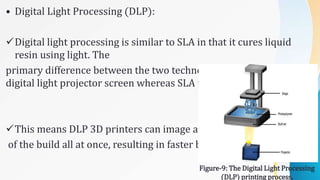
• Digital Light Processing (DLP):
Digital light processing is similar to SLA in that it cures liquid
resin using light. The
primary difference between the two technologies is that DLP uses a
digital light projector screen whereas SLA uses a UV laser.
This means DLP 3D printers can image an entire layer
of the build all at once, resulting in faster build speeds.
Figure-9: The Digital Light Processing
(DLP) printing process.
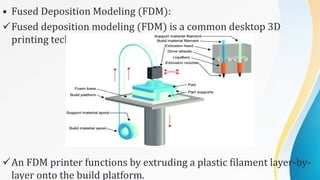
• Fused Deposition Modeling (FDM):
Fused deposition modeling (FDM) is a common desktop 3D
printing technology for plastic parts.
An FDM printer functions by extruding a plastic filament layer-by-
layer onto the build platform.
• Aerospace/Aviation:
Aerospace and aviation industry were amongst the early
adopters of the 3D printing technology.
 It is no secret that the aerospace industry is serious research
demanding industry and the complex systems are of a very
critical nature.
As recent as in May 2020, SpaceX collaborated with NASA to
send two astronauts to the International Space Station.
 SpaceX’s Crew Dragon spacecraft was fitted with a 3D printed
• Automotive:
The automobile sector is one of the biggest beneficiaries of the
3D printing technology and will always be one of its biggest
users.
Automotive companies are printing spare parts, tools, jigs and
fixtures but also end-use parts.
One such example is when Australian engineers printed parts to
bring a Delage Type-C back to life. In doing so, they had to print
parts that were out of production for decades.
Companies like Ford, Mercedes, Honda, Lamborghini, Porsche,
and General Motors are some of the early adopters in Auto
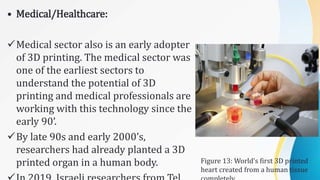
• Medical/Healthcare:
Medical sector also is an early adopter
of 3D printing. The medical sector was
one of the earliest sectors to
understand the potential of 3D
printing and medical professionals are
working with this technology since the
early 90’.
By late 90s and early 2000’s,
researchers had already planted a 3D
printed organ in a human body. Figure 13: World’s first 3D printed
heart created from a human tissue
• Art/Sculpture:
3D printing has helped to improve the existing designers and
bring out the closet designers too.
 People with great mental abilities to sculpt but were lacking the
mode of expression are now finding a new way to express their
ideas.
Specialized software is also now being developed to cater to
these designers giving them more freedom to express.
• Architecture:
Architecture is another field of interest for 3D printing
technology. The architects ideas of a project can now be easily and
quickly be converted into a tangible product.
One of the most prominent projects is announced by the UAE
government called as the Dubai 3D Printing Strategy.
In the Netherlands, a metal bridge was also 3D printed and
unveiled in the fall of 2018 by MX3D.
• 3D Printing technology could revolutionize and re-
shape the world. Advances in 3D printing technology
can significantly change and improve the way we
manufacture products and produce goods worldwide.
• If the last industrial revolution brought us mass
production and the advent of economies of scale - the
digital 3D printing revolution could bring mass
manufacturing back a full circle - to an era of mass
personalization, and a return to individual
craftsmanship.
3D  PRINTING  TECHNOLOGY  AND  THE  MATERIAL.pptx

3D PRINTING TECHNOLOGY AND THE MATERIAL.pptx

  • 2.
    • A 3Dprinting technology, which is also referred as digital fabrication technology is a scientific evolution in manufacuturing engineering, developed by the scientists in order to minimise the effort in development of the products. • The creation of a 3D printed object is achieved using additive processes. • 3D printing or Additive manufacturing technology is a process of making three-dimensional solid object layer-by-layer using a
  • 3.
    HISTORY OF 3DPRINTING • The first 3D printer ever created was made in 1983 by Chuck Hull. While he was working for the company called 3D Systems Corp. • He named the technique as Stereo lithography and obtained a patent for the technique in 1986. Chuck Hull with the first ever 3D printer, the SLA-1.
  • 4.
    • By theend of 1980s, other similar technologies such as Fused Deposition Modeling (FDM) and Selective Laser Sintering (SLS) were introduced. • In 1993, Massachusetts Institute of Technology (MIT) patented another technology, named "3 Dimensional Printing techniques". • In 2002, a 3D printed miniature human kidney was created, again at the Wake Forest Institute for Regenerative Medicine.
  • 5.
    Materials Used For3d Printing Technology in Manufacturing Industry • The 3D Printing technology has evolved immensely since its early days. The technology has not only developed in terms of the machine but also in terms of the materials used to manufacture products. • Today, the materials used in 3D printing are rapidly growing and the material manufactures are developing new types of materials that cater to different industrial requirements. • We now see materials like concrete, bio inks, and even food as a
  • 6.
    We will takea look at the some of these materials used in 3D Printing. • Metal 3D printing Material : Metal 3D printing technology gain many attentions in aerospace, automobile, medical application and manufacturing industry because the advantages existing by this process. • Polymer 3D Printing Materials : 1. Acrylonitrile Butadiene Styrene is one of the most popular materials used in 3D printing. The reason for its wide use is due to its easy availability, strength properties, widely used in industries and is available at affordable prices.
  • 7.
    • Ceramic 3DPrinting Materials: When mention ceramics, the first thing that comes to mind is the traditional pottery ceramics, where pots are made from clay and sand, mixed with liquid (usually water). Figure-4: Ceramic 3D-printing • But the field of ceramics has since been expanded by the creation of different ceramic composites to be used in technological applications far more complex. • They are special ceramics that are used for a wide range of specialised applications in different industries. From automotive, aviation, aerospace, electronics, energy to the biomedical
  • 8.
    • Concrete 3DPrinting Materials: Concrete is a complex material used in 3D printing but is now being developed at a large scale. One of the most prominent projects is announced by the UAE government called as the Dubai 3D Printing Strategy. • Composite 3D Printing Materials:  Composites can be segregated as basic or general-purpose composites and industrial composites.  Industrial composite materials used in 3D printing refer to complex and special purpose materials like carbon fibre and fibreglass which improve the durability and strength of the
  • 9.
    • Specials materials: Theexamples of special materials are: Food 3D printing technology can process and produce the desired shape and geometry by using food materials like the chocolate, meat, candy, pizza, spaghetti, sauce and so on. Lunar dust 3D printing process has the capability to directly produce multi- layered parts out of lunar dust, which has potential applicability to future moon colonization. Textile With 3D printing technology, jewellery and clothing industry will
  • 10.
    • Stereolithography (SLA): Stereolithography (SLA) is the original industrial 3D printing process. SLA printers excels at producing parts with high levels of detail, smooth surface finishes, and tight tolerances. Figure: SLA technology forms plastic parts by curing a liquid thermoset resin with a UV laser. As parts are built, they require support For example, It’s widely used in the medical industry and common applications include anatomical models and microfluidics. We use Vipers, ProJets, and iPros 3D printers manufactured by 3D Systems
  • 11.
    • PolyJet: PolyJet isanother plastic 3D printing process, but there’s a twist. It can fabricate parts with multiple properties such as colors and materials. Figure-8: Poly-jet 3D printing process If you’re prototyping an overmolding or silicone rubber design, PolyJet can save you from the need to invest in tooling early in the development cycle. PolyJet can help you iterate and validate your design faster and save you money.
  • 12.
    • Selective LaserSintering (SLS): Selective laser sintering (SLS) melts together nylon-based powders into solid plastic. Since SLS parts are made from real thermoplastic material, they are durable, suitable for functional testing, and can support living hinges and snap-fits. • Multi Jet Fusion (MJF):  Similar to SLS, Multi Jet Fusion also builds functional parts from nylon powder.  Rather than using a laser to sinter the powder, MJF uses an inkjet array to apply fusing agents to the bed of nylon powder.
  • 13.
    • Digital LightProcessing (DLP): Digital light processing is similar to SLA in that it cures liquid resin using light. The primary difference between the two technologies is that DLP uses a digital light projector screen whereas SLA uses a UV laser. This means DLP 3D printers can image an entire layer of the build all at once, resulting in faster build speeds. Figure-9: The Digital Light Processing (DLP) printing process.
  • 14.
    • Fused DepositionModeling (FDM): Fused deposition modeling (FDM) is a common desktop 3D printing technology for plastic parts. An FDM printer functions by extruding a plastic filament layer-by- layer onto the build platform.
  • 15.
    • Aerospace/Aviation: Aerospace andaviation industry were amongst the early adopters of the 3D printing technology.  It is no secret that the aerospace industry is serious research demanding industry and the complex systems are of a very critical nature. As recent as in May 2020, SpaceX collaborated with NASA to send two astronauts to the International Space Station.  SpaceX’s Crew Dragon spacecraft was fitted with a 3D printed
  • 16.
    • Automotive: The automobilesector is one of the biggest beneficiaries of the 3D printing technology and will always be one of its biggest users. Automotive companies are printing spare parts, tools, jigs and fixtures but also end-use parts. One such example is when Australian engineers printed parts to bring a Delage Type-C back to life. In doing so, they had to print parts that were out of production for decades. Companies like Ford, Mercedes, Honda, Lamborghini, Porsche, and General Motors are some of the early adopters in Auto
  • 17.
    • Medical/Healthcare: Medical sectoralso is an early adopter of 3D printing. The medical sector was one of the earliest sectors to understand the potential of 3D printing and medical professionals are working with this technology since the early 90’. By late 90s and early 2000’s, researchers had already planted a 3D printed organ in a human body. Figure 13: World’s first 3D printed heart created from a human tissue
  • 18.
    • Art/Sculpture: 3D printinghas helped to improve the existing designers and bring out the closet designers too.  People with great mental abilities to sculpt but were lacking the mode of expression are now finding a new way to express their ideas. Specialized software is also now being developed to cater to these designers giving them more freedom to express.
  • 19.
    • Architecture: Architecture isanother field of interest for 3D printing technology. The architects ideas of a project can now be easily and quickly be converted into a tangible product. One of the most prominent projects is announced by the UAE government called as the Dubai 3D Printing Strategy. In the Netherlands, a metal bridge was also 3D printed and unveiled in the fall of 2018 by MX3D.
  • 20.
    • 3D Printingtechnology could revolutionize and re- shape the world. Advances in 3D printing technology can significantly change and improve the way we manufacture products and produce goods worldwide. • If the last industrial revolution brought us mass production and the advent of economies of scale - the digital 3D printing revolution could bring mass manufacturing back a full circle - to an era of mass personalization, and a return to individual craftsmanship.