HYPOTHESIS TESTING
Frances Chumney, PhD
CONTENT OUTLINE
 Logic of Hypothesis Testing
 Error & Alpha
 Hypothesis Tests
 Effect Size
 Statistical Power
HYPOTHESIS TESTING 2
HYPOTHESIS TESTING
LOGIC OF HYPOTHESIS TESTING
how we conceptualize hypotheses
3
HYPOTHESIS TESTING
HYPOTHESIS TESTING LOGIC
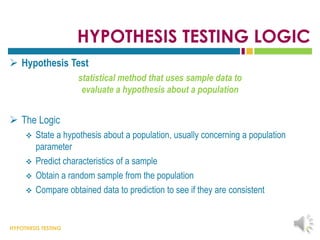
 Hypothesis Test
statistical method that uses sample data to
evaluate a hypothesis about a population
 The Logic
 State a hypothesis about a population, usually concerning a population
parameter
 Predict characteristics of a sample
 Obtain a random sample from the population
 Compare obtained data to prediction to see if they are consistent
4
HYPOTHESIS TESTING
STEPS IN HYPOTHESIS TESTING
 Step 1: State the Hypotheses
 Null Hypothesis (H0)
in the general population there is no change, no difference, or no relationship;
the independent variable will have no effect on the dependent variable
o Example
• All dogs have four legs.
• There is no difference in the number of legs dogs have.
 Alternative Hypothesis (H1)
in the general population there is a change, a difference, or a relationship;
the independent variable will have an effect on the dependent variable
o Example
• 20% of dogs have only three legs.
5
HYPOTHESIS TESTING
STEP 1: STATE THE HYPOTHESES (EXAMPLE)
 Example
6
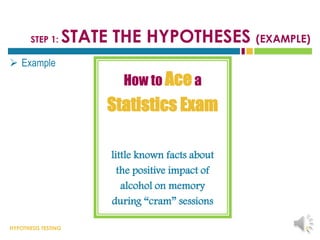
How to Acea
Statistics Exam
little known facts about
the positive impact of
alcohol on memory
during “cram” sessions
HYPOTHESIS TESTING
STEP 1: STATE THE HYPOTHESES (EXAMPLE)
 Dependent Variable
 Amount of alcohol consumed the night before a statistics exam
 Independent/Treatment Variable
 Intervention: Pamphlet (treatment group) or No Pamphlet (control group)
 Null Hypothesis (H0)
 No difference in alcohol consumption between the two groups the night before a
statistics exam.
 Alternative Hypothesis (H1)
 The treatment group will consume more alcohol than the control group.
7
HYPOTHESIS TESTING
STEP 2: SET CRITERIA FOR DECISION
 Example
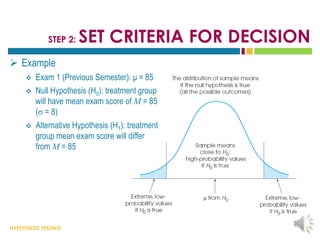
 Exam 1 (Previous Semester): μ = 85
 Null Hypothesis (H0): treatment group
will have mean exam score of M = 85
(σ = 8)
 Alternative Hypothesis (H1): treatment
group mean exam score will differ
from M = 85
8
HYPOTHESIS TESTING
STEP 2: SET CRITERIA FOR DECISION
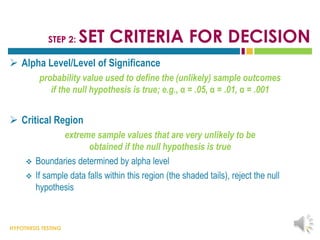
 Alpha Level/Level of Significance
probability value used to define the (unlikely) sample outcomes
if the null hypothesis is true; e.g., α = .05, α = .01, α = .001
 Critical Region
extreme sample values that are very unlikely to be
obtained if the null hypothesis is true
 Boundaries determined by alpha level
 If sample data falls within this region (the shaded tails), reject the null
hypothesis
9
HYPOTHESIS TESTING
STEP 2: SET CRITERIA FOR DECISION
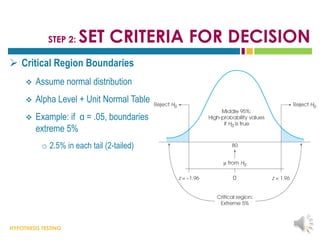
 Critical Region Boundaries
 Assume normal distribution
 Alpha Level + Unit Normal Table
 Example: if α = .05, boundaries of critical region divide middle 95% from
extreme 5%
o 2.5% in each tail (2-tailed)
10
HYPOTHESIS TESTING
STEP 2: SET CRITERIA FOR DECISION
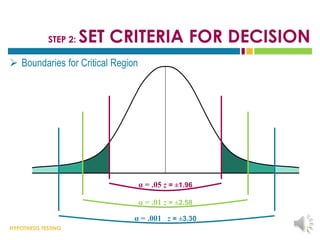
 Boundaries for Critical Region
11
α = .001 z = ±3.30
α = .01 z = ±2.58
α = .05 z = ±1.96
HYPOTHESIS TESTING
STEP 3: COLLECT, COMPUTE
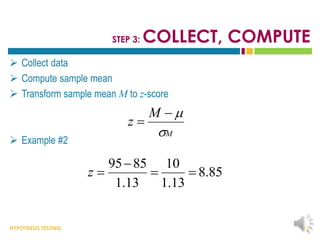
 Collect data
 Compute sample mean
 Transform sample mean M to z-score
 Example #2
12
M
M
z




85
.
8
13
.
1
10
13
.
1
85
95




z
HYPOTHESIS TESTING
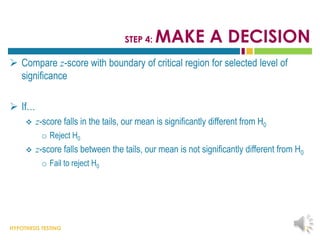
STEP 4: MAKE A DECISION
 Compare z-score with boundary of critical region for selected level of
significance
 If…
 z-score falls in the tails, our mean is significantly different from H0
o Reject H0
 z-score falls between the tails, our mean is not significantly different from H0
o Fail to reject H0
13
HYPOTHESIS TESTING
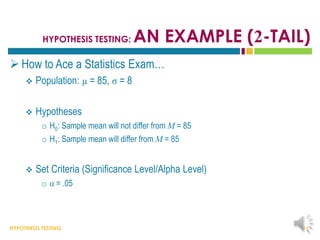
HYPOTHESIS TESTING: AN EXAMPLE (2-TAIL)
 How to Ace a Statistics Exam…
 Population: μ = 85, σ = 8
 Hypotheses
o H0: Sample mean will not differ from M = 85
o H1: Sample mean will differ from M = 85
 Set Criteria (Significance Level/Alpha Level)
o α = .05
14
HYPOTHESIS TESTING
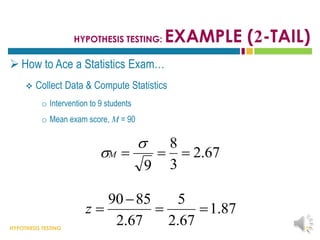
HYPOTHESIS TESTING: EXAMPLE (2-TAIL)
 How to Ace a Statistics Exam…
 Collect Data & Compute Statistics
o Intervention to 9 students
o Mean exam score, M = 90
15
67
.
2
3
8
9




M
87
.
1
67
.
2
5
67
.
2
85
90




z
HYPOTHESIS TESTING
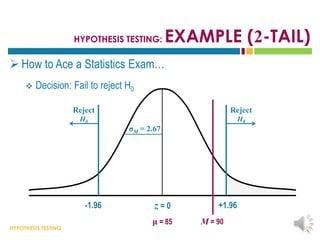
HYPOTHESIS TESTING: EXAMPLE (2-TAIL)
 How to Ace a Statistics Exam…
 Decision: Fail to reject H0
16
σM = 2.67
μ = 85 M = 90
Reject
H0
-1.96 z = 0 +1.96
Reject
H0
HYPOTHESIS TESTING
REVISITING Z-SCORE STATISTICS
 A Test Statistic
 Single, specific statistic
 Calculated from the sample data
 Used to test H0
 Rule of Thumb…
 Large values of z
o Sample data pry DID NOT occur by chance – result of IV
 Small values of z
o Sample data pry DID occur by chance – not result of IV
17
HYPOTHESIS TESTING
ERROR & ALPHA
uncertainty leads to error
18
HYPOTHESIS TESTING
UNCERTAINTY & ERROR
 Hypothesis Testing = Inferential Process
 LOTS of room for error
 Types of Error
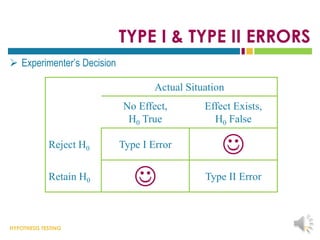
 Type I Error
 Type II Error
19
HYPOTHESIS TESTING
TYPE 1 ERRORS
error that occurs when the null hypothesis is rejected even though
it is really true; the researcher identifies a treatment effect
that does not really exist (a false positive)
 Common Cause & Biggest Problem
 Sample data are misleading due to sampling error
 Significant difference reported in literature even though it isn’t real
 Type I Errors & Alpha Level
 Alpha level = probability of committing a Type I Error
 Lower alphas = less chances of Type I Error
20
HYPOTHESIS TESTING
TYPE II ERRORS
error that occurs when the null hypothesis is not rejected
even it is really false; the researcher does not identify
a treatment effect that really exists (a false negative)
 Common Cause & Biggest Problem
 Sample mean in not in critical region even though there is a treatment effect
 Overlook effectiveness of interventions
 Type II Errors & Probability
 β = probability of committing a Type II Error
21
HYPOTHESIS TESTING
TYPE I & TYPE II ERRORS
 Experimenter’s Decision
22
Actual Situation
No Effect,
H0 True
Effect Exists,
H0 False
Reject H0 Type I Error

Retain H0  Type II Error
HYPOTHESIS TESTING
SELECTING AN ALPHA LEVEL
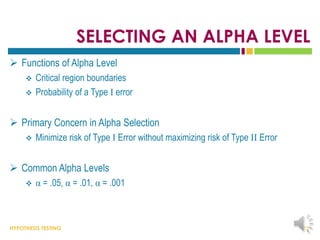
 Functions of Alpha Level
 Critical region boundaries
 Probability of a Type I error
 Primary Concern in Alpha Selection
 Minimize risk of Type I Error without maximizing risk of Type II Error
 Common Alpha Levels
 α = .05, α = .01, α = .001
23
HYPOTHESIS TESTING
HYPOTHESIS TESTS
testing null hypotheses
24
HYPOTHESIS TESTING
HYPOTHESIS TESTS: INFLUENTIAL FACTORS
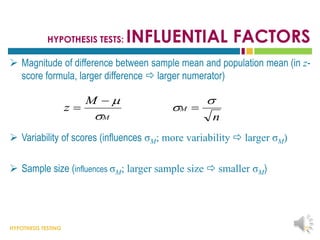
 Magnitude of difference between sample mean and population mean (in z-
score formula, larger difference  larger numerator)
 Variability of scores (influences σM; more variability  larger σM)
 Sample size (influences σM; larger sample size  smaller σM)
25
M
M
z




n
M

 
HYPOTHESIS TESTING
HYPOTHESIS TESTS: ASSUMPTIONS
 Random Sampling
 Independent Observations
 Value of σ is Constant
 Despite treatment
 Normal sampling distribution
26
HYPOTHESIS TESTING
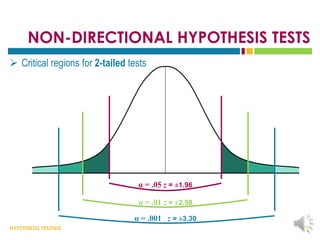
NON-DIRECTIONAL HYPOTHESIS TESTS
 Critical regions for 2-tailed tests
27
α = .001 z = ±3.30
α = .01 z = ±2.58
α = .05 z = ±1.96
HYPOTHESIS TESTING
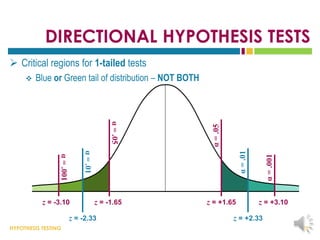
DIRECTIONAL HYPOTHESIS TESTS
 Critical regions for 1-tailed tests
 Blue or Green tail of distribution – NOT BOTH
28
z = -3.10
α
=
.01
α
=
.05
α
=
.001
z = -1.65
z = -2.33
z = +1.65 z = +3.10
z = +2.33
α
=
.01
α
=
.05
α
=
.001
HYPOTHESIS TESTING
ALTERNATIVE HYPOTHESES
 Alternative Hypotheses for 2-tailed tests
 Do not specify direction of difference
 Do not hypothesize whether sample mean should be lower or higher than
population mean
 Alternative Hypotheses for 1-tailed tests
 Specify a difference
 Hypothesis specifies whether sample mean should be lower or higher than
population mean
29
HYPOTHESIS TESTING
NULL HYPOTHESES
 Null Hypotheses for 2-tailed tests
 Specify no difference between sample & population
 Null Hypotheses for 1-tailed tests
 Specify the opposite of the alternative hypothesis
 Example #2
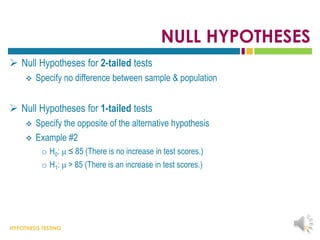
o H0: μ ≤ 85 (There is no increase in test scores.)
o H1: μ > 85 (There is an increase in test scores.)
30
HYPOTHESIS TESTING
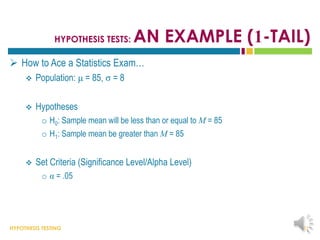
HYPOTHESIS TESTS: AN EXAMPLE (1-TAIL)
 How to Ace a Statistics Exam…
 Population: μ = 85, σ = 8
 Hypotheses
o H0: Sample mean will be less than or equal to M = 85
o H1: Sample mean be greater than M = 85
 Set Criteria (Significance Level/Alpha Level)
o α = .05
31
HYPOTHESIS TESTING
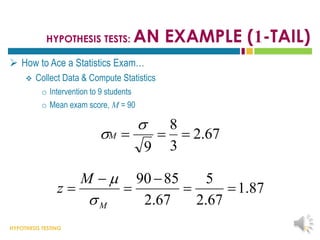
HYPOTHESIS TESTS: AN EXAMPLE (1-TAIL)
 How to Ace a Statistics Exam…
 Collect Data & Compute Statistics
o Intervention to 9 students
o Mean exam score, M = 90
32
67
.
2
3
8
9




M
87
.
1
67
.
2
5
67
.
2
85
90






M
M
z


HYPOTHESIS TESTING
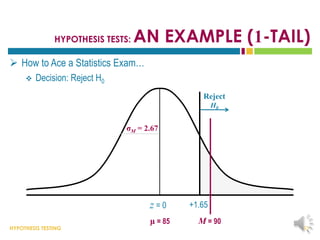
HYPOTHESIS TESTS: AN EXAMPLE (1-TAIL)
 How to Ace a Statistics Exam…
 Decision: Reject H0
33
σM = 2.67
μ = 85 M = 90
z = 0 +1.65
Reject
H0
HYPOTHESIS TESTING
EFFECT SIZE
estimating the magnitude of an effect
34
HYPOTHESIS TESTING
EFFECT SIZE
 Problem with hypothesis testing
 Significance ≠ Meaningful/Important/Big Effect
o Significance is relative comparison: treatment effect compared to standard error
 Effect Size
statistic that describes the magnitude of an effect
 Measures size of treatment effect in terms of (population) standard
deviation
35
HYPOTHESIS TESTING
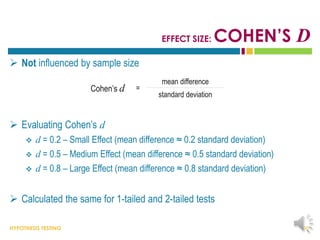
EFFECT SIZE: COHEN’S D
 Not influenced by sample size
 Evaluating Cohen’s d
 d = 0.2 – Small Effect (mean difference ≈ 0.2 standard deviation)
 d = 0.5 – Medium Effect (mean difference ≈ 0.5 standard deviation)
 d = 0.8 – Large Effect (mean difference ≈ 0.8 standard deviation)
 Calculated the same for 1-tailed and 2-tailed tests
36
Cohen’s d =
mean difference
standard deviation
HYPOTHESIS TESTING
STATISTICAL POWER
probability of correctly rejecting a false null hypothesis
37
HYPOTHESIS TESTING
STATISTICAL POWER
the probability of correctly rejecting a null hypothesis when it
is not true; the probability that a hypothesis test will identify
a treatment effect when if one really exists
 A priori
 Calculate power before collecting data
 Determine probability of finding treatment effect
 Power is influenced by…
 Sample size
 Expected effect size
 Significance level for hypothesis test (α)
38

HypothesisTesting_HANDOUT.pdf

  • 1.
  • 2.
    CONTENT OUTLINE  Logicof Hypothesis Testing  Error & Alpha  Hypothesis Tests  Effect Size  Statistical Power HYPOTHESIS TESTING 2
  • 3.
    HYPOTHESIS TESTING LOGIC OFHYPOTHESIS TESTING how we conceptualize hypotheses 3
  • 4.
    HYPOTHESIS TESTING HYPOTHESIS TESTINGLOGIC  Hypothesis Test statistical method that uses sample data to evaluate a hypothesis about a population  The Logic  State a hypothesis about a population, usually concerning a population parameter  Predict characteristics of a sample  Obtain a random sample from the population  Compare obtained data to prediction to see if they are consistent 4
  • 5.
    HYPOTHESIS TESTING STEPS INHYPOTHESIS TESTING  Step 1: State the Hypotheses  Null Hypothesis (H0) in the general population there is no change, no difference, or no relationship; the independent variable will have no effect on the dependent variable o Example • All dogs have four legs. • There is no difference in the number of legs dogs have.  Alternative Hypothesis (H1) in the general population there is a change, a difference, or a relationship; the independent variable will have an effect on the dependent variable o Example • 20% of dogs have only three legs. 5
  • 6.
    HYPOTHESIS TESTING STEP 1:STATE THE HYPOTHESES (EXAMPLE)  Example 6 How to Acea Statistics Exam little known facts about the positive impact of alcohol on memory during “cram” sessions
  • 7.
    HYPOTHESIS TESTING STEP 1:STATE THE HYPOTHESES (EXAMPLE)  Dependent Variable  Amount of alcohol consumed the night before a statistics exam  Independent/Treatment Variable  Intervention: Pamphlet (treatment group) or No Pamphlet (control group)  Null Hypothesis (H0)  No difference in alcohol consumption between the two groups the night before a statistics exam.  Alternative Hypothesis (H1)  The treatment group will consume more alcohol than the control group. 7
  • 8.
    HYPOTHESIS TESTING STEP 2:SET CRITERIA FOR DECISION  Example  Exam 1 (Previous Semester): μ = 85  Null Hypothesis (H0): treatment group will have mean exam score of M = 85 (σ = 8)  Alternative Hypothesis (H1): treatment group mean exam score will differ from M = 85 8
  • 9.
    HYPOTHESIS TESTING STEP 2:SET CRITERIA FOR DECISION  Alpha Level/Level of Significance probability value used to define the (unlikely) sample outcomes if the null hypothesis is true; e.g., α = .05, α = .01, α = .001  Critical Region extreme sample values that are very unlikely to be obtained if the null hypothesis is true  Boundaries determined by alpha level  If sample data falls within this region (the shaded tails), reject the null hypothesis 9
  • 10.
    HYPOTHESIS TESTING STEP 2:SET CRITERIA FOR DECISION  Critical Region Boundaries  Assume normal distribution  Alpha Level + Unit Normal Table  Example: if α = .05, boundaries of critical region divide middle 95% from extreme 5% o 2.5% in each tail (2-tailed) 10
  • 11.
    HYPOTHESIS TESTING STEP 2:SET CRITERIA FOR DECISION  Boundaries for Critical Region 11 α = .001 z = ±3.30 α = .01 z = ±2.58 α = .05 z = ±1.96
  • 12.
    HYPOTHESIS TESTING STEP 3:COLLECT, COMPUTE  Collect data  Compute sample mean  Transform sample mean M to z-score  Example #2 12 M M z     85 . 8 13 . 1 10 13 . 1 85 95     z
  • 13.
    HYPOTHESIS TESTING STEP 4:MAKE A DECISION  Compare z-score with boundary of critical region for selected level of significance  If…  z-score falls in the tails, our mean is significantly different from H0 o Reject H0  z-score falls between the tails, our mean is not significantly different from H0 o Fail to reject H0 13
  • 14.
    HYPOTHESIS TESTING HYPOTHESIS TESTING:AN EXAMPLE (2-TAIL)  How to Ace a Statistics Exam…  Population: μ = 85, σ = 8  Hypotheses o H0: Sample mean will not differ from M = 85 o H1: Sample mean will differ from M = 85  Set Criteria (Significance Level/Alpha Level) o α = .05 14
  • 15.
    HYPOTHESIS TESTING HYPOTHESIS TESTING:EXAMPLE (2-TAIL)  How to Ace a Statistics Exam…  Collect Data & Compute Statistics o Intervention to 9 students o Mean exam score, M = 90 15 67 . 2 3 8 9     M 87 . 1 67 . 2 5 67 . 2 85 90     z
  • 16.
    HYPOTHESIS TESTING HYPOTHESIS TESTING:EXAMPLE (2-TAIL)  How to Ace a Statistics Exam…  Decision: Fail to reject H0 16 σM = 2.67 μ = 85 M = 90 Reject H0 -1.96 z = 0 +1.96 Reject H0
  • 17.
    HYPOTHESIS TESTING REVISITING Z-SCORESTATISTICS  A Test Statistic  Single, specific statistic  Calculated from the sample data  Used to test H0  Rule of Thumb…  Large values of z o Sample data pry DID NOT occur by chance – result of IV  Small values of z o Sample data pry DID occur by chance – not result of IV 17
  • 18.
    HYPOTHESIS TESTING ERROR &ALPHA uncertainty leads to error 18
  • 19.
    HYPOTHESIS TESTING UNCERTAINTY &ERROR  Hypothesis Testing = Inferential Process  LOTS of room for error  Types of Error  Type I Error  Type II Error 19
  • 20.
    HYPOTHESIS TESTING TYPE 1ERRORS error that occurs when the null hypothesis is rejected even though it is really true; the researcher identifies a treatment effect that does not really exist (a false positive)  Common Cause & Biggest Problem  Sample data are misleading due to sampling error  Significant difference reported in literature even though it isn’t real  Type I Errors & Alpha Level  Alpha level = probability of committing a Type I Error  Lower alphas = less chances of Type I Error 20
  • 21.
    HYPOTHESIS TESTING TYPE IIERRORS error that occurs when the null hypothesis is not rejected even it is really false; the researcher does not identify a treatment effect that really exists (a false negative)  Common Cause & Biggest Problem  Sample mean in not in critical region even though there is a treatment effect  Overlook effectiveness of interventions  Type II Errors & Probability  β = probability of committing a Type II Error 21
  • 22.
    HYPOTHESIS TESTING TYPE I& TYPE II ERRORS  Experimenter’s Decision 22 Actual Situation No Effect, H0 True Effect Exists, H0 False Reject H0 Type I Error  Retain H0  Type II Error
  • 23.
    HYPOTHESIS TESTING SELECTING ANALPHA LEVEL  Functions of Alpha Level  Critical region boundaries  Probability of a Type I error  Primary Concern in Alpha Selection  Minimize risk of Type I Error without maximizing risk of Type II Error  Common Alpha Levels  α = .05, α = .01, α = .001 23
  • 24.
  • 25.
    HYPOTHESIS TESTING HYPOTHESIS TESTS:INFLUENTIAL FACTORS  Magnitude of difference between sample mean and population mean (in z- score formula, larger difference  larger numerator)  Variability of scores (influences σM; more variability  larger σM)  Sample size (influences σM; larger sample size  smaller σM) 25 M M z     n M   
  • 26.
    HYPOTHESIS TESTING HYPOTHESIS TESTS:ASSUMPTIONS  Random Sampling  Independent Observations  Value of σ is Constant  Despite treatment  Normal sampling distribution 26
  • 27.
    HYPOTHESIS TESTING NON-DIRECTIONAL HYPOTHESISTESTS  Critical regions for 2-tailed tests 27 α = .001 z = ±3.30 α = .01 z = ±2.58 α = .05 z = ±1.96
  • 28.
    HYPOTHESIS TESTING DIRECTIONAL HYPOTHESISTESTS  Critical regions for 1-tailed tests  Blue or Green tail of distribution – NOT BOTH 28 z = -3.10 α = .01 α = .05 α = .001 z = -1.65 z = -2.33 z = +1.65 z = +3.10 z = +2.33 α = .01 α = .05 α = .001
  • 29.
    HYPOTHESIS TESTING ALTERNATIVE HYPOTHESES Alternative Hypotheses for 2-tailed tests  Do not specify direction of difference  Do not hypothesize whether sample mean should be lower or higher than population mean  Alternative Hypotheses for 1-tailed tests  Specify a difference  Hypothesis specifies whether sample mean should be lower or higher than population mean 29
  • 30.
    HYPOTHESIS TESTING NULL HYPOTHESES Null Hypotheses for 2-tailed tests  Specify no difference between sample & population  Null Hypotheses for 1-tailed tests  Specify the opposite of the alternative hypothesis  Example #2 o H0: μ ≤ 85 (There is no increase in test scores.) o H1: μ > 85 (There is an increase in test scores.) 30
  • 31.
    HYPOTHESIS TESTING HYPOTHESIS TESTS:AN EXAMPLE (1-TAIL)  How to Ace a Statistics Exam…  Population: μ = 85, σ = 8  Hypotheses o H0: Sample mean will be less than or equal to M = 85 o H1: Sample mean be greater than M = 85  Set Criteria (Significance Level/Alpha Level) o α = .05 31
  • 32.
    HYPOTHESIS TESTING HYPOTHESIS TESTS:AN EXAMPLE (1-TAIL)  How to Ace a Statistics Exam…  Collect Data & Compute Statistics o Intervention to 9 students o Mean exam score, M = 90 32 67 . 2 3 8 9     M 87 . 1 67 . 2 5 67 . 2 85 90       M M z  
  • 33.
    HYPOTHESIS TESTING HYPOTHESIS TESTS:AN EXAMPLE (1-TAIL)  How to Ace a Statistics Exam…  Decision: Reject H0 33 σM = 2.67 μ = 85 M = 90 z = 0 +1.65 Reject H0
  • 34.
    HYPOTHESIS TESTING EFFECT SIZE estimatingthe magnitude of an effect 34
  • 35.
    HYPOTHESIS TESTING EFFECT SIZE Problem with hypothesis testing  Significance ≠ Meaningful/Important/Big Effect o Significance is relative comparison: treatment effect compared to standard error  Effect Size statistic that describes the magnitude of an effect  Measures size of treatment effect in terms of (population) standard deviation 35
  • 36.
    HYPOTHESIS TESTING EFFECT SIZE:COHEN’S D  Not influenced by sample size  Evaluating Cohen’s d  d = 0.2 – Small Effect (mean difference ≈ 0.2 standard deviation)  d = 0.5 – Medium Effect (mean difference ≈ 0.5 standard deviation)  d = 0.8 – Large Effect (mean difference ≈ 0.8 standard deviation)  Calculated the same for 1-tailed and 2-tailed tests 36 Cohen’s d = mean difference standard deviation
  • 37.
    HYPOTHESIS TESTING STATISTICAL POWER probabilityof correctly rejecting a false null hypothesis 37
  • 38.
    HYPOTHESIS TESTING STATISTICAL POWER theprobability of correctly rejecting a null hypothesis when it is not true; the probability that a hypothesis test will identify a treatment effect when if one really exists  A priori  Calculate power before collecting data  Determine probability of finding treatment effect  Power is influenced by…  Sample size  Expected effect size  Significance level for hypothesis test (α) 38