Concept Design 101
Turning ideas into physical plans
October 12th 2012, updated Nov 15th


FWD Helsi nki Oy             tel: +358 20 794 0180   Conf identia l            We de sign h appy custome rs
Kai saniemenkat u 6 A        www.f wd.fi             ©2012 FWD Helsinki
00100, Hels ink i Fin land   in fo@fwd. fi           All r ights re se rve d
This presentation was originally done for internal purposes,
teaching planning & concept design. It’s been around for a year
        now and we thought to share it with the world.

           We hope this can help you in some way.

               Markus Sandelin - in Helsinki, October 10th 2012
{
                1   The world has changed

  Intro
                    The customers haven’t
                2         changed


            {
                    Stop pushing problems,          The importance of

The point
                3


                4
                       start solving them


                      My First Concept®
                                             5


                                             6
                                                     presenting well


                                                  The usual end results
                                                                            {   Support


                                             7   Good tools are necessary
1   The world has changed
The world has become more complicated during the last 15
years with the web. This complication does not however mean
 that things are any more difficult than they used to be. It just
      means that we have to pay attention to more things.
The tasks themselves have become simpler, but the amount of
 those tasks have multiplied exponentially together with the
 unlimited amount of data available to be used in said tasks.
It isn’t only about who can produce the best content or visual
    design. The winners will be those who can use and filter
already existing information in the right place and at the right
                             time.
The world has also become more measurable. Before we pretty
 much just knew the number of site visitors, but now we know
  what the users are doing, what they’re buying, where they
   came from and where they continued after their action.
Business
                                                                               consultants
                              Public Relations     Event marketing
                                 agencies             agencies
                                                                                                     Analytics companies
   Advertising agencies


                                                                         Usability
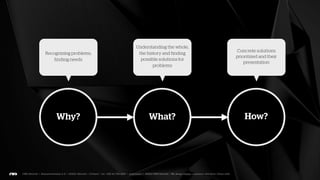
                                                                          testers
                          Translation
                           agencies

                                                 Tech vendors
  Local agencies
                                                                                             Call centers
                    Social media
                      agencies                                       Communications
                                                                        agencies


                     Before                               During                             After


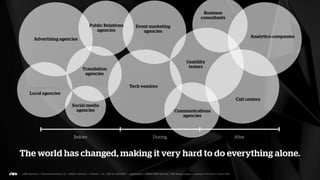
The world has changed, making it very hard to do everything alone.
Most of the large portal building companies have broken to
pieces and are now independent agencies and products. We
      have to learn to play together or face extinction.
Different browsers, devices and technologies do create
different demands, but they haven’t been limiting or slowing
      our progress for years – unless we let them do so.
The existing complexity of applications and products has
made the waterfall design model very expensive to work with.
A single person is probably unable to take a project from start
                      to finish anymore.
Users are expecting personal services and why wouldn’t we
serve them? Use cases and use needs have a great importance
when we’re choosing the winners and losers with our projects.
The user must have a role in a web service. If it isn’t so, who is
                 the service designed for?
The web is making money and has been for a while. No one
wishing to succeed online can design anything without taking
      business facts and figures into consideration and
              understanding their implications.
The end result is still always the same it ever was, our job is to
 solve our client’s problem. Before we can do that, we have to
            always do – understand that problem.
2   The customers haven’t
    changed
Does anyone remember how good customer briefings were 10
                      years ago?
They weren’t very good. Even then, when we were making
                  much simpler things.
Because the general level of customer briefing is the same and
  the world has become much more complicated, we are in a
   situation where we receive less and less information from
clients in the first phases. This means that we as designers will
         have to carry the torch even more than before.
As we mentioned earlier, there are a lot more players on the
pitch as well. If we assume that they share our ambition and
             goals, we’re sawing our own ladder.
We and everyone in the project needs to have a clear picture
 and responsibility of the whole if we really want to make a
         change and create some positive results.
We are the architects of our customers house.
This means that we have to be more active, more curious and
even more creative than ever before. Luckily that too is much
                       easier today.
Our customers want stuff. Our job is to help them understand,
      reach and love their needs, not just their wants.
Good buyers are very rare. Even rarer than our industry dares
to admit. The lure of different channels and pre-made solutions
        is strong, and usually the path to the dark side.
The more complicated the problem, the simpler our solution
                       should be.
This usually means finding several solutions that have to work
 like Lego bricks, joining together when necessary. In order to
       do this, we always have to find the lowest common
                          denominator.
3   Stop pushing problems,
    start solving them
What comes to project management, it is impossible to be too
thorough, enthusiastic or helpful. Assumption is the capital sin
                    in any failed project.
Often times when the client changes their mind, they are not
 even aware they have done that. The change originates from
the difference of our assumption and the client’s thoughts. It’s
                   easier to blame the client.
When someone disagrees with us, especially the client, it
  doesn’t automatically mean that we should change our
opinion. It also doesn’t mean that the other person is wrong.
                The strongest argument wins.
Differences of opinion are just yet another problem waiting to
 be solved. Together with our colleagues and our clients. We
have to understand the core of the problem and find a solution
          for it, curing the cause, not the symptoms.
Blaming, whining, finger pointing or general grumpiness
doesn’t help. These kinds of situations are the most common
 stagnation and fail points in projects and failing can begin.
And if you didn’t understand it yet, the same rules apply
            strongly to internal work as well.
You cannot solve a problem before you understand it.
4   My First Concept®
When we talk about a concept, we mean an idea opened up
into concrete things. Some kind of angle or solution to a known
                           problem.
The first step in any concept is recognizing that problem.
             Without that you cannot succeed.
We recognize a problem with the question “why?”
Why are you doing a project like this? Why have you created
    this kind of brief/suggestion/request for proposal?
In order to find the problem, the answer your looking for has to
 be concrete, measurable and understandable. Not an abstract
   concept that even the client doesn’t believe in. If you can’t
    quantify the problem, you haven’t probably found it yet.
Very rarely there is a single problem. There are many, in
   different shapes, importance and with different business
effects. Prioritization is your main tool in this phase. A simple
problem can be much more important than a complicated one.
The moment you really understand the problem, the concept
 will reveal itself to you. That is the secret of good concept
                             design.
The second question in forming a concept is “what?”
What is being done to solve the problem? What has already
been done? What metrics do we have? What data can we use?
What has the competition done? What can we learn from other
 industries? What can we learn from our own clients? What
   internal things has the client done before to fix things?
By doing this we create a collection of knowledge, data, needs,
  wants, experiences, viewpoints and different beginnings.
So we have created an image with problems in the center,
     surrounded by different solution possibilities.
Armed with this information we can begin our work in
thinking, solving and opening up how these problems can be
        solved and how our solutions mix together.
Dividing the problems, possibilities and concrete solutions into
small enough parts it is much easier to evaluate work amounts,
                      risks and schedules.
We cannot bypass these steps. Without this model and these
questions were are guessing and assuming, which will lead to
                          failure.
Understanding the
                                                 Concrete solutions
Recognizing problems,   whole, the history and
                                                 prioritized and their
    finding needs          finding possible
                                                     presentation
                        solutions for problems


    Why?                    What?                    How?
5   The importance of
    presenting well
When we know the problems, possible solutions and concrete
suggestions, we have to be able to present them simply enough
                 to others in order to succeed.
Most customers don’t give a damn about our brand, visual
mood or pretty much anything else. If those things support the
 facts and the presentation, it’s nice, but otherwise pointless.
The language has to be understandable by anyone, the base
level should be directed to the customer. However, no one will
 complain if your presentation is better and clearer than they
       expect. A good presentation makes you look good.
The grammar should be faultless.


      (or at least as faultless as possible)
If you’re adding something to a presentation done by someone
  else, take something out as well and let that someone know.
   This will help with version control and overall quality. Also
              remember to give credit when it’s due.
Illustration and visual style should be in harmony with the
 whole and especially with the message being presented. All
graphs, prices and schedules have to be understood even by a
 third party and their style should be similar throughout the
                         presentation.
The presentation is not just the file or the two hours spent
presenting it, it’s the whole process of invitations, deliveries
 and file sharing. Don’t try to send too big files in the mail.
Presenting itself is an art of its own which is only learned
through practice. Learning the correct rhythm and breathing
 helps a lot in nerve control and gives you the confidence to
   focus in the message. They will also focus on your body
          language, so rehearse standing up as well.
If you don’t have a role in the presentation or the meeting,
think about your participation as well. If you have a point or an
  opinion to deliver, do that and do it well. If not, go do some
                          work instead.
Your presentation does not have to be a PowerPoint.
6   The usual end results
When our clients expect an offer from us, we have to create a
high level concept before that. With that we can create a cost
                     and time estimate.
In order to create a concept, this process is a good tool to get
started so we can increase our awareness to the required level
                and create an internal briefing.
A high level concept is good to build directly into a mind map,
presentation or even a textual story. With this it’s easier to stay
              with it and focus on the right things.
A good concept answers to all three questions with sufficient
accuracy. It answers why the project is being done, pointing out
  the problems. It answers the question of what solutions we
have identified and will be proposing after our prioritizing and
   it will have an opinion on how these solutions should be
                         implemented.
Anyone should be able to create at least an initial high level
       concept from zero or from a client briefing.
7   Good tools are
    necessary
Good tools are needed in order to work, but even more
 important is learning to use those tools properly. This makes
you an efficient concept designer who can teach others as well.
There are many tools for many purposes. We use drawing tools
     such as OmniGraffle and mind mapping tools such as
  MindNode. Understanding numbers is much easier with a
 spreadsheet tools like Excel or Numbers and we use Keynote
                     for our presentations.
You can and should be learning your tools constantly, not just
copy other’s materials to your own, creating unusable files for
                            others.
You are sitting next to a person who can probably help you.
Finally: The web is full of information and its search engines
       are your most important tools. Use them well.
Kiitos   For further
         information:

Tack     Markus Sandelin
         Designer
         +358 44 36 99 887


Thanks   markus.sandelin@fwd.fi

Forward Concept Design & Planning

  • 1.
    Concept Design 101 Turningideas into physical plans October 12th 2012, updated Nov 15th FWD Helsi nki Oy tel: +358 20 794 0180 Conf identia l We de sign h appy custome rs Kai saniemenkat u 6 A www.f wd.fi ©2012 FWD Helsinki 00100, Hels ink i Fin land in fo@fwd. fi All r ights re se rve d
  • 2.
    This presentation wasoriginally done for internal purposes, teaching planning & concept design. It’s been around for a year now and we thought to share it with the world. We hope this can help you in some way. Markus Sandelin - in Helsinki, October 10th 2012
  • 3.
    { 1 The world has changed Intro The customers haven’t 2 changed { Stop pushing problems, The importance of The point 3 4 start solving them My First Concept® 5 6 presenting well The usual end results { Support 7 Good tools are necessary
  • 4.
    1 The world has changed
  • 5.
    The world hasbecome more complicated during the last 15 years with the web. This complication does not however mean that things are any more difficult than they used to be. It just means that we have to pay attention to more things.
  • 6.
    The tasks themselveshave become simpler, but the amount of those tasks have multiplied exponentially together with the unlimited amount of data available to be used in said tasks.
  • 7.
    It isn’t onlyabout who can produce the best content or visual design. The winners will be those who can use and filter already existing information in the right place and at the right time.
  • 8.
    The world hasalso become more measurable. Before we pretty much just knew the number of site visitors, but now we know what the users are doing, what they’re buying, where they came from and where they continued after their action.
  • 9.
    Business consultants Public Relations Event marketing agencies agencies Analytics companies Advertising agencies Usability testers Translation agencies Tech vendors Local agencies Call centers Social media agencies Communications agencies Before During After The world has changed, making it very hard to do everything alone.
  • 10.
    Most of thelarge portal building companies have broken to pieces and are now independent agencies and products. We have to learn to play together or face extinction.
  • 11.
    Different browsers, devicesand technologies do create different demands, but they haven’t been limiting or slowing our progress for years – unless we let them do so.
  • 12.
    The existing complexityof applications and products has made the waterfall design model very expensive to work with. A single person is probably unable to take a project from start to finish anymore.
  • 13.
    Users are expectingpersonal services and why wouldn’t we serve them? Use cases and use needs have a great importance when we’re choosing the winners and losers with our projects.
  • 14.
    The user musthave a role in a web service. If it isn’t so, who is the service designed for?
  • 15.
    The web ismaking money and has been for a while. No one wishing to succeed online can design anything without taking business facts and figures into consideration and understanding their implications.
  • 16.
    The end resultis still always the same it ever was, our job is to solve our client’s problem. Before we can do that, we have to always do – understand that problem.
  • 17.
    2 The customers haven’t changed
  • 18.
    Does anyone rememberhow good customer briefings were 10 years ago?
  • 19.
    They weren’t verygood. Even then, when we were making much simpler things.
  • 20.
    Because the generallevel of customer briefing is the same and the world has become much more complicated, we are in a situation where we receive less and less information from clients in the first phases. This means that we as designers will have to carry the torch even more than before.
  • 21.
    As we mentionedearlier, there are a lot more players on the pitch as well. If we assume that they share our ambition and goals, we’re sawing our own ladder.
  • 22.
    We and everyonein the project needs to have a clear picture and responsibility of the whole if we really want to make a change and create some positive results.
  • 23.
    We are thearchitects of our customers house.
  • 24.
    This means thatwe have to be more active, more curious and even more creative than ever before. Luckily that too is much easier today.
  • 25.
    Our customers wantstuff. Our job is to help them understand, reach and love their needs, not just their wants.
  • 26.
    Good buyers arevery rare. Even rarer than our industry dares to admit. The lure of different channels and pre-made solutions is strong, and usually the path to the dark side.
  • 27.
    The more complicatedthe problem, the simpler our solution should be.
  • 28.
    This usually meansfinding several solutions that have to work like Lego bricks, joining together when necessary. In order to do this, we always have to find the lowest common denominator.
  • 29.
    3 Stop pushing problems, start solving them
  • 30.
    What comes toproject management, it is impossible to be too thorough, enthusiastic or helpful. Assumption is the capital sin in any failed project.
  • 31.
    Often times whenthe client changes their mind, they are not even aware they have done that. The change originates from the difference of our assumption and the client’s thoughts. It’s easier to blame the client.
  • 32.
    When someone disagreeswith us, especially the client, it doesn’t automatically mean that we should change our opinion. It also doesn’t mean that the other person is wrong. The strongest argument wins.
  • 33.
    Differences of opinionare just yet another problem waiting to be solved. Together with our colleagues and our clients. We have to understand the core of the problem and find a solution for it, curing the cause, not the symptoms.
  • 34.
    Blaming, whining, fingerpointing or general grumpiness doesn’t help. These kinds of situations are the most common stagnation and fail points in projects and failing can begin.
  • 35.
    And if youdidn’t understand it yet, the same rules apply strongly to internal work as well.
  • 36.
    You cannot solvea problem before you understand it.
  • 37.
    4 My First Concept®
  • 38.
    When we talkabout a concept, we mean an idea opened up into concrete things. Some kind of angle or solution to a known problem.
  • 39.
    The first stepin any concept is recognizing that problem. Without that you cannot succeed.
  • 40.
    We recognize aproblem with the question “why?”
  • 41.
    Why are youdoing a project like this? Why have you created this kind of brief/suggestion/request for proposal?
  • 42.
    In order tofind the problem, the answer your looking for has to be concrete, measurable and understandable. Not an abstract concept that even the client doesn’t believe in. If you can’t quantify the problem, you haven’t probably found it yet.
  • 43.
    Very rarely thereis a single problem. There are many, in different shapes, importance and with different business effects. Prioritization is your main tool in this phase. A simple problem can be much more important than a complicated one.
  • 44.
    The moment youreally understand the problem, the concept will reveal itself to you. That is the secret of good concept design.
  • 45.
    The second questionin forming a concept is “what?”
  • 46.
    What is beingdone to solve the problem? What has already been done? What metrics do we have? What data can we use? What has the competition done? What can we learn from other industries? What can we learn from our own clients? What internal things has the client done before to fix things?
  • 47.
    By doing thiswe create a collection of knowledge, data, needs, wants, experiences, viewpoints and different beginnings.
  • 48.
    So we havecreated an image with problems in the center, surrounded by different solution possibilities.
  • 49.
    Armed with thisinformation we can begin our work in thinking, solving and opening up how these problems can be solved and how our solutions mix together.
  • 50.
    Dividing the problems,possibilities and concrete solutions into small enough parts it is much easier to evaluate work amounts, risks and schedules.
  • 51.
    We cannot bypassthese steps. Without this model and these questions were are guessing and assuming, which will lead to failure.
  • 52.
    Understanding the Concrete solutions Recognizing problems, whole, the history and prioritized and their finding needs finding possible presentation solutions for problems Why? What? How?
  • 53.
    5 The importance of presenting well
  • 54.
    When we knowthe problems, possible solutions and concrete suggestions, we have to be able to present them simply enough to others in order to succeed.
  • 55.
    Most customers don’tgive a damn about our brand, visual mood or pretty much anything else. If those things support the facts and the presentation, it’s nice, but otherwise pointless.
  • 56.
    The language hasto be understandable by anyone, the base level should be directed to the customer. However, no one will complain if your presentation is better and clearer than they expect. A good presentation makes you look good.
  • 57.
    The grammar shouldbe faultless. (or at least as faultless as possible)
  • 58.
    If you’re addingsomething to a presentation done by someone else, take something out as well and let that someone know. This will help with version control and overall quality. Also remember to give credit when it’s due.
  • 59.
    Illustration and visualstyle should be in harmony with the whole and especially with the message being presented. All graphs, prices and schedules have to be understood even by a third party and their style should be similar throughout the presentation.
  • 60.
    The presentation isnot just the file or the two hours spent presenting it, it’s the whole process of invitations, deliveries and file sharing. Don’t try to send too big files in the mail.
  • 61.
    Presenting itself isan art of its own which is only learned through practice. Learning the correct rhythm and breathing helps a lot in nerve control and gives you the confidence to focus in the message. They will also focus on your body language, so rehearse standing up as well.
  • 62.
    If you don’thave a role in the presentation or the meeting, think about your participation as well. If you have a point or an opinion to deliver, do that and do it well. If not, go do some work instead.
  • 63.
    Your presentation doesnot have to be a PowerPoint.
  • 64.
    6 The usual end results
  • 65.
    When our clientsexpect an offer from us, we have to create a high level concept before that. With that we can create a cost and time estimate.
  • 66.
    In order tocreate a concept, this process is a good tool to get started so we can increase our awareness to the required level and create an internal briefing.
  • 67.
    A high levelconcept is good to build directly into a mind map, presentation or even a textual story. With this it’s easier to stay with it and focus on the right things.
  • 68.
    A good conceptanswers to all three questions with sufficient accuracy. It answers why the project is being done, pointing out the problems. It answers the question of what solutions we have identified and will be proposing after our prioritizing and it will have an opinion on how these solutions should be implemented.
  • 69.
    Anyone should beable to create at least an initial high level concept from zero or from a client briefing.
  • 70.
    7 Good tools are necessary
  • 71.
    Good tools areneeded in order to work, but even more important is learning to use those tools properly. This makes you an efficient concept designer who can teach others as well.
  • 72.
    There are manytools for many purposes. We use drawing tools such as OmniGraffle and mind mapping tools such as MindNode. Understanding numbers is much easier with a spreadsheet tools like Excel or Numbers and we use Keynote for our presentations.
  • 73.
    You can andshould be learning your tools constantly, not just copy other’s materials to your own, creating unusable files for others.
  • 74.
    You are sittingnext to a person who can probably help you.
  • 75.
    Finally: The webis full of information and its search engines are your most important tools. Use them well.
  • 76.
    Kiitos For further information: Tack Markus Sandelin Designer +358 44 36 99 887 Thanks markus.sandelin@fwd.fi