Fundamentals of
Effective Planning
 Prepared By: Sutanu Maulik
              9832281818
Definition
 In simple words, planning is deciding in advance what
 action to take, how and when to take a particular action
 and who are the people to be involved in it. It involves
 anticipating the feature and consciously choosing the
 feature course of action.
Nature of Planning
   It is goal oriented.
   Planning is an intellectual or rational process.
   Planning is a primary function.
   Planning is all-pervasive.
   Planning is forward looking.
   It is perpetual process.
   Planning is an integrated process.
   It involves choice.
Significance of Planning
   Focuses attention on objectives.
   Offsets uncertainty and risk.
   Provides sense of direction.
   Provides guidelines for decision making.
   Increases organizational effectiveness.
   Provides efficiency on operations.
   Ensures better co-ordination.
   Facilitates control.
   Encourages innovation and creativity.
   Facilitates delegation.
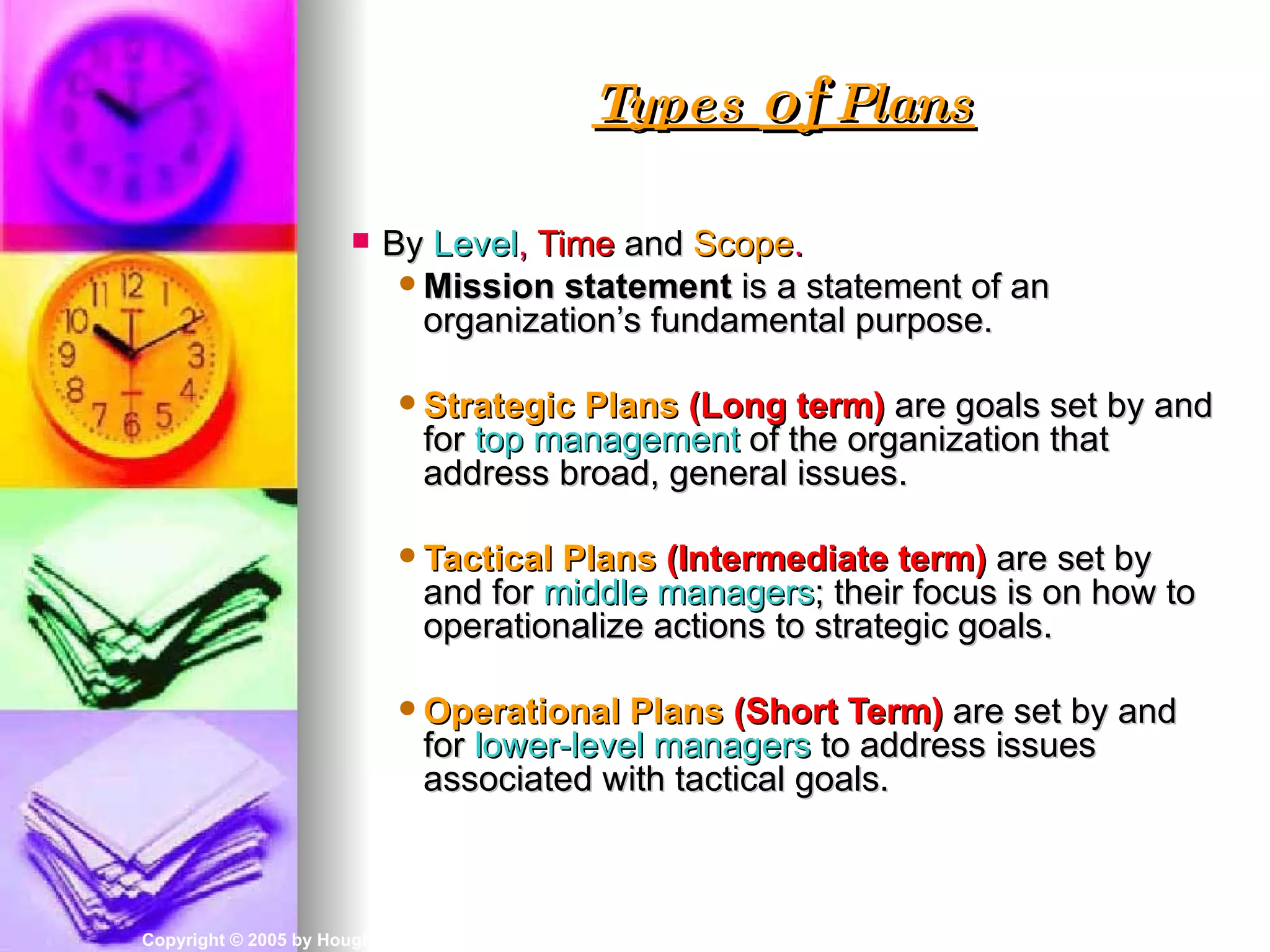
Types of Plans

                           By Level, Time and Scope.
                              Mission statement is a statement of an
                               organization’s fundamental purpose.

                              Strategic  Plans (Long term) are goals set by and
                                for top management of the organization that
                                address broad, general issues.

                              Tactical  Plans (Intermediate term) are set by
                                and for middle managers; their focus is on how to
                                operationalize actions to strategic goals.

                              Operational    Plans (Short Term) are set by and
                                for lower-level managers to address issues
                                associated with tactical goals.


Copyright © 2005 by Houghton Mifflin Company. All rights reserved.        3–5
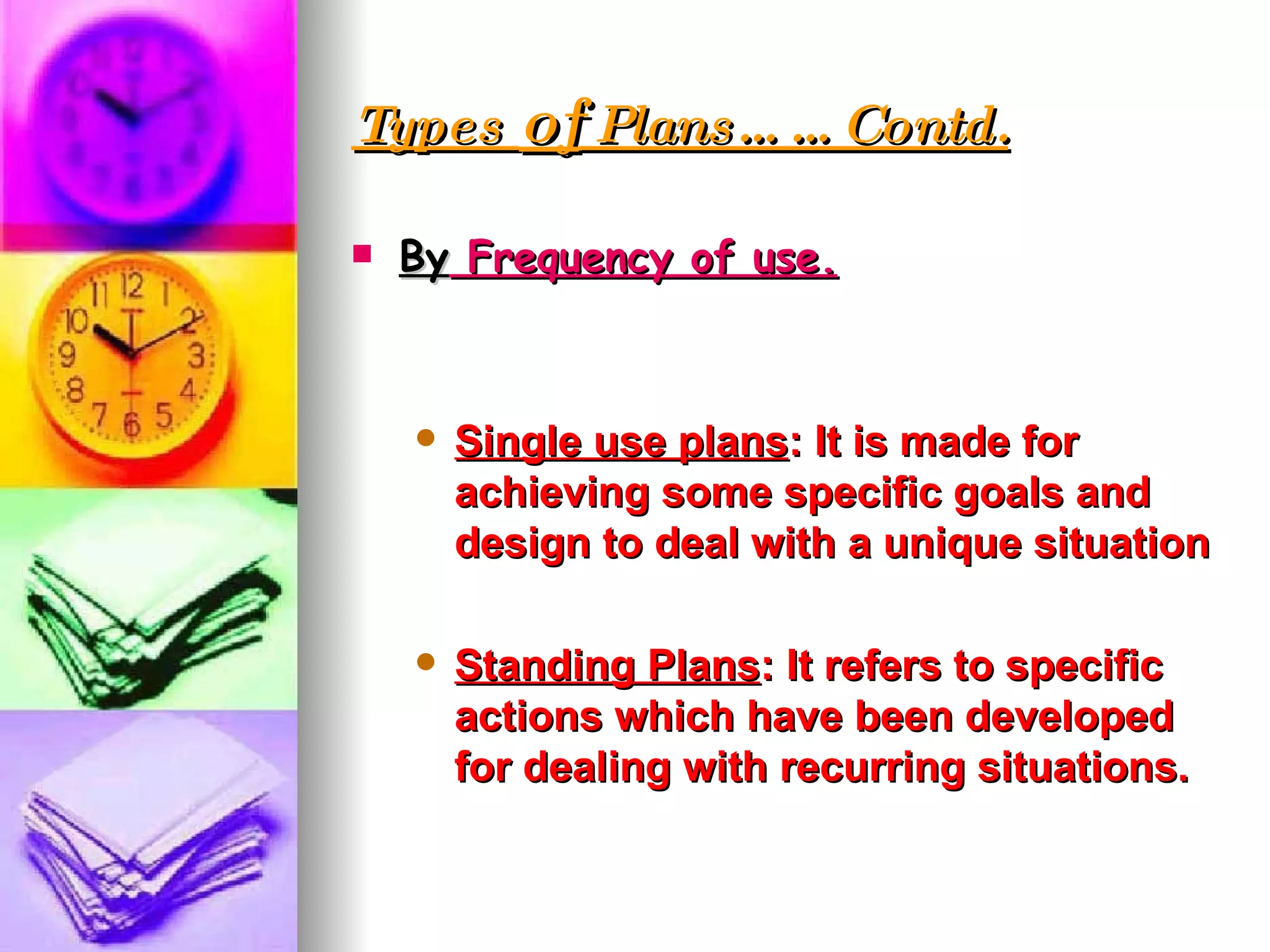
Types of Plans… … Contd.

   By Frequency of use.


       Single use plans: It is made for
        achieving some specific goals and
        design to deal with a unique situation

       Standing Plans: It refers to specific
        actions which have been developed
        for dealing with recurring situations.
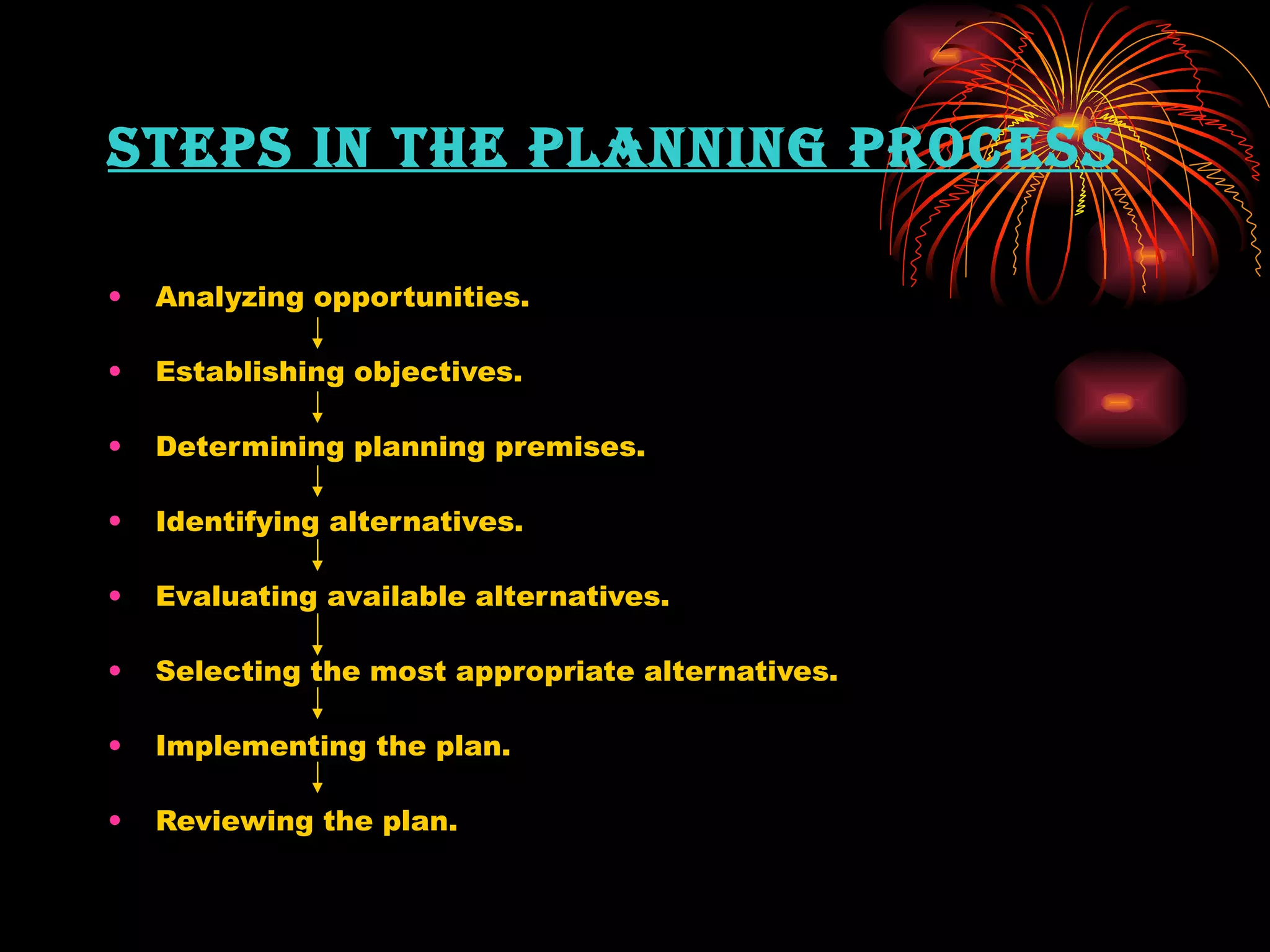
StepS In the plannIng proceSS

•   Analyzing opportunities.

•   Establishing objectives.

•   Determining planning premises.

•   Identifying alternatives.

•   Evaluating available alternatives.

•   Selecting the most appropriate alternatives.

•   Implementing the plan.

•   Reviewing the plan.
Pre re quis ite s fo r Effe c tive
                   Plan
   Establishing the right climate for planning.
   Clear and specific objectives.
   Planning premises.
   Initiative at top level.
   Participation in planning process.
   Communication of planning elements.
   Integration of long term and short term plans.
   An open system approach.
   Management of information system.
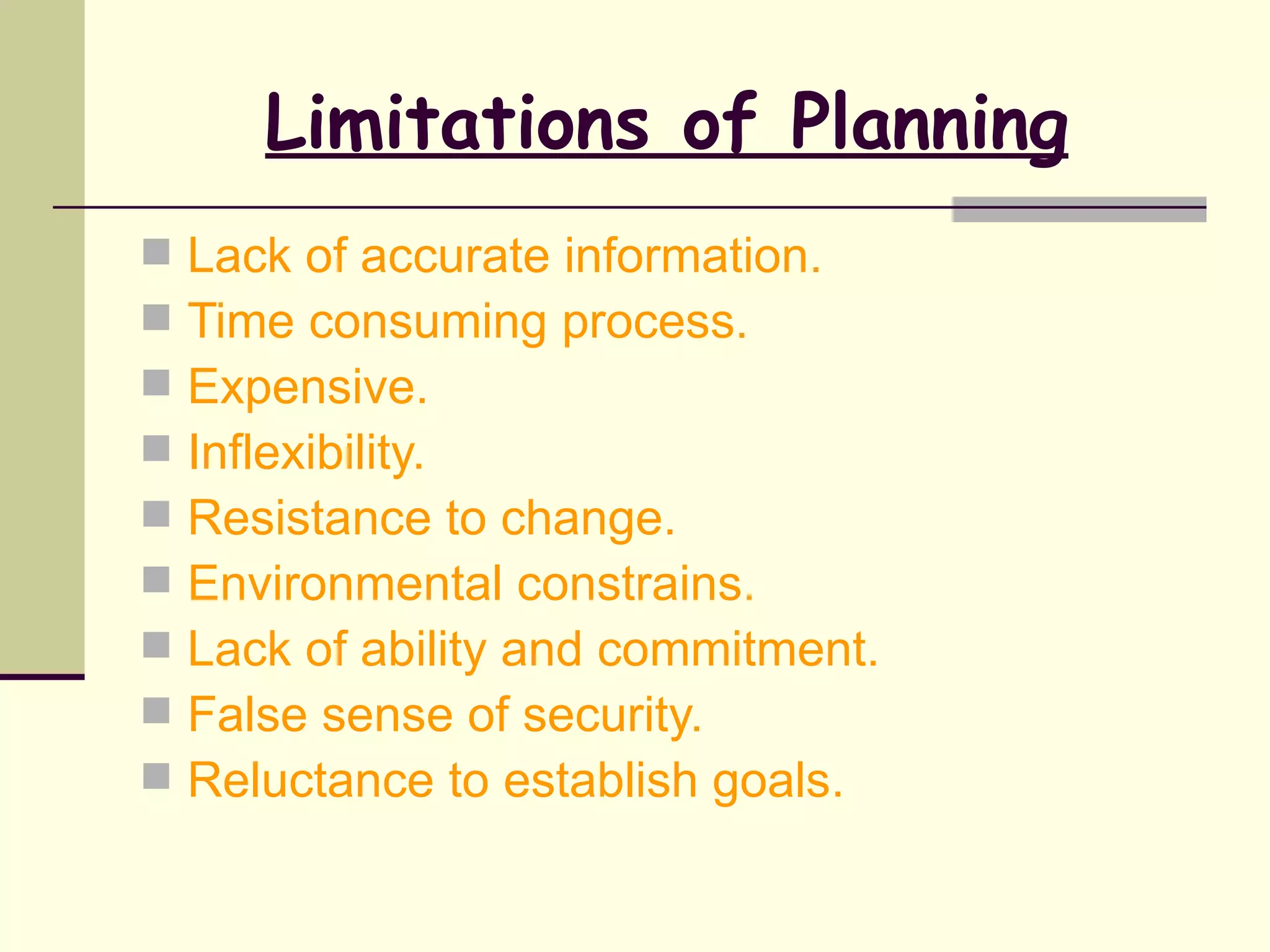
Limitations of Planning
   Lack of accurate information.
   Time consuming process.
   Expensive.
   Inflexibility.
   Resistance to change.
   Environmental constrains.
   Lack of ability and commitment.
   False sense of security.
   Reluctance to establish goals.
Thank You

Fundamentals Of Effective Planning

  • 1.
    Fundamentals of Effective Planning Prepared By: Sutanu Maulik 9832281818
  • 2.
    Definition In simplewords, planning is deciding in advance what action to take, how and when to take a particular action and who are the people to be involved in it. It involves anticipating the feature and consciously choosing the feature course of action.
  • 3.
    Nature of Planning  It is goal oriented.  Planning is an intellectual or rational process.  Planning is a primary function.  Planning is all-pervasive.  Planning is forward looking.  It is perpetual process.  Planning is an integrated process.  It involves choice.
  • 4.
    Significance of Planning  Focuses attention on objectives.  Offsets uncertainty and risk.  Provides sense of direction.  Provides guidelines for decision making.  Increases organizational effectiveness.  Provides efficiency on operations.  Ensures better co-ordination.  Facilitates control.  Encourages innovation and creativity.  Facilitates delegation.
  • 5.
    Types of Plans  By Level, Time and Scope.  Mission statement is a statement of an organization’s fundamental purpose.  Strategic Plans (Long term) are goals set by and for top management of the organization that address broad, general issues.  Tactical Plans (Intermediate term) are set by and for middle managers; their focus is on how to operationalize actions to strategic goals.  Operational Plans (Short Term) are set by and for lower-level managers to address issues associated with tactical goals. Copyright © 2005 by Houghton Mifflin Company. All rights reserved. 3–5
  • 6.
    Types of Plans…… Contd.  By Frequency of use.  Single use plans: It is made for achieving some specific goals and design to deal with a unique situation  Standing Plans: It refers to specific actions which have been developed for dealing with recurring situations.
  • 7.
    StepS In theplannIng proceSS • Analyzing opportunities. • Establishing objectives. • Determining planning premises. • Identifying alternatives. • Evaluating available alternatives. • Selecting the most appropriate alternatives. • Implementing the plan. • Reviewing the plan.
  • 8.
    Pre re quisite s fo r Effe c tive Plan  Establishing the right climate for planning.  Clear and specific objectives.  Planning premises.  Initiative at top level.  Participation in planning process.  Communication of planning elements.  Integration of long term and short term plans.  An open system approach.  Management of information system.
  • 9.
    Limitations of Planning  Lack of accurate information.  Time consuming process.  Expensive.  Inflexibility.  Resistance to change.  Environmental constrains.  Lack of ability and commitment.  False sense of security.  Reluctance to establish goals.
  • 10.