Diwakar chudal
B.Pharmacy , Institute of Medicine (IOM)
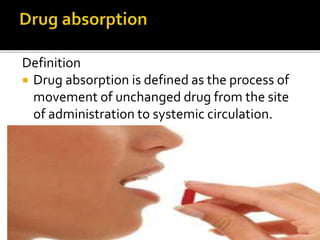
Definition
 Drug absorption is defined as the process of
movement of unchanged drug from the site
of administration to systemic circulation.
 Excipients.
 Nature and type of dosage
form.
 Storage conditions.
 Non-drug components which are added
during formulation of drug are called
excipients.
 Excipients are added during drug formulation
because:
 Ensures physico-chemical stability.
 Gives uniformity to composition.
 Gives optimum bioavailability.
 Gives suitable colouration and taste.
 Despite their importance in the drug
formulation, excipients can highly influence
the absorption of drugs.
 More the number of excipients in a dosage
form, more complex the drug becomes and
more likely to show problems in drug
absorption and bio-availability.
 Most commonly used excipients during
formulation of dosage form are:
Vehicle, diluents, binders or granulating
agents, disintegrants, lubricants, coatings,
suspending agents, surfactants, buffers,
complexing agents, colorants, sweetning
agents, precipitation inhibitors, etc
 Vehicle or solvent system is the major
component of liquid oral and parenteral
dosage form.
 Basically, 3 types of vehicles are used
▪ Aqueous vehicles (water, syrup, etc)
▪ Non-aqueous water-miscible vehicles (propylene,
glycol, glycerol, etc)
▪ Non-aqueous water-immiscible vehicles (vegetable oils)
 Aqueous and water miscible vehicles are
miscible with the body fluids so the drugs
from them are rapidly absorbed.
 Absorption of drugs in different vehicles
follows the order :
water-miscible vehicles > aqueous vehicles
>water-immiscible vehicles.
 Absorption of a drug from a viscous vehicle is
slower in comparison to non-viscous vehicle.
 Thus, nature of vehicles and viscosity of
vehicles is also one of the factor affecting the
drug absorption.
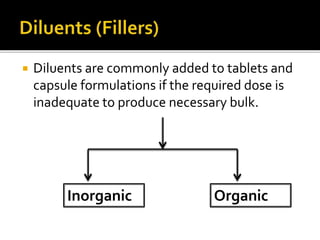
 Diluents are commonly added to tablets and
capsule formulations if the required dose is
inadequate to produce necessary bulk.
Inorganic Organic
 Organic diluents:
Starch, lactose, microcrystalline cellulose, etc
 Inorganic diluents:
Dicalcium phosphate (DCP) is most common.
 Sometimes Drug-diluent interactions alters the
absorption of drug.
Example:
Tetracycline and DCP when interacts, divalent
calcium-tetracycline complex is formed which is
poorly soluble and thus unabsorbable.
 Granulating agents are the substance which
are used to hold powders together to form
granules.
 It ensures that the tablet remains intact after
compression.
 Starch, cellulose derivatives, gelatin, sugar
solutions,etc are most common granulating
agents.
 Large amount of such granulating agents
increases hardness and decreases dissolution
rates of tablets and hence decreases the rate
of absorption.
Example:
PEG 6000 when binds with phenobarbital, it
forms complex compound with very low
solubility.
 Disintegrants are the substance which increases the
dissolution of tablets in water.
 When drug comes in contact with water, disintegrants
helps to overcome the cohesive force between drug
molecules and dissolution of tablets takes place in
aqueous medium.
 However, adsorbing disintegrants like bentonite and
vegum should be avoided with low dose drugs like
digoxin, alkaloids and steroids since a large amount of
dose is adsorbed and only a small fraction is available
for absorption.
 Lubricants are added to tablets to reduce
interparticle friction and sticking.
 Also called as anti-frictional agents.
 Lubricants are mostly hydrophobic in nature
and thus inhibits the penetration of water
into the tablets.
 Lubricants are applied by coating it over the
surface of tablets.
Coating:
 The process of applying one substance on the
surface of another.
 Deleterious effects of various coatings on
drug dissolution from a tablet follows the
order:
▪ Enteric coat > suger coat > non-enteric film coat
 Suspending agents are the substance which
stabilize the solid drug particles by reducing
their rate of settling through an increase in the
viscosity of the medium.
 Also called as viscosity imparters.
 Mostly used suspending agents are hydrophilic
polymers like:
▪ Vegetable gums (eg. Acacia)
▪ Semi-synthetic gums(eg. CMC, MC)
 An increase in viscosity by some suspending
agents acts as a mechanical barrier to the
diffusion of drug from the dosage form into
the bulk of GI fluid and from GI fluid to the
mucosal lining.
Example:
 CMC forms unabsorbable complexes with
amphetamine.
 Surfactants are used in drug formulations as
wetting agents, solubilizers,etc
 Surfactants may either increase or retard the
drug absorption interacting with drug
molecules.
 Surfactants usually increases drug absorption
by increasing membrane permeability of the
drug.
 Decrease in absorption of drug in the
presence of surfactant is due to formation of
unabsorbable drug-surfactant complex at
surfactant concentrations above the critical
concentration.
 Thus, higher surfactants concentration
always decreases the rate of drug absorption.
 Buffers are the solutions whose PH value
remains almost constant after addition of
small amounts of acids or alkali.
 Buffers are sometimes useful in increasing
the rate of dissolution of drug. Eg.buffered
aspirin tablets.
 But, certain buffer systems containing
potassium cations inhibits drug absorption as
seen in vit B2 and sulphanilamide.
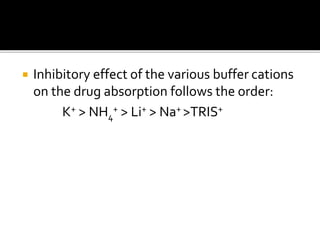
 Inhibitory effect of the various buffer cations
on the drug absorption follows the order:
K+ > NH4
+ > Li+ > Na+ >TRIS+
 In some drugs, complexing agents are added
to alter the physico-chemical and bio-
pharmaceutical properties of a drug.
 A complexed drug may have different
stability, solubility, molecular size, diffusion
rate, etc
 Examples of complexation which increases
the drug absorption are:
Ergotamine tartarate – caffeine complex. (increases
dissolution)
Caffiene-PABA complex. (increases membrane
permeability)
• However, complexation can sometime decrease the
drug absorption due to formation of poorly
absorbable complex
Eg. Complexation of tetracycline with divalent and trivalent
cations like calcium, iron, magnesium, aluminium,etc
decreases absorption.
 Colorants are added in drug formulations to
mask the unattractive original colour of a drug.
 But, colourants can also largly affect the drug
absorption.
 Very low concentrations of water soluble dye
can have an inhibitory effect on dissolution rate
of several crystalline drugs
Eg. Brilliant blue dye retards dissolution of
sulpathiazole.
 When concentration of free drug increases
above the saturation, it results in
supersaturation which leads to drug
precipitation or crystallization.
 PVP, HPMC, PEG, PVA, etc are some polymers
which prevents drug precipitation by:
Increasing the viscosity of vehicle
Adsorbing on the faces of crystals thus reducing
crystal growth.
 The rate of absorption and bio-availability of
certain drug largely depends on the proper
selection of dosage form of that drug.
This is due to the relative rate at which a particular
dosage form releases the drug to the biological
fluids and membrane.
 As a general rule, bio-availability of a drug
from various dosage forms decreases in the
following order:
 Solutions > emulsions > suspensions >
powders > capsules > coated tablets >
enteric-coated tablets > sustained-release
tablets.
 Thus, absorption of a drug from solution is
fastest with least potential for bioavailability
problems whereas absorption from
sustained-release product is slowest with
greatest bioavailability risk.
 A number of changes in the physico-chemical
properties of a drug can result due to storage
conditions which can adversely affect absorption
and thus bio-availability.
 When shelf-life of the solutions becomes long,
solubility of drug changes and precipitation can
occur.
 Similarly, decrease in rate of dissolution occurs
in suspension dosage form
 High temperature and humidity results in
increase in hardness of tablets which
decreases the rate of absorption.
 Therefore, storage conditions and product
age has significant role in the absorption of
drug from different dosage forms.
THANK YOU

Formulation factors affecting drug absorption

  • 1.
    Diwakar chudal B.Pharmacy ,Institute of Medicine (IOM)
  • 2.
    Definition  Drug absorptionis defined as the process of movement of unchanged drug from the site of administration to systemic circulation.
  • 3.
     Excipients.  Natureand type of dosage form.  Storage conditions.
  • 4.
     Non-drug componentswhich are added during formulation of drug are called excipients.  Excipients are added during drug formulation because:  Ensures physico-chemical stability.  Gives uniformity to composition.  Gives optimum bioavailability.  Gives suitable colouration and taste.
  • 5.
     Despite theirimportance in the drug formulation, excipients can highly influence the absorption of drugs.  More the number of excipients in a dosage form, more complex the drug becomes and more likely to show problems in drug absorption and bio-availability.
  • 6.
     Most commonlyused excipients during formulation of dosage form are: Vehicle, diluents, binders or granulating agents, disintegrants, lubricants, coatings, suspending agents, surfactants, buffers, complexing agents, colorants, sweetning agents, precipitation inhibitors, etc
  • 7.
     Vehicle orsolvent system is the major component of liquid oral and parenteral dosage form.  Basically, 3 types of vehicles are used ▪ Aqueous vehicles (water, syrup, etc) ▪ Non-aqueous water-miscible vehicles (propylene, glycol, glycerol, etc) ▪ Non-aqueous water-immiscible vehicles (vegetable oils)
  • 8.
     Aqueous andwater miscible vehicles are miscible with the body fluids so the drugs from them are rapidly absorbed.  Absorption of drugs in different vehicles follows the order : water-miscible vehicles > aqueous vehicles >water-immiscible vehicles.
  • 9.
     Absorption ofa drug from a viscous vehicle is slower in comparison to non-viscous vehicle.  Thus, nature of vehicles and viscosity of vehicles is also one of the factor affecting the drug absorption.
  • 10.
     Diluents arecommonly added to tablets and capsule formulations if the required dose is inadequate to produce necessary bulk. Inorganic Organic
  • 11.
     Organic diluents: Starch,lactose, microcrystalline cellulose, etc  Inorganic diluents: Dicalcium phosphate (DCP) is most common.  Sometimes Drug-diluent interactions alters the absorption of drug. Example: Tetracycline and DCP when interacts, divalent calcium-tetracycline complex is formed which is poorly soluble and thus unabsorbable.
  • 12.
     Granulating agentsare the substance which are used to hold powders together to form granules.  It ensures that the tablet remains intact after compression.  Starch, cellulose derivatives, gelatin, sugar solutions,etc are most common granulating agents.
  • 13.
     Large amountof such granulating agents increases hardness and decreases dissolution rates of tablets and hence decreases the rate of absorption. Example: PEG 6000 when binds with phenobarbital, it forms complex compound with very low solubility.
  • 14.
     Disintegrants arethe substance which increases the dissolution of tablets in water.  When drug comes in contact with water, disintegrants helps to overcome the cohesive force between drug molecules and dissolution of tablets takes place in aqueous medium.  However, adsorbing disintegrants like bentonite and vegum should be avoided with low dose drugs like digoxin, alkaloids and steroids since a large amount of dose is adsorbed and only a small fraction is available for absorption.
  • 15.
     Lubricants areadded to tablets to reduce interparticle friction and sticking.  Also called as anti-frictional agents.  Lubricants are mostly hydrophobic in nature and thus inhibits the penetration of water into the tablets.  Lubricants are applied by coating it over the surface of tablets.
  • 16.
    Coating:  The processof applying one substance on the surface of another.  Deleterious effects of various coatings on drug dissolution from a tablet follows the order: ▪ Enteric coat > suger coat > non-enteric film coat
  • 17.
     Suspending agentsare the substance which stabilize the solid drug particles by reducing their rate of settling through an increase in the viscosity of the medium.  Also called as viscosity imparters.  Mostly used suspending agents are hydrophilic polymers like: ▪ Vegetable gums (eg. Acacia) ▪ Semi-synthetic gums(eg. CMC, MC)
  • 18.
     An increasein viscosity by some suspending agents acts as a mechanical barrier to the diffusion of drug from the dosage form into the bulk of GI fluid and from GI fluid to the mucosal lining. Example:  CMC forms unabsorbable complexes with amphetamine.
  • 19.
     Surfactants areused in drug formulations as wetting agents, solubilizers,etc  Surfactants may either increase or retard the drug absorption interacting with drug molecules.  Surfactants usually increases drug absorption by increasing membrane permeability of the drug.
  • 20.
     Decrease inabsorption of drug in the presence of surfactant is due to formation of unabsorbable drug-surfactant complex at surfactant concentrations above the critical concentration.  Thus, higher surfactants concentration always decreases the rate of drug absorption.
  • 21.
     Buffers arethe solutions whose PH value remains almost constant after addition of small amounts of acids or alkali.  Buffers are sometimes useful in increasing the rate of dissolution of drug. Eg.buffered aspirin tablets.  But, certain buffer systems containing potassium cations inhibits drug absorption as seen in vit B2 and sulphanilamide.
  • 22.
     Inhibitory effectof the various buffer cations on the drug absorption follows the order: K+ > NH4 + > Li+ > Na+ >TRIS+
  • 23.
     In somedrugs, complexing agents are added to alter the physico-chemical and bio- pharmaceutical properties of a drug.  A complexed drug may have different stability, solubility, molecular size, diffusion rate, etc  Examples of complexation which increases the drug absorption are:
  • 24.
    Ergotamine tartarate –caffeine complex. (increases dissolution) Caffiene-PABA complex. (increases membrane permeability) • However, complexation can sometime decrease the drug absorption due to formation of poorly absorbable complex Eg. Complexation of tetracycline with divalent and trivalent cations like calcium, iron, magnesium, aluminium,etc decreases absorption.
  • 25.
     Colorants areadded in drug formulations to mask the unattractive original colour of a drug.  But, colourants can also largly affect the drug absorption.  Very low concentrations of water soluble dye can have an inhibitory effect on dissolution rate of several crystalline drugs Eg. Brilliant blue dye retards dissolution of sulpathiazole.
  • 26.
     When concentrationof free drug increases above the saturation, it results in supersaturation which leads to drug precipitation or crystallization.  PVP, HPMC, PEG, PVA, etc are some polymers which prevents drug precipitation by: Increasing the viscosity of vehicle Adsorbing on the faces of crystals thus reducing crystal growth.
  • 27.
     The rateof absorption and bio-availability of certain drug largely depends on the proper selection of dosage form of that drug. This is due to the relative rate at which a particular dosage form releases the drug to the biological fluids and membrane.  As a general rule, bio-availability of a drug from various dosage forms decreases in the following order:
  • 28.
     Solutions >emulsions > suspensions > powders > capsules > coated tablets > enteric-coated tablets > sustained-release tablets.  Thus, absorption of a drug from solution is fastest with least potential for bioavailability problems whereas absorption from sustained-release product is slowest with greatest bioavailability risk.
  • 29.
     A numberof changes in the physico-chemical properties of a drug can result due to storage conditions which can adversely affect absorption and thus bio-availability.  When shelf-life of the solutions becomes long, solubility of drug changes and precipitation can occur.  Similarly, decrease in rate of dissolution occurs in suspension dosage form
  • 30.
     High temperatureand humidity results in increase in hardness of tablets which decreases the rate of absorption.  Therefore, storage conditions and product age has significant role in the absorption of drug from different dosage forms.
  • 31.