FACTORS AFFECTING DRUG
ABSORPTION
Presented By Presented to
Virendra kumar Dr. Sudipta Saha
Dept. of Pharmaceutical Science Assistant professor
(Pharmacology) M. Pharm II Sem
CONTENTS
Introduction
Definition
Factors affecting
absorption
Conclusion
References
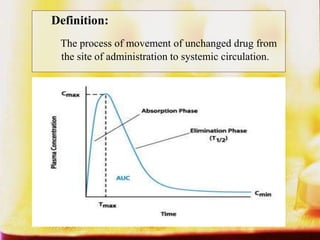
Definition:
The process of movement of unchanged drug from
the site of administration to systemic circulation.
Factors affecting absorption:
A. Pharmaceutical factors:
1. Physicochemical properties of drug
a. Drug solubility and dissolution rate
b. Particle size and effective surface area
c. Polymorphism and amorphism
d. Salt form of the drug
e. Drug stability
2. Formulation factors:
a. Disintegration time.
b. Manufacturing variables.
c. Nature and type of dosage form.
d. Pharmaceutical ingredients (excepients).
e. Product age and storage conditions.
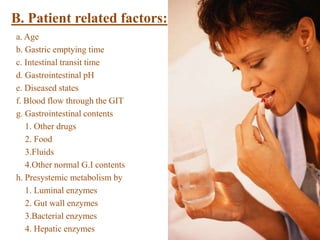
B. Patient related factors:
a. Age
b. Gastric emptying time
c. Intestinal transit time
d. Gastrointestinal pH
e. Diseased states
f. Blood flow through the GIT
g. Gastrointestinal contents
1. Other drugs
2. Food
3.Fluids
4.Other normal G.I contents
h. Presystemic metabolism by
1. Luminal enzymes
2. Gut wall enzymes
3.Bacterial enzymes
4. Hepatic enzymes
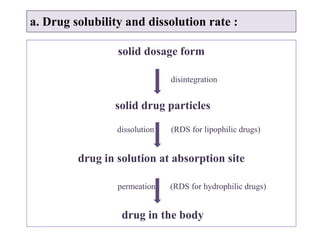
a. Drug solubility and dissolution rate :
solid dosage form
disintegration
solid drug particles
dissolution (RDS for lipophilic drugs)
drug in solution at absorption site
permeation (RDS for hydrophilic drugs)
drug in the body
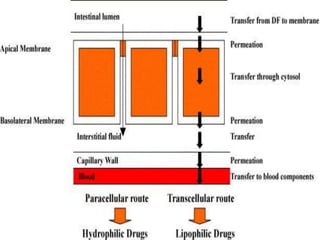
For Hydrophobic drugs:
Dissolution is rate limited step.
eg: griseofulvin , spironolactone.
For Hydrophilic drugs:
Permeation is rate limited step.
eg: cromolyn sodium, neomycin.
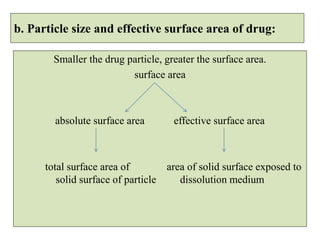
b. Particle size and effective surface area of drug:
Smaller the drug particle, greater the surface area.
surface area
absolute surface area effective surface area
total surface area of area of solid surface exposed to
solid surface of particle dissolution medium
Smaller the particle size (by micronization) greater is the
effective surface area more intimate contact b/w solid surface and
aq solvent higher is the dissolution rate increase in absorption
efficiency.
Particle size reduction has been used to increase the absorption
of a large number of poorly soluble drugs, such as
bishydroxycoumarin, digoxin, griseofulvin, nitrofurantoin,and
tolbutamide.
Griseofulvin has extremely low aqueous solubility, and material
of normal particle size gave rise to poor and erratic absorption.
Microsize particles improve absorption, but it is improved even
more when it is formulated in ultramicrosize particles as a
monomolecular dispersion in polyethylene glycol.
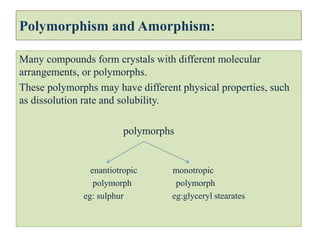
Polymorphism and Amorphism:
Many compounds form crystals with different molecular
arrangements, or polymorphs.
These polymorphs may have different physical properties, such
as dissolution rate and solubility.
polymorphs
enantiotropic monotropic
polymorph polymorph
eg: sulphur eg:glyceryl stearates
40 % of all organic compounds – exist in various polymorphic
forms.
70% of barbiturates & 65% of sulphonamides exhibit
polymorphism.
Amorphous form:
These have greater aqueous solubility than the crystaline
forms because the energy required to transfer a molecule from
crystal lattice is greater than that required for non-crystalline
solid .
eg: amorphous form of novobiocin - 10 times more soluble
than crystalline form.
amorphous > metastable> stable
Hydrates or solvates:
 The stoichiometric type of adducts where the solvent
molecule are incorporated with the crystal lattice of the solid
are called as solvates.
 Trapped solvent is the solvent of crystallisation.
 The solvates can exist in diff crystalline forms called as
pseudomorphs and the phenomenon is pseudopolymorphism.
 When the solvent in association with drug is water, the
solvate is known as hydrate.
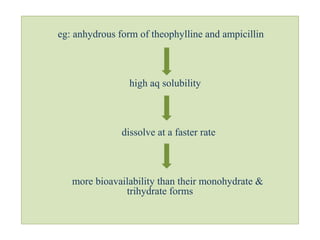
eg: anhydrous form of theophylline and ampicillin
high aq solubility
dissolve at a faster rate
more bioavailability than their monohydrate &
trihydrate forms
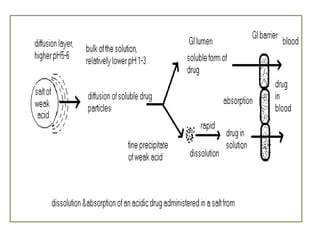
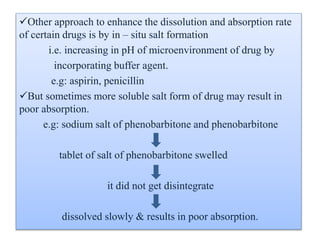
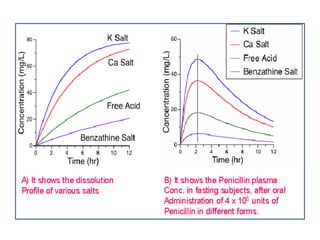
Other approach to enhance the dissolution and absorption rate
of certain drugs is by in – situ salt formation
i.e. increasing in pH of microenvironment of drug by
incorporating buffer agent.
e.g: aspirin, penicillin
But sometimes more soluble salt form of drug may result in
poor absorption.
e.g: sodium salt of phenobarbitone and phenobarbitone
tablet of salt of phenobarbitone swelled
it did not get disintegrate
dissolved slowly & results in poor absorption.
1. Disintegration time:
Rapid disintegration is important to have a rapid absorption
so lower D.T is required.
 Now D.T of tablet is directly proportional to – amount o f
binder -Compression force.
And one thing should be remembered that in vitro
disintegration test gives no means of a guarantee of drugs
bioavailability because if the disintegrated drug particles do
not dissolve then absorption is not possible.
2. Manufacturing variables: -
a) Method of granulation:
Wet granulation yields a tablet that dissolves faster than
those made by other granulating methods. But wet
granulation has several limitations like formation of crystal
bridge or chemical degradation.
Other superior recent method named APOC (agglomerative
phase of communition) that involves grinding of drug till
spontaneous agglomeration and granules are prepared with
higher surface area. So tablet made up of this granules have
higher dissolution rate.
b) Compression force:
Higher compression force yields a tablet with greater hardness
and reduced wettability & hence have a long D.T. but on other
hand higher compression force cause crushing of drug particles
into smaller ones with higher effective surface area which in
decrease in D.T.
So effect of compression force should be thoroughly studied on
each formulation.
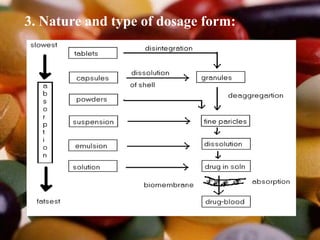
3. Nature and type of dosage form:
4. Pharmaceutical ingredients / Excipients:
 More the no. of excepients in dosage form, more complex it
is & greater the potential for absorption and Bioavailability
problems.
Changing an excipient from calcium sulfate to lactose and
increasing the proportion of magnesium silicate, increases the
activity of oral phenytoin.
 Systemic availability of thiamine and riboflavin is reduced by
the presence of Fuller’s earth.
 Absorption of tetracycline from capsules is reduced by
calcium phosphate due to complexation.
 Most of these types of interactions were reported some time
ago and are unlikely to occur in the current environment of
rigorous testing of new dosage forms and formulations.
a) Vehicle:
Rate of absorption – depends on its miscibility with biological
fluid.Miscible vehicles (aq or water miscible vehicle) –rapid
absorption e.g. propylene glycol.
Immiscible vehicles - absorption –depends on its partitioning
from oil phase to aq body fluid.
b) Diluents:
Hydrophilic diluents-form the hydrophilic coat around
hydrophobic drug particles –thus promotes dissolution and
absorption of poorly soluble hydrophobic drug.
c) Binders & granulating agent :
Hydrophilic binders – imparts hydrophilic properties to granule
surface – better dissolution of poorly wettable drug. e.g. starch,
gelatin, PVP. More amount of binder – increases hardness of
tablet – decrease dissolution & disintegration
rate.
d) Disintegrants :
 Mostly hydrophilic in nature.
Decrease in amount of disintegrants – significantly lowers
B.A.
e) Lubricants :
Commonly hydrophobic in nature – therefore inhibits
penetration of water into tablet and thus dissolution and
disintegration.
f) Suspending agents/viscosity agent :
Stabilized the solid drug particles and thus affect drug
absorption.
Macromolecular gum forms unabsorbable complex with drug
e.g. Na CMC.
 Viscosity imparters – act as a mechanical barrier to diffusion
of drug from its dosage form and retard GI transit of drug.
g) Surfactants :
May enhance or retards drug
absorption by interacting with drug
or membrane or both.
 Surfactants have been considered
as absorption enhancers, again
mostly in animals.
Polyoxyethylene ethers have been
shown to enhance gastric or rectal
absorption of lincomycin, penicillin,
cephalosporins, and fosfomycin in
rats and rabbits.
 However, in humans, oral
polyoxyethylene-20-oleyl ether
resulted in poor and variable insulin
absorption.
In general, unionic surfactants
have little effect on membrane
structure but cationic
Surfactants have been associated
with reversible cell loss and loss of
goblet cells.
 Physiologic surfactants – bile
salts – promotes absorption
e.g. Griseofulvin, steroids
 It may decrease absorption when
it forms the unabsorbable complex
with drug above CMC.
Colourants:
Even a low concentration of water soluble dye can have
an inhibitory effect on dissolution rate of several
crystalline drugs.
The dye molecules get absorbed onto the crystal faces
and inhibit the drug dissolution.
e.g: Brilliant blue retards dissolution of sulfathiazole.
5. Product age and storage conditions :
Product aging and improper storage conditions
adversely affect B.A.
e.g:precipitation of drug in solution decrease rate of
Change in particle size of suspension drug dissolution
& Hardening of tablet & absorption.
Patient related factors:
 Gastric emptying: apart from the dissolution of
drug and its permeation through the bio
membrane,the passage from stomach to small
intestine, called as gastric emptying,can also be a
rate limiting step in absorption because the major
site of drug absorption is intestine.
It is advisable where:
 Rapid onset of drug is desired eg:sedatives
 Drug not stable in gastric fluids eg:pencillin G
 Dissolution occuring in intestine eg:enteric coated
forms
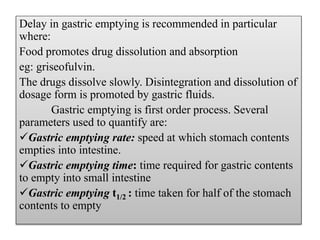
Delay in gastric emptying is recommended in particular
where:
Food promotes drug dissolution and absorption
eg: griseofulvin.
The drugs dissolve slowly. Disintegration and dissolution of
dosage form is promoted by gastric fluids.
Gastric emptying is first order process. Several
parameters used to quantify are:
Gastric emptying rate: speed at which stomach contents
empties into intestine.
Gastric emptying time: time required for gastric contents
to empty into small intestine
Gastric emptying t1/2 : time taken for half of the stomach
contents to empty
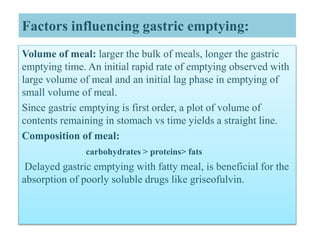
Factors influencing gastric emptying:
Volume of meal: larger the bulk of meals, longer the gastric
emptying time. An initial rapid rate of emptying observed with
large volume of meal and an initial lag phase in emptying of
small volume of meal.
Since gastric emptying is first order, a plot of volume of
contents remaining in stomach vs time yields a straight line.
Composition of meal:
carbohydrates > proteins> fats
Delayed gastric emptying with fatty meal, is beneficial for the
absorption of poorly soluble drugs like griseofulvin.
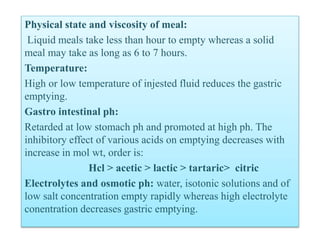
Physical state and viscosity of meal:
Liquid meals take less than hour to empty whereas a solid
meal may take as long as 6 to 7 hours.
Temperature:
High or low temperature of injested fluid reduces the gastric
emptying.
Gastro intestinal ph:
Retarded at low stomach ph and promoted at high ph. The
inhibitory effect of various acids on emptying decreases with
increase in mol wt, order is:
Hcl > acetic > lactic > tartaric> citric
Electrolytes and osmotic ph: water, isotonic solutions and of
low salt concentration empty rapidly whereas high electrolyte
conentration decreases gastric emptying.
Drugs that retard gastric emptying include
Poorly soluble antacids: aluminium hydroxide
Anticholinergics: atropine
Narcotic analgesics: morphine
Tricyclic anti depressents: imipramine
Disease state: like gastroenteritis, gastric ulcer, pyloric stenosis
retard gastric emptying rate.
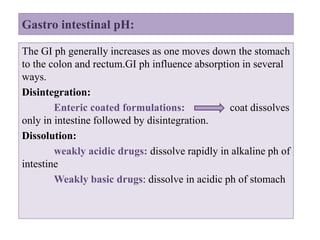
Gastro intestinal pH:
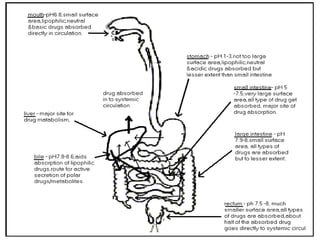
The GI ph generally increases as one moves down the stomach
to the colon and rectum.GI ph influence absorption in several
ways.
Disintegration:
Enteric coated formulations: coat dissolves
only in intestine followed by disintegration.
Dissolution:
weakly acidic drugs: dissolve rapidly in alkaline ph of
intestine
Weakly basic drugs: dissolve in acidic ph of stomach
Gastrointestinal diseases:
Altered GI motility:
Gastrointestinal diseases and infections:
 Two of the intestinal disorders related with
malabsorption syndrome that influence drug availability
are celiac disease and Crohn’s disease.
 Crohn’s disease that can alter absorption pattern are
altered gut wall microbial flora, decreased gut surface
area and intestinal transit rate.
 GI infections like shigellosis, gastroenteritis, cholera
and food poisoning also result in malabsorption.
Gastrointestinal surgery:
Gastrectomy can result in drug dumping in the intestine,
osmotic diarrhea and reduced intestinal transit time.
Cardiovascular diseases:
Several changes associated with congestive cardiac failure
influence bioavailability of a drug.
Hepatic diseases:
Disorders such as hepatic cirrhosis influence bioavailability
mainly of drugs that undergo considerable first-pass hepatic
metabolism.
e.g. propranolol.
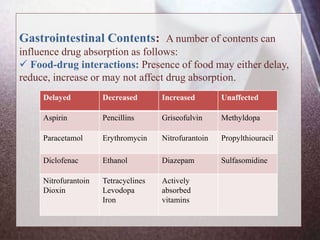
Gastrointestinal Contents: A number of contents can
influence drug absorption as follows:
 Food-drug interactions: Presence of food may either delay,
reduce, increase or may not affect drug absorption.
Delayed Decreased Increased Unaffected
Aspirin Pencillins Griseofulvin Methyldopa
Paracetamol Erythromycin Nitrofurantoin Propylthiouracil
Diclofenac Ethanol Diazepam Sulfasomidine
Nitrofurantoin
Dioxin
Tetracyclines
Levodopa
Iron
Actively
absorbed
vitamins
REFERENCES:
 Shargel L., Andrew B.C., Fourth edition
“Physiologic factors related to drug absorption”
Applied Biopharmaceutics and
Pharmacokinetics, Prentice Hall International,
INC., Stanford 1999. Page No. 99-128.
Tianjin State Key Laboratory of
Pharmacokinetics and Pharmacodynamics,
Tianjin Institute of Pharmaceutical Research,
Tianjin, 300193, China.
 Pharmaceutics , the Science of Dosage form
Design By M.E. Aulton.
Brahmankar D.M.,Jaiswal S.B., Second
edition, “Absorption of Drugs”
Biopharmaceutics and Pharmacokinetics,
Vallabh Prakashan, Delhi 2009, page no. 27-77.
Be miserable.
Or motivate yourself.
Whatever has to be
done, it's always your
choice.

Factor affecting drug absorption

  • 1.
    FACTORS AFFECTING DRUG ABSORPTION PresentedBy Presented to Virendra kumar Dr. Sudipta Saha Dept. of Pharmaceutical Science Assistant professor (Pharmacology) M. Pharm II Sem
  • 2.
  • 3.
    Definition: The process ofmovement of unchanged drug from the site of administration to systemic circulation.
  • 4.
    Factors affecting absorption: A.Pharmaceutical factors: 1. Physicochemical properties of drug a. Drug solubility and dissolution rate b. Particle size and effective surface area c. Polymorphism and amorphism d. Salt form of the drug e. Drug stability
  • 5.
    2. Formulation factors: a.Disintegration time. b. Manufacturing variables. c. Nature and type of dosage form. d. Pharmaceutical ingredients (excepients). e. Product age and storage conditions.
  • 6.
    B. Patient relatedfactors: a. Age b. Gastric emptying time c. Intestinal transit time d. Gastrointestinal pH e. Diseased states f. Blood flow through the GIT g. Gastrointestinal contents 1. Other drugs 2. Food 3.Fluids 4.Other normal G.I contents h. Presystemic metabolism by 1. Luminal enzymes 2. Gut wall enzymes 3.Bacterial enzymes 4. Hepatic enzymes
  • 7.
    a. Drug solubilityand dissolution rate : solid dosage form disintegration solid drug particles dissolution (RDS for lipophilic drugs) drug in solution at absorption site permeation (RDS for hydrophilic drugs) drug in the body
  • 8.
    For Hydrophobic drugs: Dissolutionis rate limited step. eg: griseofulvin , spironolactone. For Hydrophilic drugs: Permeation is rate limited step. eg: cromolyn sodium, neomycin.
  • 10.
    b. Particle sizeand effective surface area of drug: Smaller the drug particle, greater the surface area. surface area absolute surface area effective surface area total surface area of area of solid surface exposed to solid surface of particle dissolution medium
  • 11.
    Smaller the particlesize (by micronization) greater is the effective surface area more intimate contact b/w solid surface and aq solvent higher is the dissolution rate increase in absorption efficiency. Particle size reduction has been used to increase the absorption of a large number of poorly soluble drugs, such as bishydroxycoumarin, digoxin, griseofulvin, nitrofurantoin,and tolbutamide. Griseofulvin has extremely low aqueous solubility, and material of normal particle size gave rise to poor and erratic absorption. Microsize particles improve absorption, but it is improved even more when it is formulated in ultramicrosize particles as a monomolecular dispersion in polyethylene glycol.
  • 12.
    Polymorphism and Amorphism: Manycompounds form crystals with different molecular arrangements, or polymorphs. These polymorphs may have different physical properties, such as dissolution rate and solubility. polymorphs enantiotropic monotropic polymorph polymorph eg: sulphur eg:glyceryl stearates
  • 13.
    40 % ofall organic compounds – exist in various polymorphic forms. 70% of barbiturates & 65% of sulphonamides exhibit polymorphism. Amorphous form: These have greater aqueous solubility than the crystaline forms because the energy required to transfer a molecule from crystal lattice is greater than that required for non-crystalline solid . eg: amorphous form of novobiocin - 10 times more soluble than crystalline form. amorphous > metastable> stable
  • 14.
    Hydrates or solvates: The stoichiometric type of adducts where the solvent molecule are incorporated with the crystal lattice of the solid are called as solvates.  Trapped solvent is the solvent of crystallisation.  The solvates can exist in diff crystalline forms called as pseudomorphs and the phenomenon is pseudopolymorphism.  When the solvent in association with drug is water, the solvate is known as hydrate.
  • 15.
    eg: anhydrous formof theophylline and ampicillin high aq solubility dissolve at a faster rate more bioavailability than their monohydrate & trihydrate forms
  • 17.
    Other approach toenhance the dissolution and absorption rate of certain drugs is by in – situ salt formation i.e. increasing in pH of microenvironment of drug by incorporating buffer agent. e.g: aspirin, penicillin But sometimes more soluble salt form of drug may result in poor absorption. e.g: sodium salt of phenobarbitone and phenobarbitone tablet of salt of phenobarbitone swelled it did not get disintegrate dissolved slowly & results in poor absorption.
  • 22.
    1. Disintegration time: Rapiddisintegration is important to have a rapid absorption so lower D.T is required.  Now D.T of tablet is directly proportional to – amount o f binder -Compression force. And one thing should be remembered that in vitro disintegration test gives no means of a guarantee of drugs bioavailability because if the disintegrated drug particles do not dissolve then absorption is not possible. 2. Manufacturing variables: - a) Method of granulation: Wet granulation yields a tablet that dissolves faster than those made by other granulating methods. But wet granulation has several limitations like formation of crystal bridge or chemical degradation.
  • 23.
    Other superior recentmethod named APOC (agglomerative phase of communition) that involves grinding of drug till spontaneous agglomeration and granules are prepared with higher surface area. So tablet made up of this granules have higher dissolution rate. b) Compression force: Higher compression force yields a tablet with greater hardness and reduced wettability & hence have a long D.T. but on other hand higher compression force cause crushing of drug particles into smaller ones with higher effective surface area which in decrease in D.T. So effect of compression force should be thoroughly studied on each formulation.
  • 24.
    3. Nature andtype of dosage form:
  • 25.
    4. Pharmaceutical ingredients/ Excipients:  More the no. of excepients in dosage form, more complex it is & greater the potential for absorption and Bioavailability problems. Changing an excipient from calcium sulfate to lactose and increasing the proportion of magnesium silicate, increases the activity of oral phenytoin.  Systemic availability of thiamine and riboflavin is reduced by the presence of Fuller’s earth.  Absorption of tetracycline from capsules is reduced by calcium phosphate due to complexation.  Most of these types of interactions were reported some time ago and are unlikely to occur in the current environment of rigorous testing of new dosage forms and formulations.
  • 26.
    a) Vehicle: Rate ofabsorption – depends on its miscibility with biological fluid.Miscible vehicles (aq or water miscible vehicle) –rapid absorption e.g. propylene glycol. Immiscible vehicles - absorption –depends on its partitioning from oil phase to aq body fluid. b) Diluents: Hydrophilic diluents-form the hydrophilic coat around hydrophobic drug particles –thus promotes dissolution and absorption of poorly soluble hydrophobic drug. c) Binders & granulating agent : Hydrophilic binders – imparts hydrophilic properties to granule surface – better dissolution of poorly wettable drug. e.g. starch, gelatin, PVP. More amount of binder – increases hardness of tablet – decrease dissolution & disintegration rate.
  • 27.
    d) Disintegrants : Mostly hydrophilic in nature. Decrease in amount of disintegrants – significantly lowers B.A. e) Lubricants : Commonly hydrophobic in nature – therefore inhibits penetration of water into tablet and thus dissolution and disintegration. f) Suspending agents/viscosity agent : Stabilized the solid drug particles and thus affect drug absorption. Macromolecular gum forms unabsorbable complex with drug e.g. Na CMC.  Viscosity imparters – act as a mechanical barrier to diffusion of drug from its dosage form and retard GI transit of drug.
  • 28.
    g) Surfactants : Mayenhance or retards drug absorption by interacting with drug or membrane or both.  Surfactants have been considered as absorption enhancers, again mostly in animals. Polyoxyethylene ethers have been shown to enhance gastric or rectal absorption of lincomycin, penicillin, cephalosporins, and fosfomycin in rats and rabbits.  However, in humans, oral polyoxyethylene-20-oleyl ether resulted in poor and variable insulin absorption.
  • 29.
    In general, unionicsurfactants have little effect on membrane structure but cationic Surfactants have been associated with reversible cell loss and loss of goblet cells.  Physiologic surfactants – bile salts – promotes absorption e.g. Griseofulvin, steroids  It may decrease absorption when it forms the unabsorbable complex with drug above CMC.
  • 30.
    Colourants: Even a lowconcentration of water soluble dye can have an inhibitory effect on dissolution rate of several crystalline drugs. The dye molecules get absorbed onto the crystal faces and inhibit the drug dissolution. e.g: Brilliant blue retards dissolution of sulfathiazole. 5. Product age and storage conditions : Product aging and improper storage conditions adversely affect B.A. e.g:precipitation of drug in solution decrease rate of Change in particle size of suspension drug dissolution & Hardening of tablet & absorption.
  • 31.
    Patient related factors: Gastric emptying: apart from the dissolution of drug and its permeation through the bio membrane,the passage from stomach to small intestine, called as gastric emptying,can also be a rate limiting step in absorption because the major site of drug absorption is intestine. It is advisable where:  Rapid onset of drug is desired eg:sedatives  Drug not stable in gastric fluids eg:pencillin G  Dissolution occuring in intestine eg:enteric coated forms
  • 33.
    Delay in gastricemptying is recommended in particular where: Food promotes drug dissolution and absorption eg: griseofulvin. The drugs dissolve slowly. Disintegration and dissolution of dosage form is promoted by gastric fluids. Gastric emptying is first order process. Several parameters used to quantify are: Gastric emptying rate: speed at which stomach contents empties into intestine. Gastric emptying time: time required for gastric contents to empty into small intestine Gastric emptying t1/2 : time taken for half of the stomach contents to empty
  • 34.
    Factors influencing gastricemptying: Volume of meal: larger the bulk of meals, longer the gastric emptying time. An initial rapid rate of emptying observed with large volume of meal and an initial lag phase in emptying of small volume of meal. Since gastric emptying is first order, a plot of volume of contents remaining in stomach vs time yields a straight line. Composition of meal: carbohydrates > proteins> fats Delayed gastric emptying with fatty meal, is beneficial for the absorption of poorly soluble drugs like griseofulvin.
  • 35.
    Physical state andviscosity of meal: Liquid meals take less than hour to empty whereas a solid meal may take as long as 6 to 7 hours. Temperature: High or low temperature of injested fluid reduces the gastric emptying. Gastro intestinal ph: Retarded at low stomach ph and promoted at high ph. The inhibitory effect of various acids on emptying decreases with increase in mol wt, order is: Hcl > acetic > lactic > tartaric> citric Electrolytes and osmotic ph: water, isotonic solutions and of low salt concentration empty rapidly whereas high electrolyte conentration decreases gastric emptying.
  • 36.
    Drugs that retardgastric emptying include Poorly soluble antacids: aluminium hydroxide Anticholinergics: atropine Narcotic analgesics: morphine Tricyclic anti depressents: imipramine Disease state: like gastroenteritis, gastric ulcer, pyloric stenosis retard gastric emptying rate.
  • 37.
    Gastro intestinal pH: TheGI ph generally increases as one moves down the stomach to the colon and rectum.GI ph influence absorption in several ways. Disintegration: Enteric coated formulations: coat dissolves only in intestine followed by disintegration. Dissolution: weakly acidic drugs: dissolve rapidly in alkaline ph of intestine Weakly basic drugs: dissolve in acidic ph of stomach
  • 38.
    Gastrointestinal diseases: Altered GImotility: Gastrointestinal diseases and infections:  Two of the intestinal disorders related with malabsorption syndrome that influence drug availability are celiac disease and Crohn’s disease.  Crohn’s disease that can alter absorption pattern are altered gut wall microbial flora, decreased gut surface area and intestinal transit rate.  GI infections like shigellosis, gastroenteritis, cholera and food poisoning also result in malabsorption.
  • 39.
    Gastrointestinal surgery: Gastrectomy canresult in drug dumping in the intestine, osmotic diarrhea and reduced intestinal transit time. Cardiovascular diseases: Several changes associated with congestive cardiac failure influence bioavailability of a drug. Hepatic diseases: Disorders such as hepatic cirrhosis influence bioavailability mainly of drugs that undergo considerable first-pass hepatic metabolism. e.g. propranolol.
  • 40.
    Gastrointestinal Contents: Anumber of contents can influence drug absorption as follows:  Food-drug interactions: Presence of food may either delay, reduce, increase or may not affect drug absorption. Delayed Decreased Increased Unaffected Aspirin Pencillins Griseofulvin Methyldopa Paracetamol Erythromycin Nitrofurantoin Propylthiouracil Diclofenac Ethanol Diazepam Sulfasomidine Nitrofurantoin Dioxin Tetracyclines Levodopa Iron Actively absorbed vitamins
  • 41.
    REFERENCES:  Shargel L.,Andrew B.C., Fourth edition “Physiologic factors related to drug absorption” Applied Biopharmaceutics and Pharmacokinetics, Prentice Hall International, INC., Stanford 1999. Page No. 99-128. Tianjin State Key Laboratory of Pharmacokinetics and Pharmacodynamics, Tianjin Institute of Pharmaceutical Research, Tianjin, 300193, China.  Pharmaceutics , the Science of Dosage form Design By M.E. Aulton. Brahmankar D.M.,Jaiswal S.B., Second edition, “Absorption of Drugs” Biopharmaceutics and Pharmacokinetics, Vallabh Prakashan, Delhi 2009, page no. 27-77.
  • 42.
    Be miserable. Or motivateyourself. Whatever has to be done, it's always your choice.