Forecasting
R. Muthukrishnaveni
Assistant Professor
Introduction
• Time series data is towards forecasting the likely
value of variable in future.
• The projection of trend fitted into the values
regarding a variable over a sufficiently long
period by any of the methods
• Importance of forecasting in business and
economic fields lies on account of its role in
planning and evaluation
Meaning
• Forecasting is different from predictions and
projections
• Regression analysis, time series analysis, Index
numbers are some of the techniques through
which the predictions and projections
• Forecasting is a method of foretelling the course
of business activity based on the analysis of past
and present data mixed with the consideration
of ensuring economic policies and circumstances
Definition
• According to T.S.Levis and R.A. Fox,
“ Forecasting is using the knowledge we have at
one time to estimate what will happen at some
future movement of time”.
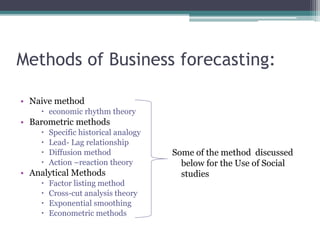
Methods of Business forecasting:
• Naive method
 economic rhythm theory
• Barometric methods
 Specific historical analogy
 Lead- Lag relationship
 Diffusion method
 Action –reaction theory
• Analytical Methods
 Factor listing method
 Cross-cut analysis theory
 Exponential smoothing
 Econometric methods
Some of the method discussed
below for the Use of Social
studies
Economic rhythm theory
• Manufactures analysis the time-series data of his
own firm and forecasts on the basis of
projections
• Applicable only for the individual firm for which
the data are analysed
• this method are not very reliable as no subjective
matters are being considered.
Diffusion method of Business
forecasting
• Principle that different factors, affecting
business, do not attain their peaks and troughs
simultaneously
• The convenience that one has not to identify
which series has a lead and which has a lag
• The diffusion index depicts the movement of
broad group of series as a whole without
bothering about the individual series.
Diffusion method of Business
forecasting
• The diffusion index shows the percentage of a
given set of series as expanding in a time period
• It should be carefully noted that the peaks and
troughs of diffusion index are not the peaks
troughs of the business cycles
• All series do not expand or contract concurrently
Diffusion method of Business
forecasting
• Hence if more than 50% are expanding at a
given time, it is taken that the business is in the
process of booming and vice - versa.
• The graphic method is usually employed to work
out the diffusion index
• .The diffusion index can be constructed for a
group of business variables like prices,
investments, profits etc.
Cross cut analysis theory of Business
forecasting:
• Thorough analysis of all the factors under
present situations has to be done and an
estimate of the composite effect of all the factors
is being made
• This method takes into account the views of
managerial staff, economists, consumers etc.
prior to the forecasting
• The forecast about the future state of the
business is made on the basis of overall
assessment of the effect of all the factors.
Forecasting

Forecasting

  • 1.
  • 2.
    Introduction • Time seriesdata is towards forecasting the likely value of variable in future. • The projection of trend fitted into the values regarding a variable over a sufficiently long period by any of the methods • Importance of forecasting in business and economic fields lies on account of its role in planning and evaluation
  • 3.
    Meaning • Forecasting isdifferent from predictions and projections • Regression analysis, time series analysis, Index numbers are some of the techniques through which the predictions and projections • Forecasting is a method of foretelling the course of business activity based on the analysis of past and present data mixed with the consideration of ensuring economic policies and circumstances
  • 4.
    Definition • According toT.S.Levis and R.A. Fox, “ Forecasting is using the knowledge we have at one time to estimate what will happen at some future movement of time”.
  • 5.
    Methods of Businessforecasting: • Naive method  economic rhythm theory • Barometric methods  Specific historical analogy  Lead- Lag relationship  Diffusion method  Action –reaction theory • Analytical Methods  Factor listing method  Cross-cut analysis theory  Exponential smoothing  Econometric methods Some of the method discussed below for the Use of Social studies
  • 6.
    Economic rhythm theory •Manufactures analysis the time-series data of his own firm and forecasts on the basis of projections • Applicable only for the individual firm for which the data are analysed • this method are not very reliable as no subjective matters are being considered.
  • 7.
    Diffusion method ofBusiness forecasting • Principle that different factors, affecting business, do not attain their peaks and troughs simultaneously • The convenience that one has not to identify which series has a lead and which has a lag • The diffusion index depicts the movement of broad group of series as a whole without bothering about the individual series.
  • 8.
    Diffusion method ofBusiness forecasting • The diffusion index shows the percentage of a given set of series as expanding in a time period • It should be carefully noted that the peaks and troughs of diffusion index are not the peaks troughs of the business cycles • All series do not expand or contract concurrently
  • 9.
    Diffusion method ofBusiness forecasting • Hence if more than 50% are expanding at a given time, it is taken that the business is in the process of booming and vice - versa. • The graphic method is usually employed to work out the diffusion index • .The diffusion index can be constructed for a group of business variables like prices, investments, profits etc.
  • 10.
    Cross cut analysistheory of Business forecasting: • Thorough analysis of all the factors under present situations has to be done and an estimate of the composite effect of all the factors is being made • This method takes into account the views of managerial staff, economists, consumers etc. prior to the forecasting • The forecast about the future state of the business is made on the basis of overall assessment of the effect of all the factors.