1
Introduction to Forecasting
2
In an manufacturing organization
Product is ready for full scale manufacturing.
What must be the next step?
3
Forecasting- The Primary function of operations
How much to Produce?
What is the number of product that can be
manufactured & sold in the market?
Thus we have to Forecast.
4
Importance of Forecast to an
organization
Produce without forecast:
1- No market for product
2-Big market for Product
1-It can influence the success or failure of any
organization.
2-It helps in planning activity and decision making
activity of any organization.
Many decision based on forecasting
5
Importance of Forecasting to supply
chain
It is very important as rest of the entire planning of your
supply chain depends on Forecasting.
Production- Aggregate Planning, inventory
Marketing- Sales force allocation, Promotions,
Finance – Plant investment, equipment
investment ,Budgeting
Forecasting actually provide input for all these
functions /activity.
6
Ex: Four wheeler Manufacturing, Hospital, Academic Institute,
Ac/Gyser etc.
Forecasting of 10000 Four wheeler in next six month
Tires
Steering
Seat covers
Gearbox etc.
Work force can produce only 8000 Four wheeler
Material planning
Financial planning
Resource planning
7
Forecast
Art
Science
Data Analysis
8
Accurate Forecast
Matching actual demand
Precise and Accurate
Very difficult
Mathematical tools
Previous data available
9
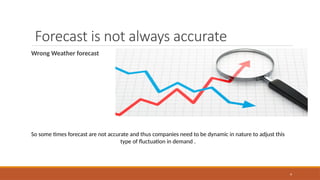
Forecast is not always accurate
Wrong Weather forecast
So some times forecast are not accurate and thus companies need to be dynamic in nature to adjust this
type of fluctuation in demand .
10
Thus forecast may be fairly accurate but we can not say that it will be absolutely accurate.
Persons who can make accurate forecast are precious.
If forecast = X
Actual demand = X ± Delta * X
Minimize Delta * X
11
Forecasting Definition
Forecast is the process of estimating the future demand in terms of quantity ,timing and location of
desired products and services .
Quantity
Timing
Location
Thus Forecasting is the process of estimating the future demand. Based on past demand information.
12
Forecast is a Magic Number
Material planning
Resource Planning
Production Planning
Aggregate Planning
Planning activity can be done well informed manner. Thus helps in overall planning and decision
making.
13
Importance of Forecasting is even more
relevant now a days
Due to reduce Product life cycle
Business environment is quite volatile
Technology is changing every now and then
Thus importance of forecasting is very high
14
Short term 0-3 months
Medium term 6 months to 18 months
Long term forecast more than that
15
A forecast is as good as the information included in the past
data
Relying on the past data
Previous data is very important.
So past data should not be confusing it should strongly related to what you expect to see in
future.
16
We need to check
What is past data
Whether it is relevant in today’s context
Can we use it to make forecasting
17
Can we predict the new e bike demand based on data on ICE bike?
1-HOW MUCH THE TWO MARKET HAVE IN COMMON?
2-IS THE CUSTOMER BASE SAME?
ONE CAN NOT USE ONE PARTICULAR PRODUCT DATA TO OTHER SPECIFIC PRODUCT.
Month Bike e-Bike
Jan 20k
Feb 15k
Mar 18k
April 14k
May 17k
So be very careful in the selection of data.
Because Market segment may be entirely
different Terms and condition may be entirely
different
Age wise segment
Type of customer focusing on bike may be
different
18
Characteristics of Forecast
They are usually wrong.
Aggregate forecasts are more accurate.
The longer the forecast horizon, the less accurate the forecast will be.
19
20
What should be consider when looking at past demand
data
Trends
Seasonality
Cyclical elements
Random variations
21
22
Methods of demand forecasting
Demand Forecasting
Qualitative Analysis Quantitative Analysis
Time Series Analysis Causal Analysis
Customer Survey Sales Force Composite
Executive
Opinion
Delphi
Method
Past Analogy
Simple Moving
Average
Trend Analysis
Simple
Exponential
Smoothing
Holt’s Double
Exponential
Smoothing
Winters’s Triple
Exponential
Smoothing
Forecast by Linear
Regression Analysis
Types of Demand Forecasting
23
Quantitative method
Quantitative forecasting methods (time series methods and regression). Using
objective(quantitative) forecasting methods, one makes forecasts based on past history.
Time series forecasting uses only the past history of the series to be forecasted, while
regression models often incorporate the past history of other series.
24
Quantitative method
1- Time series Model
Naïve approach
Moving average method
Exponential smoothing Method
2-Causal models
Trend projection
Linear regression Analysis
25
Naive approach
Quick and easy to use
Has no cost and easy to understand
The simplest way of forecast is to assume that forecast of demand in next period is equal to
the actual demand in the most recent period(i.e. current period).
Ex: Using yesterday’s sales as tomorrow’s sales forecast
They are so simple that they result in substantial forecast error
26
27
Techniques for averaging
Historical data contain a certain amount of random variation or noise. It is desirable to
completely remove any randomness from data and leave only real variations such as change in
demand.
Averaging techniques smooth fluctuations in a time series so that the forecast can be based on
an average , to exhibit less variability than the original data.
Moving Average
Exponential smoothing
28
Moving Averages
A moving average is used to smooth the trend in a time series.
It is the basic method used in measuring seasonal fluctuation.
To apply a moving average, the data needs to follow a fairly linear trend and
have a rhythmic pattern of fluctuations.
This is accomplished by “moving” the mean values through the time series.
29
Moving Average Example
The graph of sales fluctuates
but the moving average
removes the cyclical and
irregular fluctuations leaving
an upsloping trend line.
30
3- and 5-Year Moving Average Example
This is a table and graph of production numbers along with 3-year and 5-year
moving totals and moving averages. Note, moving averages do not always
result in a precise line.
31
A Weighted Moving Average Example
Cedar Fair operates eleven amusement parks, three outdoor water parks, one indoor water park, and
five hotels. Its combined attendance (in thousands) for the last 20 years is given in the following
table. A partner asks you to study the trend in attendance. Compute a three-year moving average
and a three-year weighted moving average with .2, .3, and .5 weights.
Here is the 3-
year moving
average.
32
A Weighted Moving Average Example
Continued
Notice the weighted moving average follows the data more closely than the
moving average.
33
34
35
36
37
38
39
Exponential function
Exponential functions have the form f(x) = bx
, where b > 0 and b ≠ 1. ... Where b is a constant
and x is a variable. An example of an exponential function is the growth of bacteria. Some
bacteria double every hour. If you start with 1 bacterium and it doubles every hour, you will
have 2x
bacteria after x hours. This can be written as f(x) = 2x
.
Exponential Growth
In Exponential Growth, the quantity
increases very slowly at first, and then
rapidly.
Exponential Decay
In Exponential Decay, the quantity
decreases very rapidly at first, and then
slowly
40
Difference between exponential and
moving average
Consider a system in which the demand for 300,000 inventory items is forecasted each month
using a 12-month moving average. The forecasting module alone requires saving 300,000 * 12 =
3,600,000 pieces of information.
If exponential smoothing were used, only 300,000 pieces of information need to be saved.
41
Exponentialsmoothing
Simple moving average and weighted moving average require a lot of data.
Exponential smoothing is based on the premise that the latest occurrence of data is more
indicative of the future than the past occurrence. this method gives exponentially decreasing
importance to older data and require very little data.
It is based the actual data of the previous period and smoothing constant alpha which lies
between zero and one. Exponential smoothing is the most commonly used forecasting
technique it is surprisingly accurate and easy to use.
42
Formula for Simple Exponential
smoothing
Forecast for period t = Forecast for period (t-1)+ alpha (Forecast error in period (t-1)
(At-1 - Ft-1 ) is the forecast error for period t-1
ALPHA is the smoothing parameter that defines the weighting and should be greater than 0 and less than 1.
43
The equation can also be written
The damping factor is a corrective factor that minimizes the instability of data collected
across a population. The default damping factor is 0.3.
44
45
46
Linear Trend
 The long-term trend of many business series, such as sales and production,
often approximates a straight line
47
Least Squares Method Example
The sales of Jensen Foods, a small grocery chain located in
southwest Texas, for 2012 through 2016 are in the table below.
Determine the regression equation. How much are sales increasing
each year? What is the sales forecast for 2018?
48
Methods for forecasting stationary time series. We consider two forecasting methods when the
underlying pattern of the series is stationary over time: moving averages and exponential
smoothing.
Methods for forecasting series with trend(Non stationary). When there is an upward or downward linear
trend in the data, two common forecasting methods are linear regression and double exponential
smoothing via Holt’s method.
49
Causal Models
Cause -Effect
Causal models such as linear regression ,
incorporate the variables or factors that
might influence the quantity being forecast.
Demand of sales forecast is dependent
variable and other factors that effect demand
are independent variables (causal variables).
In linear regression the dependent variable is
related to one or more independent variable
by a linear equation.
50
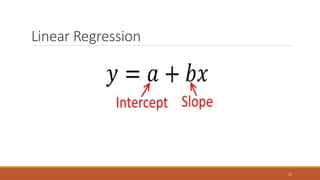
Linear Regression
A model which uses what is called the least square method to identify the relationship between
dependent variable and one or more independent variable that are present in his set of
historical observations.
In simple regression there is only one independent variable in multiple regression there is more
than one independent variable if the historical data set is time series the independent variable
is the time period.
51
Linear Regression
52
53
54
CPFR
55
56
57
◦
Thankyou

Unit 3 Demand forecasting operations.pptx

  • 1.
  • 2.
    2 In an manufacturingorganization Product is ready for full scale manufacturing. What must be the next step?
  • 3.
    3 Forecasting- The Primaryfunction of operations How much to Produce? What is the number of product that can be manufactured & sold in the market? Thus we have to Forecast.
  • 4.
    4 Importance of Forecastto an organization Produce without forecast: 1- No market for product 2-Big market for Product 1-It can influence the success or failure of any organization. 2-It helps in planning activity and decision making activity of any organization. Many decision based on forecasting
  • 5.
    5 Importance of Forecastingto supply chain It is very important as rest of the entire planning of your supply chain depends on Forecasting. Production- Aggregate Planning, inventory Marketing- Sales force allocation, Promotions, Finance – Plant investment, equipment investment ,Budgeting Forecasting actually provide input for all these functions /activity.
  • 6.
    6 Ex: Four wheelerManufacturing, Hospital, Academic Institute, Ac/Gyser etc. Forecasting of 10000 Four wheeler in next six month Tires Steering Seat covers Gearbox etc. Work force can produce only 8000 Four wheeler Material planning Financial planning Resource planning
  • 7.
  • 8.
    8 Accurate Forecast Matching actualdemand Precise and Accurate Very difficult Mathematical tools Previous data available
  • 9.
    9 Forecast is notalways accurate Wrong Weather forecast So some times forecast are not accurate and thus companies need to be dynamic in nature to adjust this type of fluctuation in demand .
  • 10.
    10 Thus forecast maybe fairly accurate but we can not say that it will be absolutely accurate. Persons who can make accurate forecast are precious. If forecast = X Actual demand = X ± Delta * X Minimize Delta * X
  • 11.
    11 Forecasting Definition Forecast isthe process of estimating the future demand in terms of quantity ,timing and location of desired products and services . Quantity Timing Location Thus Forecasting is the process of estimating the future demand. Based on past demand information.
  • 12.
    12 Forecast is aMagic Number Material planning Resource Planning Production Planning Aggregate Planning Planning activity can be done well informed manner. Thus helps in overall planning and decision making.
  • 13.
    13 Importance of Forecastingis even more relevant now a days Due to reduce Product life cycle Business environment is quite volatile Technology is changing every now and then Thus importance of forecasting is very high
  • 14.
    14 Short term 0-3months Medium term 6 months to 18 months Long term forecast more than that
  • 15.
    15 A forecast isas good as the information included in the past data Relying on the past data Previous data is very important. So past data should not be confusing it should strongly related to what you expect to see in future.
  • 16.
    16 We need tocheck What is past data Whether it is relevant in today’s context Can we use it to make forecasting
  • 17.
    17 Can we predictthe new e bike demand based on data on ICE bike? 1-HOW MUCH THE TWO MARKET HAVE IN COMMON? 2-IS THE CUSTOMER BASE SAME? ONE CAN NOT USE ONE PARTICULAR PRODUCT DATA TO OTHER SPECIFIC PRODUCT. Month Bike e-Bike Jan 20k Feb 15k Mar 18k April 14k May 17k So be very careful in the selection of data. Because Market segment may be entirely different Terms and condition may be entirely different Age wise segment Type of customer focusing on bike may be different
  • 18.
    18 Characteristics of Forecast Theyare usually wrong. Aggregate forecasts are more accurate. The longer the forecast horizon, the less accurate the forecast will be.
  • 19.
  • 20.
    20 What should beconsider when looking at past demand data Trends Seasonality Cyclical elements Random variations
  • 21.
  • 22.
    22 Methods of demandforecasting Demand Forecasting Qualitative Analysis Quantitative Analysis Time Series Analysis Causal Analysis Customer Survey Sales Force Composite Executive Opinion Delphi Method Past Analogy Simple Moving Average Trend Analysis Simple Exponential Smoothing Holt’s Double Exponential Smoothing Winters’s Triple Exponential Smoothing Forecast by Linear Regression Analysis Types of Demand Forecasting
  • 23.
    23 Quantitative method Quantitative forecastingmethods (time series methods and regression). Using objective(quantitative) forecasting methods, one makes forecasts based on past history. Time series forecasting uses only the past history of the series to be forecasted, while regression models often incorporate the past history of other series.
  • 24.
    24 Quantitative method 1- Timeseries Model Naïve approach Moving average method Exponential smoothing Method 2-Causal models Trend projection Linear regression Analysis
  • 25.
    25 Naive approach Quick andeasy to use Has no cost and easy to understand The simplest way of forecast is to assume that forecast of demand in next period is equal to the actual demand in the most recent period(i.e. current period). Ex: Using yesterday’s sales as tomorrow’s sales forecast They are so simple that they result in substantial forecast error
  • 26.
  • 27.
    27 Techniques for averaging Historicaldata contain a certain amount of random variation or noise. It is desirable to completely remove any randomness from data and leave only real variations such as change in demand. Averaging techniques smooth fluctuations in a time series so that the forecast can be based on an average , to exhibit less variability than the original data. Moving Average Exponential smoothing
  • 28.
    28 Moving Averages A movingaverage is used to smooth the trend in a time series. It is the basic method used in measuring seasonal fluctuation. To apply a moving average, the data needs to follow a fairly linear trend and have a rhythmic pattern of fluctuations. This is accomplished by “moving” the mean values through the time series.
  • 29.
    29 Moving Average Example Thegraph of sales fluctuates but the moving average removes the cyclical and irregular fluctuations leaving an upsloping trend line.
  • 30.
    30 3- and 5-YearMoving Average Example This is a table and graph of production numbers along with 3-year and 5-year moving totals and moving averages. Note, moving averages do not always result in a precise line.
  • 31.
    31 A Weighted MovingAverage Example Cedar Fair operates eleven amusement parks, three outdoor water parks, one indoor water park, and five hotels. Its combined attendance (in thousands) for the last 20 years is given in the following table. A partner asks you to study the trend in attendance. Compute a three-year moving average and a three-year weighted moving average with .2, .3, and .5 weights. Here is the 3- year moving average.
  • 32.
    32 A Weighted MovingAverage Example Continued Notice the weighted moving average follows the data more closely than the moving average.
  • 33.
  • 34.
  • 35.
  • 36.
  • 37.
  • 38.
  • 39.
    39 Exponential function Exponential functionshave the form f(x) = bx , where b > 0 and b ≠ 1. ... Where b is a constant and x is a variable. An example of an exponential function is the growth of bacteria. Some bacteria double every hour. If you start with 1 bacterium and it doubles every hour, you will have 2x bacteria after x hours. This can be written as f(x) = 2x . Exponential Growth In Exponential Growth, the quantity increases very slowly at first, and then rapidly. Exponential Decay In Exponential Decay, the quantity decreases very rapidly at first, and then slowly
  • 40.
    40 Difference between exponentialand moving average Consider a system in which the demand for 300,000 inventory items is forecasted each month using a 12-month moving average. The forecasting module alone requires saving 300,000 * 12 = 3,600,000 pieces of information. If exponential smoothing were used, only 300,000 pieces of information need to be saved.
  • 41.
    41 Exponentialsmoothing Simple moving averageand weighted moving average require a lot of data. Exponential smoothing is based on the premise that the latest occurrence of data is more indicative of the future than the past occurrence. this method gives exponentially decreasing importance to older data and require very little data. It is based the actual data of the previous period and smoothing constant alpha which lies between zero and one. Exponential smoothing is the most commonly used forecasting technique it is surprisingly accurate and easy to use.
  • 42.
    42 Formula for SimpleExponential smoothing Forecast for period t = Forecast for period (t-1)+ alpha (Forecast error in period (t-1) (At-1 - Ft-1 ) is the forecast error for period t-1 ALPHA is the smoothing parameter that defines the weighting and should be greater than 0 and less than 1.
  • 43.
    43 The equation canalso be written The damping factor is a corrective factor that minimizes the instability of data collected across a population. The default damping factor is 0.3.
  • 44.
  • 45.
  • 46.
    46 Linear Trend  Thelong-term trend of many business series, such as sales and production, often approximates a straight line
  • 47.
    47 Least Squares MethodExample The sales of Jensen Foods, a small grocery chain located in southwest Texas, for 2012 through 2016 are in the table below. Determine the regression equation. How much are sales increasing each year? What is the sales forecast for 2018?
  • 48.
    48 Methods for forecastingstationary time series. We consider two forecasting methods when the underlying pattern of the series is stationary over time: moving averages and exponential smoothing. Methods for forecasting series with trend(Non stationary). When there is an upward or downward linear trend in the data, two common forecasting methods are linear regression and double exponential smoothing via Holt’s method.
  • 49.
    49 Causal Models Cause -Effect Causalmodels such as linear regression , incorporate the variables or factors that might influence the quantity being forecast. Demand of sales forecast is dependent variable and other factors that effect demand are independent variables (causal variables). In linear regression the dependent variable is related to one or more independent variable by a linear equation.
  • 50.
    50 Linear Regression A modelwhich uses what is called the least square method to identify the relationship between dependent variable and one or more independent variable that are present in his set of historical observations. In simple regression there is only one independent variable in multiple regression there is more than one independent variable if the historical data set is time series the independent variable is the time period.
  • 51.
  • 52.
  • 53.
  • 54.
  • 55.
  • 56.
  • 57.

Editor's Notes

  • #28 First, we’ll work with moving averages examples that are not weighted and then we’ll look at an example of a moving average that is weighted. The weighted moving average assigns the most weight to more recent data and less weight to older data; in any case, the sum of the weights must equal 1.
  • #29 In this time series, the cycle repeats itself every 7 years and the amplitude for each cycle is 4, that is there are 4 units from the trough (lowest time period) to the peak. The seven-year moving average averages out the cyclical and the irregular fluctuations and the residual is the linear trend. First we determine the seven-year moving totals by totaling the first 7 years sales, $22 m and position that total opposite the middle value. Then drop off year 1 and add the remaining years to year 8 sales, that total is $23 mi and position that opposite the middle of that group of seven at year 5 and so on. After that, calculate the 7 year average by dividing each total by 7.
  • #30 Usually business and economic series do not have periods of oscillation of equal length or oscillations of equal amplitudes; therefore, the moving averages will not always result in a precise line. Here, both moving averages seem to adequately describe the trend in production since 1998.
  • #31 The three-year moving average is computed by taking three years at a time, summing the attendance numbers and dividing by 3. That means each year is given the same weight, 1/3. We’ll compute the three-year weighted moving average next.
  • #32 The three-year weighted moving average is computed by taking the first year’s attendance and multiplying by .2, then the second year’s attendance and multiplying by .3, and then the third year’s attendance and multiplying by .5; then sum those amounts and position at the middle year. Then move down one year and do the same and so on.
  • #46 The linear trend equation is "y"  ̂ = a + bt; "y"  ̂ is pronounced y hat, a is the Y-intercept, b is the slope of the line, and t is any value of time that is selected. A line is drawn in the chart to represent the typical trend of sales. Assume the company started business in 2008, the time period for that year was coded with a 1. Sales increased an average of $2m per year; sales increased from $3m in 2008 to $5m in 2009, $7m in 2010 and so on. Therefore, the slope of the line, b, is 2. Notice also the line intercepts the y-axis at $1m (when time =0).
  • #47 Time is the independent variable and the value of the time series (here, sales) is the dependent variable. If sales, production, or other data approximate a linear trend, the equation developed for the least squares technique can be used to forecast future values. In this example, 6.1 is the y-intercept and 1.3 is the slope of the line; so insert these values in the equation and solve for "y"  ̂ for all the years in the table. The data appear to follow a linear trend, so we can forecast future sales. Logically, we code 2018 as 7, and solve for "y"  ̂. Researchers suggest that we do not project more than n/2 time periods into the future.