“A STUDY ON TECHNICAL ANALYSIS OF S&PCNX NIFTY
INDEX IN INDIA”
1.1.

INTRODUCTION :

The most fascinating word amongst the investors around the world is to
invest in Indian Sensex and nifty because of its exuberant growth. India, which
is now the fourth largest economy in terms of purchasing power parity, will
overtake Japan and become third major economic power within 10 years.
Indian Economy experienced a GDP growth of 9.0 percent during 2005-06 to
9.4 percent during 2006-07. By 2025 the India's economy is projected to be
about 60 per cent the size of the US economy. Despite of this

glittering

feature we should not ignore the hidden side of the Indian economy. that is
India has the world's second largest labour force, with 509.3 million people,
60% of whom are employed in agriculture and related industries; 28% in
services and related industries; and 12% in industry. . The agricultural sector
accounts for 28% of GDP; the service and industrial sectors make up 54%
and 18% respectively. Among the service sectors stock market make more
contribution. we have 23 stock market among this two vital market that is
BSE(Bombay stock market) and NSE(National stock exchange) .The equity
market capitalization of the companies listed on the BSE was US$ 1.61 trillion,
making it the largest stock exchange in South Asia and the tenth largest in the
world. Equity market capitalization of the companies listed on the NSE was
US$ 1.46 trillion, making it the second largest stock exchange in [South
Asia].Which stand as a hub for the world investors, that is the reason why we
face lots of volatility in the market.

The interest in studying the movement of S&PCNX NIFTY Index
considerable momentum following the early study of Ms.Shalini Batia (2007)
Indicated that trader can profit from the discrepancy in the prices of NIFTY.
Mr.Saumitra N Bhaduri (2007) indicated hedging return gives better
performance in long time horizons only. Dr.Srinivas, S.S.Kumar (2005)
observed that the stock prices, on average increase and decrease significantly
on the effective day for the NIFTY Index. In this connection the researcher
would like to make on attempt to study on Technical Analysis on S&P CNX
NIFTY Index in India.

2
1.2.

ABOUT STOCK EXCHANGE :

The National Stock Exchange of India Limited (NSE) is a Mumbai-based
stock exchange. It is the largest stock exchange in India and the third largest
in the world in terms of volume of transactions. Though a number of other
exchanges exist, NSE and the Bombay Stock Exchange are the two most
significant stock exchanges in India, and between them are responsible for the
vast majority of share transactions.NSE is mutually-owned by a set of leading
financial institutions, banks, insurance companies and other financial
intermediaries in India but its ownership and management operate as
separate entities. As of 2006, the NSE VSAT terminals, 2799 in total, cover
more than 1500 cities across India. In October 2007, the equity market
capitalization of the companies listed on the NSE was US$ 1.46 trillion,
making it the second largest stock exchange in [[South Asia]. NSE is the third
largest Stock Exchange in the world in terms of the number of trades in
equities. It is the second fastest growing stock exchange in the world with a
recorded growth of 16.6

3
S&P CNX NIFTY:

It reflects the price movement of 50 stocks selected on the basis of
market capitalization and liquidity (Impact cost)

The base period selected for NIFTY index is the close of price on
November 3, 1995, which markets the completion of one year of operation of
MSE’s capital market segment. The base value of the Index has been set at
1000. It is a value weighted Index.

1.3.

SCOPE OF THE STUDY :

This study concerns with NIFTY Index only. Which is relates to National
Stock exchange. Scope of this study is not limited one because researcher
has taken five years price of the S&P CNX NIFTY Index for the purpose of this
study from 2003 to 2007. Especially researcher applied short term and long
term moving average to determine the movement of the price.

4
1.4.

IMPORTANCE OF THE STUDY :

In the broad sense this study is quite relevant to the present scenario
the share market face more volatile. Because of this investors have lost their
confidence due to more ups and down in the market. Further most of the
domestic investors are unfamiliar with most technique used in predicting stock
price hence finally they lost, their hard earned money. In this context this study
exclusively focused on simple means to predicting market movement. The
researcher has used SMA and LMA which is also useful to learn how the
market trend is moving.

5
1.5.

STATEMENT OF THE PROBLEM :

Globally, there are increased evidences to suggest that investor
confidence has assumed an important role in the economic development of a
country. The Economist (1998) indicated that a lost of issues need to be
addressed to make capital markets safer. David Bullard (1998) in Business
Times has indicated that the private investors are the big losers on listing
scars. Companies with no earning record and with inexperience directors got
listed on stock exchange. Their only objective is profit making out of inflated
market price.

HsienLoong (2000) while addressing financial institution In

Bangkok. Stressed the importance of economic co-operation among ASEAW
corporate restructuring Dr.K.Santh Swarup, a factors analysis indicates that
Investment decision are based on personal analysis than brokers advices also
current market price is a better investment indicator for investors than analysis
recommendations Joseph J.Oliver (2002) in his presentation to the senate
standing committee on banking trade and commerce suggested that
regulations the accounting professionals analysis brokerage firms, public
companies, share holders and government must ensure good corporate
governance and reduce the corporate failures. Dr.S.Janakiraman (2007)
observed that under pricing and delays in IPO’s in India are altering the price
in the market. Ms.Shali Bhatia (2007) futures Index leading the Spot Index by

6
10 to 25 minutes suggests that for a short period of time the prices, resulting
in arbitrage opportunities.

Dr.Asjeet lamb has indicates that Indian Market is influenced by the
large developed equity markets including the US, UK and Japan and that this
influenced strengthened during more recent time.

This study is based on strengthened the early studies. On the basis of
the empirical study researcher cited the following question in the mind.

1. Why the Investors lost their confident in investment
2. How a layman investor can under stand market trend
3. What factors makes market volatile.
4. How an investors has to determine to purchase or sale the
securities.

These are the questions are crack down in the mind of the researches
that takes him to make an attempt to study the technical analysis on S&P CNX
NIFTY Index.

7
1.6.

OBJECTIVES OF THE STUDY:

PRIMARY:
To study the price movement of S&P CNX NIFTY Index

SECONDARY:

•

To compare the price of S&P CNX NIFTY Index during the year 20032007.

•

1.7.

To analyse the SMA and LMA of S&P CNX NIFTY in India.

HYPOTHESIS :

1) H0 :

There is a significant relationship between GDP and S&P CNX
NIFTY Index

H1 :

There are no significant relationship between GDP and S&P CNX
NIFTY

2) H0 :

There is a significant relationship between Inflation and S&P
CNX NIFTY Index.

H1:

There are no significant relationship between Inflation and S&P
CNX NIFTY Index

8
1.8.

METHODOLOGY:
This study is based on the analytical research approach. The

researcher used the information already released by the NSE, that should be
taken into further critical evaluation.

1.9.

DATA :
This study is based on secondary method of data collection. Data have

been obtained from official website of National Stock exchange in India. The
researcher has collected only five years data from 2003-2007.

1.10. SAMPLE :
Non probability sampling techniques have been used in this research. In
which Judgement sampling method have observed. On this basis researcher
have selected 2003 to 2007 as sampling period for this research.

1.11. STATISTICAL TOOL :
Simple statistical tools have been employed for the study purpose like,
comparative analysis, trend analysis, moving average and short term and long
term moving average are used for this study. Further chi-square test and
correlation are employed for testing hypothesis.

9
1.12. PERIOD OF STUDY :

This study is conformed only the application of few technical analysis on
S&P CNX NIFTY during the period 2003-2007.

1.13. LIMITATION OF THE STUDY :

•

The Researcher has taken into account only last five years, he could
not concentrate rest of the years.

•

In sufficient time to get into deep study.

1.14. CHAPTER SCHEME :

CHAPTER I

-

Introduction

CHAPTER II

-

Review of Literature

CHAPTER III

-

Profile of NSE

CHAPTER IV

-

Analysis and Interpretation

CHAPTER V

-

Finding, Suggestion & Conclusion

10
CHAPTER – II
2.1. REVIEW OF LITERATURE IN INDIA

“A study reveals that there are various features in India which contribute
to the under-pricing and are unique by World standards. For one, the delay
from issue date to listing date is enormous in India when compared with other
countries. Among the other features are the ways the offer price is fixed and
the availability of information to lay investors. The offer price is chosen by the
firm months before the issue opens and a lack of feedback mechanism means
that there is no channel through which the market demand can alter the price.
Coupled with the fact that IPO’s”1

“According to study undertaken by Ms.SHALINI BHATIA has reveals
that the futures market leads the spot market has important implications for
arbitrageurs, who take offsetting positions in the two markets to earn assured
risk free returns. Futures index leading the spot index by 10 to 25 minutes
suggests that for a short period of time the prices in the two markets could be
out of line, resulting in profitable arbitrage opportunities. Traders can profit
from the discrepancy in the prices of Nifty futures and Nifty spot, provided they
can react quickly. An arbitrageur is required to complete both legs of an index
arbitrage transaction within a short time span. The prior knowledge of index
1

1.Dr. S. Janakiramanan Under-Pricing and long run performance of Initial Public Offerings in Indian Stock
Market, Dec 2007

11
futures leading the spot index could likely influence his decision as to which
market should he react in first, which leads to the initial trade in the futures
market.”2

“A study undertaken by Roa and Bose depicted that use the fuzzy logic
approach to model the subjective characteristics of human nature in the
decision making process involved in assessing the corporate governance risk.
Mamadani inference along with the Center of Area method of defuzzification
allowed taking into consideration even the slightest influence of a rule. Further
research would be needed to conclude the effect of various other fuzzy
operators, input aggregation operators, result aggregation operators and
defuzzification methods on the final rating”.3

“An amazing finding of Ms.SAUMITRA tries to give an overview of the
competing models in calculating optimal hedge ratio. The effectiveness of
these strategies is compared with mean returns and average variance
reduction with respect to the un hedged position. Daily data on NSE Stock
Index Futures and S&P CNX Nifty Index for the time period from 4 th
September 2000 to 4th August 2005 has been considered for developing the
optimal hedge ratio and the data from 5th August 2005 to 19th September 2005
2

Ms. Shalini Bhatia
Do the S&P CNX Nifty Index and Nifty Futures Really
Lead/Lag? Error Correction Model: A Cointegration Approach ,Nov 2007
3

Ms. Sadhalaxmi Rao and Mr Sumit Kumar Bose
A Fuzzy logic approach, May 2007

Evaluating Corporate Governance Risk:

12
has been considered for out of sample validation. The results clearly
establishes that the time varying hedge ratio derived from DVEC-GARCH
model gives a higher mean returns compared to other counterparts. On the
average variance reduction front the DVEC-GARCH model gives better
performance only in the long time horizons compared to the simple OLS
method that scores well in the short time horizons”4.

“The conclusion of G.P.SAMAMTHA is that a return series (which
possibly does not follow normal distribution) may first of all be transformed to
a

(near)

normal

variable

by

applying

suitable

transformations

to

normality/symmetry; required quantiles of this near-normal transformed
distribution would be estimated, and finally the value of the inverse function of
normality transformation at the estimated quantiles would produce required
quantiles for the original return and hence VaR for actual portfolio. Logically,
the performance of proposed strategy depends upon the efficiency of the
applied transformation to convert a non-normal distribution to a (near) normal
distribution. Unlike this, the efficiency of conventional strategies lie in their
capability in approximating unknown (true) distribution of portfolio return. The
performance of new VaR modelling strategy has been assessed with respect
to select stock price indices and exchange rates for Indian financial markets”5
4

Mr. Saumitra N Bhaduri / Mr. S. Raja Sethu Durai Optimal Hedge Ratio and
Hedging
Effectiveness of Stock Index Futures : Evidence from India, May
2007

5

Dr. G. P. Samantha

On The New Transformation-Based Approach To

13
“In a accordance with the study of MUKHERJEE it may not be feasible
to make any strong generalization on the possible lead-lag relationship among
the spot and futures market in India by looking at these results. Though our
evidence proves that new market information disseminates (may not be
equally) in both the spot and futures market and therefore serve an important
role in the matter of price discovery, they can get some more strong and
reliable results through investigating such relationship for a longer period of
time within which the problem (if any) of any periodic effect will be
disappeared. Apart from this, a comparison among the results of two longer
(at lease one year) periods – one period just after the onset of index futures,
and the other is for the recent period, can also exhibit whether there is any
change in the informational efficiency of the markets over a period of time.
Therefore, a further research in those lines can strongly focus whether there is
any real change in the informational efficiency of Indian cash market after the
introduction of derivative trading”6

“In this study is an effort to understand whether the ‘index effects’ documented
for the indices abroad happen for the Nifty and Jr. Nifty indices. They find that
Measuring Value-At-Risk: An Application To Forex Market In India, Jul 2006
6

Kedar Mukherjee / Dr. R. K. Mishra Lead-Lag relationship between Equities and
Stock Index Futures Market and its variation around Information Release: Empirical
Evidence from India, Jul 2006

14
the stock prices, on average, increase (decrease) significantly on the effective
day for the Nifty index and no such effects were observed for Jr. Nifty index.
The prices revert after around a week’s time both for additions as well as for
elections. But no abnormal volumes were detected around the effective day.
Since no such reactions were observed for Jr. Nifty revisions we can possibly
doubt the certification effect and no significant changes in the liquidity were
observed. So they can’t attribute the price reactions to the expected increase
in liquidity”7

In the conclusion of Dr.BIDISHA & JAIN is that

“For the first time, the

bid ask spread for stocks trading on the NSE, India. This allows, for the first
time, to compare the frictions to trading in an emerging market like India to the
developed western securities markets. They find that average (rupee) spread
for all stocks listed on the NSE is 2.17, which is about 3.2% of the average
price. This is much larger than the average percentage spreads observed for
NYSE and NASDAQ stocks. Comparing this to the tick size of Rs. 0.05 (same
across all stocks as per NSE regulations), the spread to tick ratio is 43.4,
which is also large by international standards. Variables that affect the bid-ask
spread, viz. trading volume, market capitalization and share price all show
extremely (right) skewed distributions”8
7

Dr. Srinivas S S Kumar
Dec 2005

8

Dr. Bidisha Chakrabarty & Dr. Pankaj Jain
Indian Markets, Aug 2005

Price and Volume Effects of S&P CNX Nifty Index Reorganization,

Understanding the Microstructure in

15
“According to the study conducted By BADRINATH is reveals that “The
increasing integration of financial markets over the years has led to greater
movement of funds between these markets and also to return and volatility
spillovers. In this study, they have examined the stock market, the foreign
exchange market and the call money market in India for evidence of volatility
spillovers using multivariate EGARCH models which facilitate the study of
asymmetric responses. The results indicate the existence of asymmetric
volatility spillovers across these markets. The results also indicate that either
the information assimilation across markets was slow or that the spillovers
were on account of contagion”9

According to the study conducted SUBBA REDDY has reveals that
“Analysis of determinants of operating performance for debt and equity
seasoned issuers shows that free cash flow has positive impact on the change
in adjusted operating cash flow for both debt and equity issuers following the
seasoned issue, though only coefficients for equity issuers are statistically
significant. Performance run up prior to seasoned offering has negative impact
on the operating performance of equity issuers in the long run. These findings
are consistent with McLaughlin, Safieddine and Vasudevan (1998).

9

H.R. Badrinath & Prakash G. Apte
Volatility Spillovers Across Stock, Call
Money And Foreign Exchange Markets, Aug 2005

16
Analysis of earnings management as proxied by discretionary component of
current accruals shows a significant negative impact “10

“Is the Findings of shows KSHAMA that index funds can effectively use
the index futures market to reduce tracking error arising out of buffer cash and
delays in dividend receipts. Due to basis risk of the index futures, funds would
not be able to obtain perfect replication and zero tracking error. Impact costs
and rollover costs would also reduce the effectiveness of the futures
implementation strategy. However, as against taking no action and suffering
tracking error, the benefits of using this strategy are clearly evident”11

“A Study reveal that, The fact that skimming and underreporting of
income was a common practice with separate sets of accounting systems
maintained to hide this finds credence in the literature. Some of this is
anecdotal and circumstantial in nature but generally accepted. Limited
empirical support is also available in case of large business groups where
tunneling of profits was observed (Bertrand et al 1999). The magnitude of
underreporting of corporate incomes can be gauged from the following figures.
According to Dutta (1997) in 1987-88, there were 40.302 taxable private
10

Dr. Y. Subba Reddy
Seasoned Capital Offerings: Earnings Management and
Long-Run Operating Performance of Indian Firms, Sep 2004

11

Ms. Kshama Fernandes
2004

Improving Index Fund Implementation in India, Jul

17
sector companies with profits of Rs.2317 Crore28 and a tax liability of Rs 1219
Crore. Of these, only 2440 companies declared taxable profits of over Rs. 10
lakh, with a total profit of Rs 1934 Crore. The remaining 37,862 companies
declared a total profit of Rs. 383 Crore with an average tax liability of just Rs.
56,500 per company. Taxable corporate profits according to a constant 1988
rupee rose from Rs. 2641 Crore in 1961-62 to Rs. 4235 Crore in 1966-67, and
have plummeted to Rs. 2317 Crore in 1987-88 (Dutta, 1997).”12
“In this paper we have defined corporate governance as a mechanism
for allocating resources efficiently in order to maximize social welfare. We
have shown that welfare costs are high if assets are not fairly priced.
Mispricing has been linked to corporate governance with an assumption that
most of the mispricing in the stock market is attributed to the information
disseminators or the corporate entities. We have devised a method to
measure mispricing during corporate announcements using DHS (1998)
theoretical framework. We find that mispricing is low on an average for good
governance companies compared to bad governance companies. Stock
prices of good governance companies are closer to their intrinsic value
compared

to

bad

governance

companies.

However,

during

event

announcement periods, the results do not hold. We find that good governance
companies are highly mispriced during event announcements. We also find
12

Dr. B. V. Phani , Mr. V. N. Reddy,N.Ramachandran & Asish K Bhattacharyya
Insider Ownership , Corporate Governance and Corporate Performance, Jul 2004

18
that mis pricing varies based on the nature of event. Good governance
companies are highly overpriced during sale of assets and preferential
allotment events. On the other hand, bad governance companies are highly
under priced for the same events. The level of over/under pricing is not that
high for merger/takeover and dividend announcements. In support of this
evidence, we find that there is more private information before the
announcement of sale of assets and preferential allotment events for good
governance companies. We also find returns calculate with varying durations
will have a significant effect on the overall results. The volatility in the private
information period during sale of assets period is higher for good governance
companies. Thus, sale of assets, which is not a widely addressed event in the
literature, is an important event while measuring corporate governance. “13

13

Dr. Vijaya B Marisetty & Dr. Vedpuriswar A V Corporate Governance and Market
reactions- Mar 2004

19
2.2

Review of Literature in Abroad

“In the study of Susanne Leitterstorf,,Petronilla Nicolett,Christian
Winkler (2008) set out to explore whether super-equivalent Listing Rules,
which go beyond the requirements of EU Directives, can contribute to firm
valuation relative to the rules which apply to the AIM market, and whether
firms should be given a choice between different listing standards. Our aim
was to exploit data on changes in firm valuation following announcements of a
transfer between the LSE’s Main Market and AIM to draw conclusions about
the effects of the super-equivalent Listing Rules applicable on the Main Market
and the merits of granting issuers a choice between the different regulatory
regimes applicable on the Main Market and AIM. We find that firms that only
announce a transfer between markets do not experience any statistically or
economically significant abnormal returns. We observe abnormal returns only
for firms that announce equity issuance alongside their decision to transfer to
another market – positive returns for those switching from Aim to the Main
Market and negative for those switching the other way.

We cannot conclude from our results that the higher regulatory
standards on the Main Market do not affect the valuation of the many larger
issuers which would not contemplate switching regimes. However, for most of
the firms our study focuses on, the differences in regulation between the Main

20
Market and AIM do not appear to be a significant factor driving valuation or at
least not one which we can isolate empirically. Expectations about future
growth appear to matter more, at least for firms announcing an impending
equity issues alongside with their intention to transfer between markets. The
FSA is keen to promote academic research into issues of direct relevance to
its objectives. We welcome comments and questions from the academic
community that may further understanding of the issues discussed in this
paper. On the basis of comments we can make appropriate modifications to
this paper.”14

“In the study Sarah Smith concludes that the introduction posed three
questions:
• What drives persistency rates among different groups in the population?
• To what extent does non-persistency reflect poor sales and advice, rather
than unpredictable events in consumers’ lives that could not have been
anticipated at the time of sale?
• Are there any messages that could be given to providers, advisers or
consumers to help improve levels of persistency?

Of course, persistency is the outcome of consumers’ changing
circumstances and the sales and advice process, as well as the changing
14

Susanne Leitterstorf,,Petronilla Nicolett,Christian Winkler
2008 page-43

The UK Listing Rules and Firm ValuationApril

21
market for financial products. It is not always possible to draw a neat dividing
line between the different causes of lapses, but a number of preliminary
conclusions do emerge from the analysis of the BHPS and aggregate
persistency data. Approximately one-quarter of cases of lapses in personal
pensions appear to be related to changes in consumers’ financial
circumstances29. In 7% of cases, lapses appear to have been caused by a
change in marital or family circumstances. Some of these changes in family
and economic circumstances may be anticipated, in other cases they may be
hard to predict. Of possibly greater concern is that, in at least a further onequarter of cases of lapse, the individual reported financial difficulties at the
time they started making contributions, suggesting that the policy may have
been unaffordable at the time it was sold. The aggregate persistency data
reveal interesting differences in persistency rates across different products
and between the two main distribution channels. A key issue is whether there
is systematic variation by duration. Diacon and O’Brien’s argument would
suggest that higher lapse rates in year one indicate a sales/ advice effect. On
average (ie across all products and channels) lapse rates in the second and
subsequent years are not significantly different from those in the first year, but
they are lower in the tied channel and for pensions. With the introduction of
more flexible stakeholder products, the penalty for consumers of lapsing on a
long-term savings product is far less.”15
15

Sarah Smith, Stopping short: why do so many consumers stop contributing to long-term
savings policies? January 2004,Page32,OP21

22
“We have developed what we hope is an intuitively simple measure of
market cleanliness. We also believe it is a useful measure. The measure was
developed following detailed consideration of alternative approaches, the full
details of which are not presented in this paper. For example, we considered
several ways of identifying those announcements which contain the most
significant news. We believe our approach avoids subjectivity involved in
reading and classifying announcements based on our own interpretation of the
information in those announcements. Our approach also avoids problems
associated with the overall increase in the number of announcements which
appears to have taken place in recent years. We welcome any comments
from interested parties on the methodology or results presented in this paper.
Measuring market cleanliness Analysis of this measure before and after the
introduction of FSMA in 2001 does not suggest that the level of insider trading
has fallen. Evidence from previous studies suggests that this could reflect the
fact that the first prosecutions under the new rules did not occur until 2004. It
may also be relevant that the fines imposed in those cases were relatively
small. The amount of work required to perform again the analysis in this paper
is minimal, as data on announcements and stock prices is easily available in
electronic form and we expect to continue to monitor this measure in future.”16
“In accordance with the study of Isaac Alfon,Isabel Argimon, have
argued that the amount of capital held by banks and building societies
16

Ben Dubow,Nuno Monteiro OP23 Measuring market cleanliness ,March 2006,Page26

23
depends on risk management, market discipline and regulatory environment.
Using both quantitative and qualitative approaches, we provide evidence on
which hypotheses hold in the UK. In particular, we analyzed prudential returns
for UK banks and building societies and the responses to a questionnaire sent
to a sample of firms that we later interviewed. Our findings are in line with the
results obtained with data from other countries (Ayuso et al. (2004) and
Lindquist (2004)). Even though all firms have a buffer over individual capital
requirements, our analysis indicates that changes in these individual capital
requirements are very likely to be accompanied by some response in the
capital ratio. For example, if a bank (building society) which is holding capital
at 15% of risk weighted assets has its individual required capital ratio
increased from 10% to 11%, it would on average increase its actual capital
ratio to 15.6% (15.4%). Our evidence indicates that the dependency of capital
ratios on capital requirements is somewhat greater for firms operating close to
their regulatory requirements than for those that hold a large amount of
excess capital. As the firms with smaller capital buffers are generally the
larger banks, it could be argued that capital policy changes introduced by the
regulator will affect large banks more than smaller ones. The firm’s degree of
risk aversion will determine the final impact. Adjustment costs affect the
amount that firms hold. They seem to be marginally larger for building
societies than for banks, maybe because of the formers’ limited access to
capital markets. Firms say that the difference between actual and desired

24
capital is mainly determined by the costs of raising further capital and by
provision for unexpected events in the economy and in the firm. We find that
the economic cycle is negatively associated with capital ratios, at least for
banks. Firms also say that their desired capital is mainly determined by the
need to finance their long term business strategy. Risk appetite and risk
management help determine capital holdings. Perhaps surprisingly, portfolios
with a higher proportion of assets falling into the high risk group category (in
our case, 100% weighted assets) are associated with lower capital ratios, a
result also obtained by Lindquist (2004).”17

“In the study of Malcolm Cook and Paul Johnson, Choosing the most
cost efficient and tax efficient way to save is a complex process. Yet the
pension policy, and increasingly the welfare policy generally, of successive
Governments have been built around the assumption that people must make
that choice. Governments have been particularly keen that people should
choose to save through a pension because only that provides the security (to
the government as well as to the individual) of an income in retirement. Saving
through a pension, though, means tying up one’s money for a long period. The
government must therefore provide incentives so that people can obtain a
better return from pension saving than from competing but more flexible
Isaac Alfon,Isabel Argimon,Patricia Bascuñana-Ambrós What determines how much
capital is held by UK banks and building societies?, July 2004,Page-32-33
17

25
savings products. The present approach of giving more generous tax
treatment to the pension lump sum at retirement than to pension income is
inconsistent with the aim of trying to encourage people to provide themselves
with an adequate income in retirement. Yet it is the existence of the tax free
lump sum that gives pensions their tax advantage over other products
currently available. However, this advantage is often more than offset
by charges, especially for basic rate taxpayers who stop contributing early on.
Indeed, for basic rate taxpayers the value of the additional tax relief is not very
substantial in itself. If there were no differences in charges, basic rate
taxpayers would only need to be willing to pay an extra 7% for the very
substantial flexibility of a CAT-standard ISA in order to make that the more
worthwhile choice. For an average level of contribution, the difference
between the charges on the median personal pension and those on a CATstandard ISA broadly cancel out the tax advantages of the former, even when
contributions are paid until retirement. For higher rate taxpayers, especially
those who expect to pay tax at the basic rate during retirement, the pension
tax relief is much more valuable. Given that the tax system itself is probably
an inadequate incentive for many people to save in a pension, the steps that
the government has taken in introducing stakeholder pensions with tightly
defined charging criteria could potentially be an important step in increasing
the relative attractiveness of pension saving. The announcement of the
stakeholder proposals has already caused many of the more expensive

26
providers to give better value when contributions are stopped early. But
whether stakeholder pensions will provide enough incentive for those who do
not want to save remains open to question”18

“Isaac Alfon and Peter Andrews study observed that the central
problem of CBA is to identify extremely complex (and to an extent
unknowable) interactions within an economy and reduce them to a set of
propositions that are simple enough to be readily understood and yet realistic
enough to be useful. Thus a successful CBA might be rather like an
impressionist painting – much less detailed than a photograph but much more
recognisable than an abstract image would be. The FSA is starting to use
CBA to help to deliver its objectives in the manner required by the draft FSMB.
The FSA’s CBA arrangements, described above, are intended to build on and
enhance the SIB’s initiative by making CBA an intrinsic part of the policy
making process. This reflects both the FSA’s own commitment to making
regulation cost-effective and the increased emphasis on CBA in the FSMB
compared with previous UK legislation on the regulation of financial services.
It is too early to determine exactly how successful all this will be but there are
grounds for optimism: the FSA’s approach is a pragmatic comparison of
regulatory options; it is reasonable to suppose that explicit analysis of the
18

Malcolm Cook and Paul Johnson,Saving for RetirementHow taxes and charges affect choice, May

2000,page-30.

27
likely impacts (costs and benefits) of proposed interventions in markets will
enable the FSA to formulate more proportionate measures than would
otherwise be the case; and there are already examples, some of which are
mentioned in this paper, of CBA providing the information needed to
determine and demonstrate whether or not specific policy options are likely to
be cost-effective. The FSA also plans to undertake specific projects, as part of
its work on the economics of financial regulation, to assess the overall costs
and benefits of financial regulation. In the longer term, it might be possible to
identify the genuinely incremental costs and benefits of the overlapping layers
of regulation and determine which layers are cost-effective and which of them
contribute little to correcting the market failures that exist in UK financial
services.”19

“According to the conclusion Clive Briault of The UK has not been
alone in establishing a single national financial services regulator. This
international trend has reflected in particular the increasing number of
institutions undertaking a range of different financial activities, the potential
economies of scale and scope from combining regulatory responsibilities
within one or two financial regulatory bodies, and a reappraisal in some
countries of the allocation of – and the accountability for – monetary stability,
19

Isaac Alfon and Peter Andrews, Cost-Benefit Analysis in Financial Regulation, How to do it and how it adds
value, September 1999,Page-25

28
financial stability and micro-regulatory responsibilities. This paper has set out
the theoretical advantages of a single national financial services regulator and
the way in which, in the UK in particular, these advantages can be delivered in
practice, while minimizing as far as possible any potential downsides from
such an approach. Good hart et al (1998, page 181) may well be correct in
stating that “there is no universal ideal model”, not least because financial
markets have developed – and will continue to develop – differently in different
countries. But, overall, a single national financial services regulator, covering a
broad range of financial services activities and spanning both prudential and
conduct of business regulation, is likely to be well placed to deliver effective,
efficient

and

properly

differentiated

regulation

in

today’s

financial

environment.”20

“In the study of David Llewellyn point was that regulators are to be
viewed as supplying regulatory, monitoring and supervisory services for which
there is an evident consumer demand. The analysis of the rationale for
financial regulation suggests that the major potential benefits of efficiently
framed regulation are derived through six main routes:

(1) reduced transactions costs for consumers (e.g. information and monitoring

20

Clive Briault,The Rationale for a Single National Financial Services Regulator May 1999,Page-34

29
costs) to the extent that these are not offset by higher transactions costs of
firms and the regulatory agency;
(2) Efficiency gains through ameliorating market breakdown or grid lock;
(3) enhanced consumer confidence;
(4) The possible generation of positive externalities;
(5) Efficient authorization procedures which remove hazardous (solvency and
conduct of business) firms from the market; and
(6) Enforced disclosure which enhances the ability of consumers to make
informed judgements, and increases the transparency of contracts.

While the rationale for regulation has been outlined, and there is an
evident consumer demand for regulation, this does not mean that optimum
regulation has no bounds. There is a cost to regulation and, in one way or
another, the consumer pays the cost. Regulation is necessarily about tradeoffs and making judgements, particularly when considering costs and benefits.
If the potential for ‘over-regulation’ is to be avoided, it needs to be firmly
grounded on a clear basis of the rationale for regulation. The concept of
‘protecting the consumer’ is largely protection against the costs of externalities
and other market imperfections and failures. For all these reasons, occasional
regulatory lapses and failures are to be regarded as the necessary cost of
devising an effective, efficient and economic system of regulation. A degree of
regulatory intensity that removed all possibility of failure would certainly be

30
excessive, in that the costs would outweigh the benefits. We must also
consider a particular moral hazard of regulation. When a regulatory or
supervisory agency is created and establishes regulatory requirements on
financial firms, a danger arises that an ‘implicit contract’ is perceived as having
been created between the consumer and the regulator. This may arise
because the consumer assumes that, because there is an authorisation
procedure, specific regulatory requirements are established, and the suppliers
of financial services are authorised and supervised, institutions must
necessarily be safe. The moral hazard is that this ‘implicit contract’ creates the
impression that the consumer need not take care with respect to the firms with
which she deals in financial services or that, if something goes wrong,
compensation will automatically be paid. There are distinct limits to what
regulation and supervision can achieve in practice. There is no viable
alternative to placing the main responsibility for risk management and
compliant behaviour on the shoulders of the management of financial
institutions.”21

The present study defers from the early study of both domestic
country and aboard .In this study researchers has to concentrate S&P CNX
NIFTY in India which would be helpful to apply preliminary techniques to find

21

David Llewellyn,The Economic Rationale for Financial Regulation, April 1999,Page-50

31
the trend of the stock market in India which is greatly helpful to the layman
investors and non institutional investors in India

In this paper, I conduct a detailed, large sample analysis of the dynamic
relationships between the South Asian markets of India, Pakistan and Sri
Lanka and the major developed markets during July 1997 -February 2003.
Using a multivariate co integration framework and vector error-correction
modeling I find that the Indian market is influenced by the large developed
equity markets including the US, UK and Japan and that this influence has
strengthened during the more recent time period of January 2000 -February
2003. In addition, I do not find that the Indian market exerts any significant
influence on the

Pakistani and Sri Lankan markets. For Pakistan and Sri

Lanka I find that these markets are relatively “22

CHAPTER – III
22

Dr. Asjeet S Lamba An Analysis of the Dynamic Relationships Between South
Asian and Developed Equity Markets, 31 Jan 2004

32
3.1

About the National Stock Exchange of India:

In the fast growing Indian financial market, there are 23 stock
exchanges trading securities. The National Stock Exchange of India (NSE)
situated in Mumbai - is the largest and most advanced exchange with 1016
companies listed and 726 trading members.

The NSE is owned by the group of leading financial institutions such as
Indian Bank or Life Insurance Corporation of India. However, in the totally
de-mutualised Exchange, the ownership as well as the management does not
have a right to trade on the Exchange. Only qualified traders can be involved
in the securities trading.

The NSE is one of the few exchanges in the world trading all types of
securities on a single platform, which is divided into three segments:
Wholesale Debt Market (WDM), Capital Market (CM), and Futures & Options
(F&O) Market. Each segment has experienced a significant growth throughout
a few years of their launch. While the WDM segment has accumulated the
annual growth of over 36% since its opening in 1994, the CM segment has
increased by even 61% during the same period.

33
The National Stock Exchange of India has stringent requirements and
criteria for the companies listed on the Exchange. Minimum capital
requirements, project appraisal, and company's track record are just a few of
the criteria. In addition, listed companies pay variable listing fees based on
their corporate capital size.

The National Stock Exchange of India Ltd. provides its clients with a
single, fully electronic trading platform that is operated through a VSAT
network. Unlike most world exchanges, the NSE uses the satellite
communication system that connects traders from 345 Indian cities. The
advanced technologies enable unto 6 million trades to be operated daily on
the NSE trading platform.
3.2

History of the National Stock Exchange of India:

Capital market reforms in India and the launch of the Securities and
Exchange Board of India (SEBI) accelerated the incorporation of the second
Indian stock exchange called the National Stock Exchange (NSE) in 1992.
After a few years of operations, the NSE has become the largest stock
exchange in India.

34
Three segments of the NSE trading platform were established one after
another. The Wholesale Debt Market (WDM) commenced operations in June
1994 and the Capital Market (CM) segment was opened at the end of 1994.
Finally, the Futures and Options segment began operating in 2000. Today the
NSE takes the 14th position in the top 40 futures exchanges in the world.

In 1996, the National Stock Exchange of India launched S&P CNX Nifty
and CNX Junior Indices that make up 100 most liquid stocks in India. CNX
Nifty is a diversified index of 50 stocks from 25 different economy sectors. The
Indices are owned and managed by India Index Services and Products Ltd
(IISL) that has a consulting and licensing agreement with Standard & Poor's.

In 1998, the National Stock Exchange of India launched its web-site and
was the first exchange in India that started trading stock on the Internet in
2000. The NSE has also proved its leadership in the Indian financial market by
gaining many awards such as 'Best IT Usage Award' by Computer Society in
India (in 1996 and 1997) and CHIP Web Award by CHIP magazine (1999).

35
3.4

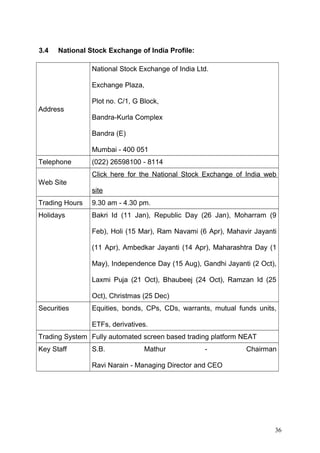
National Stock Exchange of India Profile:
National Stock Exchange of India Ltd.
Exchange Plaza,
Plot no. C/1, G Block,

Address
Bandra-Kurla Complex
Bandra (E)
Mumbai - 400 051
Telephone

(022) 26598100 - 8114
Click here for the National Stock Exchange of India web

Web Site
site
Trading Hours

9.30 am - 4.30 pm.

Holidays

Bakri Id (11 Jan), Republic Day (26 Jan), Moharram (9
Feb), Holi (15 Mar), Ram Navami (6 Apr), Mahavir Jayanti
(11 Apr), Ambedkar Jayanti (14 Apr), Maharashtra Day (1
May), Independence Day (15 Aug), Gandhi Jayanti (2 Oct),
Laxmi Puja (21 Oct), Bhaubeej (24 Oct), Ramzan Id (25
Oct), Christmas (25 Dec)

Securities

Equities, bonds, CPs, CDs, warrants, mutual funds units,
ETFs, derivatives.

Trading System Fully automated screen based trading platform NEAT
Key Staff

S.B.

Mathur

-

Chairman

Ravi Narain - Managing Director and CEO

36
The National Stock Exchange of India Limited (NSE), is a Mumbaibased stock exchange. It is the largest stock exchange in India in terms daily
turnover and number of trades, for both equities and derivative trading.
Though a number of other exchanges exist, NSE and the Bombay Stock
Exchange are the two most significant stock exchanges in India and between
them are responsible for the vast majority of share transactions.

•

NSE is mutually-owned by a set of leading financial institutions, banks,
insurance companies and other financial intermediaries in India but its
ownership and management operate as separate entities [. As of 2006, the
NSE VSAT terminals, 2799 in total, cover more than 1500 cities across
India . In October 2007, the equity market capitalization of the companies
listed on the NSE was US$ 1.46 trillion, making it the second largest stock
exchange in South Asia. NSE is the third largest Stock Exchange in the
world in terms of the number of trades in equities is the second fastest
growing stock exchange in the world with a recorded growth of 16.6%.

37
3.5

Innovations

NSE has remained in the forefront of modernization of India's capital and
financial markets, and its pioneering efforts include:
•

Being the first national, anonymous, electronic limit order book (LOB)
exchange to trade securities in India. Since the success of the NSE,
existent market and new market structures have followed the "NSE"
model.

•

Setting up the first clearing corporation "National Securities Clearing
Corporation Ltd." in India. NSCCL was a landmark in providing
innovation on all spot equity market (and later, derivatives market)
trades in India.

•

Co-promoting and setting up of National Securities Depository Limited,
first depository in India.

•

Setting up of S&P CNX Nifty.

•

NSE pioneered commencement of Internet Trading in February 2000,
which led to the wide popularization of the NSE in the broker
community.

•

Being the first exchange that, in 1996, proposed exchange traded
derivatives, particularly on an equity index, in India. After four years of
policy and regulatory debate and formulation, the NSE was permitted to
start trading equity derivatives

38
•

Being the first and the only exchange to trade GOLD ETFs (exchange
traded funds) in India.

•

NSE has also launched the NSE-CNBC-TV18 media centre in
association with CNBC-TV18, a leading business news channel in India.

3.6

The Standard & Poor's CRISIL NSE Index 50 or S&P CNX

Nifty nicknamed Nifty 50 or simply Nifty (NSE: ^NSEI), is the leading index for
large companies on the National Stock Exchange of India. The Nifty is a well
diversified 50 stock index accounting for 21 sectors of the economy. It is used
for a variety of purposes such as benchmarking fund portfolios, index based
derivatives and index funds.

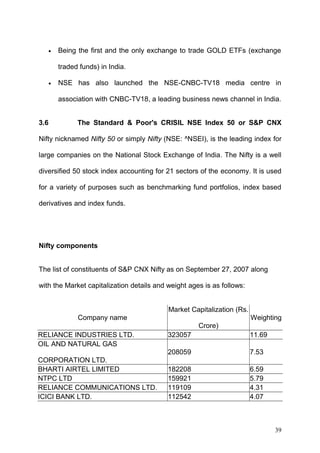
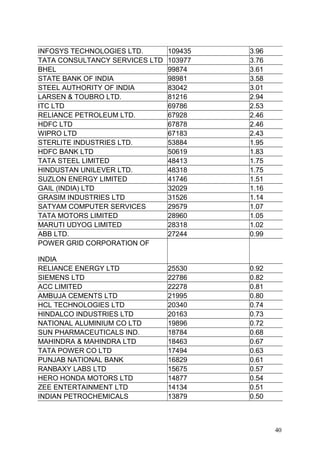
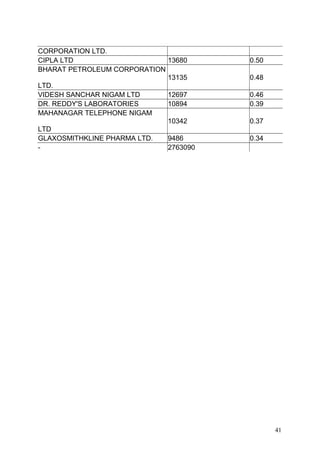
Nifty components
The list of constituents of S&P CNX Nifty as on September 27, 2007 along
with the Market capitalization details and weight ages is as follows:
Market Capitalization (Rs.
Company name

Weighting
Crore)

RELIANCE INDUSTRIES LTD.
OIL AND NATURAL GAS

11.69

208059
CORPORATION LTD.
BHARTI AIRTEL LIMITED
NTPC LTD
RELIANCE COMMUNICATIONS LTD.
ICICI BANK LTD.

323057

7.53

182208
159921
119109
112542

6.59
5.79
4.31
4.07

39
INFOSYS TECHNOLOGIES LTD.
TATA CONSULTANCY SERVICES LTD
BHEL
STATE BANK OF INDIA
STEEL AUTHORITY OF INDIA
LARSEN & TOUBRO LTD.
ITC LTD
RELIANCE PETROLEUM LTD.
HDFC LTD
WIPRO LTD
STERLITE INDUSTRIES LTD.
HDFC BANK LTD
TATA STEEL LIMITED
HINDUSTAN UNILEVER LTD.
SUZLON ENERGY LIMITED
GAIL (INDIA) LTD
GRASIM INDUSTRIES LTD
SATYAM COMPUTER SERVICES
TATA MOTORS LIMITED
MARUTI UDYOG LIMITED
ABB LTD.
POWER GRID CORPORATION OF
INDIA
RELIANCE ENERGY LTD
SIEMENS LTD
ACC LIMITED
AMBUJA CEMENTS LTD
HCL TECHNOLOGIES LTD
HINDALCO INDUSTRIES LTD
NATIONAL ALUMINIUM CO LTD
SUN PHARMACEUTICALS IND.
MAHINDRA & MAHINDRA LTD
TATA POWER CO LTD
PUNJAB NATIONAL BANK
RANBAXY LABS LTD
HERO HONDA MOTORS LTD
ZEE ENTERTAINMENT LTD
INDIAN PETROCHEMICALS

109435
103977
99874
98981
83042
81216
69786
67928
67878
67183
53884
50619
48413
48318
41746
32029
31526
29579
28960
28318
27244

3.96
3.76
3.61
3.58
3.01
2.94
2.53
2.46
2.46
2.43
1.95
1.83
1.75
1.75
1.51
1.16
1.14
1.07
1.05
1.02
0.99

25530
22786
22278
21995
20340
20163
19896
18784
18463
17494
16829
15675
14877
14134
13879

0.92
0.82
0.81
0.80
0.74
0.73
0.72
0.68
0.67
0.63
0.61
0.57
0.54
0.51
0.50

40
CORPORATION LTD.
CIPLA LTD
13680
BHARAT PETROLEUM CORPORATION
13135
LTD.
VIDESH SANCHAR NIGAM LTD
12697
DR. REDDY'S LABORATORIES
10894
MAHANAGAR TELEPHONE NIGAM
10342
LTD
GLAXOSMITHKLINE PHARMA LTD.
9486
2763090

0.50
0.48
0.46
0.39
0.37
0.34

41
CHAPTER – IV
DATA ANALYSIS & INTERPRETATION
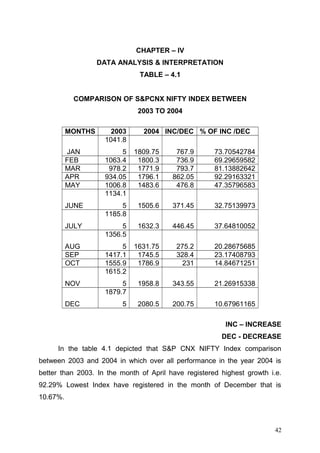
TABLE – 4.1
COMPARISON OF S&PCNX NIFTY INDEX BETWEEN
2003 TO 2004
MONTHS

2003
1041.8

2004 INC/DEC % OF INC /DEC

JAN
FEB
MAR
APR
MAY

5
1063.4
978.2
934.05
1006.8
1134.1

1809.75
1800.3
1771.9
1796.1
1483.6

767.9
736.9
793.7
862.05
476.8

73.70542784
69.29659582
81.13882642
92.29163321
47.35796583

JUNE

5
1185.8

1505.6

371.45

32.75139973

JULY

5
1356.5

1632.3

446.45

37.64810052

AUG
SEP
OCT

5
1417.1
1555.9
1615.2

1631.75
1745.5
1786.9

275.2
328.4
231

20.28675685
23.17408793
14.84671251

NOV

5
1879.7

1958.8

343.55

21.26915338

DEC

5

2080.5

200.75

10.67961165
INC – INCREASE
DEC - DECREASE

In the table 4.1 depicted that S&P CNX NIFTY Index comparison
between 2003 and 2004 in which over all performance in the year 2004 is
better than 2003. In the month of April have registered highest growth i.e.
92.29% Lowest Index have registered in the month of December that is
10.67%.

42
43
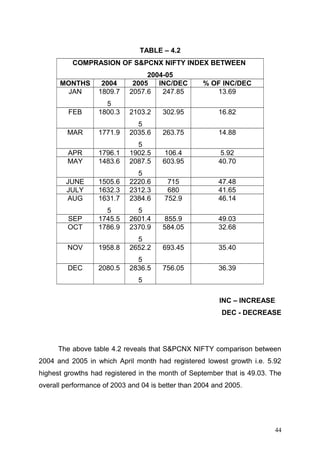
TABLE – 4.2
COMPRASION OF S&PCNX NIFTY INDEX BETWEEN
MONTHS
JAN

2004
1809.7

2004-05
2005
INC/DEC
2057.6
247.85

FEB

5
1800.3

2103.2

302.95

16.82

1771.9

5
2035.6

263.75

14.88

1796.1
1483.6

5
1902.5
2087.5

106.4
603.95

5.92
40.70

JUNE
JULY
AUG

1505.6
1632.3
1631.7

5
2220.6
2312.3
2384.6

715
680
752.9

47.48
41.65
46.14

SEP
OCT

5
1745.5
1786.9

5
2601.4
2370.9

855.9
584.05

49.03
32.68

1958.8

5
2652.2

693.45

35.40

2080.5

5
2836.5

756.05

36.39

MAR
APR
MAY

NOV
DEC

% OF INC/DEC
13.69

5
INC – INCREASE
DEC - DECREASE

The above table 4.2 reveals that S&PCNX NIFTY comparison between
2004 and 2005 in which April month had registered lowest growth i.e. 5.92
highest growths had registered in the month of September that is 49.03. The
overall performance of 2003 and 04 is better than 2004 and 2005.

44
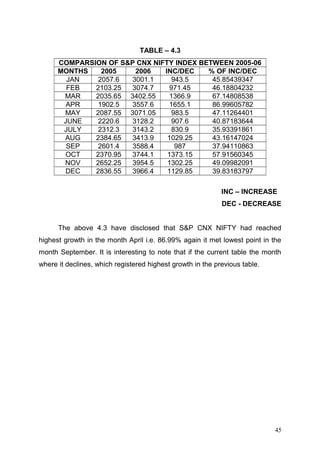
TABLE – 4.3
COMPARSION OF S&P CNX NIFTY INDEX BETWEEN 2005-06
MONTHS
2005
2006
INC/DEC
% OF INC/DEC
JAN
2057.6
3001.1
943.5
45.85439347
FEB
2103.25
3074.7
971.45
46.18804232
MAR
2035.65 3402.55
1366.9
67.14808538
APR
1902.5
3557.6
1655.1
86.99605782
MAY
2087.55 3071.05
983.5
47.11264401
JUNE
2220.6
3128.2
907.6
40.87183644
JULY
2312.3
3143.2
830.9
35.93391861
AUG
2384.65
3413.9
1029.25
43.16147024
SEP
2601.4
3588.4
987
37.94110863
OCT
2370.95
3744.1
1373.15
57.91560345
NOV
2652.25
3954.5
1302.25
49.09982091
DEC
2836.55
3966.4
1129.85
39.83183797
INC – INCREASE
DEC - DECREASE
The above 4.3 have disclosed that S&P CNX NIFTY had reached
highest growth in the month April i.e. 86.99% again it met lowest point in the
month September. It is interesting to note that if the current table the month
where it declines, which registered highest growth in the previous table.

45
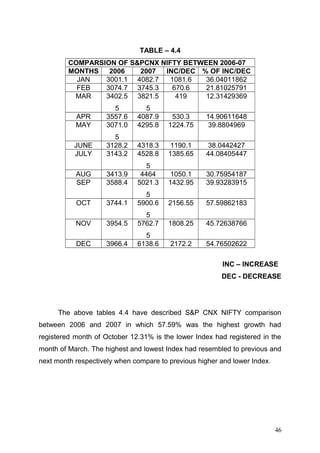
TABLE – 4.4
COMPARSION OF S&PCNX NIFTY BETWEEN 2006-07
MONTHS
2006
2007
INC/DEC % OF INC/DEC
JAN
3001.1 4082.7
1081.6
36.04011862
FEB
3074.7 3745.3
670.6
21.81025791
MAR
3402.5 3821.5
419
12.31429369
APR
MAY

5
3557.6
3071.0

5
4087.9
4295.8

530.3
1224.75

14.90611648
39.8804969

JUNE
JULY

5
3128.2
3143.2

4318.3
4528.8

1190.1
1385.65

38.0442427
44.08405447

AUG
SEP

3413.9
3588.4

5
4464
5021.3

1050.1
1432.95

30.75954187
39.93283915

3744.1

5
5900.6

2156.55

57.59862183

3954.5

5
5762.7

1808.25

45.72638766

3966.4

5
6138.6

2172.2

54.76502622

OCT
NOV
DEC

INC – INCREASE
DEC - DECREASE

The above tables 4.4 have described S&P CNX NIFTY comparison
between 2006 and 2007 in which 57.59% was the highest growth had
registered month of October 12.31% is the lower Index had registered in the
month of March. The highest and lowest Index had resembled to previous and
next month respectively when compare to previous higher and lower Index.

46
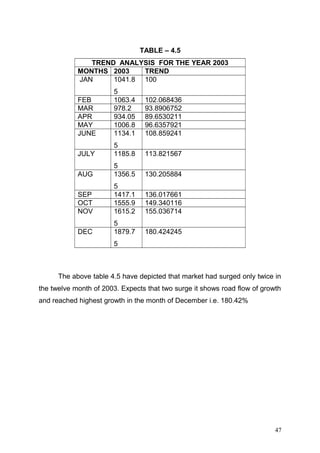
TABLE – 4.5
TREND ANALYSIS FOR THE YEAR 2003
MONTHS 2003
TREND
JAN
1041.8 100
FEB
MAR
APR
MAY
JUNE

5
1063.4
978.2
934.05
1006.8
1134.1

102.068436
93.8906752
89.6530211
96.6357921
108.859241

JULY

5
1185.8

113.821567

AUG

5
1356.5

130.205884

SEP
OCT
NOV

5
1417.1
1555.9
1615.2

136.017661
149.340116
155.036714

DEC

5
1879.7

180.424245

5

The above table 4.5 have depicted that market had surged only twice in
the twelve month of 2003. Expects that two surge it shows road flow of growth
and reached highest growth in the month of December i.e. 180.42%

47
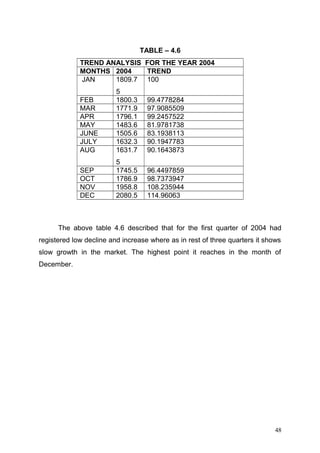
TABLE – 4.6
TREND ANALYSIS FOR THE YEAR 2004
MONTHS 2004
TREND
JAN
1809.7 100
FEB
MAR
APR
MAY
JUNE
JULY
AUG

5
1800.3
1771.9
1796.1
1483.6
1505.6
1632.3
1631.7

99.4778284
97.9085509
99.2457522
81.9781738
83.1938113
90.1947783
90.1643873

SEP
OCT
NOV
DEC

5
1745.5
1786.9
1958.8
2080.5

96.4497859
98.7373947
108.235944
114.96063

The above table 4.6 described that for the first quarter of 2004 had
registered low decline and increase where as in rest of three quarters it shows
slow growth in the market. The highest point it reaches in the month of
December.

48
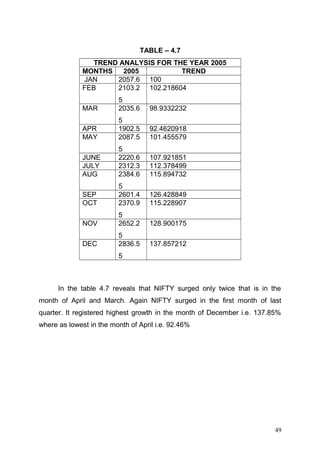
TABLE – 4.7
TREND ANALYSIS FOR THE YEAR 2005
MONTHS
2005
TREND
JAN
2057.6 100
FEB
2103.2 102.218604
MAR

5
2035.6

98.9332232

APR
MAY

5
1902.5
2087.5

92.4620918
101.455579

JUNE
JULY
AUG

5
2220.6
2312.3
2384.6

107.921851
112.378499
115.894732

SEP
OCT

5
2601.4
2370.9

126.428849
115.228907

NOV

5
2652.2

128.900175

DEC

5
2836.5

137.857212

5

In the table 4.7 reveals that NIFTY surged only twice that is in the
month of April and March. Again NIFTY surged in the first month of last
quarter. It registered highest growth in the month of December i.e. 137.85%
where as lowest in the month of April i.e. 92.46%

49
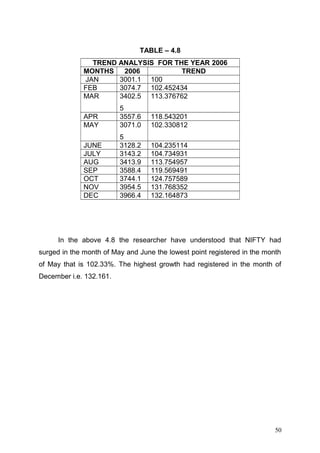
TABLE – 4.8
TREND ANALYSIS FOR THE YEAR 2006
MONTHS
2006
TREND
JAN
3001.1 100
FEB
3074.7 102.452434
MAR
3402.5 113.376762
APR
MAY

5
3557.6
3071.0

118.543201
102.330812

JUNE
JULY
AUG
SEP
OCT
NOV
DEC

5
3128.2
3143.2
3413.9
3588.4
3744.1
3954.5
3966.4

104.235114
104.734931
113.754957
119.569491
124.757589
131.768352
132.164873

In the above 4.8 the researcher have understood that NIFTY had
surged in the month of May and June the lowest point registered in the month
of May that is 102.33%. The highest growth had registered in the month of
December i.e. 132.161.

50
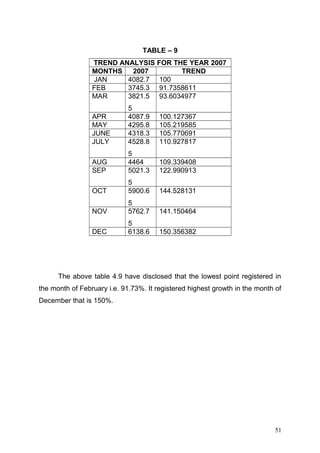
TABLE – 9
TREND ANALYSIS FOR THE YEAR 2007
MONTHS
2007
TREND
JAN
4082.7 100
FEB
3745.3 91.7358611
MAR
3821.5 93.6034977
APR
MAY
JUNE
JULY

5
4087.9
4295.8
4318.3
4528.8

100.127367
105.219585
105.770691
110.927817

AUG
SEP

5
4464
5021.3

109.339408
122.990913

OCT

5
5900.6

144.528131

NOV

5
5762.7

141.150464

DEC

5
6138.6

150.356382

The above table 4.9 have disclosed that the lowest point registered in
the month of February i.e. 91.73%. It registered highest growth in the month of
December that is 150%.

51
TABLE – 4.10
CONSOLIDATED TREND % FOR THE YEAR 2003-2007
MON

2003

2004

2005

2006

2007

2003

2004

2005

2006

2007

JAN

1041.85

1809.75

2057.6

3001.1

4082.7

100

173.7054

197.4948

288.0549

391.8702

FEB

1063.4

1800.3

2103.25

3074.7

3745.3

100

169.2966

197.7854

289.1386

352.2005

MAR

978.2

1771.9

2035.65

3402.55

3821.55

100

181.1388

208.1016

347.8379

390.6716

APR

934.05

1796.1

1902.5

3557.6

4087.9

100

192.2916

203.6829

380.879

437.6532

MAY

1006.8

1483.6

2087.55

3071.05

4295.8

100

147.358

207.3451

305.0308

426.6786

JUNE

1134.15

1505.6

2220.6

3128.2

4318.3

100

132.7514

195.7942

275.8189

380.7521

JULY

1185.85

1632.3

2312.3

3143.2

4528.85

100

137.6481

194.9909

265.0588

381.9075

AUG

1356.55

1631.75

2384.65

3413.9

4464

100

120.2868

175.7878

251.6605

329.0701

SEP

1417.1

1745.5

2601.4

3588.4

5021.35

100

123.1741

183.5721

253.2214

354.3398

OCT

1555.9

1786.9

2370.95

3744.1

5900.65

100

114.8467

152.3845

240.6389

379.2435

NOV

1615.25

1958.8

2652.25

3954.5

5762.75

100

121.2692

164.2006

244.8228

356.7714

DEC

1879.75

2080.5

2836.55

3966.4

6138.6

100

110.6796

150.9004

211.0068

326.5647

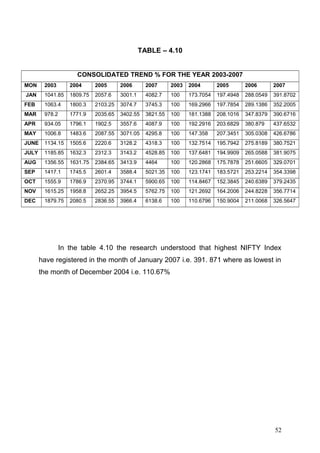
In the table 4.10 the research understood that highest NIFTY Index
have registered in the month of January 2007 i.e. 391. 871 where as lowest in
the month of December 2004 i.e. 110.67%

52
TABLE 4.11
Comparison of 15 Days and 50 Days moving average during
15 DAYS SMA
1085.513333
1052.17
1055.456667
1013.503333
983.52
938.19
977.9033333
1057.143333
1135.91
1158.6
1252.35
1375.076667
1389.063333
1517.58
1578.5
1608.26
1776.77

2003
5O DAYS LMA
1073.072
971.462
1150.35
1390.752
1638.369

53
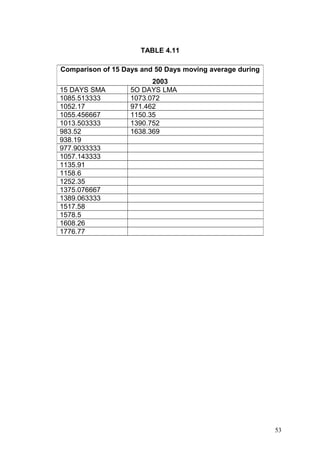
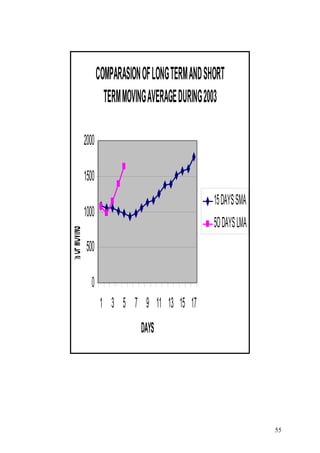
The above table 4.11 described short term and long term moving
average during the year 2003. In which we could understand one thing that
when short term moving average crosses above the long term average than
market shows upwards trend.

54
COMPARASION OF LONG TERM AND SHORT
TERM MOVING AVERAGE DURING 2003
2000
1500
15 DAYS SMA

% OF MOVING

1000

5O DAYS LMA

500
0
1 3 5 7 9 11 13 15 17
DAYS

55
TABLE 4.12
Comparison of 15 Days and 50 Days moving average during
15 Days MA
1936.13333
1842.09333
1852.11667
1762.87
1834.30333
1814.26333
1565.10667
1512.20333
1522.52
1591.55333
1612.75333
1640.22667
1739.23667
1794.62333
1848.25667
1948.12333
2041.64667

2004
50 Days MA
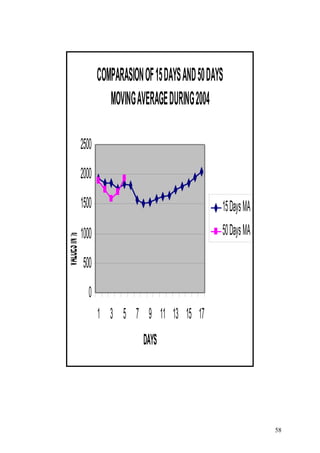
1893.594
1734.611
1584.508
1694.02
1929.247

56
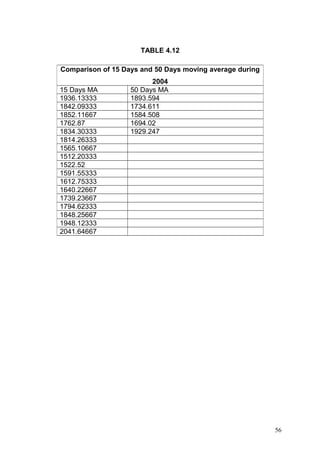
The above table 4.12 indicates that the short term moving average
crosses above long term moving average than the market is upwards. If it
cross below the long term moving average it is down wards.

57
COMPARASION OF 15 DAYS AND 50 DAYS
MOVING AVERAGE DURING 2004
2500
2000

VALUES IN %

1500

15 Days MA

1000

50 Days MA

500
0
1 3 5 7 9 11 13 15 17
DAYS

58
TABLE 4.13
Comparison of 15 Days and 50 Days moving average during
2014.15
2006.5
2071.71
2125.42333
2027.32667
1940.72667
2011.28667
2097.55667
2189.74
2244.87667
2361.07333
2401.18667
2564.77667
2493.48333
2487.09
2673.50667
2808.10667

2005
2091.865
2001.647
2241.294
2469.787
2631.826

59
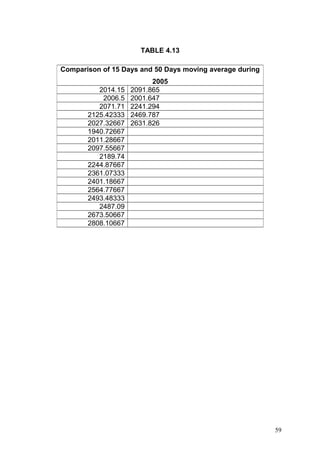
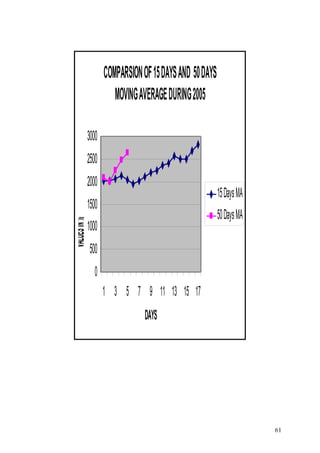
The above table 4.13 indicates that the when the market faces
downwards if the short term moving average crosses below the long term
average.

60
COMPARSION OF 15 DAYS AND 50 DAYS
MOVING AVERAGE DURING 2005
3000
2500
2000

15 Days MA

VALUES IN %

1500

50 Days MA

1000
500
0
1 3 5 7 9 11 13 15 17
DAYS

61
TABLE 4.14
Comparison of 15 Days and 50 Days moving average during
2848.84
2920.93333
3032.47
3190.05333
3393.37
3572.47
3408.1
2892.93333
3041.62
3071.47667
3249.21333
3418.88333
3516.59333
3639.78
3807.36
3953.15
3877.19667

2006
3050.026
3436.757
3081.628
3463.084
3858.772

62
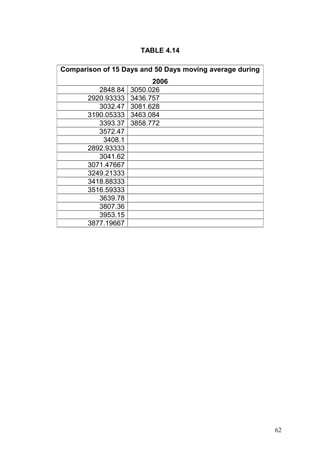
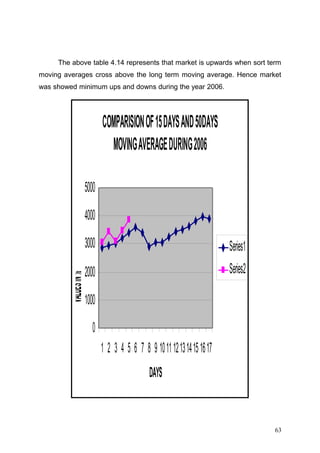
The above table 4.14 represents that market is upwards when sort term
moving averages cross above the long term moving average. Hence market
was showed minimum ups and downs during the year 2006.

COMPARISION OF 15 DAYS AND 50DAYS
MOVING AVERAGE DURING 2006
5000
4000

VALUES IN %

3000

Series1

2000

Series2

1000
0
1 2 3 4 5 6 7 8 9 1011 12131415 1617
DAYS

63
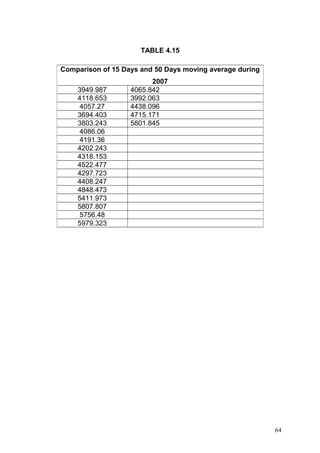
TABLE 4.15
Comparison of 15 Days and 50 Days moving average during
3949.987
4118.653
4057.27
3694.403
3803.243
4086.06
4191.36
4202.243
4318.153
4522.477
4297.723
4408.247
4848.473
5411.973
5807.807
5756.48
5979.323

2007
4065.842
3992.063
4438.096
4715.171
5801.845

64
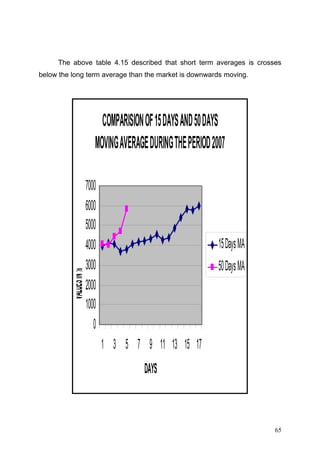
The above table 4.15 described that short term averages is crosses
below the long term average than the market is downwards moving.

VALUES IN %

COMPARISION OF 15 DAYS AND 50 DAYS
MOVING AVERAGE DURING THE PERIOD 2007
7000
6000
5000
4000
3000
2000
1000
0

15 Days MA
50 Days MA

1 3 5 7 9 11 13 15 17
DAYS

65
66
TABLE 4.16
THREE DAYS MOVING AVERAGE
FOR THE YEARS 2003
MONTHS
2003
JAN
1041.8

CF

3 Days MA

FEB
MAR
APR
MAY
JUNE

5
1063.4
978.2
934.05
1006.8
1134.1

3083.45
2975.65
2919.05
3075

1027.81667
991.883333
973.016667
1025

JULY

5
1185.8

3326.8

1108.93333

AUG

5
1356.5

3676.55 1225.51667

SEP
OCT
NOV

5
1417.1
1555.9
1615.2

3959.5 1319.83333
4329.55 1443.18333
4588.25 1529.41667

DEC

5
1879.7

5050.9

1683.63333

5

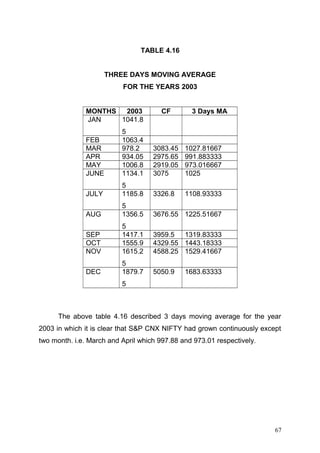
The above table 4.16 described 3 days moving average for the year
2003 in which it is clear that S&P CNX NIFTY had grown continuously except
two month. i.e. March and April which 997.88 and 973.01 respectively.

67
TABLE 4.17
THREE DAYS MOVING AVERAGE
FOR THE YEARS 2004
MONTHS
JAN
FEB
MAR
APR
MAY
JUNE
JULY
AUG
SEP
OCT
NOV
DEC

2004
1809.7
5
1800.3
1771.9
1796.1
1483.6
1505.6
1632.3
1631.7
5
1745.5
1786.9
1958.8
2080.5

CF

3 Days MA

5381.95
5368.3
5051.6
4785.3
4621.5

1793.98333
1789.43333
1683.86667
1595.1
1540.5

4769.65

1589.88333

5009.55
5164.15
5491.2
5826.2

1669.85
1721.38333
1830.4
1942.06667

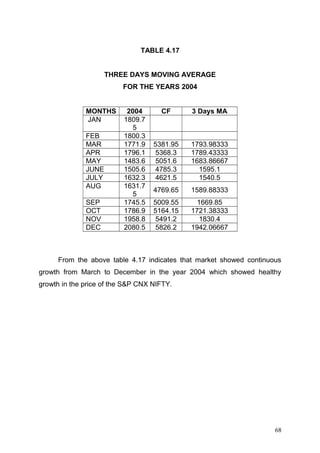
From the above table 4.17 indicates that market showed continuous
growth from March to December in the year 2004 which showed healthy
growth in the price of the S&P CNX NIFTY.

68
TABLE 4.18
THREE DAYS MOVING AVERAGE
FOR THE YEARS 2005
MONTHS
JAN
FEB
MAR
APR
MAY
JUNE
JULY
AUG
SEP
OCT
NOV
DEC

2005
2057.6
2103.2
5
2035.6
5
1902.5
2087.5
5
2220.6
2312.3
2384.6
5
2601.4
2370.9
5
2652.2
5
2836.5
5

CF

3 Days MA

6196.5

2065.5

6041.4

2013.8

6025.7

2008.56667

6210.65
6620.45

2070.21667
2206.81667

6917.55

2305.85

7298.35

2432.78333

7357

2452.33333

7624.6

2541.53333

7859.75

2619.91667

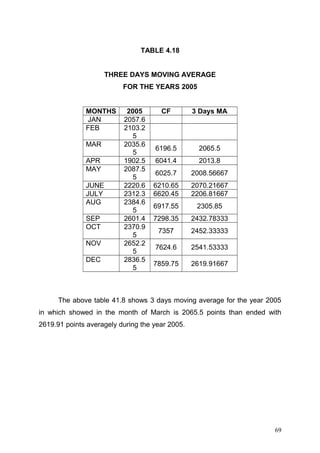
The above table 41.8 shows 3 days moving average for the year 2005
in which showed in the month of March is 2065.5 points than ended with
2619.91 points averagely during the year 2005.

69
TABLE 4.19
THREE DAYS MOVING AVERAGE
FOR THE YEARS 2006
MONTHS
JAN
FEB
MAR
APR
MAY
JUNE
JULY
AUG
SEP
OCT
NOV
DEC

2006
3001.1
3074.7
3402.5
5
3557.6
3071.0
5
3128.2
3143.2
3413.9
3588.4
3744.1
3954.5
3966.4

CF

3 Days MA

9478.35

3159.45

10034.85

3344.95

10031.2

3343.73333

9756.85
9342.45
9685.3
10145.5
10746.4
11287
11665

3252.28333
3114.15
3228.43333
3381.83333
3582.13333
3762.33333
3888.33333

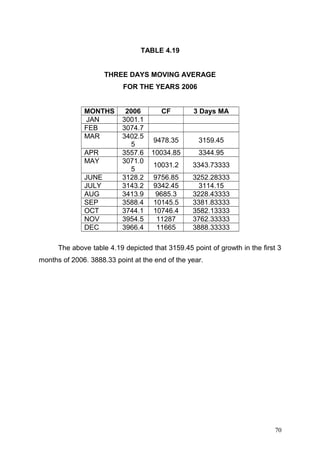
The above table 4.19 depicted that 3159.45 point of growth in the first 3
months of 2006. 3888.33 point at the end of the year.

70
TABLE 4.20
THREE DAYS MOVING AVERAGE
FOR THE YEARS 2006
MONTHS
JAN
FEB
MAR
APR
MAY
JUNE
JULY
AUG
SEP
OCT
NOV
DEC

2007
4082.7
3745.3
3821.5
5
4087.9
4295.8
4318.3
4528.8
5
4464
5021.3
5
5900.6
5
5762.7
5
6138.6

CF

3 Days MA

11649.55

3883.18333

11654.75
12205.25
12702

3884.91667
4068.41667
4234

13142.95

4380.98333

13311.15

4437.05

14014.2

4671.4

15386

5128.66667

16684.75

5561.58333

17802

5934

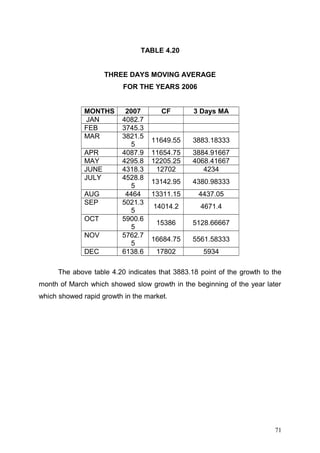
The above table 4.20 indicates that 3883.18 point of the growth to the
month of March which showed slow growth in the beginning of the year later
which showed rapid growth in the market.

71
1) H0 :

There is a significant relationship between inflation and
NIFTY Index.

H1:

There are no significant relationship between inflation and NIFTY
Index.

O
4.2
5.3
4.8
5.6
4.5
1879.7
5
2080.5
2836.5
5
3966.4
6138.6

E
2.715812
3.006789
4.095954
5.725845
8.855599
1881.234

O-E
1.484188
2.293211
0.704046
-0.12585
-4.3556
-1.48419

2082.793 -2.29321
2837.254 -0.70405

O-E2
2.202814
5.258815
0.49568
0.015837
18.97124
2.202814

O-E2/E
0.811106721
1.748979954
0.121017097
0.00276588
2.142287916
0.001170941

5.258815 0.002524886
0.49568 0.000174704

3966.274 0.125845 0.015837 3.99292E-06
6134.244 4.355599 18.97124 0.003092678
4.833124769

X2

= Σ ( (O-E)2/E) = 4.83

v

= (r-1) (c-1)
= (2-1) (5-1)
=1x4=4

For v = 4, X2 0.05 = 14.9

The calculated value of X2 is 4.83 less than the table value 14.9. The
hypothesis is accepted.

72
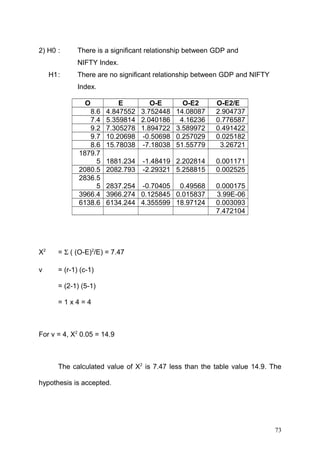
2) H0 :

There is a significant relationship between GDP and
NIFTY Index.

H1:

There are no significant relationship between GDP and NIFTY
Index.
O
8.6
7.4
9.2
9.7
8.6
1879.7
5
2080.5
2836.5
5
3966.4
6138.6

E
O-E
O-E2
4.847552 3.752448 14.08087
5.359814 2.040186 4.16236
7.305278 1.894722 3.589972
10.20698 -0.50698 0.257029
15.78038 -7.18038 51.55779

O-E2/E
2.904737
0.776587
0.491422
0.025182
3.26721

1881.234
2082.793

-1.48419 2.202814
-2.29321 5.258815

0.001171
0.002525

2837.254 -0.70405 0.49568
3966.274 0.125845 0.015837
6134.244 4.355599 18.97124

0.000175
3.99E-06
0.003093
7.472104

X2

= Σ ( (O-E)2/E) = 7.47

v

= (r-1) (c-1)
= (2-1) (5-1)
=1x4=4

For v = 4, X2 0.05 = 14.9

The calculated value of X2 is 7.47 less than the table value 14.9. The
hypothesis is accepted.

73
3) CORRELATION BETWEEN INFLATION AND S&P CNX NIFTY
Years

X

2003
2004

4.2
5.3

2005

4.8

Y
x=X-X
x2
1879.7
5 -0.68 0.4624
2080.5
0.42 0.1764
2836.5
5 -0.08 0.0064

2006

5.6

3966.4

0.72 0.5184

3966.4

2007

4.5

6138.6
16901.
8

-0.38 0.1444

6138.6

24.4

1.308

y=Y-Y
1879.7
5
2080.5
2836.5
5

y2

xy

3533460
4328480

1633872
763543.9

8046016
51494.5
1573232
9 8155639
3768241
0 5441340
6932269
5 16045890

ΣX
x=-----------N
24.4
x =--------5
x=4.88
ΣY
y= -----------N
16901.8
y= -----------5
y= 3380.36
r

Σxy
= ---------------√ ΣX2* Σy2

r

16045890
= ---------------------------√ 1.308* 69322695

r=

-0.0271

74
4) CORRELATION BETWEEN GDP AND S&P CNX NIFTY
Years
X
2003 8.6
2004
2005

7.4
9.2

2006
2007

9.7
8.6
43.5

Y
1879.7
5
2080.5
2836.5
5
3966.4
6138.6
16901.
8

x=X-X x2
y=Y-Y
-0.1
0.01 -1500.61

y2
2251830

xy
22518.3

-1.3
0.5

1.69 -1299.86
0.25 -543.81

1689636
295729.3

2855485
73932.33

1
-0.1

1
586.04
0.01 2758.24
2.96

343442.9
343442.9
7607888
76078.88
12188526.49 3371457

ΣX
x=-----------N
43.5
x =--------5
x=8.7
ΣY
y= -----------N
16901.8
y= -----------5
y= 3380.36
r

r
r=

Σxy
= ---------------√ Σx2* Σy2
3371457
= ---------------------------√ 2.96* 12188526.49

0.312693

75
CHAPTER – V
FINDINGS

1. The researcher has found that highest growth had recorded in the month of
April when compared 2003 and 2004 i.e. 92.29%

2. While researcher compared 2004 and 05, found that lowest growth had
registered in the month of April i.e. 5.92% where as highest growth
registered in the month of September i.e. 49.03%

3. It is interesting to note that NIFTY show lowest growth in the mo nth where
it shows highest growth in the previous year.

4. It is found that experience is repeating again market shows highest growth
in the month of April that is 86.99%

5. While the researcher has found that NIFTY had declined 10 months where
as it show increasing trend only in the two month during the year 2003.

6. In the year 2004 and 2005 market shows 8 months, increased trend and 4
months declined trends

76
7. It is another interesting fin ding is that for the last five years market expects
one year market stood peaked up only in the month of April.

8. It is found that market averagely gowned in the year 2006 to 2007.

9. While we are looking trend percentage the researcher found that in the
month of December market had registered highest growth for the last five
years.
10.

NIFTY Index shows down wards when short term moving average

crosses below the long term moving average.
11.

When short term moving average crosses above the long term average

than the market shows upwards trend.
12.

GRP Growth has greater influence in the S&P CNX NIFTY Index

growth.
13.

Inflation is also play an important role in the market growth.

77
SUGGESTION

After completed the finding researcher has to make following
suggestion which is based only on this study and analysis.

•

As far as Investors is concerned they can com use such analysis for
better understanding the market.

•

Investors must be careful in the months where nifty prices gone up.

•

Performance of the last five year from 2003 to 2007 market shows rapid
growth.

•

Market surged at least twice in the year from 2003 to 2005 where as
last two years it is minimum than the previous years.

•

The researcher suggest when the short term moving average crosses
above the long term moving average is the time to sold the stock.

•

When the short term moving average crosses below the long term
moving average than the market shows down wards when one can
purchased.

•

Inflation is also an important factor which determines the growth of the
stock market.

•

Gross Domestic product is also play a vital role in the performance of
S&P CNX NIFTY Index.

78
CONCLUSION

The researcher has concluded this study with the satisfaction of the
performance of NSE. The researcher fell that S&P CNX NIFTY Index
movement is clearly upwards from the 2003 to 2007. The researchers found
that the Journey of S&P CNX NIFTY from 2003 was starts with 1041.85 point
which is increased with 6138.6 points in the year 2007. The researcher hopes
that this market will surely reach 10k very soon. The researcher found mother
thing that this second largest market in Asia will have chance to come first
market due to it extraordinary performance. Further this study is on initial only;
the researcher recommended that there would be need for further research in
the same area which wills insight the many facts NSE Index showed rapid
growth the researcher felt that there would be close relationship between GDP
and NIFTY Index & between Inflation and NIFTY Index. Further researcher
concludes that market showed down trend where in the month it’s upwards in
the previous year in the same month. Short term moving average is crosses
the above the long term moving average than the market is growing.

The researcher recommended further study in the same area so that we
can better understand the market in future.

79
BIBLIOGRAPHY

1.

Bhole, L.M, Financial Institutions and Markets (3rd Ed.),331-332,
Tata McGraw-HillPublishing Company

2. Campbell, J.Y, A.W.Lo, and A.C.Mackinlay, 1997, The Econometrics of
Financial Markets, Princeton University Press, New Jersey, 84-98

3. Centre for Monitoring Indian Economy (CMIE), Monthly Review of
Indian Economy, May 2000, and p.129

4. Dimson, E., 1974, Dependencies in stock market indices, Paper
presented at theThird congress on Financial Theory and Decision Models
(Garmisch- Partenkirchen).

5. Dimson, E.1979, Risk Measurement when shares are subject to
infrequent trading,
Journal of Financial Economics, 7, 197-226

80
6. Fama, E.F., 1965, Tomorrow on the New York Stock Exchange, Journal
of Business 38, 285-299.

7. Fisher, L.1966, Some new Stock-Market indexes, Journal of Business
39(suppl.).191-225

8. Franks JR., J.E. Broyles and M.J. Hecht, 1977, An industry study of the
profitability of mergers in the United Kingdom, Journal of Finance 32,
1513-525.

9. Ibbotson, R.G, 1975,Price Performance of Common stock New Issues,
Journal of Financial Economics, 2, 235-272.

10. Marsh, P.R., 1979, Equity rights issues and the efficiency of the
U.K.Stock Market,Journal of Finance,

11. National Stock Exchange of India, Mumbai

12. Reserve Bank of India (RBI), Annual Reports, 1996-97, p208-209,
1998-99, p.119-120

13. RBI, Report on Trends and Progress in Banking in India, 1998-99

81
14. Scholes, M. and J. Williams.1977, Estimating Betas from Nonsynchronous Data, Journal of Financial Economics, 5, 309-327.

15.

Schwartz,

R.A.

and

D.K.Whitcomb,

1977.The

Time-variance

Relationship: Evidence on auto-correlation in common stock returns,
Journal of Finance, 1, 41-55.

16. Schwert, G.W., 1977, Stock exchange seats as capital assets, Journal
of Financial Economics, 4, 51-78.

82
WEBLIOGRAPHY

1. www.nseindia.com

2. www.finance.indiamart.com
3. www.nsx.com
4. www.answers.oneindia.in/index.php?article
5. www.surfindia.com/finance/national-stock-exchange.html
6. www.nasscom.in/Nasscom
7. www.en.wikipedia.org
8. www.moneycontrol.com
9. www.economywatch.com
10. www.nationalstockexchange.com
11. www.sfa.gov.uk

83

Technical analysis project report

  • 1.
    “A STUDY ONTECHNICAL ANALYSIS OF S&PCNX NIFTY INDEX IN INDIA” 1.1. INTRODUCTION : The most fascinating word amongst the investors around the world is to invest in Indian Sensex and nifty because of its exuberant growth. India, which is now the fourth largest economy in terms of purchasing power parity, will overtake Japan and become third major economic power within 10 years. Indian Economy experienced a GDP growth of 9.0 percent during 2005-06 to 9.4 percent during 2006-07. By 2025 the India's economy is projected to be about 60 per cent the size of the US economy. Despite of this glittering feature we should not ignore the hidden side of the Indian economy. that is India has the world's second largest labour force, with 509.3 million people, 60% of whom are employed in agriculture and related industries; 28% in services and related industries; and 12% in industry. . The agricultural sector accounts for 28% of GDP; the service and industrial sectors make up 54% and 18% respectively. Among the service sectors stock market make more contribution. we have 23 stock market among this two vital market that is BSE(Bombay stock market) and NSE(National stock exchange) .The equity market capitalization of the companies listed on the BSE was US$ 1.61 trillion, making it the largest stock exchange in South Asia and the tenth largest in the world. Equity market capitalization of the companies listed on the NSE was
  • 2.
    US$ 1.46 trillion,making it the second largest stock exchange in [South Asia].Which stand as a hub for the world investors, that is the reason why we face lots of volatility in the market. The interest in studying the movement of S&PCNX NIFTY Index considerable momentum following the early study of Ms.Shalini Batia (2007) Indicated that trader can profit from the discrepancy in the prices of NIFTY. Mr.Saumitra N Bhaduri (2007) indicated hedging return gives better performance in long time horizons only. Dr.Srinivas, S.S.Kumar (2005) observed that the stock prices, on average increase and decrease significantly on the effective day for the NIFTY Index. In this connection the researcher would like to make on attempt to study on Technical Analysis on S&P CNX NIFTY Index in India. 2
  • 3.
    1.2. ABOUT STOCK EXCHANGE: The National Stock Exchange of India Limited (NSE) is a Mumbai-based stock exchange. It is the largest stock exchange in India and the third largest in the world in terms of volume of transactions. Though a number of other exchanges exist, NSE and the Bombay Stock Exchange are the two most significant stock exchanges in India, and between them are responsible for the vast majority of share transactions.NSE is mutually-owned by a set of leading financial institutions, banks, insurance companies and other financial intermediaries in India but its ownership and management operate as separate entities. As of 2006, the NSE VSAT terminals, 2799 in total, cover more than 1500 cities across India. In October 2007, the equity market capitalization of the companies listed on the NSE was US$ 1.46 trillion, making it the second largest stock exchange in [[South Asia]. NSE is the third largest Stock Exchange in the world in terms of the number of trades in equities. It is the second fastest growing stock exchange in the world with a recorded growth of 16.6 3
  • 4.
    S&P CNX NIFTY: Itreflects the price movement of 50 stocks selected on the basis of market capitalization and liquidity (Impact cost) The base period selected for NIFTY index is the close of price on November 3, 1995, which markets the completion of one year of operation of MSE’s capital market segment. The base value of the Index has been set at 1000. It is a value weighted Index. 1.3. SCOPE OF THE STUDY : This study concerns with NIFTY Index only. Which is relates to National Stock exchange. Scope of this study is not limited one because researcher has taken five years price of the S&P CNX NIFTY Index for the purpose of this study from 2003 to 2007. Especially researcher applied short term and long term moving average to determine the movement of the price. 4
  • 5.
    1.4. IMPORTANCE OF THESTUDY : In the broad sense this study is quite relevant to the present scenario the share market face more volatile. Because of this investors have lost their confidence due to more ups and down in the market. Further most of the domestic investors are unfamiliar with most technique used in predicting stock price hence finally they lost, their hard earned money. In this context this study exclusively focused on simple means to predicting market movement. The researcher has used SMA and LMA which is also useful to learn how the market trend is moving. 5
  • 6.
    1.5. STATEMENT OF THEPROBLEM : Globally, there are increased evidences to suggest that investor confidence has assumed an important role in the economic development of a country. The Economist (1998) indicated that a lost of issues need to be addressed to make capital markets safer. David Bullard (1998) in Business Times has indicated that the private investors are the big losers on listing scars. Companies with no earning record and with inexperience directors got listed on stock exchange. Their only objective is profit making out of inflated market price. HsienLoong (2000) while addressing financial institution In Bangkok. Stressed the importance of economic co-operation among ASEAW corporate restructuring Dr.K.Santh Swarup, a factors analysis indicates that Investment decision are based on personal analysis than brokers advices also current market price is a better investment indicator for investors than analysis recommendations Joseph J.Oliver (2002) in his presentation to the senate standing committee on banking trade and commerce suggested that regulations the accounting professionals analysis brokerage firms, public companies, share holders and government must ensure good corporate governance and reduce the corporate failures. Dr.S.Janakiraman (2007) observed that under pricing and delays in IPO’s in India are altering the price in the market. Ms.Shali Bhatia (2007) futures Index leading the Spot Index by 6
  • 7.
    10 to 25minutes suggests that for a short period of time the prices, resulting in arbitrage opportunities. Dr.Asjeet lamb has indicates that Indian Market is influenced by the large developed equity markets including the US, UK and Japan and that this influenced strengthened during more recent time. This study is based on strengthened the early studies. On the basis of the empirical study researcher cited the following question in the mind. 1. Why the Investors lost their confident in investment 2. How a layman investor can under stand market trend 3. What factors makes market volatile. 4. How an investors has to determine to purchase or sale the securities. These are the questions are crack down in the mind of the researches that takes him to make an attempt to study the technical analysis on S&P CNX NIFTY Index. 7
  • 8.
    1.6. OBJECTIVES OF THESTUDY: PRIMARY: To study the price movement of S&P CNX NIFTY Index SECONDARY: • To compare the price of S&P CNX NIFTY Index during the year 20032007. • 1.7. To analyse the SMA and LMA of S&P CNX NIFTY in India. HYPOTHESIS : 1) H0 : There is a significant relationship between GDP and S&P CNX NIFTY Index H1 : There are no significant relationship between GDP and S&P CNX NIFTY 2) H0 : There is a significant relationship between Inflation and S&P CNX NIFTY Index. H1: There are no significant relationship between Inflation and S&P CNX NIFTY Index 8
  • 9.
    1.8. METHODOLOGY: This study isbased on the analytical research approach. The researcher used the information already released by the NSE, that should be taken into further critical evaluation. 1.9. DATA : This study is based on secondary method of data collection. Data have been obtained from official website of National Stock exchange in India. The researcher has collected only five years data from 2003-2007. 1.10. SAMPLE : Non probability sampling techniques have been used in this research. In which Judgement sampling method have observed. On this basis researcher have selected 2003 to 2007 as sampling period for this research. 1.11. STATISTICAL TOOL : Simple statistical tools have been employed for the study purpose like, comparative analysis, trend analysis, moving average and short term and long term moving average are used for this study. Further chi-square test and correlation are employed for testing hypothesis. 9
  • 10.
    1.12. PERIOD OFSTUDY : This study is conformed only the application of few technical analysis on S&P CNX NIFTY during the period 2003-2007. 1.13. LIMITATION OF THE STUDY : • The Researcher has taken into account only last five years, he could not concentrate rest of the years. • In sufficient time to get into deep study. 1.14. CHAPTER SCHEME : CHAPTER I - Introduction CHAPTER II - Review of Literature CHAPTER III - Profile of NSE CHAPTER IV - Analysis and Interpretation CHAPTER V - Finding, Suggestion & Conclusion 10
  • 11.
    CHAPTER – II 2.1.REVIEW OF LITERATURE IN INDIA “A study reveals that there are various features in India which contribute to the under-pricing and are unique by World standards. For one, the delay from issue date to listing date is enormous in India when compared with other countries. Among the other features are the ways the offer price is fixed and the availability of information to lay investors. The offer price is chosen by the firm months before the issue opens and a lack of feedback mechanism means that there is no channel through which the market demand can alter the price. Coupled with the fact that IPO’s”1 “According to study undertaken by Ms.SHALINI BHATIA has reveals that the futures market leads the spot market has important implications for arbitrageurs, who take offsetting positions in the two markets to earn assured risk free returns. Futures index leading the spot index by 10 to 25 minutes suggests that for a short period of time the prices in the two markets could be out of line, resulting in profitable arbitrage opportunities. Traders can profit from the discrepancy in the prices of Nifty futures and Nifty spot, provided they can react quickly. An arbitrageur is required to complete both legs of an index arbitrage transaction within a short time span. The prior knowledge of index 1 1.Dr. S. Janakiramanan Under-Pricing and long run performance of Initial Public Offerings in Indian Stock Market, Dec 2007 11
  • 12.
    futures leading thespot index could likely influence his decision as to which market should he react in first, which leads to the initial trade in the futures market.”2 “A study undertaken by Roa and Bose depicted that use the fuzzy logic approach to model the subjective characteristics of human nature in the decision making process involved in assessing the corporate governance risk. Mamadani inference along with the Center of Area method of defuzzification allowed taking into consideration even the slightest influence of a rule. Further research would be needed to conclude the effect of various other fuzzy operators, input aggregation operators, result aggregation operators and defuzzification methods on the final rating”.3 “An amazing finding of Ms.SAUMITRA tries to give an overview of the competing models in calculating optimal hedge ratio. The effectiveness of these strategies is compared with mean returns and average variance reduction with respect to the un hedged position. Daily data on NSE Stock Index Futures and S&P CNX Nifty Index for the time period from 4 th September 2000 to 4th August 2005 has been considered for developing the optimal hedge ratio and the data from 5th August 2005 to 19th September 2005 2 Ms. Shalini Bhatia Do the S&P CNX Nifty Index and Nifty Futures Really Lead/Lag? Error Correction Model: A Cointegration Approach ,Nov 2007 3 Ms. Sadhalaxmi Rao and Mr Sumit Kumar Bose A Fuzzy logic approach, May 2007 Evaluating Corporate Governance Risk: 12
  • 13.
    has been consideredfor out of sample validation. The results clearly establishes that the time varying hedge ratio derived from DVEC-GARCH model gives a higher mean returns compared to other counterparts. On the average variance reduction front the DVEC-GARCH model gives better performance only in the long time horizons compared to the simple OLS method that scores well in the short time horizons”4. “The conclusion of G.P.SAMAMTHA is that a return series (which possibly does not follow normal distribution) may first of all be transformed to a (near) normal variable by applying suitable transformations to normality/symmetry; required quantiles of this near-normal transformed distribution would be estimated, and finally the value of the inverse function of normality transformation at the estimated quantiles would produce required quantiles for the original return and hence VaR for actual portfolio. Logically, the performance of proposed strategy depends upon the efficiency of the applied transformation to convert a non-normal distribution to a (near) normal distribution. Unlike this, the efficiency of conventional strategies lie in their capability in approximating unknown (true) distribution of portfolio return. The performance of new VaR modelling strategy has been assessed with respect to select stock price indices and exchange rates for Indian financial markets”5 4 Mr. Saumitra N Bhaduri / Mr. S. Raja Sethu Durai Optimal Hedge Ratio and Hedging Effectiveness of Stock Index Futures : Evidence from India, May 2007 5 Dr. G. P. Samantha On The New Transformation-Based Approach To 13
  • 14.
    “In a accordancewith the study of MUKHERJEE it may not be feasible to make any strong generalization on the possible lead-lag relationship among the spot and futures market in India by looking at these results. Though our evidence proves that new market information disseminates (may not be equally) in both the spot and futures market and therefore serve an important role in the matter of price discovery, they can get some more strong and reliable results through investigating such relationship for a longer period of time within which the problem (if any) of any periodic effect will be disappeared. Apart from this, a comparison among the results of two longer (at lease one year) periods – one period just after the onset of index futures, and the other is for the recent period, can also exhibit whether there is any change in the informational efficiency of the markets over a period of time. Therefore, a further research in those lines can strongly focus whether there is any real change in the informational efficiency of Indian cash market after the introduction of derivative trading”6 “In this study is an effort to understand whether the ‘index effects’ documented for the indices abroad happen for the Nifty and Jr. Nifty indices. They find that Measuring Value-At-Risk: An Application To Forex Market In India, Jul 2006 6 Kedar Mukherjee / Dr. R. K. Mishra Lead-Lag relationship between Equities and Stock Index Futures Market and its variation around Information Release: Empirical Evidence from India, Jul 2006 14
  • 15.
    the stock prices,on average, increase (decrease) significantly on the effective day for the Nifty index and no such effects were observed for Jr. Nifty index. The prices revert after around a week’s time both for additions as well as for elections. But no abnormal volumes were detected around the effective day. Since no such reactions were observed for Jr. Nifty revisions we can possibly doubt the certification effect and no significant changes in the liquidity were observed. So they can’t attribute the price reactions to the expected increase in liquidity”7 In the conclusion of Dr.BIDISHA & JAIN is that “For the first time, the bid ask spread for stocks trading on the NSE, India. This allows, for the first time, to compare the frictions to trading in an emerging market like India to the developed western securities markets. They find that average (rupee) spread for all stocks listed on the NSE is 2.17, which is about 3.2% of the average price. This is much larger than the average percentage spreads observed for NYSE and NASDAQ stocks. Comparing this to the tick size of Rs. 0.05 (same across all stocks as per NSE regulations), the spread to tick ratio is 43.4, which is also large by international standards. Variables that affect the bid-ask spread, viz. trading volume, market capitalization and share price all show extremely (right) skewed distributions”8 7 Dr. Srinivas S S Kumar Dec 2005 8 Dr. Bidisha Chakrabarty & Dr. Pankaj Jain Indian Markets, Aug 2005 Price and Volume Effects of S&P CNX Nifty Index Reorganization, Understanding the Microstructure in 15
  • 16.
    “According to thestudy conducted By BADRINATH is reveals that “The increasing integration of financial markets over the years has led to greater movement of funds between these markets and also to return and volatility spillovers. In this study, they have examined the stock market, the foreign exchange market and the call money market in India for evidence of volatility spillovers using multivariate EGARCH models which facilitate the study of asymmetric responses. The results indicate the existence of asymmetric volatility spillovers across these markets. The results also indicate that either the information assimilation across markets was slow or that the spillovers were on account of contagion”9 According to the study conducted SUBBA REDDY has reveals that “Analysis of determinants of operating performance for debt and equity seasoned issuers shows that free cash flow has positive impact on the change in adjusted operating cash flow for both debt and equity issuers following the seasoned issue, though only coefficients for equity issuers are statistically significant. Performance run up prior to seasoned offering has negative impact on the operating performance of equity issuers in the long run. These findings are consistent with McLaughlin, Safieddine and Vasudevan (1998). 9 H.R. Badrinath & Prakash G. Apte Volatility Spillovers Across Stock, Call Money And Foreign Exchange Markets, Aug 2005 16
  • 17.
    Analysis of earningsmanagement as proxied by discretionary component of current accruals shows a significant negative impact “10 “Is the Findings of shows KSHAMA that index funds can effectively use the index futures market to reduce tracking error arising out of buffer cash and delays in dividend receipts. Due to basis risk of the index futures, funds would not be able to obtain perfect replication and zero tracking error. Impact costs and rollover costs would also reduce the effectiveness of the futures implementation strategy. However, as against taking no action and suffering tracking error, the benefits of using this strategy are clearly evident”11 “A Study reveal that, The fact that skimming and underreporting of income was a common practice with separate sets of accounting systems maintained to hide this finds credence in the literature. Some of this is anecdotal and circumstantial in nature but generally accepted. Limited empirical support is also available in case of large business groups where tunneling of profits was observed (Bertrand et al 1999). The magnitude of underreporting of corporate incomes can be gauged from the following figures. According to Dutta (1997) in 1987-88, there were 40.302 taxable private 10 Dr. Y. Subba Reddy Seasoned Capital Offerings: Earnings Management and Long-Run Operating Performance of Indian Firms, Sep 2004 11 Ms. Kshama Fernandes 2004 Improving Index Fund Implementation in India, Jul 17
  • 18.
    sector companies withprofits of Rs.2317 Crore28 and a tax liability of Rs 1219 Crore. Of these, only 2440 companies declared taxable profits of over Rs. 10 lakh, with a total profit of Rs 1934 Crore. The remaining 37,862 companies declared a total profit of Rs. 383 Crore with an average tax liability of just Rs. 56,500 per company. Taxable corporate profits according to a constant 1988 rupee rose from Rs. 2641 Crore in 1961-62 to Rs. 4235 Crore in 1966-67, and have plummeted to Rs. 2317 Crore in 1987-88 (Dutta, 1997).”12 “In this paper we have defined corporate governance as a mechanism for allocating resources efficiently in order to maximize social welfare. We have shown that welfare costs are high if assets are not fairly priced. Mispricing has been linked to corporate governance with an assumption that most of the mispricing in the stock market is attributed to the information disseminators or the corporate entities. We have devised a method to measure mispricing during corporate announcements using DHS (1998) theoretical framework. We find that mispricing is low on an average for good governance companies compared to bad governance companies. Stock prices of good governance companies are closer to their intrinsic value compared to bad governance companies. However, during event announcement periods, the results do not hold. We find that good governance companies are highly mispriced during event announcements. We also find 12 Dr. B. V. Phani , Mr. V. N. Reddy,N.Ramachandran & Asish K Bhattacharyya Insider Ownership , Corporate Governance and Corporate Performance, Jul 2004 18
  • 19.
    that mis pricingvaries based on the nature of event. Good governance companies are highly overpriced during sale of assets and preferential allotment events. On the other hand, bad governance companies are highly under priced for the same events. The level of over/under pricing is not that high for merger/takeover and dividend announcements. In support of this evidence, we find that there is more private information before the announcement of sale of assets and preferential allotment events for good governance companies. We also find returns calculate with varying durations will have a significant effect on the overall results. The volatility in the private information period during sale of assets period is higher for good governance companies. Thus, sale of assets, which is not a widely addressed event in the literature, is an important event while measuring corporate governance. “13 13 Dr. Vijaya B Marisetty & Dr. Vedpuriswar A V Corporate Governance and Market reactions- Mar 2004 19
  • 20.
    2.2 Review of Literaturein Abroad “In the study of Susanne Leitterstorf,,Petronilla Nicolett,Christian Winkler (2008) set out to explore whether super-equivalent Listing Rules, which go beyond the requirements of EU Directives, can contribute to firm valuation relative to the rules which apply to the AIM market, and whether firms should be given a choice between different listing standards. Our aim was to exploit data on changes in firm valuation following announcements of a transfer between the LSE’s Main Market and AIM to draw conclusions about the effects of the super-equivalent Listing Rules applicable on the Main Market and the merits of granting issuers a choice between the different regulatory regimes applicable on the Main Market and AIM. We find that firms that only announce a transfer between markets do not experience any statistically or economically significant abnormal returns. We observe abnormal returns only for firms that announce equity issuance alongside their decision to transfer to another market – positive returns for those switching from Aim to the Main Market and negative for those switching the other way. We cannot conclude from our results that the higher regulatory standards on the Main Market do not affect the valuation of the many larger issuers which would not contemplate switching regimes. However, for most of the firms our study focuses on, the differences in regulation between the Main 20
  • 21.
    Market and AIMdo not appear to be a significant factor driving valuation or at least not one which we can isolate empirically. Expectations about future growth appear to matter more, at least for firms announcing an impending equity issues alongside with their intention to transfer between markets. The FSA is keen to promote academic research into issues of direct relevance to its objectives. We welcome comments and questions from the academic community that may further understanding of the issues discussed in this paper. On the basis of comments we can make appropriate modifications to this paper.”14 “In the study Sarah Smith concludes that the introduction posed three questions: • What drives persistency rates among different groups in the population? • To what extent does non-persistency reflect poor sales and advice, rather than unpredictable events in consumers’ lives that could not have been anticipated at the time of sale? • Are there any messages that could be given to providers, advisers or consumers to help improve levels of persistency? Of course, persistency is the outcome of consumers’ changing circumstances and the sales and advice process, as well as the changing 14 Susanne Leitterstorf,,Petronilla Nicolett,Christian Winkler 2008 page-43 The UK Listing Rules and Firm ValuationApril 21
  • 22.
    market for financialproducts. It is not always possible to draw a neat dividing line between the different causes of lapses, but a number of preliminary conclusions do emerge from the analysis of the BHPS and aggregate persistency data. Approximately one-quarter of cases of lapses in personal pensions appear to be related to changes in consumers’ financial circumstances29. In 7% of cases, lapses appear to have been caused by a change in marital or family circumstances. Some of these changes in family and economic circumstances may be anticipated, in other cases they may be hard to predict. Of possibly greater concern is that, in at least a further onequarter of cases of lapse, the individual reported financial difficulties at the time they started making contributions, suggesting that the policy may have been unaffordable at the time it was sold. The aggregate persistency data reveal interesting differences in persistency rates across different products and between the two main distribution channels. A key issue is whether there is systematic variation by duration. Diacon and O’Brien’s argument would suggest that higher lapse rates in year one indicate a sales/ advice effect. On average (ie across all products and channels) lapse rates in the second and subsequent years are not significantly different from those in the first year, but they are lower in the tied channel and for pensions. With the introduction of more flexible stakeholder products, the penalty for consumers of lapsing on a long-term savings product is far less.”15 15 Sarah Smith, Stopping short: why do so many consumers stop contributing to long-term savings policies? January 2004,Page32,OP21 22
  • 23.
    “We have developedwhat we hope is an intuitively simple measure of market cleanliness. We also believe it is a useful measure. The measure was developed following detailed consideration of alternative approaches, the full details of which are not presented in this paper. For example, we considered several ways of identifying those announcements which contain the most significant news. We believe our approach avoids subjectivity involved in reading and classifying announcements based on our own interpretation of the information in those announcements. Our approach also avoids problems associated with the overall increase in the number of announcements which appears to have taken place in recent years. We welcome any comments from interested parties on the methodology or results presented in this paper. Measuring market cleanliness Analysis of this measure before and after the introduction of FSMA in 2001 does not suggest that the level of insider trading has fallen. Evidence from previous studies suggests that this could reflect the fact that the first prosecutions under the new rules did not occur until 2004. It may also be relevant that the fines imposed in those cases were relatively small. The amount of work required to perform again the analysis in this paper is minimal, as data on announcements and stock prices is easily available in electronic form and we expect to continue to monitor this measure in future.”16 “In accordance with the study of Isaac Alfon,Isabel Argimon, have argued that the amount of capital held by banks and building societies 16 Ben Dubow,Nuno Monteiro OP23 Measuring market cleanliness ,March 2006,Page26 23
  • 24.
    depends on riskmanagement, market discipline and regulatory environment. Using both quantitative and qualitative approaches, we provide evidence on which hypotheses hold in the UK. In particular, we analyzed prudential returns for UK banks and building societies and the responses to a questionnaire sent to a sample of firms that we later interviewed. Our findings are in line with the results obtained with data from other countries (Ayuso et al. (2004) and Lindquist (2004)). Even though all firms have a buffer over individual capital requirements, our analysis indicates that changes in these individual capital requirements are very likely to be accompanied by some response in the capital ratio. For example, if a bank (building society) which is holding capital at 15% of risk weighted assets has its individual required capital ratio increased from 10% to 11%, it would on average increase its actual capital ratio to 15.6% (15.4%). Our evidence indicates that the dependency of capital ratios on capital requirements is somewhat greater for firms operating close to their regulatory requirements than for those that hold a large amount of excess capital. As the firms with smaller capital buffers are generally the larger banks, it could be argued that capital policy changes introduced by the regulator will affect large banks more than smaller ones. The firm’s degree of risk aversion will determine the final impact. Adjustment costs affect the amount that firms hold. They seem to be marginally larger for building societies than for banks, maybe because of the formers’ limited access to capital markets. Firms say that the difference between actual and desired 24
  • 25.
    capital is mainlydetermined by the costs of raising further capital and by provision for unexpected events in the economy and in the firm. We find that the economic cycle is negatively associated with capital ratios, at least for banks. Firms also say that their desired capital is mainly determined by the need to finance their long term business strategy. Risk appetite and risk management help determine capital holdings. Perhaps surprisingly, portfolios with a higher proportion of assets falling into the high risk group category (in our case, 100% weighted assets) are associated with lower capital ratios, a result also obtained by Lindquist (2004).”17 “In the study of Malcolm Cook and Paul Johnson, Choosing the most cost efficient and tax efficient way to save is a complex process. Yet the pension policy, and increasingly the welfare policy generally, of successive Governments have been built around the assumption that people must make that choice. Governments have been particularly keen that people should choose to save through a pension because only that provides the security (to the government as well as to the individual) of an income in retirement. Saving through a pension, though, means tying up one’s money for a long period. The government must therefore provide incentives so that people can obtain a better return from pension saving than from competing but more flexible Isaac Alfon,Isabel Argimon,Patricia Bascuñana-Ambrós What determines how much capital is held by UK banks and building societies?, July 2004,Page-32-33 17 25
  • 26.
    savings products. Thepresent approach of giving more generous tax treatment to the pension lump sum at retirement than to pension income is inconsistent with the aim of trying to encourage people to provide themselves with an adequate income in retirement. Yet it is the existence of the tax free lump sum that gives pensions their tax advantage over other products currently available. However, this advantage is often more than offset by charges, especially for basic rate taxpayers who stop contributing early on. Indeed, for basic rate taxpayers the value of the additional tax relief is not very substantial in itself. If there were no differences in charges, basic rate taxpayers would only need to be willing to pay an extra 7% for the very substantial flexibility of a CAT-standard ISA in order to make that the more worthwhile choice. For an average level of contribution, the difference between the charges on the median personal pension and those on a CATstandard ISA broadly cancel out the tax advantages of the former, even when contributions are paid until retirement. For higher rate taxpayers, especially those who expect to pay tax at the basic rate during retirement, the pension tax relief is much more valuable. Given that the tax system itself is probably an inadequate incentive for many people to save in a pension, the steps that the government has taken in introducing stakeholder pensions with tightly defined charging criteria could potentially be an important step in increasing the relative attractiveness of pension saving. The announcement of the stakeholder proposals has already caused many of the more expensive 26
  • 27.
    providers to givebetter value when contributions are stopped early. But whether stakeholder pensions will provide enough incentive for those who do not want to save remains open to question”18 “Isaac Alfon and Peter Andrews study observed that the central problem of CBA is to identify extremely complex (and to an extent unknowable) interactions within an economy and reduce them to a set of propositions that are simple enough to be readily understood and yet realistic enough to be useful. Thus a successful CBA might be rather like an impressionist painting – much less detailed than a photograph but much more recognisable than an abstract image would be. The FSA is starting to use CBA to help to deliver its objectives in the manner required by the draft FSMB. The FSA’s CBA arrangements, described above, are intended to build on and enhance the SIB’s initiative by making CBA an intrinsic part of the policy making process. This reflects both the FSA’s own commitment to making regulation cost-effective and the increased emphasis on CBA in the FSMB compared with previous UK legislation on the regulation of financial services. It is too early to determine exactly how successful all this will be but there are grounds for optimism: the FSA’s approach is a pragmatic comparison of regulatory options; it is reasonable to suppose that explicit analysis of the 18 Malcolm Cook and Paul Johnson,Saving for RetirementHow taxes and charges affect choice, May 2000,page-30. 27
  • 28.
    likely impacts (costsand benefits) of proposed interventions in markets will enable the FSA to formulate more proportionate measures than would otherwise be the case; and there are already examples, some of which are mentioned in this paper, of CBA providing the information needed to determine and demonstrate whether or not specific policy options are likely to be cost-effective. The FSA also plans to undertake specific projects, as part of its work on the economics of financial regulation, to assess the overall costs and benefits of financial regulation. In the longer term, it might be possible to identify the genuinely incremental costs and benefits of the overlapping layers of regulation and determine which layers are cost-effective and which of them contribute little to correcting the market failures that exist in UK financial services.”19 “According to the conclusion Clive Briault of The UK has not been alone in establishing a single national financial services regulator. This international trend has reflected in particular the increasing number of institutions undertaking a range of different financial activities, the potential economies of scale and scope from combining regulatory responsibilities within one or two financial regulatory bodies, and a reappraisal in some countries of the allocation of – and the accountability for – monetary stability, 19 Isaac Alfon and Peter Andrews, Cost-Benefit Analysis in Financial Regulation, How to do it and how it adds value, September 1999,Page-25 28
  • 29.
    financial stability andmicro-regulatory responsibilities. This paper has set out the theoretical advantages of a single national financial services regulator and the way in which, in the UK in particular, these advantages can be delivered in practice, while minimizing as far as possible any potential downsides from such an approach. Good hart et al (1998, page 181) may well be correct in stating that “there is no universal ideal model”, not least because financial markets have developed – and will continue to develop – differently in different countries. But, overall, a single national financial services regulator, covering a broad range of financial services activities and spanning both prudential and conduct of business regulation, is likely to be well placed to deliver effective, efficient and properly differentiated regulation in today’s financial environment.”20 “In the study of David Llewellyn point was that regulators are to be viewed as supplying regulatory, monitoring and supervisory services for which there is an evident consumer demand. The analysis of the rationale for financial regulation suggests that the major potential benefits of efficiently framed regulation are derived through six main routes: (1) reduced transactions costs for consumers (e.g. information and monitoring 20 Clive Briault,The Rationale for a Single National Financial Services Regulator May 1999,Page-34 29
  • 30.
    costs) to theextent that these are not offset by higher transactions costs of firms and the regulatory agency; (2) Efficiency gains through ameliorating market breakdown or grid lock; (3) enhanced consumer confidence; (4) The possible generation of positive externalities; (5) Efficient authorization procedures which remove hazardous (solvency and conduct of business) firms from the market; and (6) Enforced disclosure which enhances the ability of consumers to make informed judgements, and increases the transparency of contracts. While the rationale for regulation has been outlined, and there is an evident consumer demand for regulation, this does not mean that optimum regulation has no bounds. There is a cost to regulation and, in one way or another, the consumer pays the cost. Regulation is necessarily about tradeoffs and making judgements, particularly when considering costs and benefits. If the potential for ‘over-regulation’ is to be avoided, it needs to be firmly grounded on a clear basis of the rationale for regulation. The concept of ‘protecting the consumer’ is largely protection against the costs of externalities and other market imperfections and failures. For all these reasons, occasional regulatory lapses and failures are to be regarded as the necessary cost of devising an effective, efficient and economic system of regulation. A degree of regulatory intensity that removed all possibility of failure would certainly be 30
  • 31.
    excessive, in thatthe costs would outweigh the benefits. We must also consider a particular moral hazard of regulation. When a regulatory or supervisory agency is created and establishes regulatory requirements on financial firms, a danger arises that an ‘implicit contract’ is perceived as having been created between the consumer and the regulator. This may arise because the consumer assumes that, because there is an authorisation procedure, specific regulatory requirements are established, and the suppliers of financial services are authorised and supervised, institutions must necessarily be safe. The moral hazard is that this ‘implicit contract’ creates the impression that the consumer need not take care with respect to the firms with which she deals in financial services or that, if something goes wrong, compensation will automatically be paid. There are distinct limits to what regulation and supervision can achieve in practice. There is no viable alternative to placing the main responsibility for risk management and compliant behaviour on the shoulders of the management of financial institutions.”21 The present study defers from the early study of both domestic country and aboard .In this study researchers has to concentrate S&P CNX NIFTY in India which would be helpful to apply preliminary techniques to find 21 David Llewellyn,The Economic Rationale for Financial Regulation, April 1999,Page-50 31
  • 32.
    the trend ofthe stock market in India which is greatly helpful to the layman investors and non institutional investors in India In this paper, I conduct a detailed, large sample analysis of the dynamic relationships between the South Asian markets of India, Pakistan and Sri Lanka and the major developed markets during July 1997 -February 2003. Using a multivariate co integration framework and vector error-correction modeling I find that the Indian market is influenced by the large developed equity markets including the US, UK and Japan and that this influence has strengthened during the more recent time period of January 2000 -February 2003. In addition, I do not find that the Indian market exerts any significant influence on the Pakistani and Sri Lankan markets. For Pakistan and Sri Lanka I find that these markets are relatively “22 CHAPTER – III 22 Dr. Asjeet S Lamba An Analysis of the Dynamic Relationships Between South Asian and Developed Equity Markets, 31 Jan 2004 32
  • 33.
    3.1 About the NationalStock Exchange of India: In the fast growing Indian financial market, there are 23 stock exchanges trading securities. The National Stock Exchange of India (NSE) situated in Mumbai - is the largest and most advanced exchange with 1016 companies listed and 726 trading members. The NSE is owned by the group of leading financial institutions such as Indian Bank or Life Insurance Corporation of India. However, in the totally de-mutualised Exchange, the ownership as well as the management does not have a right to trade on the Exchange. Only qualified traders can be involved in the securities trading. The NSE is one of the few exchanges in the world trading all types of securities on a single platform, which is divided into three segments: Wholesale Debt Market (WDM), Capital Market (CM), and Futures & Options (F&O) Market. Each segment has experienced a significant growth throughout a few years of their launch. While the WDM segment has accumulated the annual growth of over 36% since its opening in 1994, the CM segment has increased by even 61% during the same period. 33
  • 34.
    The National StockExchange of India has stringent requirements and criteria for the companies listed on the Exchange. Minimum capital requirements, project appraisal, and company's track record are just a few of the criteria. In addition, listed companies pay variable listing fees based on their corporate capital size. The National Stock Exchange of India Ltd. provides its clients with a single, fully electronic trading platform that is operated through a VSAT network. Unlike most world exchanges, the NSE uses the satellite communication system that connects traders from 345 Indian cities. The advanced technologies enable unto 6 million trades to be operated daily on the NSE trading platform. 3.2 History of the National Stock Exchange of India: Capital market reforms in India and the launch of the Securities and Exchange Board of India (SEBI) accelerated the incorporation of the second Indian stock exchange called the National Stock Exchange (NSE) in 1992. After a few years of operations, the NSE has become the largest stock exchange in India. 34
  • 35.
    Three segments ofthe NSE trading platform were established one after another. The Wholesale Debt Market (WDM) commenced operations in June 1994 and the Capital Market (CM) segment was opened at the end of 1994. Finally, the Futures and Options segment began operating in 2000. Today the NSE takes the 14th position in the top 40 futures exchanges in the world. In 1996, the National Stock Exchange of India launched S&P CNX Nifty and CNX Junior Indices that make up 100 most liquid stocks in India. CNX Nifty is a diversified index of 50 stocks from 25 different economy sectors. The Indices are owned and managed by India Index Services and Products Ltd (IISL) that has a consulting and licensing agreement with Standard & Poor's. In 1998, the National Stock Exchange of India launched its web-site and was the first exchange in India that started trading stock on the Internet in 2000. The NSE has also proved its leadership in the Indian financial market by gaining many awards such as 'Best IT Usage Award' by Computer Society in India (in 1996 and 1997) and CHIP Web Award by CHIP magazine (1999). 35
  • 36.
    3.4 National Stock Exchangeof India Profile: National Stock Exchange of India Ltd. Exchange Plaza, Plot no. C/1, G Block, Address Bandra-Kurla Complex Bandra (E) Mumbai - 400 051 Telephone (022) 26598100 - 8114 Click here for the National Stock Exchange of India web Web Site site Trading Hours 9.30 am - 4.30 pm. Holidays Bakri Id (11 Jan), Republic Day (26 Jan), Moharram (9 Feb), Holi (15 Mar), Ram Navami (6 Apr), Mahavir Jayanti (11 Apr), Ambedkar Jayanti (14 Apr), Maharashtra Day (1 May), Independence Day (15 Aug), Gandhi Jayanti (2 Oct), Laxmi Puja (21 Oct), Bhaubeej (24 Oct), Ramzan Id (25 Oct), Christmas (25 Dec) Securities Equities, bonds, CPs, CDs, warrants, mutual funds units, ETFs, derivatives. Trading System Fully automated screen based trading platform NEAT Key Staff S.B. Mathur - Chairman Ravi Narain - Managing Director and CEO 36
  • 37.
    The National StockExchange of India Limited (NSE), is a Mumbaibased stock exchange. It is the largest stock exchange in India in terms daily turnover and number of trades, for both equities and derivative trading. Though a number of other exchanges exist, NSE and the Bombay Stock Exchange are the two most significant stock exchanges in India and between them are responsible for the vast majority of share transactions. • NSE is mutually-owned by a set of leading financial institutions, banks, insurance companies and other financial intermediaries in India but its ownership and management operate as separate entities [. As of 2006, the NSE VSAT terminals, 2799 in total, cover more than 1500 cities across India . In October 2007, the equity market capitalization of the companies listed on the NSE was US$ 1.46 trillion, making it the second largest stock exchange in South Asia. NSE is the third largest Stock Exchange in the world in terms of the number of trades in equities is the second fastest growing stock exchange in the world with a recorded growth of 16.6%. 37
  • 38.
    3.5 Innovations NSE has remainedin the forefront of modernization of India's capital and financial markets, and its pioneering efforts include: • Being the first national, anonymous, electronic limit order book (LOB) exchange to trade securities in India. Since the success of the NSE, existent market and new market structures have followed the "NSE" model. • Setting up the first clearing corporation "National Securities Clearing Corporation Ltd." in India. NSCCL was a landmark in providing innovation on all spot equity market (and later, derivatives market) trades in India. • Co-promoting and setting up of National Securities Depository Limited, first depository in India. • Setting up of S&P CNX Nifty. • NSE pioneered commencement of Internet Trading in February 2000, which led to the wide popularization of the NSE in the broker community. • Being the first exchange that, in 1996, proposed exchange traded derivatives, particularly on an equity index, in India. After four years of policy and regulatory debate and formulation, the NSE was permitted to start trading equity derivatives 38
  • 39.
    • Being the firstand the only exchange to trade GOLD ETFs (exchange traded funds) in India. • NSE has also launched the NSE-CNBC-TV18 media centre in association with CNBC-TV18, a leading business news channel in India. 3.6 The Standard & Poor's CRISIL NSE Index 50 or S&P CNX Nifty nicknamed Nifty 50 or simply Nifty (NSE: ^NSEI), is the leading index for large companies on the National Stock Exchange of India. The Nifty is a well diversified 50 stock index accounting for 21 sectors of the economy. It is used for a variety of purposes such as benchmarking fund portfolios, index based derivatives and index funds. Nifty components The list of constituents of S&P CNX Nifty as on September 27, 2007 along with the Market capitalization details and weight ages is as follows: Market Capitalization (Rs. Company name Weighting Crore) RELIANCE INDUSTRIES LTD. OIL AND NATURAL GAS 11.69 208059 CORPORATION LTD. BHARTI AIRTEL LIMITED NTPC LTD RELIANCE COMMUNICATIONS LTD. ICICI BANK LTD. 323057 7.53 182208 159921 119109 112542 6.59 5.79 4.31 4.07 39
  • 40.
    INFOSYS TECHNOLOGIES LTD. TATACONSULTANCY SERVICES LTD BHEL STATE BANK OF INDIA STEEL AUTHORITY OF INDIA LARSEN & TOUBRO LTD. ITC LTD RELIANCE PETROLEUM LTD. HDFC LTD WIPRO LTD STERLITE INDUSTRIES LTD. HDFC BANK LTD TATA STEEL LIMITED HINDUSTAN UNILEVER LTD. SUZLON ENERGY LIMITED GAIL (INDIA) LTD GRASIM INDUSTRIES LTD SATYAM COMPUTER SERVICES TATA MOTORS LIMITED MARUTI UDYOG LIMITED ABB LTD. POWER GRID CORPORATION OF INDIA RELIANCE ENERGY LTD SIEMENS LTD ACC LIMITED AMBUJA CEMENTS LTD HCL TECHNOLOGIES LTD HINDALCO INDUSTRIES LTD NATIONAL ALUMINIUM CO LTD SUN PHARMACEUTICALS IND. MAHINDRA & MAHINDRA LTD TATA POWER CO LTD PUNJAB NATIONAL BANK RANBAXY LABS LTD HERO HONDA MOTORS LTD ZEE ENTERTAINMENT LTD INDIAN PETROCHEMICALS 109435 103977 99874 98981 83042 81216 69786 67928 67878 67183 53884 50619 48413 48318 41746 32029 31526 29579 28960 28318 27244 3.96 3.76 3.61 3.58 3.01 2.94 2.53 2.46 2.46 2.43 1.95 1.83 1.75 1.75 1.51 1.16 1.14 1.07 1.05 1.02 0.99 25530 22786 22278 21995 20340 20163 19896 18784 18463 17494 16829 15675 14877 14134 13879 0.92 0.82 0.81 0.80 0.74 0.73 0.72 0.68 0.67 0.63 0.61 0.57 0.54 0.51 0.50 40
  • 41.
    CORPORATION LTD. CIPLA LTD 13680 BHARATPETROLEUM CORPORATION 13135 LTD. VIDESH SANCHAR NIGAM LTD 12697 DR. REDDY'S LABORATORIES 10894 MAHANAGAR TELEPHONE NIGAM 10342 LTD GLAXOSMITHKLINE PHARMA LTD. 9486 2763090 0.50 0.48 0.46 0.39 0.37 0.34 41
  • 42.
    CHAPTER – IV DATAANALYSIS & INTERPRETATION TABLE – 4.1 COMPARISON OF S&PCNX NIFTY INDEX BETWEEN 2003 TO 2004 MONTHS 2003 1041.8 2004 INC/DEC % OF INC /DEC JAN FEB MAR APR MAY 5 1063.4 978.2 934.05 1006.8 1134.1 1809.75 1800.3 1771.9 1796.1 1483.6 767.9 736.9 793.7 862.05 476.8 73.70542784 69.29659582 81.13882642 92.29163321 47.35796583 JUNE 5 1185.8 1505.6 371.45 32.75139973 JULY 5 1356.5 1632.3 446.45 37.64810052 AUG SEP OCT 5 1417.1 1555.9 1615.2 1631.75 1745.5 1786.9 275.2 328.4 231 20.28675685 23.17408793 14.84671251 NOV 5 1879.7 1958.8 343.55 21.26915338 DEC 5 2080.5 200.75 10.67961165 INC – INCREASE DEC - DECREASE In the table 4.1 depicted that S&P CNX NIFTY Index comparison between 2003 and 2004 in which over all performance in the year 2004 is better than 2003. In the month of April have registered highest growth i.e. 92.29% Lowest Index have registered in the month of December that is 10.67%. 42
  • 43.
  • 44.
    TABLE – 4.2 COMPRASIONOF S&PCNX NIFTY INDEX BETWEEN MONTHS JAN 2004 1809.7 2004-05 2005 INC/DEC 2057.6 247.85 FEB 5 1800.3 2103.2 302.95 16.82 1771.9 5 2035.6 263.75 14.88 1796.1 1483.6 5 1902.5 2087.5 106.4 603.95 5.92 40.70 JUNE JULY AUG 1505.6 1632.3 1631.7 5 2220.6 2312.3 2384.6 715 680 752.9 47.48 41.65 46.14 SEP OCT 5 1745.5 1786.9 5 2601.4 2370.9 855.9 584.05 49.03 32.68 1958.8 5 2652.2 693.45 35.40 2080.5 5 2836.5 756.05 36.39 MAR APR MAY NOV DEC % OF INC/DEC 13.69 5 INC – INCREASE DEC - DECREASE The above table 4.2 reveals that S&PCNX NIFTY comparison between 2004 and 2005 in which April month had registered lowest growth i.e. 5.92 highest growths had registered in the month of September that is 49.03. The overall performance of 2003 and 04 is better than 2004 and 2005. 44
  • 45.
    TABLE – 4.3 COMPARSIONOF S&P CNX NIFTY INDEX BETWEEN 2005-06 MONTHS 2005 2006 INC/DEC % OF INC/DEC JAN 2057.6 3001.1 943.5 45.85439347 FEB 2103.25 3074.7 971.45 46.18804232 MAR 2035.65 3402.55 1366.9 67.14808538 APR 1902.5 3557.6 1655.1 86.99605782 MAY 2087.55 3071.05 983.5 47.11264401 JUNE 2220.6 3128.2 907.6 40.87183644 JULY 2312.3 3143.2 830.9 35.93391861 AUG 2384.65 3413.9 1029.25 43.16147024 SEP 2601.4 3588.4 987 37.94110863 OCT 2370.95 3744.1 1373.15 57.91560345 NOV 2652.25 3954.5 1302.25 49.09982091 DEC 2836.55 3966.4 1129.85 39.83183797 INC – INCREASE DEC - DECREASE The above 4.3 have disclosed that S&P CNX NIFTY had reached highest growth in the month April i.e. 86.99% again it met lowest point in the month September. It is interesting to note that if the current table the month where it declines, which registered highest growth in the previous table. 45
  • 46.
    TABLE – 4.4 COMPARSIONOF S&PCNX NIFTY BETWEEN 2006-07 MONTHS 2006 2007 INC/DEC % OF INC/DEC JAN 3001.1 4082.7 1081.6 36.04011862 FEB 3074.7 3745.3 670.6 21.81025791 MAR 3402.5 3821.5 419 12.31429369 APR MAY 5 3557.6 3071.0 5 4087.9 4295.8 530.3 1224.75 14.90611648 39.8804969 JUNE JULY 5 3128.2 3143.2 4318.3 4528.8 1190.1 1385.65 38.0442427 44.08405447 AUG SEP 3413.9 3588.4 5 4464 5021.3 1050.1 1432.95 30.75954187 39.93283915 3744.1 5 5900.6 2156.55 57.59862183 3954.5 5 5762.7 1808.25 45.72638766 3966.4 5 6138.6 2172.2 54.76502622 OCT NOV DEC INC – INCREASE DEC - DECREASE The above tables 4.4 have described S&P CNX NIFTY comparison between 2006 and 2007 in which 57.59% was the highest growth had registered month of October 12.31% is the lower Index had registered in the month of March. The highest and lowest Index had resembled to previous and next month respectively when compare to previous higher and lower Index. 46
  • 47.
    TABLE – 4.5 TRENDANALYSIS FOR THE YEAR 2003 MONTHS 2003 TREND JAN 1041.8 100 FEB MAR APR MAY JUNE 5 1063.4 978.2 934.05 1006.8 1134.1 102.068436 93.8906752 89.6530211 96.6357921 108.859241 JULY 5 1185.8 113.821567 AUG 5 1356.5 130.205884 SEP OCT NOV 5 1417.1 1555.9 1615.2 136.017661 149.340116 155.036714 DEC 5 1879.7 180.424245 5 The above table 4.5 have depicted that market had surged only twice in the twelve month of 2003. Expects that two surge it shows road flow of growth and reached highest growth in the month of December i.e. 180.42% 47
  • 48.
    TABLE – 4.6 TRENDANALYSIS FOR THE YEAR 2004 MONTHS 2004 TREND JAN 1809.7 100 FEB MAR APR MAY JUNE JULY AUG 5 1800.3 1771.9 1796.1 1483.6 1505.6 1632.3 1631.7 99.4778284 97.9085509 99.2457522 81.9781738 83.1938113 90.1947783 90.1643873 SEP OCT NOV DEC 5 1745.5 1786.9 1958.8 2080.5 96.4497859 98.7373947 108.235944 114.96063 The above table 4.6 described that for the first quarter of 2004 had registered low decline and increase where as in rest of three quarters it shows slow growth in the market. The highest point it reaches in the month of December. 48
  • 49.
    TABLE – 4.7 TRENDANALYSIS FOR THE YEAR 2005 MONTHS 2005 TREND JAN 2057.6 100 FEB 2103.2 102.218604 MAR 5 2035.6 98.9332232 APR MAY 5 1902.5 2087.5 92.4620918 101.455579 JUNE JULY AUG 5 2220.6 2312.3 2384.6 107.921851 112.378499 115.894732 SEP OCT 5 2601.4 2370.9 126.428849 115.228907 NOV 5 2652.2 128.900175 DEC 5 2836.5 137.857212 5 In the table 4.7 reveals that NIFTY surged only twice that is in the month of April and March. Again NIFTY surged in the first month of last quarter. It registered highest growth in the month of December i.e. 137.85% where as lowest in the month of April i.e. 92.46% 49
  • 50.
    TABLE – 4.8 TRENDANALYSIS FOR THE YEAR 2006 MONTHS 2006 TREND JAN 3001.1 100 FEB 3074.7 102.452434 MAR 3402.5 113.376762 APR MAY 5 3557.6 3071.0 118.543201 102.330812 JUNE JULY AUG SEP OCT NOV DEC 5 3128.2 3143.2 3413.9 3588.4 3744.1 3954.5 3966.4 104.235114 104.734931 113.754957 119.569491 124.757589 131.768352 132.164873 In the above 4.8 the researcher have understood that NIFTY had surged in the month of May and June the lowest point registered in the month of May that is 102.33%. The highest growth had registered in the month of December i.e. 132.161. 50
  • 51.
    TABLE – 9 TRENDANALYSIS FOR THE YEAR 2007 MONTHS 2007 TREND JAN 4082.7 100 FEB 3745.3 91.7358611 MAR 3821.5 93.6034977 APR MAY JUNE JULY 5 4087.9 4295.8 4318.3 4528.8 100.127367 105.219585 105.770691 110.927817 AUG SEP 5 4464 5021.3 109.339408 122.990913 OCT 5 5900.6 144.528131 NOV 5 5762.7 141.150464 DEC 5 6138.6 150.356382 The above table 4.9 have disclosed that the lowest point registered in the month of February i.e. 91.73%. It registered highest growth in the month of December that is 150%. 51
  • 52.
    TABLE – 4.10 CONSOLIDATEDTREND % FOR THE YEAR 2003-2007 MON 2003 2004 2005 2006 2007 2003 2004 2005 2006 2007 JAN 1041.85 1809.75 2057.6 3001.1 4082.7 100 173.7054 197.4948 288.0549 391.8702 FEB 1063.4 1800.3 2103.25 3074.7 3745.3 100 169.2966 197.7854 289.1386 352.2005 MAR 978.2 1771.9 2035.65 3402.55 3821.55 100 181.1388 208.1016 347.8379 390.6716 APR 934.05 1796.1 1902.5 3557.6 4087.9 100 192.2916 203.6829 380.879 437.6532 MAY 1006.8 1483.6 2087.55 3071.05 4295.8 100 147.358 207.3451 305.0308 426.6786 JUNE 1134.15 1505.6 2220.6 3128.2 4318.3 100 132.7514 195.7942 275.8189 380.7521 JULY 1185.85 1632.3 2312.3 3143.2 4528.85 100 137.6481 194.9909 265.0588 381.9075 AUG 1356.55 1631.75 2384.65 3413.9 4464 100 120.2868 175.7878 251.6605 329.0701 SEP 1417.1 1745.5 2601.4 3588.4 5021.35 100 123.1741 183.5721 253.2214 354.3398 OCT 1555.9 1786.9 2370.95 3744.1 5900.65 100 114.8467 152.3845 240.6389 379.2435 NOV 1615.25 1958.8 2652.25 3954.5 5762.75 100 121.2692 164.2006 244.8228 356.7714 DEC 1879.75 2080.5 2836.55 3966.4 6138.6 100 110.6796 150.9004 211.0068 326.5647 In the table 4.10 the research understood that highest NIFTY Index have registered in the month of January 2007 i.e. 391. 871 where as lowest in the month of December 2004 i.e. 110.67% 52
  • 53.
    TABLE 4.11 Comparison of15 Days and 50 Days moving average during 15 DAYS SMA 1085.513333 1052.17 1055.456667 1013.503333 983.52 938.19 977.9033333 1057.143333 1135.91 1158.6 1252.35 1375.076667 1389.063333 1517.58 1578.5 1608.26 1776.77 2003 5O DAYS LMA 1073.072 971.462 1150.35 1390.752 1638.369 53
  • 54.
    The above table4.11 described short term and long term moving average during the year 2003. In which we could understand one thing that when short term moving average crosses above the long term average than market shows upwards trend. 54
  • 55.
    COMPARASION OF LONGTERM AND SHORT TERM MOVING AVERAGE DURING 2003 2000 1500 15 DAYS SMA % OF MOVING 1000 5O DAYS LMA 500 0 1 3 5 7 9 11 13 15 17 DAYS 55
  • 56.
    TABLE 4.12 Comparison of15 Days and 50 Days moving average during 15 Days MA 1936.13333 1842.09333 1852.11667 1762.87 1834.30333 1814.26333 1565.10667 1512.20333 1522.52 1591.55333 1612.75333 1640.22667 1739.23667 1794.62333 1848.25667 1948.12333 2041.64667 2004 50 Days MA 1893.594 1734.611 1584.508 1694.02 1929.247 56
  • 57.
    The above table4.12 indicates that the short term moving average crosses above long term moving average than the market is upwards. If it cross below the long term moving average it is down wards. 57
  • 58.
    COMPARASION OF 15DAYS AND 50 DAYS MOVING AVERAGE DURING 2004 2500 2000 VALUES IN % 1500 15 Days MA 1000 50 Days MA 500 0 1 3 5 7 9 11 13 15 17 DAYS 58
  • 59.
    TABLE 4.13 Comparison of15 Days and 50 Days moving average during 2014.15 2006.5 2071.71 2125.42333 2027.32667 1940.72667 2011.28667 2097.55667 2189.74 2244.87667 2361.07333 2401.18667 2564.77667 2493.48333 2487.09 2673.50667 2808.10667 2005 2091.865 2001.647 2241.294 2469.787 2631.826 59
  • 60.
    The above table4.13 indicates that the when the market faces downwards if the short term moving average crosses below the long term average. 60
  • 61.
    COMPARSION OF 15DAYS AND 50 DAYS MOVING AVERAGE DURING 2005 3000 2500 2000 15 Days MA VALUES IN % 1500 50 Days MA 1000 500 0 1 3 5 7 9 11 13 15 17 DAYS 61
  • 62.
    TABLE 4.14 Comparison of15 Days and 50 Days moving average during 2848.84 2920.93333 3032.47 3190.05333 3393.37 3572.47 3408.1 2892.93333 3041.62 3071.47667 3249.21333 3418.88333 3516.59333 3639.78 3807.36 3953.15 3877.19667 2006 3050.026 3436.757 3081.628 3463.084 3858.772 62
  • 63.
    The above table4.14 represents that market is upwards when sort term moving averages cross above the long term moving average. Hence market was showed minimum ups and downs during the year 2006. COMPARISION OF 15 DAYS AND 50DAYS MOVING AVERAGE DURING 2006 5000 4000 VALUES IN % 3000 Series1 2000 Series2 1000 0 1 2 3 4 5 6 7 8 9 1011 12131415 1617 DAYS 63
  • 64.
    TABLE 4.15 Comparison of15 Days and 50 Days moving average during 3949.987 4118.653 4057.27 3694.403 3803.243 4086.06 4191.36 4202.243 4318.153 4522.477 4297.723 4408.247 4848.473 5411.973 5807.807 5756.48 5979.323 2007 4065.842 3992.063 4438.096 4715.171 5801.845 64
  • 65.
    The above table4.15 described that short term averages is crosses below the long term average than the market is downwards moving. VALUES IN % COMPARISION OF 15 DAYS AND 50 DAYS MOVING AVERAGE DURING THE PERIOD 2007 7000 6000 5000 4000 3000 2000 1000 0 15 Days MA 50 Days MA 1 3 5 7 9 11 13 15 17 DAYS 65
  • 66.
  • 67.
    TABLE 4.16 THREE DAYSMOVING AVERAGE FOR THE YEARS 2003 MONTHS 2003 JAN 1041.8 CF 3 Days MA FEB MAR APR MAY JUNE 5 1063.4 978.2 934.05 1006.8 1134.1 3083.45 2975.65 2919.05 3075 1027.81667 991.883333 973.016667 1025 JULY 5 1185.8 3326.8 1108.93333 AUG 5 1356.5 3676.55 1225.51667 SEP OCT NOV 5 1417.1 1555.9 1615.2 3959.5 1319.83333 4329.55 1443.18333 4588.25 1529.41667 DEC 5 1879.7 5050.9 1683.63333 5 The above table 4.16 described 3 days moving average for the year 2003 in which it is clear that S&P CNX NIFTY had grown continuously except two month. i.e. March and April which 997.88 and 973.01 respectively. 67
  • 68.
    TABLE 4.17 THREE DAYSMOVING AVERAGE FOR THE YEARS 2004 MONTHS JAN FEB MAR APR MAY JUNE JULY AUG SEP OCT NOV DEC 2004 1809.7 5 1800.3 1771.9 1796.1 1483.6 1505.6 1632.3 1631.7 5 1745.5 1786.9 1958.8 2080.5 CF 3 Days MA 5381.95 5368.3 5051.6 4785.3 4621.5 1793.98333 1789.43333 1683.86667 1595.1 1540.5 4769.65 1589.88333 5009.55 5164.15 5491.2 5826.2 1669.85 1721.38333 1830.4 1942.06667 From the above table 4.17 indicates that market showed continuous growth from March to December in the year 2004 which showed healthy growth in the price of the S&P CNX NIFTY. 68
  • 69.
    TABLE 4.18 THREE DAYSMOVING AVERAGE FOR THE YEARS 2005 MONTHS JAN FEB MAR APR MAY JUNE JULY AUG SEP OCT NOV DEC 2005 2057.6 2103.2 5 2035.6 5 1902.5 2087.5 5 2220.6 2312.3 2384.6 5 2601.4 2370.9 5 2652.2 5 2836.5 5 CF 3 Days MA 6196.5 2065.5 6041.4 2013.8 6025.7 2008.56667 6210.65 6620.45 2070.21667 2206.81667 6917.55 2305.85 7298.35 2432.78333 7357 2452.33333 7624.6 2541.53333 7859.75 2619.91667 The above table 41.8 shows 3 days moving average for the year 2005 in which showed in the month of March is 2065.5 points than ended with 2619.91 points averagely during the year 2005. 69
  • 70.
    TABLE 4.19 THREE DAYSMOVING AVERAGE FOR THE YEARS 2006 MONTHS JAN FEB MAR APR MAY JUNE JULY AUG SEP OCT NOV DEC 2006 3001.1 3074.7 3402.5 5 3557.6 3071.0 5 3128.2 3143.2 3413.9 3588.4 3744.1 3954.5 3966.4 CF 3 Days MA 9478.35 3159.45 10034.85 3344.95 10031.2 3343.73333 9756.85 9342.45 9685.3 10145.5 10746.4 11287 11665 3252.28333 3114.15 3228.43333 3381.83333 3582.13333 3762.33333 3888.33333 The above table 4.19 depicted that 3159.45 point of growth in the first 3 months of 2006. 3888.33 point at the end of the year. 70
  • 71.
    TABLE 4.20 THREE DAYSMOVING AVERAGE FOR THE YEARS 2006 MONTHS JAN FEB MAR APR MAY JUNE JULY AUG SEP OCT NOV DEC 2007 4082.7 3745.3 3821.5 5 4087.9 4295.8 4318.3 4528.8 5 4464 5021.3 5 5900.6 5 5762.7 5 6138.6 CF 3 Days MA 11649.55 3883.18333 11654.75 12205.25 12702 3884.91667 4068.41667 4234 13142.95 4380.98333 13311.15 4437.05 14014.2 4671.4 15386 5128.66667 16684.75 5561.58333 17802 5934 The above table 4.20 indicates that 3883.18 point of the growth to the month of March which showed slow growth in the beginning of the year later which showed rapid growth in the market. 71
  • 72.
    1) H0 : Thereis a significant relationship between inflation and NIFTY Index. H1: There are no significant relationship between inflation and NIFTY Index. O 4.2 5.3 4.8 5.6 4.5 1879.7 5 2080.5 2836.5 5 3966.4 6138.6 E 2.715812 3.006789 4.095954 5.725845 8.855599 1881.234 O-E 1.484188 2.293211 0.704046 -0.12585 -4.3556 -1.48419 2082.793 -2.29321 2837.254 -0.70405 O-E2 2.202814 5.258815 0.49568 0.015837 18.97124 2.202814 O-E2/E 0.811106721 1.748979954 0.121017097 0.00276588 2.142287916 0.001170941 5.258815 0.002524886 0.49568 0.000174704 3966.274 0.125845 0.015837 3.99292E-06 6134.244 4.355599 18.97124 0.003092678 4.833124769 X2 = Σ ( (O-E)2/E) = 4.83 v = (r-1) (c-1) = (2-1) (5-1) =1x4=4 For v = 4, X2 0.05 = 14.9 The calculated value of X2 is 4.83 less than the table value 14.9. The hypothesis is accepted. 72
  • 73.
    2) H0 : Thereis a significant relationship between GDP and NIFTY Index. H1: There are no significant relationship between GDP and NIFTY Index. O 8.6 7.4 9.2 9.7 8.6 1879.7 5 2080.5 2836.5 5 3966.4 6138.6 E O-E O-E2 4.847552 3.752448 14.08087 5.359814 2.040186 4.16236 7.305278 1.894722 3.589972 10.20698 -0.50698 0.257029 15.78038 -7.18038 51.55779 O-E2/E 2.904737 0.776587 0.491422 0.025182 3.26721 1881.234 2082.793 -1.48419 2.202814 -2.29321 5.258815 0.001171 0.002525 2837.254 -0.70405 0.49568 3966.274 0.125845 0.015837 6134.244 4.355599 18.97124 0.000175 3.99E-06 0.003093 7.472104 X2 = Σ ( (O-E)2/E) = 7.47 v = (r-1) (c-1) = (2-1) (5-1) =1x4=4 For v = 4, X2 0.05 = 14.9 The calculated value of X2 is 7.47 less than the table value 14.9. The hypothesis is accepted. 73
  • 74.
    3) CORRELATION BETWEENINFLATION AND S&P CNX NIFTY Years X 2003 2004 4.2 5.3 2005 4.8 Y x=X-X x2 1879.7 5 -0.68 0.4624 2080.5 0.42 0.1764 2836.5 5 -0.08 0.0064 2006 5.6 3966.4 0.72 0.5184 3966.4 2007 4.5 6138.6 16901. 8 -0.38 0.1444 6138.6 24.4 1.308 y=Y-Y 1879.7 5 2080.5 2836.5 5 y2 xy 3533460 4328480 1633872 763543.9 8046016 51494.5 1573232 9 8155639 3768241 0 5441340 6932269 5 16045890 ΣX x=-----------N 24.4 x =--------5 x=4.88 ΣY y= -----------N 16901.8 y= -----------5 y= 3380.36 r Σxy = ---------------√ ΣX2* Σy2 r 16045890 = ---------------------------√ 1.308* 69322695 r= -0.0271 74
  • 75.
    4) CORRELATION BETWEENGDP AND S&P CNX NIFTY Years X 2003 8.6 2004 2005 7.4 9.2 2006 2007 9.7 8.6 43.5 Y 1879.7 5 2080.5 2836.5 5 3966.4 6138.6 16901. 8 x=X-X x2 y=Y-Y -0.1 0.01 -1500.61 y2 2251830 xy 22518.3 -1.3 0.5 1.69 -1299.86 0.25 -543.81 1689636 295729.3 2855485 73932.33 1 -0.1 1 586.04 0.01 2758.24 2.96 343442.9 343442.9 7607888 76078.88 12188526.49 3371457 ΣX x=-----------N 43.5 x =--------5 x=8.7 ΣY y= -----------N 16901.8 y= -----------5 y= 3380.36 r r r= Σxy = ---------------√ Σx2* Σy2 3371457 = ---------------------------√ 2.96* 12188526.49 0.312693 75
  • 76.
    CHAPTER – V FINDINGS 1.The researcher has found that highest growth had recorded in the month of April when compared 2003 and 2004 i.e. 92.29% 2. While researcher compared 2004 and 05, found that lowest growth had registered in the month of April i.e. 5.92% where as highest growth registered in the month of September i.e. 49.03% 3. It is interesting to note that NIFTY show lowest growth in the mo nth where it shows highest growth in the previous year. 4. It is found that experience is repeating again market shows highest growth in the month of April that is 86.99% 5. While the researcher has found that NIFTY had declined 10 months where as it show increasing trend only in the two month during the year 2003. 6. In the year 2004 and 2005 market shows 8 months, increased trend and 4 months declined trends 76
  • 77.
    7. It isanother interesting fin ding is that for the last five years market expects one year market stood peaked up only in the month of April. 8. It is found that market averagely gowned in the year 2006 to 2007. 9. While we are looking trend percentage the researcher found that in the month of December market had registered highest growth for the last five years. 10. NIFTY Index shows down wards when short term moving average crosses below the long term moving average. 11. When short term moving average crosses above the long term average than the market shows upwards trend. 12. GRP Growth has greater influence in the S&P CNX NIFTY Index growth. 13. Inflation is also play an important role in the market growth. 77
  • 78.
    SUGGESTION After completed thefinding researcher has to make following suggestion which is based only on this study and analysis. • As far as Investors is concerned they can com use such analysis for better understanding the market. • Investors must be careful in the months where nifty prices gone up. • Performance of the last five year from 2003 to 2007 market shows rapid growth. • Market surged at least twice in the year from 2003 to 2005 where as last two years it is minimum than the previous years. • The researcher suggest when the short term moving average crosses above the long term moving average is the time to sold the stock. • When the short term moving average crosses below the long term moving average than the market shows down wards when one can purchased. • Inflation is also an important factor which determines the growth of the stock market. • Gross Domestic product is also play a vital role in the performance of S&P CNX NIFTY Index. 78
  • 79.
    CONCLUSION The researcher hasconcluded this study with the satisfaction of the performance of NSE. The researcher fell that S&P CNX NIFTY Index movement is clearly upwards from the 2003 to 2007. The researchers found that the Journey of S&P CNX NIFTY from 2003 was starts with 1041.85 point which is increased with 6138.6 points in the year 2007. The researcher hopes that this market will surely reach 10k very soon. The researcher found mother thing that this second largest market in Asia will have chance to come first market due to it extraordinary performance. Further this study is on initial only; the researcher recommended that there would be need for further research in the same area which wills insight the many facts NSE Index showed rapid growth the researcher felt that there would be close relationship between GDP and NIFTY Index & between Inflation and NIFTY Index. Further researcher concludes that market showed down trend where in the month it’s upwards in the previous year in the same month. Short term moving average is crosses the above the long term moving average than the market is growing. The researcher recommended further study in the same area so that we can better understand the market in future. 79
  • 80.
    BIBLIOGRAPHY 1. Bhole, L.M, FinancialInstitutions and Markets (3rd Ed.),331-332, Tata McGraw-HillPublishing Company 2. Campbell, J.Y, A.W.Lo, and A.C.Mackinlay, 1997, The Econometrics of Financial Markets, Princeton University Press, New Jersey, 84-98 3. Centre for Monitoring Indian Economy (CMIE), Monthly Review of Indian Economy, May 2000, and p.129 4. Dimson, E., 1974, Dependencies in stock market indices, Paper presented at theThird congress on Financial Theory and Decision Models (Garmisch- Partenkirchen). 5. Dimson, E.1979, Risk Measurement when shares are subject to infrequent trading, Journal of Financial Economics, 7, 197-226 80
  • 81.
    6. Fama, E.F.,1965, Tomorrow on the New York Stock Exchange, Journal of Business 38, 285-299. 7. Fisher, L.1966, Some new Stock-Market indexes, Journal of Business 39(suppl.).191-225 8. Franks JR., J.E. Broyles and M.J. Hecht, 1977, An industry study of the profitability of mergers in the United Kingdom, Journal of Finance 32, 1513-525. 9. Ibbotson, R.G, 1975,Price Performance of Common stock New Issues, Journal of Financial Economics, 2, 235-272. 10. Marsh, P.R., 1979, Equity rights issues and the efficiency of the U.K.Stock Market,Journal of Finance, 11. National Stock Exchange of India, Mumbai 12. Reserve Bank of India (RBI), Annual Reports, 1996-97, p208-209, 1998-99, p.119-120 13. RBI, Report on Trends and Progress in Banking in India, 1998-99 81
  • 82.
    14. Scholes, M.and J. Williams.1977, Estimating Betas from Nonsynchronous Data, Journal of Financial Economics, 5, 309-327. 15. Schwartz, R.A. and D.K.Whitcomb, 1977.The Time-variance Relationship: Evidence on auto-correlation in common stock returns, Journal of Finance, 1, 41-55. 16. Schwert, G.W., 1977, Stock exchange seats as capital assets, Journal of Financial Economics, 4, 51-78. 82
  • 83.
    WEBLIOGRAPHY 1. www.nseindia.com 2. www.finance.indiamart.com 3.www.nsx.com 4. www.answers.oneindia.in/index.php?article 5. www.surfindia.com/finance/national-stock-exchange.html 6. www.nasscom.in/Nasscom 7. www.en.wikipedia.org 8. www.moneycontrol.com 9. www.economywatch.com 10. www.nationalstockexchange.com 11. www.sfa.gov.uk 83