
A SEMINAR REPORT
ON
“ROTARy OR ORbITAl fORgINg ”
Orbital Forging – An Introduction
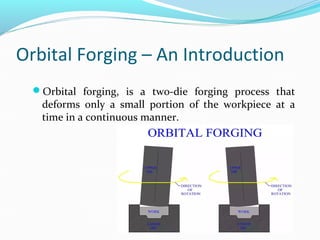
Orbital forging, is a two-die forging process that
deforms only a small portion of the workpiece at a
time in a continuous manner.
WORKING PRINCIPLE
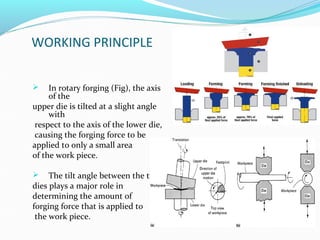
 In rotary forging (Fig), the axis
of the
upper die is tilted at a slight angle
with
respect to the axis of the lower die,
causing the forging force to be
applied to only a small area
of the work piece.
 The tilt angle between the two
dies plays a major role in
determining the amount of
forging force that is applied to
the work piece.
ROTARY FORGING-
TYPES
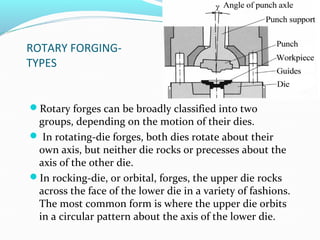
Rotary forges can be broadly classified into two
groups, depending on the motion of their dies.
 In rotating-die forges, both dies rotate about their
own axis, but neither die rocks or precesses about the
axis of the other die.
In rocking-die, or orbital, forges, the upper die rocks
across the face of the lower die in a variety of fashions.
The most common form is where the upper die orbits
in a circular pattern about the axis of the lower die.
ROTARY FORGING-TYPES
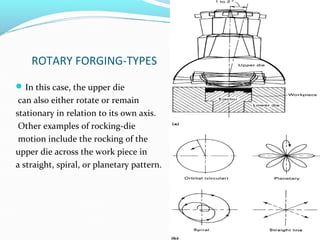
In this case, the upper die
can also either rotate or remain
stationary in relation to its own axis.
Other examples of rocking-die
motion include the rocking of the
upper die across the work piece in
a straight, spiral, or planetary pattern.
Classification of Machine
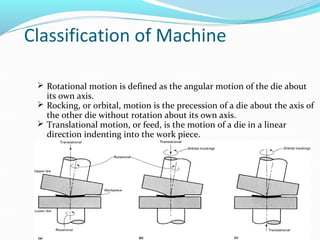
 Rotational motion is defined as the angular motion of the die about
its own axis.
 Rocking, or orbital, motion is the precession of a die about the axis of
the other die without rotation about its own axis.
 Translational motion, or feed, is the motion of a die in a linear
direction indenting into the work piece.
Advantages
o Economical:
 1. No material waste- near net shaping is a chip less operation
 2. Simplifies manufacturing- eliminates expensive secondary
machining and brazing operations
 3. Inexpensive long life tooling
• Increased material strength:
 1. Strength, hardness and surface finish improved through orbital
cold working
 2. Grain structures rearranged
 3. Less expensive materials achieve tensile strength upgrades after
the orbital cold working process.
• Consistent quality:
 1.Higher strength to weight ratio in structural components
 2.Low friction forging operation extends die life
 3.Repeatable low force forging process yields accurate manufacturing
runs
Disadvantages
1. The principal disadvantages of rotary forging lie in
the relative newness of the current technology..
2. A major problem lies in the design of rotary forge
machines.
3. The large lateral forces associated with the unique
die motion make the overall frame design of the
machines more difficult.
4.These large forces must be properly supported by the
frame in order for the forge to maintain a consistent
level of accuracy.
Difference between rotary and
radial forging:
 (a) In rotary forging, the upper die, tilted with respect to the lower die,
rotates around the work piece. The tilt angle and shape of the upper die
result in only a small area of contact (footprint) between the work piece
and the upper die at any given time. Because the footprint is typically
only about one-fifth the work piece surface area, rotary forging requires
considerably less force than conventional forging.
 (b) In radial forging, the work piece is fed between the dies, which are
given a rapid periodic motion as the work piece rotates. In this manner,
the forging force acts on only a small portion of the work piece at any
one time.
Applications
1. Automobile industry
2. Aerospace
 a) cylinders
 b) Tube
 c) Cones
 d) Rings
Work piece Configuration.
1. Parts that have been found to be applicable to rotary forging include
gears, flanges, hubs, cams, rings, and tapered rollers, as well as thin disks
and flat shapes.
2. These parts are axially symmetric and are formed by using an orbital die
motion. More complex parts can be forged through the use of such rocking-
die motions as straight line, planetary, and spiral.
3. Straight-line die motion is most commonly used to produce asymmetric
pieces, such as T-flanges.
4. Rotary forging is especially effective in forging parts that have high
diameter-to-thickness ratios.
Work piece Materials.
1.Ferrous or nonferrous, that has adequate ductility and cold-forming
qualities can be rotary forged.
2. These materials include carbon and alloy steels, stainless steels,
brass, and aluminum alloys.
3. In the past, cold-forged production parts were primarily steels with
Rockwell C hardness 30 or lower.
4.Warm rotary forging is used when the material has Rockwell C
hardness greater than 30 or when an unusually large amount of lateral
movement in the work piece is required.
5.Materials are heated to a point below their recrystallization temperature;
for steels, this is generally in the range of 650 to 800 °C (1200 to 1470 °F).
Because the working temperature is below the recrystallization
temperature, the inherent structure and properties of the metal are
preserved.
Dies
Rotary forging dies will typically produce 15,000 to 50,000 pieces
before they must be refinished.
Naturally, die life depends on the material being forged and on the
complexity of the piece.
 Therefore, die cost is lower than in other conventional forging
methods.
Lubrication of the dies, although not essential, is suggested in order
to increase die life.
 Both dies can be changed within 15 min to complete job change
and adjustments require approximately 30 min.
This makes rotary forging particularly attractive for short production
runs.
Examples
 
Example : Rotary Forging of a Copper Alloy Seal Fitting.
A rotating-die machine was used to cold forge a naval brass seal 
fitting.
 
This fitting is used in high-pressure piping, such as in air 
conditioners or steam turbines.
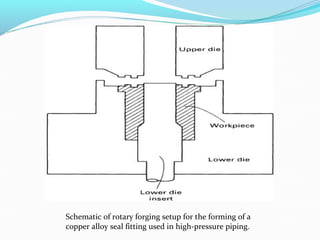
 As shown in Fig. 6, the tube preform was fitted over a cylindrical 
insert that protrudes from the lower die.
 The upper die was lowered until indentation was made. Die 
rotation then began.
 The work piece was deformed to fit the dimensions of the lower 
die and then ejected.
Schematic of rotary forging setup for the forming of a
copper alloy seal fitting used in high-pressure piping.
Applications
Rotary forging is generally considered to be a substitute for
conventional drop-hammer or press forging. Currently, parts
that are either hammer or press forged could be formed on a
rotary forge. These parts include symmetric and asymmetric
shapes. In addition, modern rotary forge machines use dies
that are 152 to 305 mm (6 to 12 in.) in diameter, limiting the
maximum size of a part. In the current technology, rotating or
orbiting die forges are mainly limited to the production of
symmetrical parts. Through a more complex die operation,
rocking-die forges are able to produce both symmetric and
asymmetric pieces.
THANK YOU

Rotary forging OR Orbital forging

  • 1.
    A SEMINAR REPORT ON “ROTARyOR ORbITAl fORgINg ”
  • 2.
    Orbital Forging –An Introduction Orbital forging, is a two-die forging process that deforms only a small portion of the workpiece at a time in a continuous manner.
  • 3.
    WORKING PRINCIPLE  Inrotary forging (Fig), the axis of the upper die is tilted at a slight angle with respect to the axis of the lower die, causing the forging force to be applied to only a small area of the work piece.  The tilt angle between the two dies plays a major role in determining the amount of forging force that is applied to the work piece.
  • 4.
    ROTARY FORGING- TYPES Rotary forgescan be broadly classified into two groups, depending on the motion of their dies.  In rotating-die forges, both dies rotate about their own axis, but neither die rocks or precesses about the axis of the other die. In rocking-die, or orbital, forges, the upper die rocks across the face of the lower die in a variety of fashions. The most common form is where the upper die orbits in a circular pattern about the axis of the lower die.
  • 5.
    ROTARY FORGING-TYPES In thiscase, the upper die can also either rotate or remain stationary in relation to its own axis. Other examples of rocking-die motion include the rocking of the upper die across the work piece in a straight, spiral, or planetary pattern.
  • 6.
    Classification of Machine Rotational motion is defined as the angular motion of the die about its own axis.  Rocking, or orbital, motion is the precession of a die about the axis of the other die without rotation about its own axis.  Translational motion, or feed, is the motion of a die in a linear direction indenting into the work piece.
  • 7.
    Advantages o Economical:  1.No material waste- near net shaping is a chip less operation  2. Simplifies manufacturing- eliminates expensive secondary machining and brazing operations  3. Inexpensive long life tooling • Increased material strength:  1. Strength, hardness and surface finish improved through orbital cold working  2. Grain structures rearranged  3. Less expensive materials achieve tensile strength upgrades after the orbital cold working process. • Consistent quality:  1.Higher strength to weight ratio in structural components  2.Low friction forging operation extends die life  3.Repeatable low force forging process yields accurate manufacturing runs
  • 8.
    Disadvantages 1. The principaldisadvantages of rotary forging lie in the relative newness of the current technology.. 2. A major problem lies in the design of rotary forge machines. 3. The large lateral forces associated with the unique die motion make the overall frame design of the machines more difficult. 4.These large forces must be properly supported by the frame in order for the forge to maintain a consistent level of accuracy.
  • 9.
    Difference between rotaryand radial forging:  (a) In rotary forging, the upper die, tilted with respect to the lower die, rotates around the work piece. The tilt angle and shape of the upper die result in only a small area of contact (footprint) between the work piece and the upper die at any given time. Because the footprint is typically only about one-fifth the work piece surface area, rotary forging requires considerably less force than conventional forging.  (b) In radial forging, the work piece is fed between the dies, which are given a rapid periodic motion as the work piece rotates. In this manner, the forging force acts on only a small portion of the work piece at any one time. Applications 1. Automobile industry 2. Aerospace  a) cylinders  b) Tube  c) Cones  d) Rings
  • 10.
    Work piece Configuration. 1.Parts that have been found to be applicable to rotary forging include gears, flanges, hubs, cams, rings, and tapered rollers, as well as thin disks and flat shapes. 2. These parts are axially symmetric and are formed by using an orbital die motion. More complex parts can be forged through the use of such rocking- die motions as straight line, planetary, and spiral. 3. Straight-line die motion is most commonly used to produce asymmetric pieces, such as T-flanges. 4. Rotary forging is especially effective in forging parts that have high diameter-to-thickness ratios.
  • 11.
    Work piece Materials. 1.Ferrousor nonferrous, that has adequate ductility and cold-forming qualities can be rotary forged. 2. These materials include carbon and alloy steels, stainless steels, brass, and aluminum alloys. 3. In the past, cold-forged production parts were primarily steels with Rockwell C hardness 30 or lower. 4.Warm rotary forging is used when the material has Rockwell C hardness greater than 30 or when an unusually large amount of lateral movement in the work piece is required. 5.Materials are heated to a point below their recrystallization temperature; for steels, this is generally in the range of 650 to 800 °C (1200 to 1470 °F). Because the working temperature is below the recrystallization temperature, the inherent structure and properties of the metal are preserved.
  • 12.
    Dies Rotary forging dieswill typically produce 15,000 to 50,000 pieces before they must be refinished. Naturally, die life depends on the material being forged and on the complexity of the piece.  Therefore, die cost is lower than in other conventional forging methods. Lubrication of the dies, although not essential, is suggested in order to increase die life.  Both dies can be changed within 15 min to complete job change and adjustments require approximately 30 min. This makes rotary forging particularly attractive for short production runs.
  • 13.
  • 14.
    Schematic of rotaryforging setup for the forming of a copper alloy seal fitting used in high-pressure piping.
  • 15.
    Applications Rotary forging isgenerally considered to be a substitute for conventional drop-hammer or press forging. Currently, parts that are either hammer or press forged could be formed on a rotary forge. These parts include symmetric and asymmetric shapes. In addition, modern rotary forge machines use dies that are 152 to 305 mm (6 to 12 in.) in diameter, limiting the maximum size of a part. In the current technology, rotating or orbiting die forges are mainly limited to the production of symmetrical parts. Through a more complex die operation, rocking-die forges are able to produce both symmetric and asymmetric pieces.
  • 16.