NUTRITIONAL LABELLING
Ramya.H.
What information does a food
label provide?
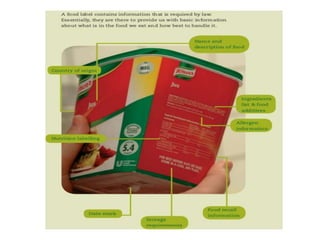
• Product name and description.
• Which nutrients, and in what quantities, are
present.
• Warnings if a food contains food allergens.
• Whether the food is fresh or out of date.
• Storage, preparation or cooking advice.
• A list of product ingredients.
• Information on where the food was produced
and by which company.
How do I check the Label?
• The Basics of the Food Label
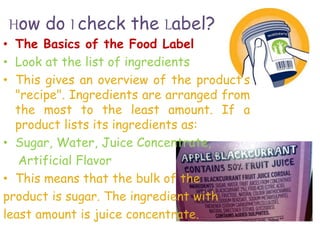
• Look at the list of ingredients
• This gives an overview of the product’s
"recipe". Ingredients are arranged from
the most to the least amount. If a
product lists its ingredients as:
• Sugar, Water, Juice Concentrate,
Artificial Flavor
• This means that the bulk of the
product is sugar. The ingredient with
least amount is juice concentrate.
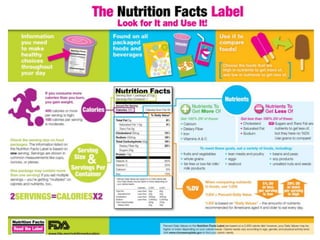
• Watch the nutrient
amounts.
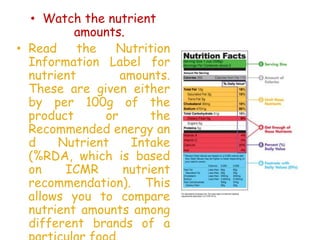
• Read the Nutrition
Information Label for
nutrient amounts.
These are given either
by per 100g of the
product or the
Recommended energy an
d Nutrient Intake
(%RDA, which is based
on ICMR nutrient
recommendation). This
allows you to compare
nutrient amounts among
different brands of a
• Get more value
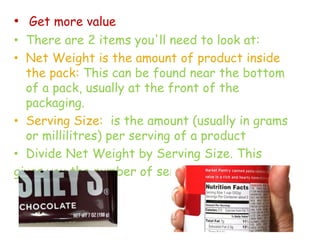
• There are 2 items you'll need to look at:
• Net Weight is the amount of product inside
the pack: This can be found near the bottom
of a pack, usually at the front of the
packaging.
• Serving Size: is the amount (usually in grams
or millilitres) per serving of a product
• Divide Net Weight by Serving Size. This
gives you the number of servings in the pack.
• Understand nutrient content claims.
They are not always as they seem!
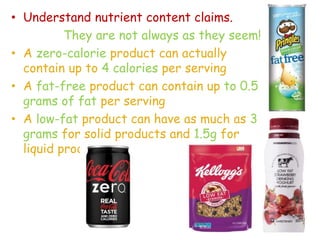
• A zero-calorie product can actually
contain up to 4 calories per serving
• A fat-free product can contain up to 0.5
grams of fat per serving
• A low-fat product can have as much as 3
grams for solid products and 1.5g for
liquid products
• Here are some pointers to help you read and
interpret the information on food labels.
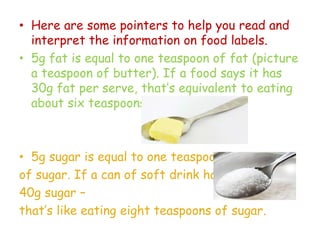
• 5g fat is equal to one teaspoon of fat (picture
a teaspoon of butter). If a food says it has
30g fat per serve, that’s equivalent to eating
about six teaspoons of butter!
• 5g sugar is equal to one teaspoon
of sugar. If a can of soft drink has
40g sugar –
that’s like eating eight teaspoons of sugar.
Contd..
• Foods with 3 g of dietary fibre means that they
are a source of dietary fibre and that with 6 g
per 100 g means that they are high in fibre.
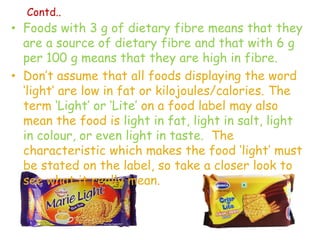
• Don’t assume that all foods displaying the word
‘light’ are low in fat or kilojoules/calories. The
term ‘Light’ or ‘Lite’ on a food label may also
mean the food is light in fat, light in salt, light
in colour, or even light in taste. The
characteristic which makes the food ‘light’ must
be stated on the label, so take a closer look to
see what it really mean.
Nutritional Labelling

Nutritional Labelling

  • 1.
  • 2.
    What information doesa food label provide? • Product name and description. • Which nutrients, and in what quantities, are present. • Warnings if a food contains food allergens. • Whether the food is fresh or out of date. • Storage, preparation or cooking advice. • A list of product ingredients. • Information on where the food was produced and by which company.
  • 4.
    How do Icheck the Label? • The Basics of the Food Label • Look at the list of ingredients • This gives an overview of the product’s "recipe". Ingredients are arranged from the most to the least amount. If a product lists its ingredients as: • Sugar, Water, Juice Concentrate, Artificial Flavor • This means that the bulk of the product is sugar. The ingredient with least amount is juice concentrate.
  • 5.
    • Watch thenutrient amounts. • Read the Nutrition Information Label for nutrient amounts. These are given either by per 100g of the product or the Recommended energy an d Nutrient Intake (%RDA, which is based on ICMR nutrient recommendation). This allows you to compare nutrient amounts among different brands of a
  • 6.
    • Get morevalue • There are 2 items you'll need to look at: • Net Weight is the amount of product inside the pack: This can be found near the bottom of a pack, usually at the front of the packaging. • Serving Size: is the amount (usually in grams or millilitres) per serving of a product • Divide Net Weight by Serving Size. This gives you the number of servings in the pack.
  • 7.
    • Understand nutrientcontent claims. They are not always as they seem! • A zero-calorie product can actually contain up to 4 calories per serving • A fat-free product can contain up to 0.5 grams of fat per serving • A low-fat product can have as much as 3 grams for solid products and 1.5g for liquid products
  • 9.
    • Here aresome pointers to help you read and interpret the information on food labels. • 5g fat is equal to one teaspoon of fat (picture a teaspoon of butter). If a food says it has 30g fat per serve, that’s equivalent to eating about six teaspoons of butter! • 5g sugar is equal to one teaspoon of sugar. If a can of soft drink has 40g sugar – that’s like eating eight teaspoons of sugar.
  • 10.
    Contd.. • Foods with3 g of dietary fibre means that they are a source of dietary fibre and that with 6 g per 100 g means that they are high in fibre. • Don’t assume that all foods displaying the word ‘light’ are low in fat or kilojoules/calories. The term ‘Light’ or ‘Lite’ on a food label may also mean the food is light in fat, light in salt, light in colour, or even light in taste. The characteristic which makes the food ‘light’ must be stated on the label, so take a closer look to see what it really mean.