


 Food labelling is used to inform
 consumers of the properties of
 pre-packaged food. The most
 important rule of labelling is that
 the consumer should not be
 misled. This section covers some
 of the main areas of food labelling
 requirements.
   The term "label" refers to any
    written, printed, or graphic matter on
    the food's immediate container.
    "Labelling" includes the label and any
    other written, printed, or graphic
    matter accompanying the product in
    commerce (e.g., point-of-sale
    pamphlets). Most label information is
    required to appear on either the
    "principal display panel" (PDP) or the
    "information panel."
The PDP is the part of the label most likely
to be displayed to, and examined
by, consumers under customary conditions
of retail sale. The information panel is
generally the panel contiguous to, and to
the right of, the PDP. If that panel is
unusable or too small, the next panel to the
right of it may serve as the information
panel. If the top of the container is the
PDP, the information panel may be any
panel adjacent to the PDP.
   General prohibition against misbranding.

    Federal law provides that a food product
    may be deemed "misbranded" if any part of
    its labelling is false or misleading. This
    general provision establishes misbranding
    even where no specific regulatory
    requirement has been violated. A food also
    may be deemed misbranded if any required
    information is not presented prominently
    enough—that is, likely to be read and
    understood by the ordinary consumer under
    usual conditions of purchase and use.
 Must  the information on the
  label be in English?
 What must appear on the
  label?
 Is there anything else that
  should go on the label?
 THE
    GENERAL LABELING
 REQUIREMENTS ARE THAT FOODS
 MUST BE LABEL IN ENGLISH.THE
 FOODS MAY ALSO BE LABELED IN
 OTHER LANGUAGES BUT ONLY IN
 ADDITION TO ENGLISH.
 INGREDIENTS
 QUANTITY OF CERTAIN INGREDIENTS
 NET QUANTITY
 DATE OF MINIMUM DURABILITY
 ANY SPECIAL STORAGE INSTRUCTIONS
  OR CONDITIONS OF USE
 BUSINESS NAME AND ADDRESS OF THE
  MANUFACTURER OR PACKAGER.
 PLACE OF ORIGIN OF THE FOOD
  STUFF IF ITS ABSENCE MIGHT
  MISLEAD THE CONSUMER TO A
  MATERIAL DEGREE.
 INSTRUCTION FOR USE IF
  NECESSARY
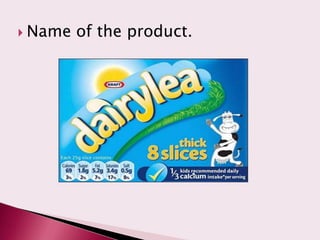
 Name   of the product.
   Statement of identity.
    The statement of identity (i.e., the name of the product) must be
    presented on the PDP. Both the FDA and the USDA have regulations
    establishing "standards of identity" for certain foods. These
    regulations prescribe the composition of a food and specify the name
    of the food to be used in labeling. For example, a food composed of
    tomato concentrate, vinegar, and spices must be identified as
    "catsup," "ketchup," or "catchup." However, not all statements of
    identity are dictated with such specificity. For any given product, the
    statement of identity is one of the following:

   The name of the food as specified in any applicable federal law or
    regulation, such as a standard of identity (e.g., "ketchup") or a federal
    common or usual name regulation (e.g, "peanut spread")
   The common or usual name of the food, established by common
    usage (e.g., "French toast")
   An appropriately descriptive term (e.g., "hard candy")
   A fanciful name commonly used by the public when the nature of the
    food is obvious (e.g., "candy corn").
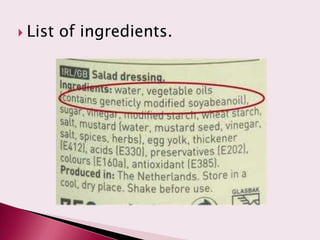
 List   of ingredients.
   Ingredients list.
    Each ingredient present in a food product must be
    listed by its common or usual name in descending
    order of predominance by weight. While most
    ingredients must be identified by their specific
    name, use of generic names is permitted for
    certain ingredients (e.g., "spices," "natural flavor").
    Special rules apply to the listing of certain types of
    ingredients. For example, chemical preservatives
    must be listed by their name, followed by a
    description of their function—such as "BHT (a
    preservative)." Certified color additives must be
    identified by their specific name (e.g., "Yellow 5" or
    "FD&C Blue 1 Lake"), but color additives not subject
    to certification may be listed using a generic term
    (e.g., "artificial color") or a specific name followed
    by a description of its function (e.g., "caramel
    color").
An ingredient that itself contains two or more
ingredients must be listed in one of two ways:
By declaring the common or usual name of the
ingredient followed by a parenthetical listing all of
its components—for example, "milk chocolate
(sugar, cocoa butter, milk, chocolate liquor, soy
lecithin, vanilla)," or
By listing each component of the multicomponent
ingredient without declaring the multicomponent
ingredient itself—for example, "sugar, cocoa
butter, milk, chocolate liquor, soy lecithin, vanilla."
The ingredients list may appear on either the PDP
or the information panel, but it usually appears on
the information panel. It must appear on the same
panel as the nutrition facts and the signature line
unless space constraints prevent such placement.
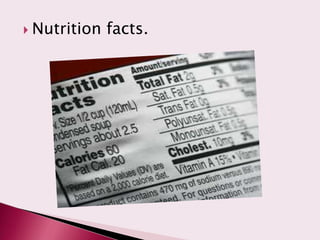
 Nutrition   facts.
   The amounts of certain nutrients present in one serving of the
    food product must be presented in the "nutrition facts" panel.
    Similar products have the same serving size so that consumers
    can easily compare nutrient levels. Nutrition facts must state
    the serving size (i.e., the size of one serving) and, unless the
    product contains only a single serving, the number of servings
    in the package. Generally, the following nutrients must be
    declared: calories, calories from fat, total fat, saturated fat,
    cholesterol, sodium, total carbohydrate, dietary fiber, sugars,
    protein, vitamin A, vitamin C, calcium, and iron. If other
    vitamins or minerals are added to the food, they also must be
    declared.
    The graphic requirements for nutrition facts are highly detailed.
    Nutrition facts generally must appear on the PDP or the
    information panel. They must appear on the same panel as the
    ingredients list and the signature line, unless there are space
    constraints.
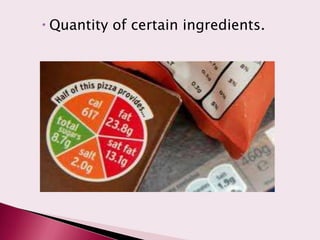
 Quantity of certain ingredients.
   The net quantity of contents must be
    presented on the PDP of the food label
    in measures both English avoirdupois
    (i.e., ounces, pounds, etc.) and metric
    (i.e., liters, grams, etc.). For meat and
    poultry products, the net contents
    declaration is required to appear only
    in avoirdupois measure.
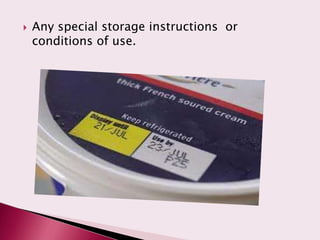
   Any special storage instructions or
    conditions of use.
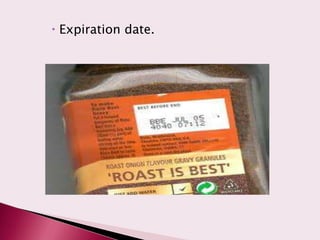
 Expiration date.
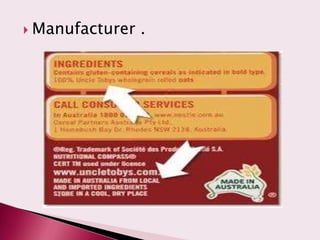
 Manufacturer   .
   The name and place of business of the manufacturer,
    packer, or distributor is typically called the "signature
    line" and must be presented on the same panel as the
    ingredients list and nutrition facts (usually the
    information panel), unless space constraints preclude
    such placement. If the name is not that of the
    manufacturer, it must be preceded by a qualifying
    phrase stating the firm's relation to the product (e.g.,
    "manufactured for" or "distributed by"). The signature
    line must include a city or town, state (or country, if
    outside the United States), and ZIP code (or mailing
    code if outside the United States). A street address
    must be provided unless the firm is listed in a current
    city or telephone directory.
   Any information that is false or misleading in any
    particular will render a product misbranded. In
    determining whether a food label is false or
    misleading, both affirmative representations and
    omissions of material facts may be considered.
    Certain information is clearly prohibited from the
    labeling of food products. This includes
    unauthorized nutrient content claims (for
    instance, claiming "high in omega-3 fatty
    acids"), health claims not authorized by FDA or
    supported by an authoritative statement, and
    disease claims (for instance, claiming "helps
    lower blood pressure" would subject a product to
    regulation as a drug).

Food labelling

  • 2.
     Food labellingis used to inform consumers of the properties of pre-packaged food. The most important rule of labelling is that the consumer should not be misled. This section covers some of the main areas of food labelling requirements.
  • 3.
    The term "label" refers to any written, printed, or graphic matter on the food's immediate container. "Labelling" includes the label and any other written, printed, or graphic matter accompanying the product in commerce (e.g., point-of-sale pamphlets). Most label information is required to appear on either the "principal display panel" (PDP) or the "information panel."
  • 4.
    The PDP isthe part of the label most likely to be displayed to, and examined by, consumers under customary conditions of retail sale. The information panel is generally the panel contiguous to, and to the right of, the PDP. If that panel is unusable or too small, the next panel to the right of it may serve as the information panel. If the top of the container is the PDP, the information panel may be any panel adjacent to the PDP.
  • 5.
    General prohibition against misbranding. Federal law provides that a food product may be deemed "misbranded" if any part of its labelling is false or misleading. This general provision establishes misbranding even where no specific regulatory requirement has been violated. A food also may be deemed misbranded if any required information is not presented prominently enough—that is, likely to be read and understood by the ordinary consumer under usual conditions of purchase and use.
  • 7.
     Must the information on the label be in English?  What must appear on the label?  Is there anything else that should go on the label?
  • 8.
     THE GENERAL LABELING REQUIREMENTS ARE THAT FOODS MUST BE LABEL IN ENGLISH.THE FOODS MAY ALSO BE LABELED IN OTHER LANGUAGES BUT ONLY IN ADDITION TO ENGLISH.
  • 9.
     INGREDIENTS  QUANTITYOF CERTAIN INGREDIENTS  NET QUANTITY  DATE OF MINIMUM DURABILITY  ANY SPECIAL STORAGE INSTRUCTIONS OR CONDITIONS OF USE  BUSINESS NAME AND ADDRESS OF THE MANUFACTURER OR PACKAGER.
  • 10.
     PLACE OFORIGIN OF THE FOOD STUFF IF ITS ABSENCE MIGHT MISLEAD THE CONSUMER TO A MATERIAL DEGREE.  INSTRUCTION FOR USE IF NECESSARY
  • 11.
     Name of the product.
  • 12.
    Statement of identity. The statement of identity (i.e., the name of the product) must be presented on the PDP. Both the FDA and the USDA have regulations establishing "standards of identity" for certain foods. These regulations prescribe the composition of a food and specify the name of the food to be used in labeling. For example, a food composed of tomato concentrate, vinegar, and spices must be identified as "catsup," "ketchup," or "catchup." However, not all statements of identity are dictated with such specificity. For any given product, the statement of identity is one of the following:  The name of the food as specified in any applicable federal law or regulation, such as a standard of identity (e.g., "ketchup") or a federal common or usual name regulation (e.g, "peanut spread")  The common or usual name of the food, established by common usage (e.g., "French toast")  An appropriately descriptive term (e.g., "hard candy")  A fanciful name commonly used by the public when the nature of the food is obvious (e.g., "candy corn").
  • 13.
     List of ingredients.
  • 14.
    Ingredients list. Each ingredient present in a food product must be listed by its common or usual name in descending order of predominance by weight. While most ingredients must be identified by their specific name, use of generic names is permitted for certain ingredients (e.g., "spices," "natural flavor"). Special rules apply to the listing of certain types of ingredients. For example, chemical preservatives must be listed by their name, followed by a description of their function—such as "BHT (a preservative)." Certified color additives must be identified by their specific name (e.g., "Yellow 5" or "FD&C Blue 1 Lake"), but color additives not subject to certification may be listed using a generic term (e.g., "artificial color") or a specific name followed by a description of its function (e.g., "caramel color").
  • 15.
    An ingredient thatitself contains two or more ingredients must be listed in one of two ways: By declaring the common or usual name of the ingredient followed by a parenthetical listing all of its components—for example, "milk chocolate (sugar, cocoa butter, milk, chocolate liquor, soy lecithin, vanilla)," or By listing each component of the multicomponent ingredient without declaring the multicomponent ingredient itself—for example, "sugar, cocoa butter, milk, chocolate liquor, soy lecithin, vanilla." The ingredients list may appear on either the PDP or the information panel, but it usually appears on the information panel. It must appear on the same panel as the nutrition facts and the signature line unless space constraints prevent such placement.
  • 16.
  • 17.
    The amounts of certain nutrients present in one serving of the food product must be presented in the "nutrition facts" panel. Similar products have the same serving size so that consumers can easily compare nutrient levels. Nutrition facts must state the serving size (i.e., the size of one serving) and, unless the product contains only a single serving, the number of servings in the package. Generally, the following nutrients must be declared: calories, calories from fat, total fat, saturated fat, cholesterol, sodium, total carbohydrate, dietary fiber, sugars, protein, vitamin A, vitamin C, calcium, and iron. If other vitamins or minerals are added to the food, they also must be declared. The graphic requirements for nutrition facts are highly detailed. Nutrition facts generally must appear on the PDP or the information panel. They must appear on the same panel as the ingredients list and the signature line, unless there are space constraints.
  • 18.
     Quantity ofcertain ingredients.
  • 19.
    The net quantity of contents must be presented on the PDP of the food label in measures both English avoirdupois (i.e., ounces, pounds, etc.) and metric (i.e., liters, grams, etc.). For meat and poultry products, the net contents declaration is required to appear only in avoirdupois measure.
  • 20.
    Any special storage instructions or conditions of use.
  • 21.
  • 22.
  • 23.
    The name and place of business of the manufacturer, packer, or distributor is typically called the "signature line" and must be presented on the same panel as the ingredients list and nutrition facts (usually the information panel), unless space constraints preclude such placement. If the name is not that of the manufacturer, it must be preceded by a qualifying phrase stating the firm's relation to the product (e.g., "manufactured for" or "distributed by"). The signature line must include a city or town, state (or country, if outside the United States), and ZIP code (or mailing code if outside the United States). A street address must be provided unless the firm is listed in a current city or telephone directory.
  • 24.
    Any information that is false or misleading in any particular will render a product misbranded. In determining whether a food label is false or misleading, both affirmative representations and omissions of material facts may be considered. Certain information is clearly prohibited from the labeling of food products. This includes unauthorized nutrient content claims (for instance, claiming "high in omega-3 fatty acids"), health claims not authorized by FDA or supported by an authoritative statement, and disease claims (for instance, claiming "helps lower blood pressure" would subject a product to regulation as a drug).