CLOUD COMPUTING
When it's smarter to rent
than to buy..
Presented by:
MOHIT PANDEY
COMPUTER SCIENCE ENGINEERING
AITS
What is Cloud Computing?.
• An environment created in a user’s machine from
an on-line application stored on the cloud and run
through a web browser.
• In the simplest terms,cloud computing means
storing and accessing data and programs over the
Internet instead of your computer's hard drive.
The cloud is just a metaphor for the Internet.
Types of Computing
:
That share characteristics with cloud computing :
1.Autonomic Computing
2.Client – Server model
3.Grid Computing
4.Mainframe Computer
5.Utility Computer
6.Peer to Peer
Types of cloud computing :
Based on the usage cloud computing is divided into 4 major
types. Each of which has their limitations and their area of
use. They are as follows :
•Public cloud
•Community cloud
•Hybrid cloud
•Private cloud
Applications of cloud
computing :
The applications of cloud computing are practically limitless.
Potentially, everything from generic word processing software to
customized computer programs designed for a specific company could
work on a cloud computing system.
•Clients would be able to access their applications and data from
anywhere at any time.
•Cloud computing gives the companies the option of storing data on
someone else's hardware, removing the need for physical space on
the front end.
•Google docs is another application of Cloud Computing.
Real Time Applications :
Real time applications of cloud computing includes one of the
most widely used concept of Google cloud printing which
provides printing on the go.
Another real time application of the cloud computing is the
usage of cloud printing by the traffic police to print the challan
by using a smartphone.
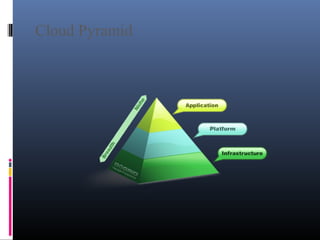
Cloud Pyramid
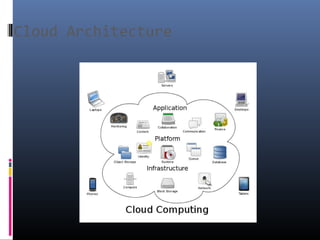
Cloud Architecture
Cloud Computing Services
 Software as a Service (SaaS)-End Users
 Platform as a Service (PaaS)-Application Developers
 Infrastructure as a Service (IaaS)-Network Architects
Platform as a Service (PaaS)-
Application Developers
• Give us nice API (Application Programming
Interface) and take care of the implementation.
• In the PaaS model, cloud providers deliver a
computing platform and/or solution stack
typically including operating system,
programming language execution environment,
database, and web server.
• is a platform for developers to write and create
their own applications.
• which means rapid development at low cost.
• E.g.: Salesforce.com, Windows Azure etc.
Infrastructure as a Service (IaaS)-Network
Architect
 also known as hardware as a service.
 is a computing power that you can rent for a limited
period of time.
 allows existing applications to be run on a cloud
suppliers hardware.
 cloud providers offer computers – as physical or
more often as virtual machines – raw (block)
storage, firewalls, load balancers, and networks
Modes of Clouds
Public Cloud
• Computing infrastructure is hosted by cloud vendor at the
vendors premises.
• and can be shared by various organizations.
• E.g. : Amazon, Google, Microsoft, Sales force
Private Cloud
• The computing infrastructure is dedicated to a particular
organization and not shared with other organizations.
• more expensive and more secure when compare to public
cloud.
• E.g. : HP data center, IBM, Sun, Oracle, 3tera
Hybrid Cloud
• Organizations may host critical applications on private clouds.
• where as relatively less security concerns on public cloud.
• usage of both public and private together is called hybrid
cloud.
Advantages of Cloud
Computing :
There are many ways in which the concept of
cloud computing  has advantage over the other types of
computing .
The five main advantages of cloud computing
which have proved very much useful to the mankind over
the decade are as follows…
1. Reduced Cost :
Cloud technology is paid incrementally, saving
organizations money. 
Organizations can store more data than on private
computer systems.
2. Increased Storage :
3. Highly Automated :
No longer do IT personnel need to worry about
keeping software up to date.
4. Flexibility :
Cloud computing offers much more flexibility than past
computing methods.
5. More Mobility :
Employees can access information wherever they
are, rather than having to remain at their desks.
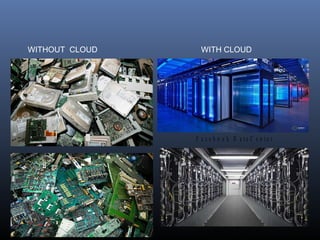
Is Cloud Computing reduces E-Waste?.
 Green IT Cloud Computing
 Cloud Computing is Eco-Friendly.
 We can reduce E-waste by using Cloud
Computing i.e. by Infrastructure as a Service
(IaaS).
 Cloud Computing Helps to Accelerate Green IT
 Can reduce Global Warming too..
F a c e b o o k D a t e C e n t e r
G o o g l e S e r v e r
WITHOUT CLOUD WITH CLOUD
Disadvantages of Cloud Computing
 Cloud computing is impossible if you cannot connect to
the Internet.
 Since you use the Internet to connect to both your
applications and documents, if you do not have an
Internet connection you cannot access anything, even
your own documents.
 A dead Internet connection means no work and in areas
where Internet connections are few or inherently
unreliable, this could be a deal-breaker.
 When you are offline, cloud computing simply does not
work.
CONCLUSION
Cloud computing is an online form of computing , where a user can
access applications via a browser while the application is installed and
stored on a server. This is a new form of computing in which
thousands of users all around the world can access something without
downloading and installing anything on their laptops or personal
computers.
Queries?..
Thanking You

Cloud computing

  • 2.
    CLOUD COMPUTING When it'ssmarter to rent than to buy.. Presented by: MOHIT PANDEY COMPUTER SCIENCE ENGINEERING AITS
  • 3.
    What is CloudComputing?. • An environment created in a user’s machine from an on-line application stored on the cloud and run through a web browser. • In the simplest terms,cloud computing means storing and accessing data and programs over the Internet instead of your computer's hard drive. The cloud is just a metaphor for the Internet.
  • 4.
    Types of Computing : Thatshare characteristics with cloud computing : 1.Autonomic Computing 2.Client – Server model 3.Grid Computing 4.Mainframe Computer 5.Utility Computer 6.Peer to Peer
  • 5.
    Types of cloudcomputing : Based on the usage cloud computing is divided into 4 major types. Each of which has their limitations and their area of use. They are as follows : •Public cloud •Community cloud •Hybrid cloud •Private cloud
  • 6.
    Applications of cloud computing: The applications of cloud computing are practically limitless. Potentially, everything from generic word processing software to customized computer programs designed for a specific company could work on a cloud computing system. •Clients would be able to access their applications and data from anywhere at any time. •Cloud computing gives the companies the option of storing data on someone else's hardware, removing the need for physical space on the front end. •Google docs is another application of Cloud Computing.
  • 7.
    Real Time Applications: Real time applications of cloud computing includes one of the most widely used concept of Google cloud printing which provides printing on the go. Another real time application of the cloud computing is the usage of cloud printing by the traffic police to print the challan by using a smartphone.
  • 8.
  • 9.
  • 10.
    Cloud Computing Services Software as a Service (SaaS)-End Users  Platform as a Service (PaaS)-Application Developers  Infrastructure as a Service (IaaS)-Network Architects
  • 11.
    Platform as aService (PaaS)- Application Developers • Give us nice API (Application Programming Interface) and take care of the implementation. • In the PaaS model, cloud providers deliver a computing platform and/or solution stack typically including operating system, programming language execution environment, database, and web server. • is a platform for developers to write and create their own applications. • which means rapid development at low cost. • E.g.: Salesforce.com, Windows Azure etc.
  • 12.
    Infrastructure as aService (IaaS)-Network Architect  also known as hardware as a service.  is a computing power that you can rent for a limited period of time.  allows existing applications to be run on a cloud suppliers hardware.  cloud providers offer computers – as physical or more often as virtual machines – raw (block) storage, firewalls, load balancers, and networks
  • 13.
    Modes of Clouds PublicCloud • Computing infrastructure is hosted by cloud vendor at the vendors premises. • and can be shared by various organizations. • E.g. : Amazon, Google, Microsoft, Sales force Private Cloud • The computing infrastructure is dedicated to a particular organization and not shared with other organizations. • more expensive and more secure when compare to public cloud. • E.g. : HP data center, IBM, Sun, Oracle, 3tera Hybrid Cloud • Organizations may host critical applications on private clouds. • where as relatively less security concerns on public cloud. • usage of both public and private together is called hybrid cloud.
  • 14.
    Advantages of Cloud Computing: There are many ways in which the concept of cloud computing  has advantage over the other types of computing . The five main advantages of cloud computing which have proved very much useful to the mankind over the decade are as follows…
  • 15.
    1. Reduced Cost: Cloud technology is paid incrementally, saving organizations money. 
  • 16.
    Organizations can storemore data than on private computer systems. 2. Increased Storage :
  • 17.
    3. Highly Automated: No longer do IT personnel need to worry about keeping software up to date.
  • 18.
    4. Flexibility : Cloudcomputing offers much more flexibility than past computing methods.
  • 19.
    5. More Mobility: Employees can access information wherever they are, rather than having to remain at their desks.
  • 20.
    Is Cloud Computingreduces E-Waste?.  Green IT Cloud Computing  Cloud Computing is Eco-Friendly.  We can reduce E-waste by using Cloud Computing i.e. by Infrastructure as a Service (IaaS).  Cloud Computing Helps to Accelerate Green IT  Can reduce Global Warming too..
  • 21.
    F a ce b o o k D a t e C e n t e r G o o g l e S e r v e r WITHOUT CLOUD WITH CLOUD
  • 22.
    Disadvantages of CloudComputing  Cloud computing is impossible if you cannot connect to the Internet.  Since you use the Internet to connect to both your applications and documents, if you do not have an Internet connection you cannot access anything, even your own documents.  A dead Internet connection means no work and in areas where Internet connections are few or inherently unreliable, this could be a deal-breaker.  When you are offline, cloud computing simply does not work.
  • 24.
    CONCLUSION Cloud computing isan online form of computing , where a user can access applications via a browser while the application is installed and stored on a server. This is a new form of computing in which thousands of users all around the world can access something without downloading and installing anything on their laptops or personal computers.
  • 25.