Focus Group Guide by Rafael Porto Carrero
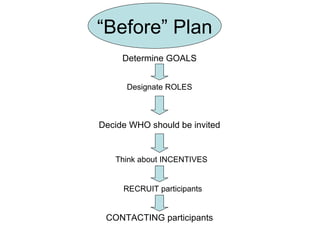
“ Before” Plan Determine GOALS Decide WHO should be invited RECRUIT participants CONTACTING participants Designate ROLES Think about INCENTIVES
Determine GOALS What is the purpose of the study? What do you wish to gain from the focus group?
Designate ROLES  The  moderator  should be Comfortable with leading a group Able to guide the discussion The  assistant moderator  should be different than the moderator Demographics Experiences
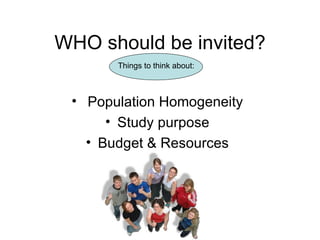
WHO should be invited? Population Homogeneity Study purpose Budget & Resources Things to think about:
Incentives Incentives can speed up recruitment Incentive types depend on knowing what matters to the participants Money is often most convenient incentive
RECRUIT participants Get the word out! Things to include:  Study particulars Incentives Contact information
CONTACTING participants Initial Screening -~2 weeks before the session -Drop names Reminder Calls -The day before the session -Short & Simple
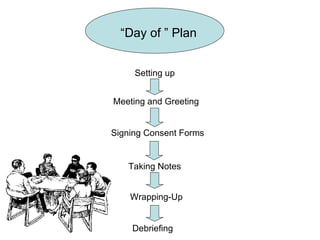
“ Day of ” Plan Setting up  Meeting and Greeting Wrapping-Up Debriefing  Taking Notes Signing Consent Forms
Setting up  Refreshments   Consent forms Note-taking supplies Seating   Recorders
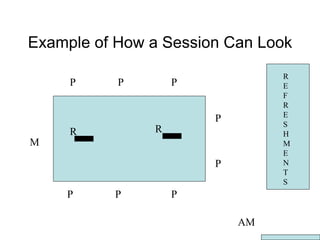
Example of How a Session Can Look M P P P P P P P P REFRESHMENTS AM R R
Meeting and greeting Sets the atmosphere for participants to get acquainted Encourages everyone to talk in a group Designed to make people feel comfortable by identifying common characteristics
Informed consent Human Subjects Research Review Committee defines issues that need to be addressed Whenever subjects may be at risk, a statement of informed consent must be presented and signed. Informed Consent must: Explain potential risks to participants in project Inform participant of their rights in project
Starting the discussion Moderator facilitates introductions Assistant begins recording, taking notes Moderator guides discussion and  facilitates interaction Notes ideas to bring up later
Taking notes  Do not participate unless asked to Sketch seating assignment  Do not attempt to write everything Capture well-said quotes word for word Include nonverbal communication Nods, emotion, eye contact Note questions for wrap-up
Meeting Wrap-Up Options for closing: Summarize main points and invite additional comments and questions Address questions that were deferred to end Sign for incentives  Thank everyone Move people out the door
De-briefing ASAP --  FIRST –  Make sure the recording worked!   --  Then  -- The moderator and assistant compare notes and think about how to structure the analysis
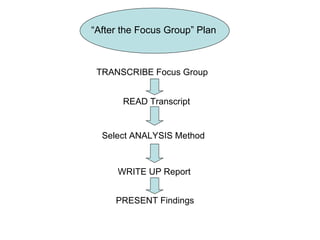
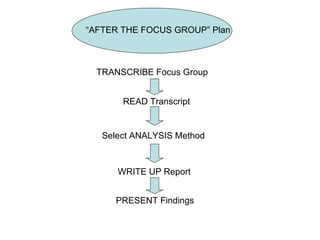
“ After the Focus Group” Plan TRANSCRIBE Focus Group READ Transcript PRESENT Findings WRITE UP Report Select ANALYSIS Method
Transcribing Identify the moderator Delete  “umms” and “ahs” Type comments word for word Use parentheses for non words e.g. laughter, interruptions, collective agreement + disagreement, prolonged silences  Remember:  It will take longer than you think!
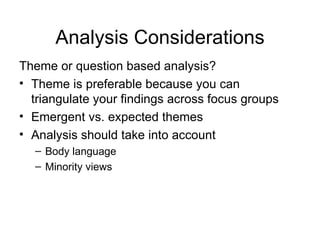
Analysis Considerations Theme or question based analysis? Theme is preferable because you can triangulate your findings across focus groups Emergent vs. expected themes  Analysis should take into account  Body language Minority views
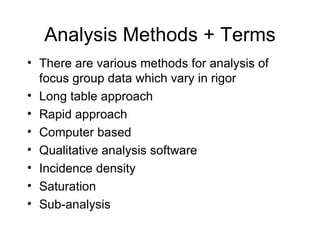
Analysis Methods + Terms There are various methods for analysis of focus group data which vary in rigor  Long table approach  Rapid approach Computer based  Qualitative analysis software  Incidence density Saturation Sub-analysis
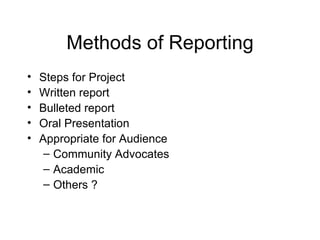
Methods of Reporting Steps for Project  Written report Bulleted report Oral Presentation Appropriate for Audience  Community Advocates  Academic Others ?
“ AFTER THE FOCUS GROUP” Plan TRANSCRIBE Focus Group READ Transcript PRESENT Findings WRITE UP Report Select ANALYSIS Method
Transcribing Identify the moderator Method depends on resources and time  Delete  “umms” and “ahs” Type comments word for word Use parentheses for non words e.g. laughter, interruptions, collective agreement + disagreement, prolonged silences  Remember:  It will take longer than you think!
Analysis Considerations Theme or question based analysis? Theme is preferable because you can triangulate your findings across focus groups Emergent vs. expected themes  Analysis should take into account  Body language Minority views
Analysis Methods + Terms There are various methods for analysis of focus group data which vary in rigor  Long table approach  Rapid approach Computer based  Qualitative analysis software  Incidence density Extensiveness and intensity Saturation Sub-analysis
Methods of Reporting Steps for Project  Written report Bulleted report Oral Presentation Appropriate for Audience  Community Advocates  Academic Others ?
Questions

Focus group guide

  • 1.
    Focus Group Guideby Rafael Porto Carrero
  • 2.
    “ Before” PlanDetermine GOALS Decide WHO should be invited RECRUIT participants CONTACTING participants Designate ROLES Think about INCENTIVES
  • 3.
    Determine GOALS Whatis the purpose of the study? What do you wish to gain from the focus group?
  • 4.
    Designate ROLES The moderator should be Comfortable with leading a group Able to guide the discussion The assistant moderator should be different than the moderator Demographics Experiences
  • 5.
    WHO should beinvited? Population Homogeneity Study purpose Budget & Resources Things to think about:
  • 6.
    Incentives Incentives canspeed up recruitment Incentive types depend on knowing what matters to the participants Money is often most convenient incentive
  • 7.
    RECRUIT participants Getthe word out! Things to include: Study particulars Incentives Contact information
  • 8.
    CONTACTING participants InitialScreening -~2 weeks before the session -Drop names Reminder Calls -The day before the session -Short & Simple
  • 9.
    “ Day of” Plan Setting up Meeting and Greeting Wrapping-Up Debriefing Taking Notes Signing Consent Forms
  • 10.
    Setting up Refreshments Consent forms Note-taking supplies Seating Recorders
  • 11.
    Example of Howa Session Can Look M P P P P P P P P REFRESHMENTS AM R R
  • 12.
    Meeting and greetingSets the atmosphere for participants to get acquainted Encourages everyone to talk in a group Designed to make people feel comfortable by identifying common characteristics
  • 13.
    Informed consent HumanSubjects Research Review Committee defines issues that need to be addressed Whenever subjects may be at risk, a statement of informed consent must be presented and signed. Informed Consent must: Explain potential risks to participants in project Inform participant of their rights in project
  • 14.
    Starting the discussionModerator facilitates introductions Assistant begins recording, taking notes Moderator guides discussion and facilitates interaction Notes ideas to bring up later
  • 15.
    Taking notes Do not participate unless asked to Sketch seating assignment Do not attempt to write everything Capture well-said quotes word for word Include nonverbal communication Nods, emotion, eye contact Note questions for wrap-up
  • 16.
    Meeting Wrap-Up Optionsfor closing: Summarize main points and invite additional comments and questions Address questions that were deferred to end Sign for incentives Thank everyone Move people out the door
  • 17.
    De-briefing ASAP -- FIRST – Make sure the recording worked! -- Then -- The moderator and assistant compare notes and think about how to structure the analysis
  • 18.
    “ After theFocus Group” Plan TRANSCRIBE Focus Group READ Transcript PRESENT Findings WRITE UP Report Select ANALYSIS Method
  • 19.
    Transcribing Identify themoderator Delete “umms” and “ahs” Type comments word for word Use parentheses for non words e.g. laughter, interruptions, collective agreement + disagreement, prolonged silences Remember: It will take longer than you think!
  • 20.
    Analysis Considerations Themeor question based analysis? Theme is preferable because you can triangulate your findings across focus groups Emergent vs. expected themes Analysis should take into account Body language Minority views
  • 21.
    Analysis Methods +Terms There are various methods for analysis of focus group data which vary in rigor Long table approach Rapid approach Computer based Qualitative analysis software Incidence density Saturation Sub-analysis
  • 22.
    Methods of ReportingSteps for Project Written report Bulleted report Oral Presentation Appropriate for Audience Community Advocates Academic Others ?
  • 23.
    “ AFTER THEFOCUS GROUP” Plan TRANSCRIBE Focus Group READ Transcript PRESENT Findings WRITE UP Report Select ANALYSIS Method
  • 24.
    Transcribing Identify themoderator Method depends on resources and time Delete “umms” and “ahs” Type comments word for word Use parentheses for non words e.g. laughter, interruptions, collective agreement + disagreement, prolonged silences Remember: It will take longer than you think!
  • 25.
    Analysis Considerations Themeor question based analysis? Theme is preferable because you can triangulate your findings across focus groups Emergent vs. expected themes Analysis should take into account Body language Minority views
  • 26.
    Analysis Methods +Terms There are various methods for analysis of focus group data which vary in rigor Long table approach Rapid approach Computer based Qualitative analysis software Incidence density Extensiveness and intensity Saturation Sub-analysis
  • 27.
    Methods of ReportingSteps for Project Written report Bulleted report Oral Presentation Appropriate for Audience Community Advocates Academic Others ?
  • 28.