FOCUS GROUP
DISCUSSION
By
Sumbal
MPhil Sociology
Email: sumbalfarooq43@gmail.com
What is focus group discussion?
• Gathering people from similar backgrounds or experiences together to
discuss a specific topic of interest.
• In FGD questions are asked about perceptions attitudes, beliefs, opinion or
ideas.
• In FDG participants are free to talk with other group members.
• It generally involves group interviewing in which a small group of usually 8
to 12 people.
• It is led by a moderator (interviewer) in a loosely structured discussion of
various topics of interest.
What is focus group discussion?
• The group discussion should be carefully planned to create a comforting
environment for participants to feel free to talk openly and give honest
opinions.
• All the participants are encouraging to express their own opinions and to
respond to other members questions.
• FDGs are structured, directed and expressive to yield a lot of information in
a short period of time.
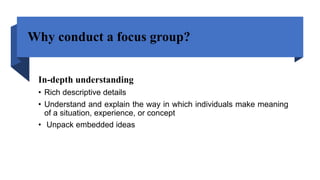
Why conduct a focus group?
• To find solution to problems
• To deepen understanding of Qualitative data
• To investigate group attitudes and beliefs
• When there is believed to be a difference in power between the researcher and
participants
• To investigate complex ideas and behavior
• To explore difference and commonalities
• To generate ideas at the exploratory stage
Why conduct a focus group?
In-depth understanding
• Rich descriptive details
• Understand and explain the way in which individuals make meaning
of a situation, experience, or concept
• Unpack embedded ideas
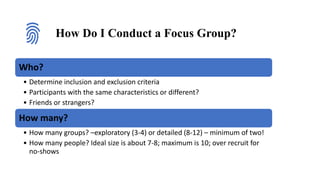
How Do I Conduct a Focus Group?
Who?
• Determine inclusion and exclusion criteria
• Participants with the same characteristics or different?
• Friends or strangers?
How many?
• How many groups? –exploratory (3-4) or detailed (8-12) – minimum of two!
• How many people? Ideal size is about 7-8; maximum is 10; over recruit for
no-shows
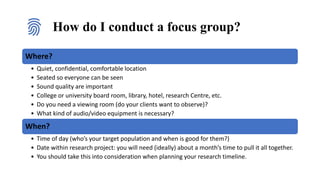
How do I conduct a focus group?
Where?
• Quiet, confidential, comfortable location
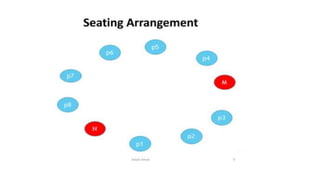
• Seated so everyone can be seen
• Sound quality are important
• College or university board room, library, hotel, research Centre, etc.
• Do you need a viewing room (do your clients want to observe)?
• What kind of audio/video equipment is necessary?
When?
• Time of day (who’s your target population and when is good for them?)
• Date within research project: you will need (ideally) about a month’s time to pull it all together.
• You should take this into consideration when planning your research timeline.
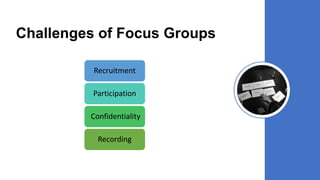
Challenges of Focus Groups
Recruitment
Participation
Confidentiality
Recording
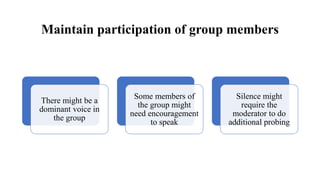
Maintain participation of group members
There might be a
dominant voice in
the group
Some members of
the group might
need encouragement
to speak
Silence might
require the
moderator to do
additional probing
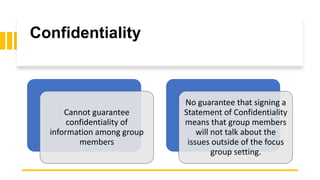
Confidentiality
Cannot guarantee
confidentiality of
information among group
members
No guarantee that signing a
Statement of Confidentiality
means that group members
will not talk about the
issues outside of the focus
group setting.
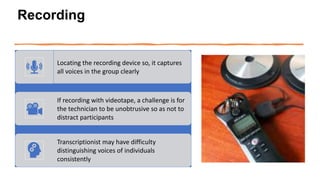
Recording
Locating the recording device so, it captures
all voices in the group clearly
If recording with videotape, a challenge is for
the technician to be unobtrusive so as not to
distract participants
Transcriptionist may have difficulty
distinguishing voices of individuals
consistently
What other
challenges
can you think
of?
FOCUS GROUP DISCUSSION.pptx

FOCUS GROUP DISCUSSION.pptx

  • 1.
  • 2.
    What is focusgroup discussion? • Gathering people from similar backgrounds or experiences together to discuss a specific topic of interest. • In FGD questions are asked about perceptions attitudes, beliefs, opinion or ideas. • In FDG participants are free to talk with other group members. • It generally involves group interviewing in which a small group of usually 8 to 12 people. • It is led by a moderator (interviewer) in a loosely structured discussion of various topics of interest.
  • 3.
    What is focusgroup discussion? • The group discussion should be carefully planned to create a comforting environment for participants to feel free to talk openly and give honest opinions. • All the participants are encouraging to express their own opinions and to respond to other members questions. • FDGs are structured, directed and expressive to yield a lot of information in a short period of time.
  • 5.
    Why conduct afocus group? • To find solution to problems • To deepen understanding of Qualitative data • To investigate group attitudes and beliefs • When there is believed to be a difference in power between the researcher and participants • To investigate complex ideas and behavior • To explore difference and commonalities • To generate ideas at the exploratory stage
  • 6.
    Why conduct afocus group? In-depth understanding • Rich descriptive details • Understand and explain the way in which individuals make meaning of a situation, experience, or concept • Unpack embedded ideas
  • 7.
    How Do IConduct a Focus Group? Who? • Determine inclusion and exclusion criteria • Participants with the same characteristics or different? • Friends or strangers? How many? • How many groups? –exploratory (3-4) or detailed (8-12) – minimum of two! • How many people? Ideal size is about 7-8; maximum is 10; over recruit for no-shows
  • 8.
    How do Iconduct a focus group? Where? • Quiet, confidential, comfortable location • Seated so everyone can be seen • Sound quality are important • College or university board room, library, hotel, research Centre, etc. • Do you need a viewing room (do your clients want to observe)? • What kind of audio/video equipment is necessary? When? • Time of day (who’s your target population and when is good for them?) • Date within research project: you will need (ideally) about a month’s time to pull it all together. • You should take this into consideration when planning your research timeline.
  • 9.
    Challenges of FocusGroups Recruitment Participation Confidentiality Recording
  • 10.
    Maintain participation ofgroup members There might be a dominant voice in the group Some members of the group might need encouragement to speak Silence might require the moderator to do additional probing
  • 11.
    Confidentiality Cannot guarantee confidentiality of informationamong group members No guarantee that signing a Statement of Confidentiality means that group members will not talk about the issues outside of the focus group setting.
  • 12.
    Recording Locating the recordingdevice so, it captures all voices in the group clearly If recording with videotape, a challenge is for the technician to be unobtrusive so as not to distract participants Transcriptionist may have difficulty distinguishing voices of individuals consistently
  • 13.