International Research Journal of Engineering and Technology (IRJET) e-ISSN: 2395 -0056
Volume: 04 Issue: 06 | June -2017 www.irjet.net p-ISSN: 2395-0072
© 2017, IRJET | Impact Factor value: 5.181 | ISO 9001:2008 Certified Journal | Page 263
Quality Improvement Using FMEA : A Short Review
Sourabh Rana1, Dr. R.M.Belokar2
1Production Engineering Department PEC University of Technology, Chandigarh
2Production Engineering Department PEC University of Technology. Chandigarh
---------------------------------------------------------------------***---------------------------------------------------------------------
Abstract - - Failure mode and effect analysis (FMEA) is
systematic, proactive method for evaluating the process to
identify were and it might be fail to assist the relevant impact
of different failures in order to identify the part of processes
that are most needed of the change. The FMEA process
associated with step wise process starting from potential
failure causes ,study existing and complete the working of
mechanism , calculate the risk priority number (RPN)of
existing and modified. The presented paper deals with the
review of industrial case study and implementation of FMEA
on them. This work discusses about implementationofProcess
Failure mode and effect analysis for improvement in welding
process through better ment in various sub-processes . We
considered various parameters and examined them. The
parameters are discussed along with their rankings. Severity,
Occurrence and Detection are detected to calculate the Risk
Priority Number (RPN). The Risk Priority Number (RPN) can
be obtained by multiplying Occurrence with Severity and
Detection. RPN gives the idea about the most affecting
parameters in the existing welding process. We detected how
failure can occur and suggested the preventive action.
Key Words: Severity, Occurrence, Detection and RPN,
DFMEA, PFMEA, SAW Welding and risk evaluation.
1.INTRODUCTION
The purpose of FMEA is to analyze the design
characteristics relative to the planned manufacturing
process to ensure that the resultant product meets
customer needs and expectations. When modes of
failure are identified, improvement can be done by
reducing the chances for occurrence by taking some
correct actions . FMEA provides an organized analysis
of failure modes of the system being defined and
identifies related causes. It uses probabilities of
detection and occurance in addition with a severity
criteria to develop a risk priority number (RPN) for
ranking corrective action considerations. Used in both
the design and manufacturing processes, they
substantially reduce costs by identifying product and
process improvements early in the develop process
when changes are relatively easy and inexpensive to
make. The result obtainedfoundrobust,astheneedfor
post corrective action and problems are reduced
completely. This project discuses and implementation
of Process Failure mode and effect analysis for
improvement in all sub-processes involved till the
completion of welding process.
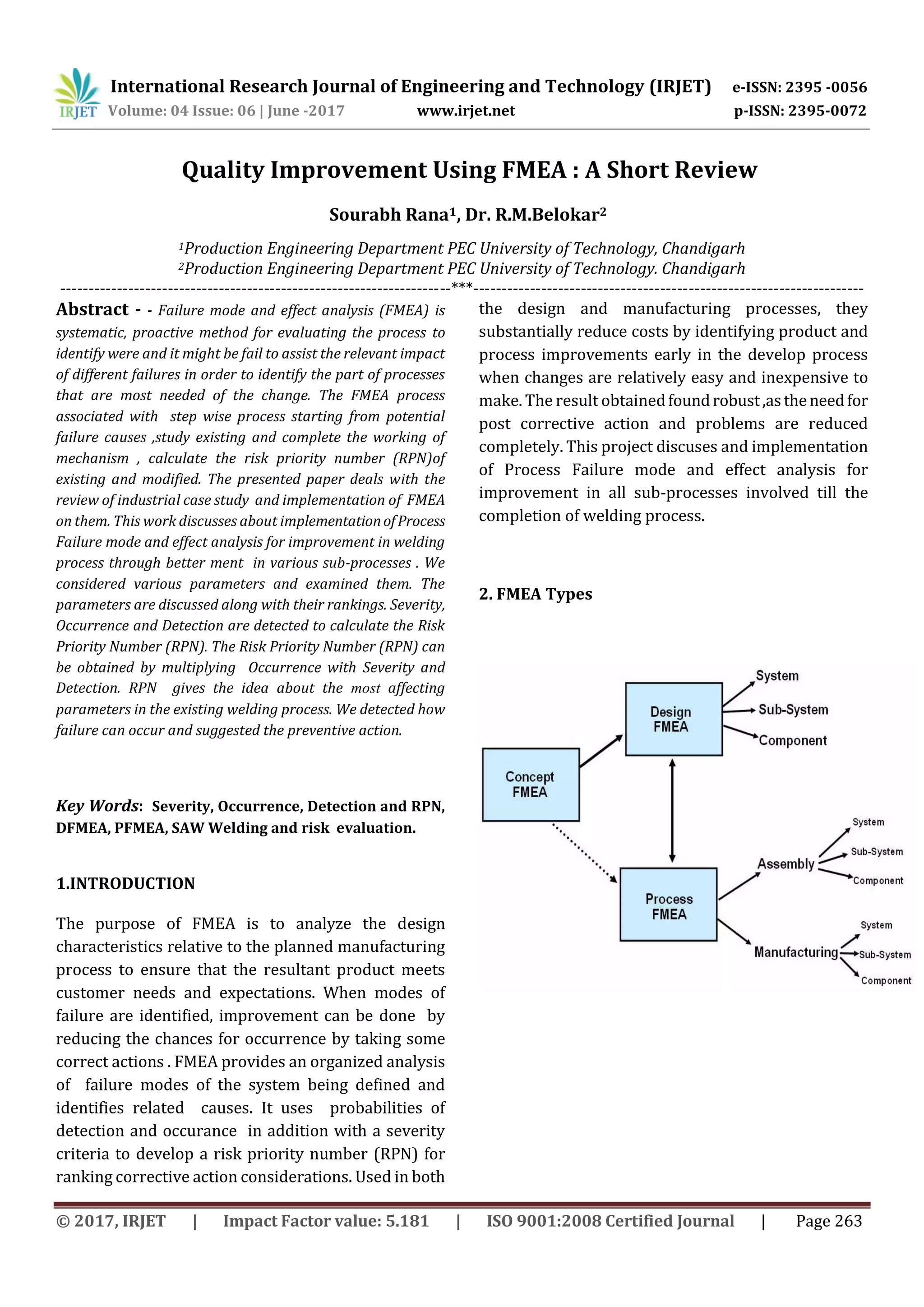
2. FMEA Types
International Research Journal of Engineering and Technology (IRJET) e-ISSN: 2395 -0056
Volume: 04 Issue: 06 | June -2017 www.irjet.net p-ISSN: 2395-0072
© 2017, IRJET | Impact Factor value: 5.181 | ISO 9001:2008 Certified Journal | Page 264
2.1 Design FMEA (DFMEA)
DFMEA is kind of tool to identify and prevent
failure modes of products, that are related to their
design, in order to validate the established design
parameters for a specific functional performance
level, at system, subsystem or component level. It
aids in the objective evaluation of design
requirements and design alternatives. It provides
additional information to aid in the planning of
efficient design testing.
In order to eliminate or mitigate the effects, DFMEA
plays an important role by selecting the optimal
design variant and develop a documentary base to
support future designs in order to reduce the risks
which is associated with the faulty products that
reach to the customers.
2.2 Process FMEA (PFMEA)
The purpose of this variantofFMEAistodeterminethe
potential failure modes of manufacturing/assembly
processes at operation, subsystem or system level and
to eliminate as early as possible the process faults that
could lead to the separation of defective products and
avoid using impropermethodsaspartoftheprocesses.
PFMEA also provides solutions for the development of
future processes and validation programs.
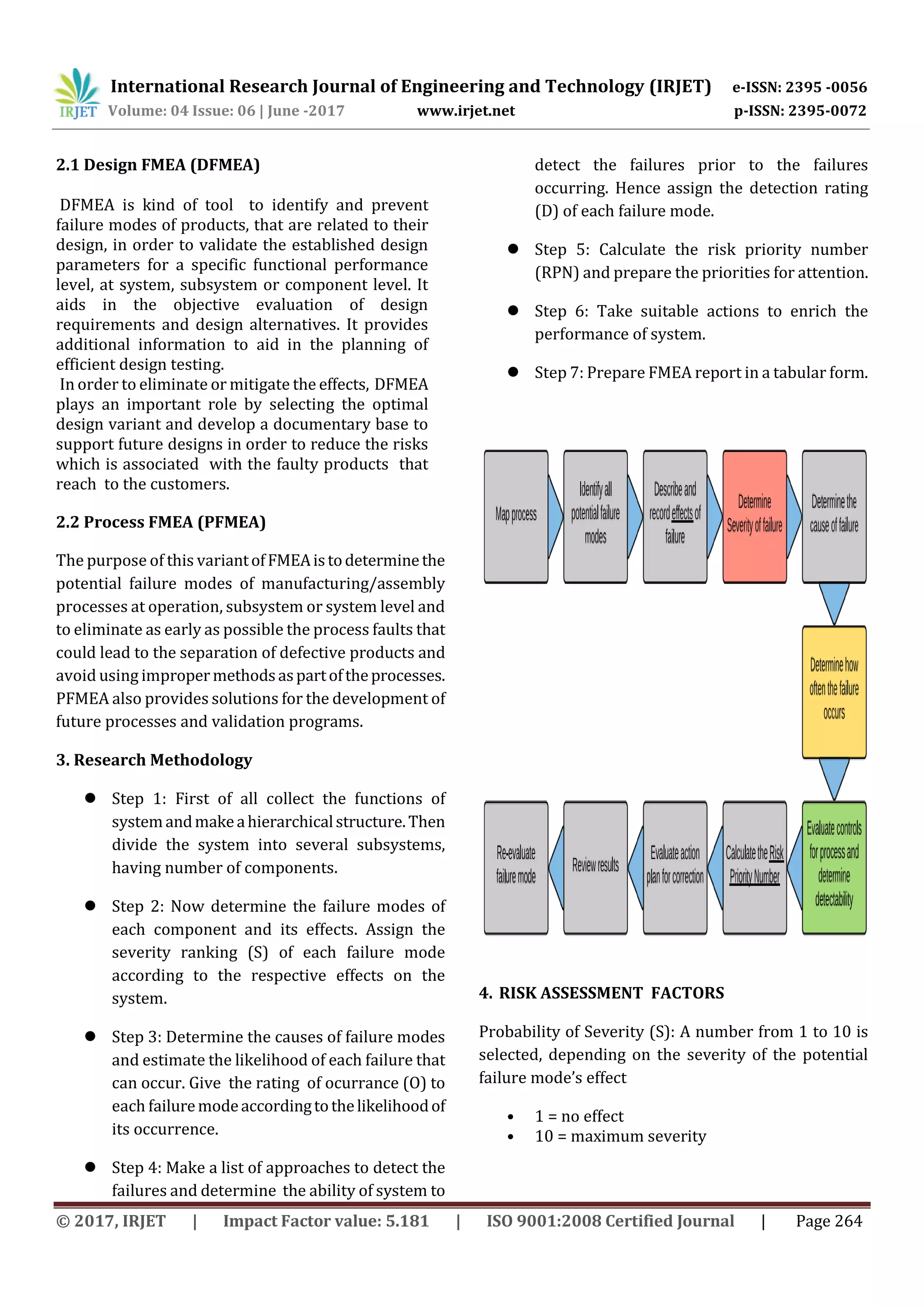
3. Research Methodology
 Step 1: First of all collect the functions of
systemandmakeahierarchicalstructure.Then
divide the system into several subsystems,
having number of components.
 Step 2: Now determine the failure modes of
each component and its effects. Assign the
severity ranking (S) of each failure mode
according to the respective effects on the
system.
 Step 3: Determine the causes of failure modes
and estimate the likelihood of each failure that
can occur. Give the rating of ocurrance (O) to
each failuremodeaccordingtothelikelihoodof
its occurrence.
 Step 4: Make a list of approaches to detect the
failures and determine the ability of system to
detect the failures prior to the failures
occurring. Hence assign the detection rating
(D) of each failure mode.
 Step 5: Calculate the risk priority number
(RPN) and prepare the priorities for attention.
 Step 6: Take suitable actions to enrich the
performance of system.
 Step 7: Prepare FMEA report in a tabular form.
4. RISK ASSESSMENT FACTORS
Probability of Severity (S): A number from 1 to 10 is
selected, depending on the severity of the potential
failure mode’s effect
• 1 = no effect
• 10 = maximum severity
International Research Journal of Engineering and Technology (IRJET) e-ISSN: 2395 -0056
Volume: 04 Issue: 06 | June -2017 www.irjet.net p-ISSN: 2395-0072
© 2017, IRJET | Impact Factor value: 5.181 | ISO 9001:2008 Certified Journal | Page 265
Table -1:
Severity Ranking Table
Probability of occurrence (O):Anumberfrom1to10 is
selected, depending on the likelihood of the failure
mode’s occurrence
• 1 = very unlikely to occur
• 10 = almost certain to occur
Table -2:
Occurrence Ranking Table
Probability of detection (D): A number from 1 to 10 is
selected, depending on how unlikely it is that the fault
will be detected by the system responsible (design
control process, quality testing, etc.)
• 1 = nearly certain detention
• 10 = impossible to detect
Table -3:
Detection Ranking Table
Risk Priority Number (RPN): The failure mode’s risk is
calculated by the formula RPN = S x O x D. RPN =
Severity x Probability of Occurrence x Probability of
Detection. RPN will be a number between 1 (virtually
no risk) and 1000 (extreme risk).
Table -4:
Final Table
International Research Journal of Engineering and Technology (IRJET) e-ISSN: 2395 -0056
Volume: 04 Issue: 06 | June -2017 www.irjet.net p-ISSN: 2395-0072
© 2017, IRJET | Impact Factor value: 5.181 | ISO 9001:2008 Certified Journal | Page 266
5. Applications
 Used in the design of products and processes
(manufacturing line, service procedures, etc.)
to anticipate and address potential failure
modes early in the process when they are least
expensive for correction.
 It contributes to the development of effective
maintenance procedures. For instance, MSG-3
analysis for aircraft industry.
 Identifies the failure modes discovered during
testing and update the probabilities of
occurrence based on the Reliability Growth
testing data.
 It is used to evaluate critical plans to modify an
existing process.
 Used to investigate the credibility of existing
systems/processes.
 Helps in providing a central location for
reliability-related information for the process.
 Provides a basic knowledge that helps for the
future troubleshooting efforts.
 Acts as a learning tool for new engineers.
 It provides input to other system analyses, for
example ReliabilityBlockDiagram(RBD),Fault
Tree, etc.
 It can be used to Contribute in the
identification of requirements for built-in test
equipment (BITE).
 It is also included among Probabilistic Risk
Assessment (PRA) techniques (such as in
nuclear power and other industries).
 It is performed to satisfy a customer
requirement and/or to comply with Safetyand
Quality requirements, such as:
o Six Sigma
o FDA Good Manufacturing Practices
o Process Safety Management Act (PSM
act)
6. Conclusion
In 1950s the attention was paid to the safety to
prevent accidents that canbepredictedinaerospace
industry in advance led to the development of the
FMEA methodology. Later, it was introduced as key
tool for increasing efficiency and quality in
manufacturing processes. In 1970’s automobile
company came with FMEA to address the potential
problemsintheResearchandDevelopment(R&D)in
the early stage of production and published the
Potential Failure Mode and Effects Analysis
Handbook in 1984 to promote FMEA. FMEA
methodology is now effectively used in a variety
of industries including semiconductor, processing,
food service, plastics, software, and healthcare.
Several approaches and applications of FMEA have
been developed so far. FMEA can be used to
optimize the decision making process in new
product developmentin automobile industry.FMEA
can be implemented at the design stage once actual
failures are observed during test, production and
operation.
On the basis of results and analysis stated above we
are going to implement FMEA on the sub processes
involved in welding processes starting from the
sheet handling to welding process.
7. Reference
[1] A. A. Nannikar, D. N. Raut, M. Chanmanwar, S. B.
Kamble and D. B. Patil, “FMEA for Manufacturing and
Assembly Process”, International Conference on
Technology and Business Management, pp. 26-28,
March 2012.
[2] Segismundo, Paulo CauchickMiguel,"Failuremode
and effects analysis (FMEA) in the context of risk
management in new product development: A case
study in an automotive company", International
Journal of Quality & Reliability Management, Volume
25 Issue 9, pp.89 – 912, 2008.
[3] Arabian-Hoseynabadi, H. and Oraee, H. andTavner,
P. J. “Failure Modes and Effects Analysis (FMEA) ”,
International journal of electrical power and energy
systems, Issue 7, pp. 817-824, 2010.
[4] ArunChauhan, Raj Kamal Malik, Gaurav Sharma,
MukeshVerma, “Performance Evaluation of Casting
Industry by FMEA - A Case Study”, International
Journal of Mechanical Engineering Applications
Research, Volume 2, Issue 2, pp. 113-121, 2011.
[5] Carl S. Carlson, “Understanding and applying the
fundamental of FMEAs”, IEEE, January 2014.
International Research Journal of Engineering and Technology (IRJET) e-ISSN: 2395 -0056
Volume: 04 Issue: 06 | June -2017 www.irjet.net p-ISSN: 2395-0072
© 2017, IRJET | Impact Factor value: 5.181 | ISO 9001:2008 Certified Journal | Page 267
[6] Dr. D.R.Prajapati, “Application of FMEA in Casting
Industries: A case study”, UdyogPragati,vol.35,Issue4,
pp. 6-14,December 2011.
[7] Ioannis S. Arvanitoyannis and Theodoros H.
Varzakas, “Application of ISO 22000 and failure mode
and effect analysis [FMEA] for industrial processing of
salmon: A case study”, Critical reviews in Food science
and Nutrition, Volume 48, pp. 411-429,2008.
[8] Rakesh.R Bobin Cherian Jos and George Mathew,
“FMEA Analysis for Reducing Breakdowns of a Sub
System in the Life Care Product Manufacturing.

Quality Improvement using FMEA : A Short Review

  • 1.
    International Research Journalof Engineering and Technology (IRJET) e-ISSN: 2395 -0056 Volume: 04 Issue: 06 | June -2017 www.irjet.net p-ISSN: 2395-0072 © 2017, IRJET | Impact Factor value: 5.181 | ISO 9001:2008 Certified Journal | Page 263 Quality Improvement Using FMEA : A Short Review Sourabh Rana1, Dr. R.M.Belokar2 1Production Engineering Department PEC University of Technology, Chandigarh 2Production Engineering Department PEC University of Technology. Chandigarh ---------------------------------------------------------------------***--------------------------------------------------------------------- Abstract - - Failure mode and effect analysis (FMEA) is systematic, proactive method for evaluating the process to identify were and it might be fail to assist the relevant impact of different failures in order to identify the part of processes that are most needed of the change. The FMEA process associated with step wise process starting from potential failure causes ,study existing and complete the working of mechanism , calculate the risk priority number (RPN)of existing and modified. The presented paper deals with the review of industrial case study and implementation of FMEA on them. This work discusses about implementationofProcess Failure mode and effect analysis for improvement in welding process through better ment in various sub-processes . We considered various parameters and examined them. The parameters are discussed along with their rankings. Severity, Occurrence and Detection are detected to calculate the Risk Priority Number (RPN). The Risk Priority Number (RPN) can be obtained by multiplying Occurrence with Severity and Detection. RPN gives the idea about the most affecting parameters in the existing welding process. We detected how failure can occur and suggested the preventive action. Key Words: Severity, Occurrence, Detection and RPN, DFMEA, PFMEA, SAW Welding and risk evaluation. 1.INTRODUCTION The purpose of FMEA is to analyze the design characteristics relative to the planned manufacturing process to ensure that the resultant product meets customer needs and expectations. When modes of failure are identified, improvement can be done by reducing the chances for occurrence by taking some correct actions . FMEA provides an organized analysis of failure modes of the system being defined and identifies related causes. It uses probabilities of detection and occurance in addition with a severity criteria to develop a risk priority number (RPN) for ranking corrective action considerations. Used in both the design and manufacturing processes, they substantially reduce costs by identifying product and process improvements early in the develop process when changes are relatively easy and inexpensive to make. The result obtainedfoundrobust,astheneedfor post corrective action and problems are reduced completely. This project discuses and implementation of Process Failure mode and effect analysis for improvement in all sub-processes involved till the completion of welding process. 2. FMEA Types
  • 2.
    International Research Journalof Engineering and Technology (IRJET) e-ISSN: 2395 -0056 Volume: 04 Issue: 06 | June -2017 www.irjet.net p-ISSN: 2395-0072 © 2017, IRJET | Impact Factor value: 5.181 | ISO 9001:2008 Certified Journal | Page 264 2.1 Design FMEA (DFMEA) DFMEA is kind of tool to identify and prevent failure modes of products, that are related to their design, in order to validate the established design parameters for a specific functional performance level, at system, subsystem or component level. It aids in the objective evaluation of design requirements and design alternatives. It provides additional information to aid in the planning of efficient design testing. In order to eliminate or mitigate the effects, DFMEA plays an important role by selecting the optimal design variant and develop a documentary base to support future designs in order to reduce the risks which is associated with the faulty products that reach to the customers. 2.2 Process FMEA (PFMEA) The purpose of this variantofFMEAistodeterminethe potential failure modes of manufacturing/assembly processes at operation, subsystem or system level and to eliminate as early as possible the process faults that could lead to the separation of defective products and avoid using impropermethodsaspartoftheprocesses. PFMEA also provides solutions for the development of future processes and validation programs. 3. Research Methodology  Step 1: First of all collect the functions of systemandmakeahierarchicalstructure.Then divide the system into several subsystems, having number of components.  Step 2: Now determine the failure modes of each component and its effects. Assign the severity ranking (S) of each failure mode according to the respective effects on the system.  Step 3: Determine the causes of failure modes and estimate the likelihood of each failure that can occur. Give the rating of ocurrance (O) to each failuremodeaccordingtothelikelihoodof its occurrence.  Step 4: Make a list of approaches to detect the failures and determine the ability of system to detect the failures prior to the failures occurring. Hence assign the detection rating (D) of each failure mode.  Step 5: Calculate the risk priority number (RPN) and prepare the priorities for attention.  Step 6: Take suitable actions to enrich the performance of system.  Step 7: Prepare FMEA report in a tabular form. 4. RISK ASSESSMENT FACTORS Probability of Severity (S): A number from 1 to 10 is selected, depending on the severity of the potential failure mode’s effect • 1 = no effect • 10 = maximum severity
  • 3.
    International Research Journalof Engineering and Technology (IRJET) e-ISSN: 2395 -0056 Volume: 04 Issue: 06 | June -2017 www.irjet.net p-ISSN: 2395-0072 © 2017, IRJET | Impact Factor value: 5.181 | ISO 9001:2008 Certified Journal | Page 265 Table -1: Severity Ranking Table Probability of occurrence (O):Anumberfrom1to10 is selected, depending on the likelihood of the failure mode’s occurrence • 1 = very unlikely to occur • 10 = almost certain to occur Table -2: Occurrence Ranking Table Probability of detection (D): A number from 1 to 10 is selected, depending on how unlikely it is that the fault will be detected by the system responsible (design control process, quality testing, etc.) • 1 = nearly certain detention • 10 = impossible to detect Table -3: Detection Ranking Table Risk Priority Number (RPN): The failure mode’s risk is calculated by the formula RPN = S x O x D. RPN = Severity x Probability of Occurrence x Probability of Detection. RPN will be a number between 1 (virtually no risk) and 1000 (extreme risk). Table -4: Final Table
  • 4.
    International Research Journalof Engineering and Technology (IRJET) e-ISSN: 2395 -0056 Volume: 04 Issue: 06 | June -2017 www.irjet.net p-ISSN: 2395-0072 © 2017, IRJET | Impact Factor value: 5.181 | ISO 9001:2008 Certified Journal | Page 266 5. Applications  Used in the design of products and processes (manufacturing line, service procedures, etc.) to anticipate and address potential failure modes early in the process when they are least expensive for correction.  It contributes to the development of effective maintenance procedures. For instance, MSG-3 analysis for aircraft industry.  Identifies the failure modes discovered during testing and update the probabilities of occurrence based on the Reliability Growth testing data.  It is used to evaluate critical plans to modify an existing process.  Used to investigate the credibility of existing systems/processes.  Helps in providing a central location for reliability-related information for the process.  Provides a basic knowledge that helps for the future troubleshooting efforts.  Acts as a learning tool for new engineers.  It provides input to other system analyses, for example ReliabilityBlockDiagram(RBD),Fault Tree, etc.  It can be used to Contribute in the identification of requirements for built-in test equipment (BITE).  It is also included among Probabilistic Risk Assessment (PRA) techniques (such as in nuclear power and other industries).  It is performed to satisfy a customer requirement and/or to comply with Safetyand Quality requirements, such as: o Six Sigma o FDA Good Manufacturing Practices o Process Safety Management Act (PSM act) 6. Conclusion In 1950s the attention was paid to the safety to prevent accidents that canbepredictedinaerospace industry in advance led to the development of the FMEA methodology. Later, it was introduced as key tool for increasing efficiency and quality in manufacturing processes. In 1970’s automobile company came with FMEA to address the potential problemsintheResearchandDevelopment(R&D)in the early stage of production and published the Potential Failure Mode and Effects Analysis Handbook in 1984 to promote FMEA. FMEA methodology is now effectively used in a variety of industries including semiconductor, processing, food service, plastics, software, and healthcare. Several approaches and applications of FMEA have been developed so far. FMEA can be used to optimize the decision making process in new product developmentin automobile industry.FMEA can be implemented at the design stage once actual failures are observed during test, production and operation. On the basis of results and analysis stated above we are going to implement FMEA on the sub processes involved in welding processes starting from the sheet handling to welding process. 7. Reference [1] A. A. Nannikar, D. N. Raut, M. Chanmanwar, S. B. Kamble and D. B. Patil, “FMEA for Manufacturing and Assembly Process”, International Conference on Technology and Business Management, pp. 26-28, March 2012. [2] Segismundo, Paulo CauchickMiguel,"Failuremode and effects analysis (FMEA) in the context of risk management in new product development: A case study in an automotive company", International Journal of Quality & Reliability Management, Volume 25 Issue 9, pp.89 – 912, 2008. [3] Arabian-Hoseynabadi, H. and Oraee, H. andTavner, P. J. “Failure Modes and Effects Analysis (FMEA) ”, International journal of electrical power and energy systems, Issue 7, pp. 817-824, 2010. [4] ArunChauhan, Raj Kamal Malik, Gaurav Sharma, MukeshVerma, “Performance Evaluation of Casting Industry by FMEA - A Case Study”, International Journal of Mechanical Engineering Applications Research, Volume 2, Issue 2, pp. 113-121, 2011. [5] Carl S. Carlson, “Understanding and applying the fundamental of FMEAs”, IEEE, January 2014.
  • 5.
    International Research Journalof Engineering and Technology (IRJET) e-ISSN: 2395 -0056 Volume: 04 Issue: 06 | June -2017 www.irjet.net p-ISSN: 2395-0072 © 2017, IRJET | Impact Factor value: 5.181 | ISO 9001:2008 Certified Journal | Page 267 [6] Dr. D.R.Prajapati, “Application of FMEA in Casting Industries: A case study”, UdyogPragati,vol.35,Issue4, pp. 6-14,December 2011. [7] Ioannis S. Arvanitoyannis and Theodoros H. Varzakas, “Application of ISO 22000 and failure mode and effect analysis [FMEA] for industrial processing of salmon: A case study”, Critical reviews in Food science and Nutrition, Volume 48, pp. 411-429,2008. [8] Rakesh.R Bobin Cherian Jos and George Mathew, “FMEA Analysis for Reducing Breakdowns of a Sub System in the Life Care Product Manufacturing.