
Flux Cored Arc Welding
Group No 4
History
 First developed in the early 1950s.
 Alternative to Shielded Metal Arc Welding.(SMAW)
 Main benefit of this method over shielded metal arc welding is that the
unnecessary of the stick electrodes.
 This feature helped Flux cored arc welding(FCAW) to overcome many
of the restrictions connected with Shield metal arc welding.
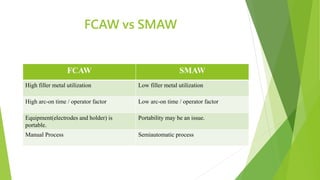
FCAW vs SMAW
FCAW SMAW
High filler metal utilization Low filler metal utilization
High arc-on time / operator factor Low arc-on time / operator factor
Equipment(electrodes and holder) is
portable.
Portability may be an issue.
Manual Process Semiautomatic process
Flux Cored Arc Welding
 This is a semi-automatic or automatic arc welding process.
 Requires a continuously-fed consumable tubular electrode containing a
flux and a constant-voltage or, less commonly, a constant-current
welding power supply.
 Mainly 2 types.
a) FCAW which requires shielding gas
b) FCAW which requires no shielding gas
FCAW which uses a shielding gas
 Must be supplied by an external supply.
 Known as “Dual Shield” welding.
 Uses both a flux cored electrode and an external shielding gas. (combination
of gas metal and flux cored arc welding)
 The slag created by the flux is also easy to remove.
 This method is preferable for closed shop environment not for windy
environment, because the loss of the shielding gas from air flow will produce
porosity in the weld.
 The main advantage of this process is that in a closed shop environment, it
generally produces welds of better and more consistent mechanical properties
with fewer weld defects.
FCAW which doesn’t require
shielding gas This is made possible by the flux core in the tubular consumable electrode.
 Core contains more than just flux, it also contains various ingredients that
when exposed to the high temperatures of welding generate a shielding gas
for protecting the arc.
 Portable and generally has good penetration into the base metal.
 Windy conditions need not be considered as other type.
 This process can produce excessive, noxious smoke (making it difficult to see
the weld pool). - main drawback
 Operator skill should be considered, unless improper electrode manipulation
or machine setup can cause porosity.
Process Variables
 Wire feed speed (and current)
 Arc voltage
 Electrode extension
 Travel speed and angle
 Electrode angles
 Electrode wire type
 Shielding gas composition (if required)
Advantages
 Porosity chances very low.
 Less pre-cleaning of metal required.
 A high deposition rate process.
Applications
 For some high speed applications (automotive, marine engineering)
 Used on the following alloys
a) Mild and low alloy steels
b) Stainless steels
c) Some high nickel alloys
d) Some wear-facing
e) Surfacing alloys
Disadvantages
 Irregular wire feed (mechanical problem)
 Melted contact tip – when the contact tip actually contacts the base metal,
fusing the 2 and melting the hole on the end.
 The equipment is less mobile and comparatively more costly.
 The amount of smoke generated can far exceed that of SMAW.
Thank You

Flux cored arc welding

  • 1.
    Flux Cored ArcWelding Group No 4
  • 2.
    History  First developedin the early 1950s.  Alternative to Shielded Metal Arc Welding.(SMAW)  Main benefit of this method over shielded metal arc welding is that the unnecessary of the stick electrodes.  This feature helped Flux cored arc welding(FCAW) to overcome many of the restrictions connected with Shield metal arc welding.
  • 3.
    FCAW vs SMAW FCAWSMAW High filler metal utilization Low filler metal utilization High arc-on time / operator factor Low arc-on time / operator factor Equipment(electrodes and holder) is portable. Portability may be an issue. Manual Process Semiautomatic process
  • 4.
    Flux Cored ArcWelding  This is a semi-automatic or automatic arc welding process.  Requires a continuously-fed consumable tubular electrode containing a flux and a constant-voltage or, less commonly, a constant-current welding power supply.  Mainly 2 types. a) FCAW which requires shielding gas b) FCAW which requires no shielding gas
  • 5.
    FCAW which usesa shielding gas  Must be supplied by an external supply.  Known as “Dual Shield” welding.  Uses both a flux cored electrode and an external shielding gas. (combination of gas metal and flux cored arc welding)  The slag created by the flux is also easy to remove.  This method is preferable for closed shop environment not for windy environment, because the loss of the shielding gas from air flow will produce porosity in the weld.  The main advantage of this process is that in a closed shop environment, it generally produces welds of better and more consistent mechanical properties with fewer weld defects.
  • 6.
    FCAW which doesn’trequire shielding gas This is made possible by the flux core in the tubular consumable electrode.  Core contains more than just flux, it also contains various ingredients that when exposed to the high temperatures of welding generate a shielding gas for protecting the arc.  Portable and generally has good penetration into the base metal.  Windy conditions need not be considered as other type.  This process can produce excessive, noxious smoke (making it difficult to see the weld pool). - main drawback  Operator skill should be considered, unless improper electrode manipulation or machine setup can cause porosity.
  • 7.
    Process Variables  Wirefeed speed (and current)  Arc voltage  Electrode extension  Travel speed and angle  Electrode angles  Electrode wire type  Shielding gas composition (if required)
  • 8.
    Advantages  Porosity chancesvery low.  Less pre-cleaning of metal required.  A high deposition rate process.
  • 9.
    Applications  For somehigh speed applications (automotive, marine engineering)  Used on the following alloys a) Mild and low alloy steels b) Stainless steels c) Some high nickel alloys d) Some wear-facing e) Surfacing alloys
  • 10.
    Disadvantages  Irregular wirefeed (mechanical problem)  Melted contact tip – when the contact tip actually contacts the base metal, fusing the 2 and melting the hole on the end.  The equipment is less mobile and comparatively more costly.  The amount of smoke generated can far exceed that of SMAW.
  • 11.