TRAINING ON
WELDING
ABHISHEK MATHAD
Total Exp : 7 Yr.
 CADD center – 1.5 Yr.
 Smart Enovations India Pvt Ltd – 3.5 Yr.
 Tata Elxsi Ltd – Jaguar Land Rover – 1.5 Yr.
 ITC infotech – From Feb 2020
Contents:
§ INTRODUCTION
§ DIFFERENT WELDING PROCESSES
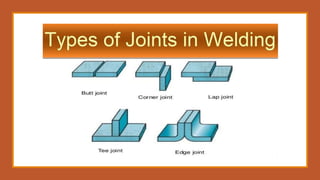
§ TYPES OF WELD JOINTS
§ WELDING AND WELD SYMBOLS
§ WELDING SYMBOL IN DETAIL
§ FILLET WELDING STANDAREDS
§ CHOOSSING THE RIGHT WELDING PROCESS
INTRODUCTION
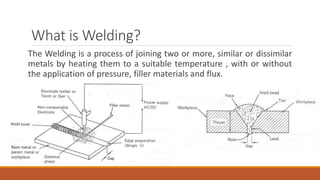
What is Welding?
The Welding is a process of joining two or more, similar or dissimilar
metals by heating them to a suitable temperature , with or without
the application of pressure, filler materials and flux.
When/Why we need to go for welding?
 Non Serviceable parts (permanent joints).
As no hole is required for welding, hence no reduction of area. So
structural members are more effective in taking the load.
The efficiency of welded joint is more than that of the riveted
joint.
The welded joints look better than the bulky riveted/butted joints.
TYPES OF WELDING :
Plastic Welding or Pressure Welding:
The piece of metal to be joined are heated to a plastic state and
forced together by external pressure.
(Ex) -Resistance welding.
Fusion Welding or Non-Pressure Welding:
The material at the joint is heated to a molten state and allowed to
solidify
(Ex)- Gas welding, Arc welding.
DIFFERENT
WELDING
PROCESSES
DIFFERENT WELDING PROCESSES:
Gas welding(Oxy- Acetylene)
Arc welding(Metal Arc)
Resistance welding
Gas Welding:
Gas Welding is a fusion welding process, in which the heat for
welding is obtained by the combustion of oxygen and fuel.
Types: Depending on the fuel gas used,
 Oxy- Acetylene
 Air-Acetylene
 Oxy-Hydrogen
 Oxy-Propene
Arc Welding:
Arc welding is a fusion welding process in which the heat required to
fuse the metal is obtain from the electric arc induced between the
base metal and an electrode.
Types:
 Metal Arc Welding
 Submerged Arc Welding
Tungsten Inert Gas Welding
Metal Inert Gas Welding
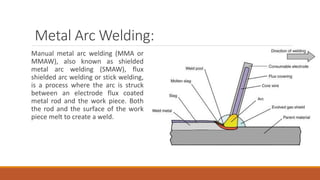
Metal Arc Welding:
Manual metal arc welding (MMA or
MMAW), also known as shielded
metal arc welding (SMAW), flux
shielded arc welding or stick welding,
is a process where the arc is struck
between an electrode flux coated
metal rod and the work piece. Both
the rod and the surface of the work
piece melt to create a weld.
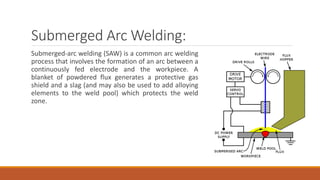
Submerged Arc Welding:
Submerged-arc welding (SAW) is a common arc welding
process that involves the formation of an arc between a
continuously fed electrode and the workpiece. A
blanket of powdered flux generates a protective gas
shield and a slag (and may also be used to add alloying
elements to the weld pool) which protects the weld
zone.
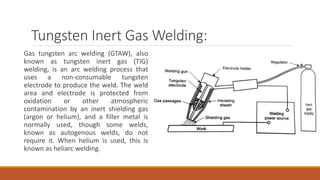
Tungsten Inert Gas Welding:
Gas tungsten arc welding (GTAW), also
known as tungsten inert gas (TIG)
welding, is an arc welding process that
uses a non-consumable tungsten
electrode to produce the weld. The weld
area and electrode is protected from
oxidation or other atmospheric
contamination by an inert shielding gas
(argon or helium), and a filler metal is
normally used, though some welds,
known as autogenous welds, do not
require it. When helium is used, this is
known as heliarc welding.
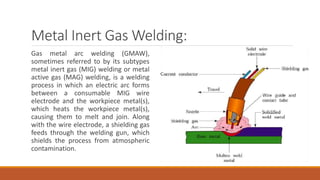
Metal Inert Gas Welding:
Gas metal arc welding (GMAW),
sometimes referred to by its subtypes
metal inert gas (MIG) welding or metal
active gas (MAG) welding, is a welding
process in which an electric arc forms
between a consumable MIG wire
electrode and the workpiece metal(s),
which heats the workpiece metal(s),
causing them to melt and join. Along
with the wire electrode, a shielding gas
feeds through the welding gun, which
shields the process from atmospheric
contamination.
Resistance welding:
Electric resistance welding (ERW) is a welding process where metal parts in contact are
permanently joined by heating them with an electric current. Electric resistance welding
is widely used, for example, in manufacture of steel pipe and in assembly of bodies for
automobiles. The electric current can be supplied to electrodes that also apply clamping
pressure.
Types:
Spot welding
Seam welding
Low-frequency Electric resistance welding
Welding and
weld symbol
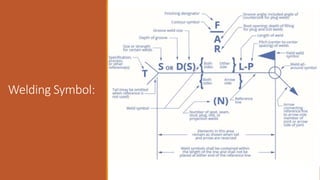
Welding Symbol:
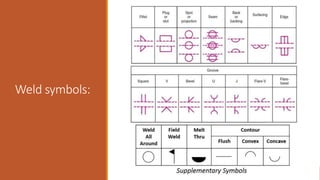
Weld symbols:
Welding Symbol
in Detail
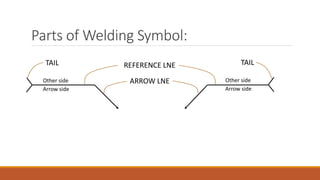
Parts of Welding Symbol:
REFERENCE LNE
ARROW LNEOther side
Arrow side
Other side
Arrow side
TAIL TAIL
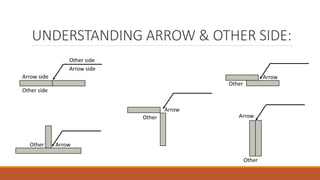
UNDERSTANDING ARROW & OTHER SIDE:
Other side
Arrow side
Arrow side
Other side
Arrow
Other
ArrowOther
Arrow
Other
Arrow
Other
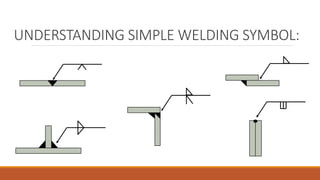
UNDERSTANDING SIMPLE WELDING SYMBOL:
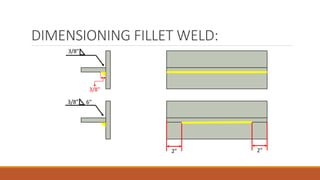
DIMENSIONING FILLET WELD:
3/8”
3/8”
3/8” 6”
2” 2”
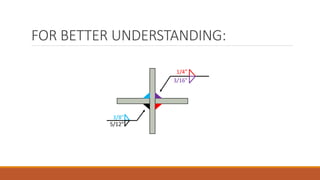
FOR BETTER UNDERSTANDING:
3/8”
5/12”
1/4”
3/16”
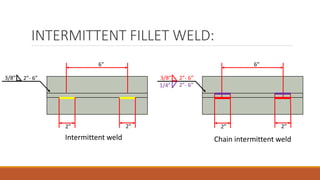
INTERMITTENT FILLET WELD:
3/8” 2”- 6”
2” 2”
6”
3/8” 2”- 6”
2” 2”
6”
1/4” 2”- 6”
Chain intermittent weldIntermittent weld
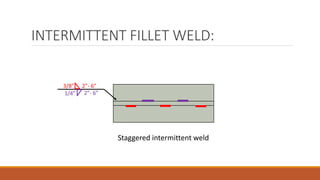
INTERMITTENT FILLET WELD:
3/8” 2”- 6”
1/4” 2”- 6”
Staggered intermittent weld
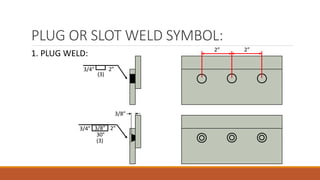
PLUG OR SLOT WELD SYMBOL:
3/4”
(3)
2”
3/8”3/4” 2”
1. PLUG WELD: 2” 2”
(3)
30°
3/8”
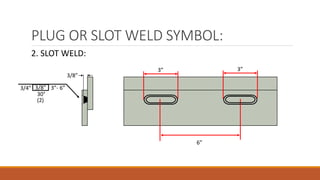
PLUG OR SLOT WELD SYMBOL:
2. SLOT WELD:
3/8”3/4” 3”- 6”
(2)
30°
3/8”
3” 3”
6”
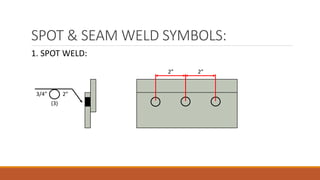
SPOT & SEAM WELD SYMBOLS:
1. SPOT WELD:
3/4”
(3)
2”
2” 2”
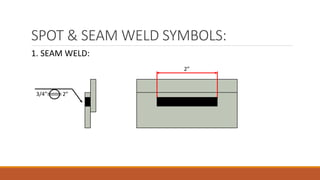
SPOT & SEAM WELD SYMBOLS:
1. SEAM WELD:
3/4” 2”
2”
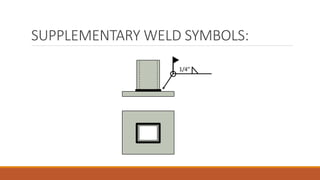
SUPPLEMENTARY WELD SYMBOLS:
1/4”
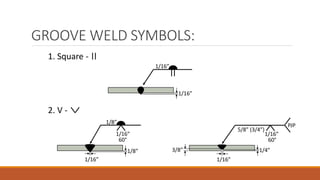
GROOVE WELD SYMBOLS:
1/16”
1/16”
1. Square -
2. V -
1/16”
60°
1/16”
1/8”
1/8”
1/16”
60°
1/16”
1/4”
5/8” (3/4”)
PJP
3/8”
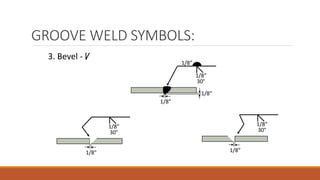
GROOVE WELD SYMBOLS:
1/8”
1/8”
3. Bevel -
1/8”
30°
1/8”
1/8”
30°
1/8”
1/8”
30°
1/8”
GROOVE WELD SYMBOLS:
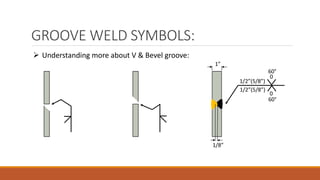
 Understanding more about V & Bevel groove:
0
60°
1/2”(5/8”)
1/2”(5/8”)
0
60°
1”
1/8”
GROOVE WELD SYMBOLS:
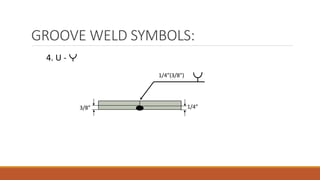
4. U -
1/4”
1/4”(3/8”)
3/8”
GROOVE WELD SYMBOLS:
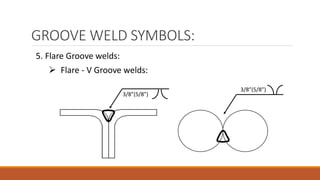
5. Flare Groove welds:
 Flare - V Groove welds:
3/8”(5/8”)
3/8”(5/8”)
GROOVE WELD SYMBOLS:
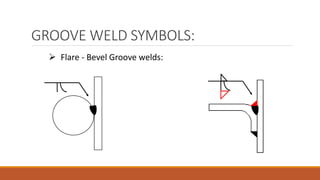
 Flare - Bevel Groove welds:
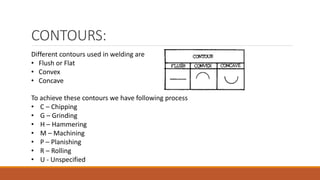
CONTOURS:
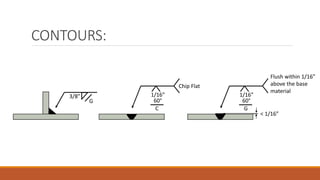
Different contours used in welding are
• Flush or Flat
• Convex
• Concave
To achieve these contours we have following process
• C – Chipping
• G – Grinding
• H – Hammering
• M – Machining
• P – Planishing
• R – Rolling
• U - Unspecified
CONTOURS:
3/8”
G
1/16”
60°
C
Chip Flat
1/16”
60°
G
Flush within 1/16”
above the base
material
< 1/16”
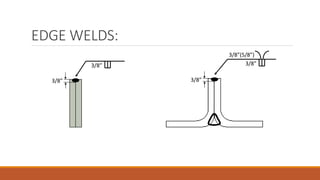
EDGE WELDS:
3/8”
3/8”
3/8”
3/8”(5/8”)
3/8”
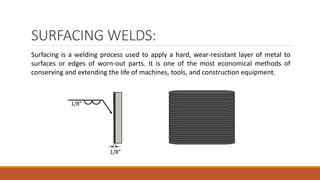
SURFACING WELDS:
Surfacing is a welding process used to apply a hard, wear-resistant layer of metal to
surfaces or edges of worn-out parts. It is one of the most economical methods of
conserving and extending the life of machines, tools, and construction equipment.
1/8”
1/8”
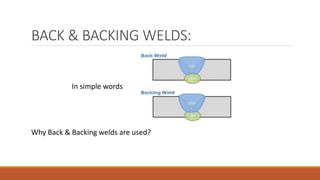
BACK & BACKING WELDS:
In simple words
Why Back & Backing welds are used?
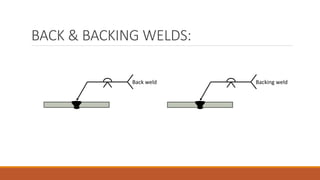
BACK & BACKING WELDS:
Back weld Backing weld
FILLET WELDING
STANDAREDS
FILLET WELDING STANDAREDS
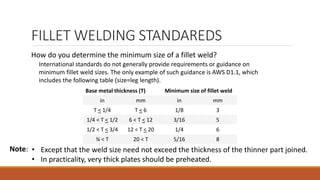
How do you determine the minimum size of a fillet weld?
Base metal thickness (T) Minimum size of fillet weld
in mm in mm
T < 1/4 T < 6 1/8 3
1/4 < T < 1/2 6 < T < 12 3/16 5
1/2 < T < 3/4 12 < T < 20 1/4 6
¾ < T 20 < T 5/16 8
International standards do not generally provide requirements or guidance on
minimum fillet weld sizes. The only example of such guidance is AWS D1.1, which
includes the following table (size=leg length).
• Except that the weld size need not exceed the thickness of the thinner part joined.
• In practicality, very thick plates should be preheated.
Note:
FILLET WELDING STANDAREDS
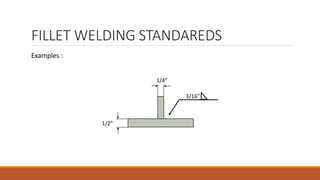
Examples :
1/2”
1/4”
3/16”
FILLET WELDING STANDAREDS
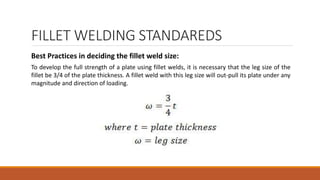
Best Practices in deciding the fillet weld size:
To develop the full strength of a plate using fillet welds, it is necessary that the leg size of the
fillet be 3/4 of the plate thickness. A fillet weld with this leg size will out-pull its plate under any
magnitude and direction of loading.
FILLET WELDING STANDAREDS
This rule of thumb assumes the following:
• fillet weld on both sides of the plate
• fillet weld for the full length of the plate
• If the plates are different thicknesses, the thinner plate thickness
should be used
If the stress in the plate is lower than 1/3 to 1/2 of the yield strength, a leg size
of only 1/4 to 3/8 of the thickness of the plate is required. Intermittent welds
may also be used to reduce the total volume of weld for a rigidity design.
FILLET WELDING STANDAREDS
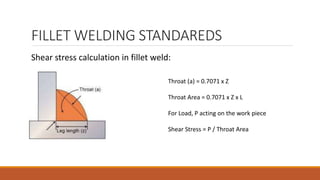
Shear stress calculation in fillet weld:
Throat (a) = 0.7071 x Z
Throat Area = 0.7071 x Z x L
For Load, P acting on the work piece
Shear Stress = P / Throat Area
CHOOSSING THE
RIGHT WELDING
PROCESS
CHOOSSING THE RIGHT WELDING
PROCESS
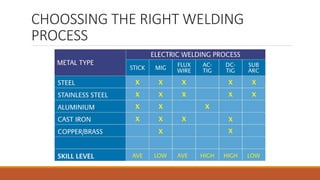
To evaluate the welding process most appropriate for the job at hand, the
following factors would typically be considered:
• Type of material being welded
• Thickness of the material
• Type of welding power source and the amount of current available
• The welding position
• Time requirements
• Working conditions
CHOOSSING THE RIGHT WELDING
PROCESS
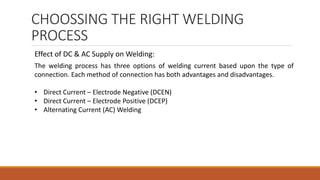
The welding process has three options of welding current based upon the type of
connection. Each method of connection has both advantages and disadvantages.
• Direct Current – Electrode Negative (DCEN)
• Direct Current – Electrode Positive (DCEP)
• Alternating Current (AC) Welding
Effect of DC & AC Supply on Welding:
CHOOSSING THE RIGHT WELDING
PROCESS
CHOOSSING THE RIGHT WELDING
PROCESS
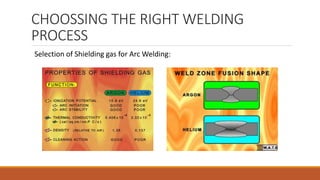
Selection of Shielding gas for Arc Welding:
THANK YOU

welding process and welding symbol

  • 1.
    TRAINING ON WELDING ABHISHEK MATHAD TotalExp : 7 Yr.  CADD center – 1.5 Yr.  Smart Enovations India Pvt Ltd – 3.5 Yr.  Tata Elxsi Ltd – Jaguar Land Rover – 1.5 Yr.  ITC infotech – From Feb 2020
  • 2.
    Contents: § INTRODUCTION § DIFFERENTWELDING PROCESSES § TYPES OF WELD JOINTS § WELDING AND WELD SYMBOLS § WELDING SYMBOL IN DETAIL § FILLET WELDING STANDAREDS § CHOOSSING THE RIGHT WELDING PROCESS
  • 3.
  • 4.
    What is Welding? TheWelding is a process of joining two or more, similar or dissimilar metals by heating them to a suitable temperature , with or without the application of pressure, filler materials and flux.
  • 5.
    When/Why we needto go for welding?  Non Serviceable parts (permanent joints). As no hole is required for welding, hence no reduction of area. So structural members are more effective in taking the load. The efficiency of welded joint is more than that of the riveted joint. The welded joints look better than the bulky riveted/butted joints.
  • 6.
    TYPES OF WELDING: Plastic Welding or Pressure Welding: The piece of metal to be joined are heated to a plastic state and forced together by external pressure. (Ex) -Resistance welding. Fusion Welding or Non-Pressure Welding: The material at the joint is heated to a molten state and allowed to solidify (Ex)- Gas welding, Arc welding.
  • 7.
  • 8.
    DIFFERENT WELDING PROCESSES: Gaswelding(Oxy- Acetylene) Arc welding(Metal Arc) Resistance welding
  • 9.
    Gas Welding: Gas Weldingis a fusion welding process, in which the heat for welding is obtained by the combustion of oxygen and fuel. Types: Depending on the fuel gas used,  Oxy- Acetylene  Air-Acetylene  Oxy-Hydrogen  Oxy-Propene
  • 10.
    Arc Welding: Arc weldingis a fusion welding process in which the heat required to fuse the metal is obtain from the electric arc induced between the base metal and an electrode. Types:  Metal Arc Welding  Submerged Arc Welding Tungsten Inert Gas Welding Metal Inert Gas Welding
  • 11.
    Metal Arc Welding: Manualmetal arc welding (MMA or MMAW), also known as shielded metal arc welding (SMAW), flux shielded arc welding or stick welding, is a process where the arc is struck between an electrode flux coated metal rod and the work piece. Both the rod and the surface of the work piece melt to create a weld.
  • 12.
    Submerged Arc Welding: Submerged-arcwelding (SAW) is a common arc welding process that involves the formation of an arc between a continuously fed electrode and the workpiece. A blanket of powdered flux generates a protective gas shield and a slag (and may also be used to add alloying elements to the weld pool) which protects the weld zone.
  • 13.
    Tungsten Inert GasWelding: Gas tungsten arc welding (GTAW), also known as tungsten inert gas (TIG) welding, is an arc welding process that uses a non-consumable tungsten electrode to produce the weld. The weld area and electrode is protected from oxidation or other atmospheric contamination by an inert shielding gas (argon or helium), and a filler metal is normally used, though some welds, known as autogenous welds, do not require it. When helium is used, this is known as heliarc welding.
  • 14.
    Metal Inert GasWelding: Gas metal arc welding (GMAW), sometimes referred to by its subtypes metal inert gas (MIG) welding or metal active gas (MAG) welding, is a welding process in which an electric arc forms between a consumable MIG wire electrode and the workpiece metal(s), which heats the workpiece metal(s), causing them to melt and join. Along with the wire electrode, a shielding gas feeds through the welding gun, which shields the process from atmospheric contamination.
  • 15.
    Resistance welding: Electric resistancewelding (ERW) is a welding process where metal parts in contact are permanently joined by heating them with an electric current. Electric resistance welding is widely used, for example, in manufacture of steel pipe and in assembly of bodies for automobiles. The electric current can be supplied to electrodes that also apply clamping pressure. Types: Spot welding Seam welding Low-frequency Electric resistance welding
  • 17.
  • 18.
  • 19.
  • 20.
  • 21.
    Parts of WeldingSymbol: REFERENCE LNE ARROW LNEOther side Arrow side Other side Arrow side TAIL TAIL
  • 22.
    UNDERSTANDING ARROW &OTHER SIDE: Other side Arrow side Arrow side Other side Arrow Other ArrowOther Arrow Other Arrow Other
  • 23.
  • 24.
  • 25.
  • 26.
    INTERMITTENT FILLET WELD: 3/8”2”- 6” 2” 2” 6” 3/8” 2”- 6” 2” 2” 6” 1/4” 2”- 6” Chain intermittent weldIntermittent weld
  • 27.
    INTERMITTENT FILLET WELD: 3/8”2”- 6” 1/4” 2”- 6” Staggered intermittent weld
  • 28.
    PLUG OR SLOTWELD SYMBOL: 3/4” (3) 2” 3/8”3/4” 2” 1. PLUG WELD: 2” 2” (3) 30° 3/8”
  • 29.
    PLUG OR SLOTWELD SYMBOL: 2. SLOT WELD: 3/8”3/4” 3”- 6” (2) 30° 3/8” 3” 3” 6”
  • 30.
    SPOT & SEAMWELD SYMBOLS: 1. SPOT WELD: 3/4” (3) 2” 2” 2”
  • 31.
    SPOT & SEAMWELD SYMBOLS: 1. SEAM WELD: 3/4” 2” 2”
  • 32.
  • 33.
    GROOVE WELD SYMBOLS: 1/16” 1/16” 1.Square - 2. V - 1/16” 60° 1/16” 1/8” 1/8” 1/16” 60° 1/16” 1/4” 5/8” (3/4”) PJP 3/8”
  • 34.
    GROOVE WELD SYMBOLS: 1/8” 1/8” 3.Bevel - 1/8” 30° 1/8” 1/8” 30° 1/8” 1/8” 30° 1/8”
  • 35.
    GROOVE WELD SYMBOLS: Understanding more about V & Bevel groove: 0 60° 1/2”(5/8”) 1/2”(5/8”) 0 60° 1” 1/8”
  • 36.
    GROOVE WELD SYMBOLS: 4.U - 1/4” 1/4”(3/8”) 3/8”
  • 37.
    GROOVE WELD SYMBOLS: 5.Flare Groove welds:  Flare - V Groove welds: 3/8”(5/8”) 3/8”(5/8”)
  • 38.
    GROOVE WELD SYMBOLS: Flare - Bevel Groove welds:
  • 39.
    CONTOURS: Different contours usedin welding are • Flush or Flat • Convex • Concave To achieve these contours we have following process • C – Chipping • G – Grinding • H – Hammering • M – Machining • P – Planishing • R – Rolling • U - Unspecified
  • 40.
  • 41.
  • 42.
    SURFACING WELDS: Surfacing isa welding process used to apply a hard, wear-resistant layer of metal to surfaces or edges of worn-out parts. It is one of the most economical methods of conserving and extending the life of machines, tools, and construction equipment. 1/8” 1/8”
  • 43.
    BACK & BACKINGWELDS: In simple words Why Back & Backing welds are used?
  • 44.
    BACK & BACKINGWELDS: Back weld Backing weld
  • 45.
  • 46.
    FILLET WELDING STANDAREDS Howdo you determine the minimum size of a fillet weld? Base metal thickness (T) Minimum size of fillet weld in mm in mm T < 1/4 T < 6 1/8 3 1/4 < T < 1/2 6 < T < 12 3/16 5 1/2 < T < 3/4 12 < T < 20 1/4 6 ¾ < T 20 < T 5/16 8 International standards do not generally provide requirements or guidance on minimum fillet weld sizes. The only example of such guidance is AWS D1.1, which includes the following table (size=leg length). • Except that the weld size need not exceed the thickness of the thinner part joined. • In practicality, very thick plates should be preheated. Note:
  • 47.
    FILLET WELDING STANDAREDS Examples: 1/2” 1/4” 3/16”
  • 48.
    FILLET WELDING STANDAREDS BestPractices in deciding the fillet weld size: To develop the full strength of a plate using fillet welds, it is necessary that the leg size of the fillet be 3/4 of the plate thickness. A fillet weld with this leg size will out-pull its plate under any magnitude and direction of loading.
  • 49.
    FILLET WELDING STANDAREDS Thisrule of thumb assumes the following: • fillet weld on both sides of the plate • fillet weld for the full length of the plate • If the plates are different thicknesses, the thinner plate thickness should be used If the stress in the plate is lower than 1/3 to 1/2 of the yield strength, a leg size of only 1/4 to 3/8 of the thickness of the plate is required. Intermittent welds may also be used to reduce the total volume of weld for a rigidity design.
  • 50.
    FILLET WELDING STANDAREDS Shearstress calculation in fillet weld: Throat (a) = 0.7071 x Z Throat Area = 0.7071 x Z x L For Load, P acting on the work piece Shear Stress = P / Throat Area
  • 51.
  • 52.
    CHOOSSING THE RIGHTWELDING PROCESS To evaluate the welding process most appropriate for the job at hand, the following factors would typically be considered: • Type of material being welded • Thickness of the material • Type of welding power source and the amount of current available • The welding position • Time requirements • Working conditions
  • 53.
    CHOOSSING THE RIGHTWELDING PROCESS The welding process has three options of welding current based upon the type of connection. Each method of connection has both advantages and disadvantages. • Direct Current – Electrode Negative (DCEN) • Direct Current – Electrode Positive (DCEP) • Alternating Current (AC) Welding Effect of DC & AC Supply on Welding:
  • 54.
    CHOOSSING THE RIGHTWELDING PROCESS
  • 55.
    CHOOSSING THE RIGHTWELDING PROCESS Selection of Shielding gas for Arc Welding:
  • 56.