Group B
Members
Muhammad Saad Baig (E12-338)
Shoaib Ibrahim (E12-314)
Department Of Metallurgy & Materials Engineering
College of Engineering & Emerging Technologies
University Of the Punjab
Flux Cored Arc Welding
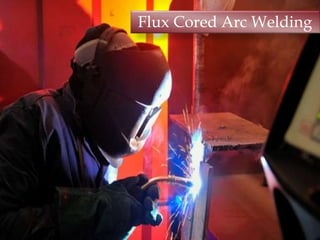
Flux-cored arc welding (FCAW or FCA) is a semi-automatic or automatic arc
welding process.
 FCAW requires a continuously-fed consumable tubular electrode containing
a flux and a constant-voltage or, less commonly, a constant-current welding power
supply. An externally supplied shielding gas is sometimes used, but often the flux itself is
relied upon to generate the necessary protection from the atmosphere, producing both
gaseous protection and liquid slag protecting the weld.
 FCAW was first developed in the early 1950s as an alternative to shielded metal arc
welding (SMAW).
 Flux Cored Arc Welding (FCAW) is quite similar to MIG welding as far as operation
and equipment are concerned. However, the electrode is not solid but consists of a
metal sheath surrounding a flux core.
 FCAW require adequate ventilation and the use of a sealed mask that will provide the
welder with fresh air. Also eyes and skin should be protected by appropriate goggles and
clothes.
The electrodes used in this welding process are usually 0.5mm to 4 mm in diameter
and the power required is about 20 kW. Most power sources operate on 230 or 460
volt input power, but machines that operate on 200 or 575 volt input are also
available.
. Small diameter electrodes have made the welding of thinner materials not only
possible but often preferable for using. Also small diameter electrodes make it
relatively easy to weld joints in different positions.
 The flux-cored arc welding process is similar to Gas Metal-arc Welding, except that
the electrode is tubular in shape and is filled with flux. Cored electrodes produce a
more stable arc and produce better mechanical properties of the weld metal. The flux
in these electrodes is much more flexible than the brittle coating used on Shielded
Metal-arc Welding electrodes, so the tubular electrode can be provided in long coiled
lengths.
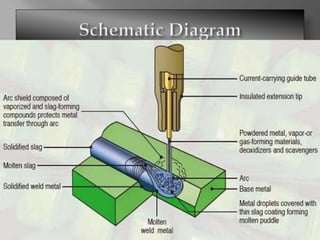
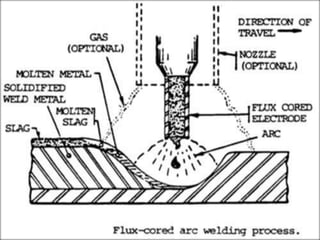
 In which the heat for welding is provided by an arc between a continuously fed tubular
electrode wire and the work-piece. Shielding is obtained by a flux contained within the
tubular electrode wire or by the flux.
The flux-cored welding wire, or electrode, is a hollow tube filled with a mixture of
deoxidizers, fluxing agents. Flux-cored electrode welding can be done in two ways:
 Carbon dioxide gas can be used with the flux to provide additional shielding. The carbon
dioxide gas shield produces a deeply penetrating arc and usually provides better weld than
is possible without an external gas shield.
In semiautomatic welding, the wire feeder feeds the electrode wire and the power source
maintains the arc length. The welding operator continuously monitors the welding and
makes adjustments in the welding parameters. Automatic welding is used in high production
applications.
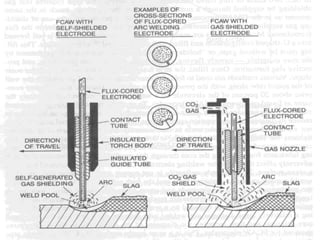
1. Self-shielded FCAW (without shielding gas)
FCAW is used in outdoor conditions where wind would blow away a shielding gas.
The fluxing agents in self shielded FCAW are designed to not only deoxidize the weld
pool but also to allow for shielding of the weld pool and metal droplets from the
atmosphere.
2. The flux in Gas-shielded FCAW provides for deoxidation of the weld pool and, to a
smaller degree than in self-shielded FCAW, provides secondary shielding from
the atmosphere. The flux is designed to support the weld pool for out-of position
welds. This variation of the process is used for increasing productivity of out-of-
position welds and for deeper penetration.
.
 A major difference between the gas shielded electrodes and the self-shielded
electrodes is that the gas shielded wires also require a gas shielding system. This
may also have an effect on the type of welding gun used. For machines and
automatic welding, several items, such as motion devices, are added to the basic
equipment.
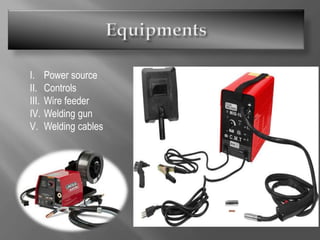
I. Power source
II. Controls
III. Wire feeder
IV. Welding gun
V. Welding cables
FCAW vs SMAW:
I. As with SMAW, the slag must be removed between passes on multi-pass welds. This can
slow down the productivity of the application and result in possible slag inclusion
discontinuities. For gas shielded FCAW, porosity can occur as a result of insufficient gas
coverage.
II. Large amounts of fume are produced by the FCAW process due to the high currents,
voltages, and the flux inherent with the process. Increased costs the need for ventilation
equipment for proper health and safety.
III. FCAW is more complex and more expensive than SMAW because it requires a wire
feeder and welding gun.
FCAW vs GMAW:
 Flux-cored arc welding is similar to gas metal arc welding (GMAW or MIG) in many ways.
At high welding currents, the arc is smooth and more manageable. The arc and weld pool are
clearly visible to the welder. A slag coating which is left on the surface of the weld bead must
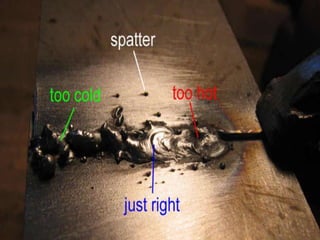
be removed. Since the filler metal transfers across the arc, some spatter is created and some
smoke produced. The flux for FCAW consumables can be designed to support larger weld
pools out of position and provide higher penetration compared to using a solid wire (GMAW).
This improves productivity and reduces distortion of a weldment.
 A flux cored welding power supply is also a MIG welding power supply, they are the
same machine. That is a “Constant Voltage Power Supply”. Constant voltage power
supplies keep the voltage near, or at the same level. Unlike a TIG, or Stick welder, that
keeps the amperage consistent. In the flux cored welder the amperage is changed with the
wire feed speed. The faster the wire feeds, the more contact the electrode has, producing
more amperage, and heat.
. The polarity used in industrial flux core arc welding is typically D/C electrode (+) positive.
This means that the handle is the positive side of the circuit. This is typical when larger
electrodes are used. When welding with smaller electrodes and sheet metals, the polarity is
changed to D/C electrode (-) negative. Some self-shielding flux-cored ties are used with
DCEP while others used with DCEN. Electrode positive current gives better penetration into
the weld joint. Electrode negative current gives lighter penetration and is used for welding
thinner metals.
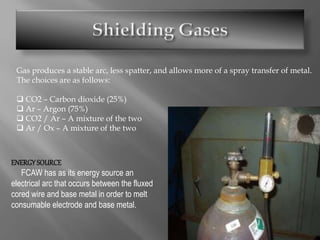
Gas produces a stable arc, less spatter, and allows more of a spray transfer of metal.
The choices are as follows:
 CO2 – Carbon dioxide (25%)
 Ar – Argon (75%)
 CO2 / Ar – A mixture of the two
 Ar / Ox – A mixture of the two
ENERGYSOURCE
FCAW has as its energy source an
electrical arc that occurs between the fluxed
cored wire and base metal in order to melt
consumable electrode and base metal.
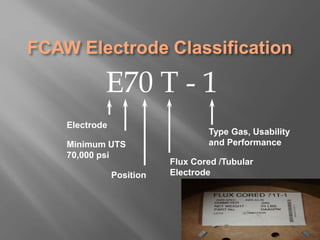
E70 T - 1
Electrode
Minimum UTS
70,000 psi
Position
Flux Cored /Tubular
Electrode
Type Gas, Usability
and Performance
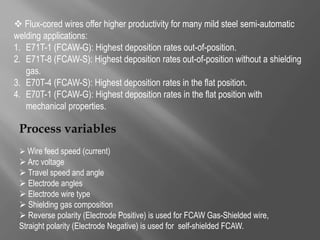
 Flux-cored wires offer higher productivity for many mild steel semi-automatic
welding applications:
1. E71T-1 (FCAW-G): Highest deposition rates out-of-position.
2. E71T-8 (FCAW-S): Highest deposition rates out-of-position without a shielding
gas.
3. E70T-4 (FCAW-S): Highest deposition rates in the flat position.
4. E70T-1 (FCAW-G): Highest deposition rates in the flat position with
mechanical properties.
Process variables
 Wire feed speed (current)
 Arc voltage
 Travel speed and angle
 Electrode angles
 Electrode wire type
 Shielding gas composition
 Reverse polarity (Electrode Positive) is used for FCAW Gas-Shielded wire,
Straight polarity (Electrode Negative) is used for self-shielded FCAW.
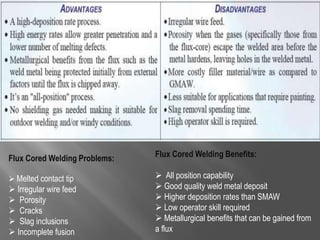
Flux Cored Welding Problems:
 Melted contact tip
 Irregular wire feed
 Porosity
 Cracks
 Slag inclusions
 Incomplete fusion
Flux Cored Welding Benefits:
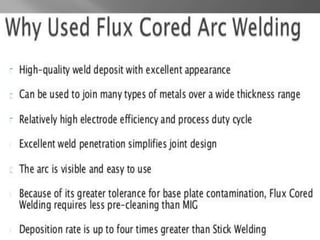
 All position capability
 Good quality weld metal deposit
 Higher deposition rates than SMAW
 Low operator skill required
 Metallurgical benefits that can be gained from
a flux
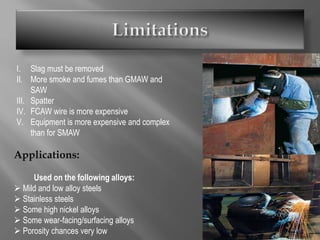
I. Slag must be removed
II. More smoke and fumes than GMAW and
SAW
III. Spatter
IV. FCAW wire is more expensive
V. Equipment is more expensive and complex
than for SMAW
Applications:
Used on the following alloys:
 Mild and low alloy steels
 Stainless steels
 Some high nickel alloys
 Some wear-facing/surfacing alloys
 Porosity chances very low
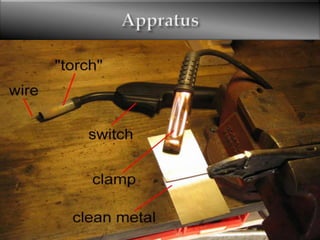
The reality of flux core arc welding is using a typical MIG welding machine and
mostly the same equipment, with a few small exceptions! Although they are
considered two different types of welding processes, it is only the electrode type,
and shielding type, that separate them. Flux core welding use a different type of
electrode in a MIG welding machine. That is all there really is to flux core arc
welding.
 http://www.gowelding.org/welding/fcaw-flux-cored-arc-welding/
 http://www.weldingengineer.com/1flux.htm
 http://www.esab.com/global/en/education/processes-fcaw.cfm
 http://en.wikipedia.org/wiki/Flux-cored_arc_welding
 http://www.slideshare.net/amargulius/flux-cored-wire problems2?qid=eb1ae30be-
472f-9016-d2225574c49c&v=default&b=&from_search=4
 https://www.google.com.pk/?gws_rd=cr&ei=j16-
VJ3qB4mAUa3lg_AJ#q=basic+principle+of+flux+cored+arc+welding
Flux cored arc welding

Flux cored arc welding

  • 1.
    Group B Members Muhammad SaadBaig (E12-338) Shoaib Ibrahim (E12-314) Department Of Metallurgy & Materials Engineering College of Engineering & Emerging Technologies University Of the Punjab
  • 2.
  • 3.
    Flux-cored arc welding(FCAW or FCA) is a semi-automatic or automatic arc welding process.  FCAW requires a continuously-fed consumable tubular electrode containing a flux and a constant-voltage or, less commonly, a constant-current welding power supply. An externally supplied shielding gas is sometimes used, but often the flux itself is relied upon to generate the necessary protection from the atmosphere, producing both gaseous protection and liquid slag protecting the weld.  FCAW was first developed in the early 1950s as an alternative to shielded metal arc welding (SMAW).  Flux Cored Arc Welding (FCAW) is quite similar to MIG welding as far as operation and equipment are concerned. However, the electrode is not solid but consists of a metal sheath surrounding a flux core.  FCAW require adequate ventilation and the use of a sealed mask that will provide the welder with fresh air. Also eyes and skin should be protected by appropriate goggles and clothes.
  • 4.
    The electrodes usedin this welding process are usually 0.5mm to 4 mm in diameter and the power required is about 20 kW. Most power sources operate on 230 or 460 volt input power, but machines that operate on 200 or 575 volt input are also available. . Small diameter electrodes have made the welding of thinner materials not only possible but often preferable for using. Also small diameter electrodes make it relatively easy to weld joints in different positions.  The flux-cored arc welding process is similar to Gas Metal-arc Welding, except that the electrode is tubular in shape and is filled with flux. Cored electrodes produce a more stable arc and produce better mechanical properties of the weld metal. The flux in these electrodes is much more flexible than the brittle coating used on Shielded Metal-arc Welding electrodes, so the tubular electrode can be provided in long coiled lengths.
  • 5.
     In whichthe heat for welding is provided by an arc between a continuously fed tubular electrode wire and the work-piece. Shielding is obtained by a flux contained within the tubular electrode wire or by the flux. The flux-cored welding wire, or electrode, is a hollow tube filled with a mixture of deoxidizers, fluxing agents. Flux-cored electrode welding can be done in two ways:  Carbon dioxide gas can be used with the flux to provide additional shielding. The carbon dioxide gas shield produces a deeply penetrating arc and usually provides better weld than is possible without an external gas shield. In semiautomatic welding, the wire feeder feeds the electrode wire and the power source maintains the arc length. The welding operator continuously monitors the welding and makes adjustments in the welding parameters. Automatic welding is used in high production applications.
  • 7.
    1. Self-shielded FCAW(without shielding gas) FCAW is used in outdoor conditions where wind would blow away a shielding gas. The fluxing agents in self shielded FCAW are designed to not only deoxidize the weld pool but also to allow for shielding of the weld pool and metal droplets from the atmosphere. 2. The flux in Gas-shielded FCAW provides for deoxidation of the weld pool and, to a smaller degree than in self-shielded FCAW, provides secondary shielding from the atmosphere. The flux is designed to support the weld pool for out-of position welds. This variation of the process is used for increasing productivity of out-of- position welds and for deeper penetration. .  A major difference between the gas shielded electrodes and the self-shielded electrodes is that the gas shielded wires also require a gas shielding system. This may also have an effect on the type of welding gun used. For machines and automatic welding, several items, such as motion devices, are added to the basic equipment.
  • 10.
    I. Power source II.Controls III. Wire feeder IV. Welding gun V. Welding cables
  • 13.
    FCAW vs SMAW: I.As with SMAW, the slag must be removed between passes on multi-pass welds. This can slow down the productivity of the application and result in possible slag inclusion discontinuities. For gas shielded FCAW, porosity can occur as a result of insufficient gas coverage. II. Large amounts of fume are produced by the FCAW process due to the high currents, voltages, and the flux inherent with the process. Increased costs the need for ventilation equipment for proper health and safety. III. FCAW is more complex and more expensive than SMAW because it requires a wire feeder and welding gun. FCAW vs GMAW:  Flux-cored arc welding is similar to gas metal arc welding (GMAW or MIG) in many ways. At high welding currents, the arc is smooth and more manageable. The arc and weld pool are clearly visible to the welder. A slag coating which is left on the surface of the weld bead must be removed. Since the filler metal transfers across the arc, some spatter is created and some smoke produced. The flux for FCAW consumables can be designed to support larger weld pools out of position and provide higher penetration compared to using a solid wire (GMAW). This improves productivity and reduces distortion of a weldment.
  • 14.
     A fluxcored welding power supply is also a MIG welding power supply, they are the same machine. That is a “Constant Voltage Power Supply”. Constant voltage power supplies keep the voltage near, or at the same level. Unlike a TIG, or Stick welder, that keeps the amperage consistent. In the flux cored welder the amperage is changed with the wire feed speed. The faster the wire feeds, the more contact the electrode has, producing more amperage, and heat. . The polarity used in industrial flux core arc welding is typically D/C electrode (+) positive. This means that the handle is the positive side of the circuit. This is typical when larger electrodes are used. When welding with smaller electrodes and sheet metals, the polarity is changed to D/C electrode (-) negative. Some self-shielding flux-cored ties are used with DCEP while others used with DCEN. Electrode positive current gives better penetration into the weld joint. Electrode negative current gives lighter penetration and is used for welding thinner metals.
  • 15.
    Gas produces astable arc, less spatter, and allows more of a spray transfer of metal. The choices are as follows:  CO2 – Carbon dioxide (25%)  Ar – Argon (75%)  CO2 / Ar – A mixture of the two  Ar / Ox – A mixture of the two ENERGYSOURCE FCAW has as its energy source an electrical arc that occurs between the fluxed cored wire and base metal in order to melt consumable electrode and base metal.
  • 17.
    E70 T -1 Electrode Minimum UTS 70,000 psi Position Flux Cored /Tubular Electrode Type Gas, Usability and Performance
  • 18.
     Flux-cored wiresoffer higher productivity for many mild steel semi-automatic welding applications: 1. E71T-1 (FCAW-G): Highest deposition rates out-of-position. 2. E71T-8 (FCAW-S): Highest deposition rates out-of-position without a shielding gas. 3. E70T-4 (FCAW-S): Highest deposition rates in the flat position. 4. E70T-1 (FCAW-G): Highest deposition rates in the flat position with mechanical properties. Process variables  Wire feed speed (current)  Arc voltage  Travel speed and angle  Electrode angles  Electrode wire type  Shielding gas composition  Reverse polarity (Electrode Positive) is used for FCAW Gas-Shielded wire, Straight polarity (Electrode Negative) is used for self-shielded FCAW.
  • 19.
    Flux Cored WeldingProblems:  Melted contact tip  Irregular wire feed  Porosity  Cracks  Slag inclusions  Incomplete fusion Flux Cored Welding Benefits:  All position capability  Good quality weld metal deposit  Higher deposition rates than SMAW  Low operator skill required  Metallurgical benefits that can be gained from a flux
  • 20.
    I. Slag mustbe removed II. More smoke and fumes than GMAW and SAW III. Spatter IV. FCAW wire is more expensive V. Equipment is more expensive and complex than for SMAW Applications: Used on the following alloys:  Mild and low alloy steels  Stainless steels  Some high nickel alloys  Some wear-facing/surfacing alloys  Porosity chances very low
  • 21.
    The reality offlux core arc welding is using a typical MIG welding machine and mostly the same equipment, with a few small exceptions! Although they are considered two different types of welding processes, it is only the electrode type, and shielding type, that separate them. Flux core welding use a different type of electrode in a MIG welding machine. That is all there really is to flux core arc welding.
  • 22.
     http://www.gowelding.org/welding/fcaw-flux-cored-arc-welding/  http://www.weldingengineer.com/1flux.htm http://www.esab.com/global/en/education/processes-fcaw.cfm  http://en.wikipedia.org/wiki/Flux-cored_arc_welding  http://www.slideshare.net/amargulius/flux-cored-wire problems2?qid=eb1ae30be- 472f-9016-d2225574c49c&v=default&b=&from_search=4  https://www.google.com.pk/?gws_rd=cr&ei=j16- VJ3qB4mAUa3lg_AJ#q=basic+principle+of+flux+cored+arc+welding