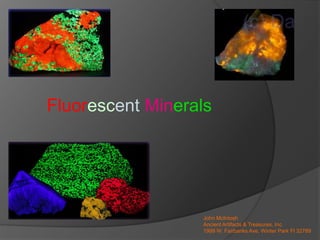
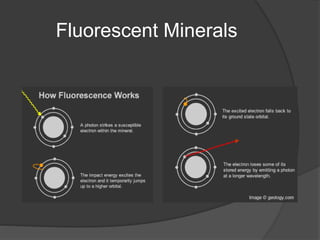
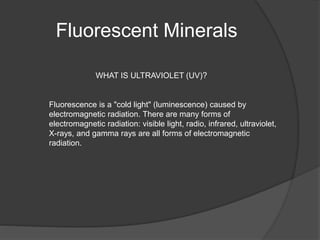
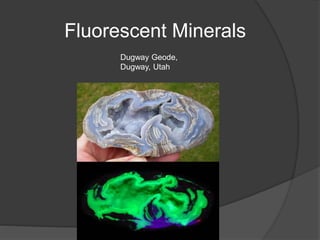
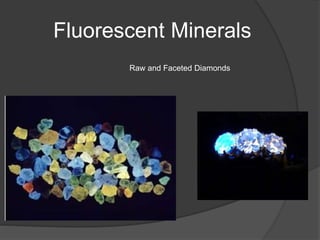
This document discusses fluorescent minerals, which are minerals that temporarily absorb light and re-emit light of a different wavelength, causing a color change. Fluorescence is caused by certain impurities in minerals called activators, such as metals like tungsten, molybdenum, and rare earth elements. About 15% of known minerals fluoresce. Common fluorescent minerals mentioned include calcite, tourmaline, topaz, and diamonds. Ultraviolet light is needed to see fluorescence, and different types of UV wavelengths cause different color changes in minerals.













![Fluorescent Minerals
Fluorescent Mineral References
[1] Basic Concepts in Fluorescence: Michael W. Davidson and
others, Optical Microscopy Primer, Florida State University, last
accessed October 2016.
[2] Fluorescent Minerals: James O. Hamblen, a website about
fluorescent minerals, Georgia Tech, 2003.
[3] The World of Fluorescent Minerals, Stuart Schneider, Schiffer
Publishing Ltd., 2006.
[4] Dugway Geodes page on the SpiritRock Shop website, last
accessed May 2017.
[5] Collecting Fluorescent Minerals, Stuart Schneider, Schiffer
Publishing Ltd., 2004.
[6] Ultraviolet Light Safety: Connecticut High School Science
Safety, Connecticut State Department of Education, last accessed
October 2016.
[7] A Contribution to Understanding the Effect of Blue
Fluorescence on the Appearance of Diamonds: Thomas M.
Moses and others, Gems and Gemology, Gemological Institute of
America, Winter 1997.
Good Reference Books](https://image.slidesharecdn.com/fluorescentmineralscopy-190201165102/85/Fluorescent-Minerals-26-320.jpg)