
YADU’S
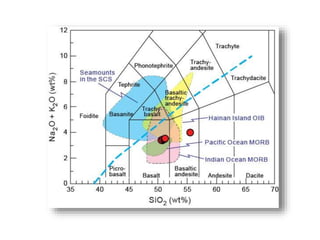
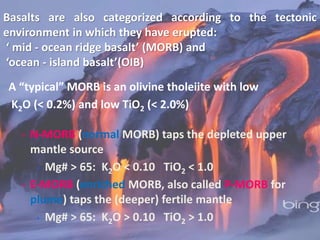
Basalts are also categorized according to the tectonic
environment in which they have erupted:
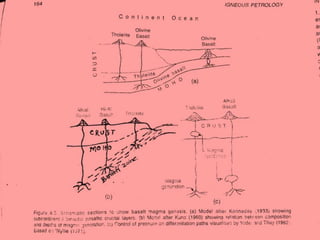
‘ mid - ocean ridge basalt’ (MORB) and
‘ocean - island basalt’(OIB)
A “typical” MORB is an olivine tholeiite with low
K2O (< 0.2%) and low TiO2 (< 2.0%)
 N-MORB (normal MORB) taps the depleted upper
mantle source
 Mg# > 65: K2O < 0.10 TiO2 < 1.0
 E-MORB (enriched MORB, also called P-MORB for
plume) taps the (deeper) fertile mantle
 Mg# > 65: K2O > 0.10 TiO2 > 1.0
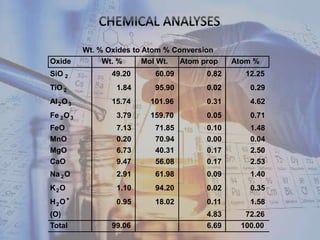
Wt. % Oxides to Atom % Conversion
Oxide Wt. % Mol Wt. Atom prop Atom %
SiO 2 49.20 60.09 0.82 12.25
TiO 2 1.84 95.90 0.02 0.29
Al2O3 15.74 101.96 0.31 4.62
Fe 2O3 3.79 159.70 0.05 0.71
FeO 7.13 71.85 0.10 1.48
MnO 0.20 70.94 0.00 0.04
MgO 6.73 40.31 0.17 2.50
CaO 9.47 56.08 0.17 2.53
Na 2O 2.91 61.98 0.09 1.40
K2O 1.10 94.20 0.02 0.35
H2O+
0.95 18.02 0.11 1.58
(O) 4.83 72.26
Total 99.06 6.69 100.00
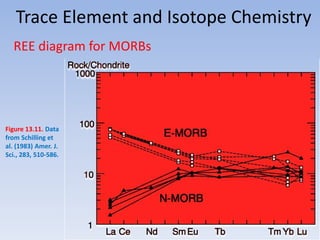
Trace Element and Isotope Chemistry
REE diagram for MORBs
Figure 13.11. Data
from Schilling et
al. (1983) Amer. J.
Sci., 283, 510-586.
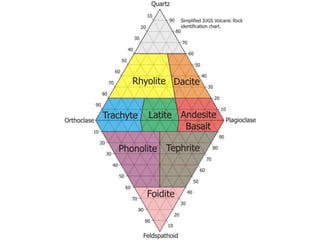
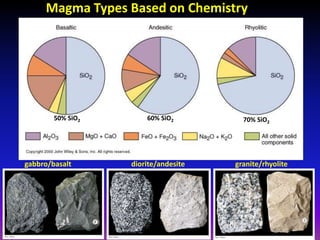
Magma Types Based on Chemistry
gabbro/basalt diorite/andesite granite/rhyolite
50% SiO2 60% SiO2 70% SiO2
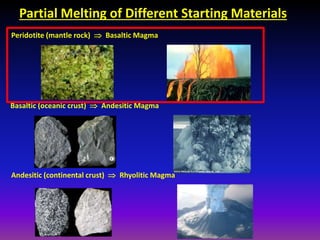
Partial Melting of Different Starting Materials
Peridotite (mantle rock)  Basaltic Magma
Basaltic (oceanic crust)  Andesitic Magma
Andesitic (continental crust)  Rhyolitic Magma
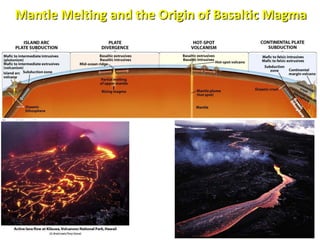
Mantle Melting and the Origin of Basaltic Magma
Primary Basaltic Magmas
• Mantle melts with no subsequent modification by
secondary processes (fractional crystallization, assimilation,
mixing).
• Criteria:
• SiO₂ < 50 wt%
• MgO > 7 wt%
• Cr > 1000 ppm
• Ni > 400 ppm
• Rarely observed, “Holy Grail” of basalts, very important for
petrologists and geochemists, fingerprint of mantle source!
Uses of Basalt
The industrial applications of basalt are based on the basic
quality properties of basalt such as high abrasion
resistance, compressive strength and chemical resistance.
Basalt can made into fine, superfine and ultra fine fibers,
basalt fibers are considered superior to other fibers in
terms of thermal stability, heat and sound insulation
properties, vibration resistance and durability.
Basalt continuous fibers offer the prospect of a completely
new range of composite materials and products, such
products have no toxic re-action with air or water, are non
combustible and explosion proof, when it contact with
other chemicals they produce no chemical reactions that
may damage health or environment.
Basalt replaces almost all applications of asbestos and has
three times heat reinforced plastics (1 kg. of basalt
reinforcement equal 9 kg. steel).
Basalt

Basalt

  • 2.
  • 13.
    Basalts are alsocategorized according to the tectonic environment in which they have erupted: ‘ mid - ocean ridge basalt’ (MORB) and ‘ocean - island basalt’(OIB) A “typical” MORB is an olivine tholeiite with low K2O (< 0.2%) and low TiO2 (< 2.0%)  N-MORB (normal MORB) taps the depleted upper mantle source  Mg# > 65: K2O < 0.10 TiO2 < 1.0  E-MORB (enriched MORB, also called P-MORB for plume) taps the (deeper) fertile mantle  Mg# > 65: K2O > 0.10 TiO2 > 1.0
  • 14.
    Wt. % Oxidesto Atom % Conversion Oxide Wt. % Mol Wt. Atom prop Atom % SiO 2 49.20 60.09 0.82 12.25 TiO 2 1.84 95.90 0.02 0.29 Al2O3 15.74 101.96 0.31 4.62 Fe 2O3 3.79 159.70 0.05 0.71 FeO 7.13 71.85 0.10 1.48 MnO 0.20 70.94 0.00 0.04 MgO 6.73 40.31 0.17 2.50 CaO 9.47 56.08 0.17 2.53 Na 2O 2.91 61.98 0.09 1.40 K2O 1.10 94.20 0.02 0.35 H2O+ 0.95 18.02 0.11 1.58 (O) 4.83 72.26 Total 99.06 6.69 100.00
  • 16.
    Trace Element andIsotope Chemistry REE diagram for MORBs Figure 13.11. Data from Schilling et al. (1983) Amer. J. Sci., 283, 510-586.
  • 18.
    Magma Types Basedon Chemistry gabbro/basalt diorite/andesite granite/rhyolite 50% SiO2 60% SiO2 70% SiO2
  • 19.
    Partial Melting ofDifferent Starting Materials Peridotite (mantle rock)  Basaltic Magma Basaltic (oceanic crust)  Andesitic Magma Andesitic (continental crust)  Rhyolitic Magma
  • 20.
    Mantle Melting andthe Origin of Basaltic Magma
  • 22.
    Primary Basaltic Magmas •Mantle melts with no subsequent modification by secondary processes (fractional crystallization, assimilation, mixing). • Criteria: • SiO₂ < 50 wt% • MgO > 7 wt% • Cr > 1000 ppm • Ni > 400 ppm • Rarely observed, “Holy Grail” of basalts, very important for petrologists and geochemists, fingerprint of mantle source!
  • 24.
    Uses of Basalt Theindustrial applications of basalt are based on the basic quality properties of basalt such as high abrasion resistance, compressive strength and chemical resistance. Basalt can made into fine, superfine and ultra fine fibers, basalt fibers are considered superior to other fibers in terms of thermal stability, heat and sound insulation properties, vibration resistance and durability. Basalt continuous fibers offer the prospect of a completely new range of composite materials and products, such products have no toxic re-action with air or water, are non combustible and explosion proof, when it contact with other chemicals they produce no chemical reactions that may damage health or environment. Basalt replaces almost all applications of asbestos and has three times heat reinforced plastics (1 kg. of basalt reinforcement equal 9 kg. steel).