SCIENCE
CURIOSITY
NATURAL
SCIENCE
SOCIAL
SCIENCE
APPLIED
SCIENCE
PHYSICAL
SCIENCE
LIFE SCIENCE
PHYSICS
CHEMISTRY
ASTRONOMY
EARTH SCIENCE
Systematized
body of
knowledge
observing and
measuring
Unlike in previous grade levels, there
is only one strand in the Earth and
Space unit of Grade 10: GEOLOGY.
Module 1: PLATE
TECTONICS
OBJECTIVES
At the end of the lesson, the students are expected to:
a.Locate the epicenter of an earthquake using triangulation
method;
b.enumerate ways to ensure disaster preparedness during
earthquakes, tsunamis, and volcanic eruptions; and
c. suggest ways by which one can contribute to government
efforts in reducing damage due to earthquakes, tsunamis, and
volcanic eruptions.
ACTIVITY 1: FIND THE CENTER
This Photo by Unknown Author is licensed under CC BY-SA
LET’S CHECK
YOUR
KNOWLEDGE!
PRE -TEST
1. It is the location on the Earth's
surface directly above the focus of an
earthquake.
a.center
b.direct center
c.epic center
d.epicenter
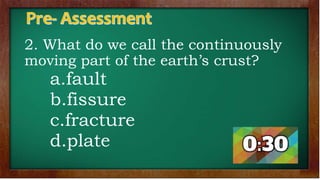
2. What do we call the continuously
moving part of the earth’s crust?
a.fault
b.fissure
c.fracture
d.plate
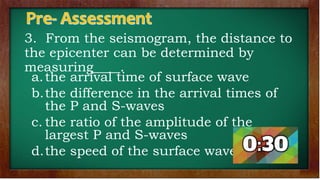
3. From the seismogram, the distance to
the epicenter can be determined by
measuring____.
a.the arrival time of surface wave
b.the difference in the arrival times of
the P and S-waves
c. the ratio of the amplitude of the
largest P and S-waves
d.the speed of the surface wave
4. You were provided with data showing the
arrival time of the P and S-waves recorded
from three seismic stations. Which of these
can you possibly determine?
a.the damage at the focus
b.the intensity of the
earthquake
c. the distance to the
earthquake
d.the location of the epicenter
5. Why is it important to be aware of
places prone to earthquakes?
a.to identify what crop must be
stored
b.to identify when to evacuate
c.to locate where to stay best
d.to perform necessary
precautions
1. It is the location on the Earth's
surface directly above the focus of an
earthquake.
a.center
b.direct center
c.epic center
d.epicenter
Answer
2. What do we call the continuously
moving part of the earth’s crust?
a.fault
b.fissure
c.fracture
d.plate
Answe
r
3. From the seismogram, the distance to
the epicenter can be determined by
measuring____.
a.the arrival time of surface wave
b.the difference in the arrival time of
the P and S-waves
c. the ratio of the amplitude of the
largest P and S-waves
d.the speed of the surface wave
Answer
4. You were provided with data showing the
arrival time of the P and S-waves recorded
from three seismic stations. Which of these
can you possibly determine?
a.the damage at the focus
b.the intensity of the
earthquake
c. the distance to the
earthquake
d.the location of the epicenter
Answer
5. Why is it important to be aware of
places prone to earthquakes?
a.to identify what crop must be
stored
b.to identify when to evacuate
c.to locate where to stay best
d.to perform necessary
precautions
Answer
What is an Earthquake?
Let’s find the
meaning!
○Earthquake
○Epicenter
○Focus
○Seismology
○Seismologist
○Seismograph
○Seismogram
○Seismic Waves
○P-waves
○S-waves
EARTHQUAKES/TREMOR
• Definition
1. a shaking or vibration of the ground
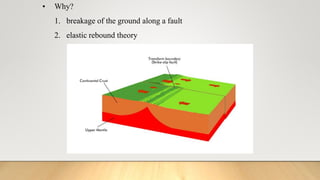
• Why?
1. breakage of the ground along a fault
2. elastic rebound theory
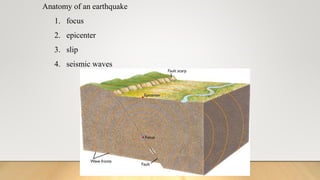
Anatomy of an earthquake
1. focus
2. epicenter
3. slip
4. seismic waves
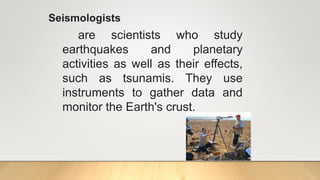
Seismologists
are scientists who study
earthquakes and planetary
activities as well as their effects,
such as tsunamis. They use
instruments to gather data and
monitor the Earth's crust.
Seismic Waves
1. measure with a seismograph
Detecting Earthquake
SeismograPH
Detecting Earthquake
SeismograM
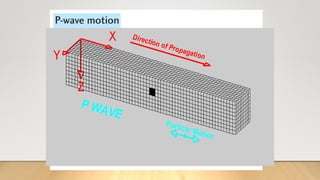
Seismic Waves
(1) P-waves
(2) S-waves
Find the Epicenter
(Adapted and modified from the Learner’s
Material)
•Map for Learning
Task 1 (NOTE:
Dots represent
the Seismic
Stations)
.
.
.
Study the data showing the difference in the arrival
time of P-wave and S-wave on three seismic
recording stations.
Station Td km Scaled
distance
cm(radius
of the circle)
cm(diamete
r of the
circle)
Occidental Mindoro 62.4 s
Samar 32.8 s
Zamboanga del
Norte
36.8 s
Procedure
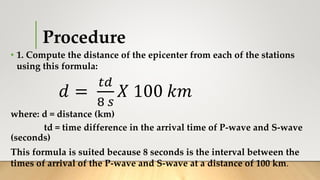
• 1. Compute the distance of the epicenter from each of the stations
using this formula:
𝑑 =
𝑡𝑑
8 𝑠
𝑋 100 𝑘𝑚
where: d = distance (km)
td = time difference in the arrival time of P-wave and S-wave
(seconds)
This formula is suited because 8 seconds is the interval between the
times of arrival of the P-wave and S-wave at a distance of 100 km.
Procedure
•2. Choose one of the recording stations and
measure the computed distance on the scale
(the scale of the map is 1 cm: 100 km).
Set your compass for that computed distance.
Center your compass on the station you have
chosen. Draw a circle.
Procedure
•3. Repeat steps 3 and 4 for the rest
of the stations. You should get
three circles that intersect or
nearly intersect at a point. This
intersection is the epicenter.
Do the Activity: Activity 1 Find the
Center
Study the data showing the difference in the arrival
time of P-wave and S-wave on three seismic
recording stations.
Station Td km Scaled
distance
cm(radius
of the circle)
cm(diamete
r of the
circle)
Occidental Mindoro 40 s
Samar 32 s
Zamboanga del
Norte
36 s
Assessment:
Review for a short quiz on the next
meeting about our lesson for today.

1 Earthquake, Triangulation Method.pptx

  • 5.
  • 6.
    Unlike in previousgrade levels, there is only one strand in the Earth and Space unit of Grade 10: GEOLOGY. Module 1: PLATE TECTONICS
  • 9.
    OBJECTIVES At the endof the lesson, the students are expected to: a.Locate the epicenter of an earthquake using triangulation method; b.enumerate ways to ensure disaster preparedness during earthquakes, tsunamis, and volcanic eruptions; and c. suggest ways by which one can contribute to government efforts in reducing damage due to earthquakes, tsunamis, and volcanic eruptions.
  • 10.
    ACTIVITY 1: FINDTHE CENTER
  • 11.
    This Photo byUnknown Author is licensed under CC BY-SA
  • 12.
  • 13.
  • 14.
    1. It isthe location on the Earth's surface directly above the focus of an earthquake. a.center b.direct center c.epic center d.epicenter
  • 15.
    2. What dowe call the continuously moving part of the earth’s crust? a.fault b.fissure c.fracture d.plate
  • 16.
    3. From theseismogram, the distance to the epicenter can be determined by measuring____. a.the arrival time of surface wave b.the difference in the arrival times of the P and S-waves c. the ratio of the amplitude of the largest P and S-waves d.the speed of the surface wave
  • 17.
    4. You wereprovided with data showing the arrival time of the P and S-waves recorded from three seismic stations. Which of these can you possibly determine? a.the damage at the focus b.the intensity of the earthquake c. the distance to the earthquake d.the location of the epicenter
  • 18.
    5. Why isit important to be aware of places prone to earthquakes? a.to identify what crop must be stored b.to identify when to evacuate c.to locate where to stay best d.to perform necessary precautions
  • 20.
    1. It isthe location on the Earth's surface directly above the focus of an earthquake. a.center b.direct center c.epic center d.epicenter Answer
  • 21.
    2. What dowe call the continuously moving part of the earth’s crust? a.fault b.fissure c.fracture d.plate Answe r
  • 22.
    3. From theseismogram, the distance to the epicenter can be determined by measuring____. a.the arrival time of surface wave b.the difference in the arrival time of the P and S-waves c. the ratio of the amplitude of the largest P and S-waves d.the speed of the surface wave Answer
  • 23.
    4. You wereprovided with data showing the arrival time of the P and S-waves recorded from three seismic stations. Which of these can you possibly determine? a.the damage at the focus b.the intensity of the earthquake c. the distance to the earthquake d.the location of the epicenter Answer
  • 24.
    5. Why isit important to be aware of places prone to earthquakes? a.to identify what crop must be stored b.to identify when to evacuate c.to locate where to stay best d.to perform necessary precautions Answer
  • 25.
    What is anEarthquake?
  • 26.
  • 27.
    EARTHQUAKES/TREMOR • Definition 1. ashaking or vibration of the ground
  • 28.
    • Why? 1. breakageof the ground along a fault 2. elastic rebound theory
  • 29.
    Anatomy of anearthquake 1. focus 2. epicenter 3. slip 4. seismic waves
  • 30.
    Seismologists are scientists whostudy earthquakes and planetary activities as well as their effects, such as tsunamis. They use instruments to gather data and monitor the Earth's crust.
  • 31.
    Seismic Waves 1. measurewith a seismograph
  • 32.
  • 33.
  • 34.
  • 37.
    Find the Epicenter (Adaptedand modified from the Learner’s Material) •Map for Learning Task 1 (NOTE: Dots represent the Seismic Stations) . . .
  • 39.
    Study the datashowing the difference in the arrival time of P-wave and S-wave on three seismic recording stations. Station Td km Scaled distance cm(radius of the circle) cm(diamete r of the circle) Occidental Mindoro 62.4 s Samar 32.8 s Zamboanga del Norte 36.8 s
  • 40.
    Procedure • 1. Computethe distance of the epicenter from each of the stations using this formula: 𝑑 = 𝑡𝑑 8 𝑠 𝑋 100 𝑘𝑚 where: d = distance (km) td = time difference in the arrival time of P-wave and S-wave (seconds) This formula is suited because 8 seconds is the interval between the times of arrival of the P-wave and S-wave at a distance of 100 km.
  • 41.
    Procedure •2. Choose oneof the recording stations and measure the computed distance on the scale (the scale of the map is 1 cm: 100 km). Set your compass for that computed distance. Center your compass on the station you have chosen. Draw a circle.
  • 42.
    Procedure •3. Repeat steps3 and 4 for the rest of the stations. You should get three circles that intersect or nearly intersect at a point. This intersection is the epicenter.
  • 43.
    Do the Activity:Activity 1 Find the Center
  • 44.
    Study the datashowing the difference in the arrival time of P-wave and S-wave on three seismic recording stations. Station Td km Scaled distance cm(radius of the circle) cm(diamete r of the circle) Occidental Mindoro 40 s Samar 32 s Zamboanga del Norte 36 s
  • 45.
    Assessment: Review for ashort quiz on the next meeting about our lesson for today.