Mantle melting And
Magmatic process
Presented by : Ananya Mittal
5th year , IMT Geological Technology
CONTENTS
1. Mantle Petrology and Composition
2. Mantle melting
 Mantle heating
3. Magmatic processes
 Partial melting
 Magma Accumulation and Separation
 Magma Mixing
 Magma Emplacement
 Magma Differentiation
Mantle Petrology
1. Seismology
Seismic studies define changes in the physical properties of mantle rock with
depth. Important boundaries include:
• the Moho – boundary between low density felsic and mafic rocks of the
crust and high density ultramafic rocks of the mantle
• lithosphere-asthenosphere – boundary between the rigid outer layer of
the Earth and a mechanically weak layer that acts like a viscous fluid
• 400 km discontinuity – increase in seismic velocity (density) caused by a
change in olivine structure to that of spinel
• 670 km discontinuity – change in spinel structure of olivine to that of
perovskite
Earth's Interior and Geophysical Properties by Dwight Bishop
Mantle Petrology
2. Composition of the mantle
Direct samples offer a peep into the sub-lithospheric mantle, thus giving accurate idea of
mineralogy and composition
Sources of mantle Origin
A. Ophiolites :
• suites of temporally and spatially associated ultramafic, mafic, and felsic rocks ,interpreted
as the remnants of ancient oceanic crust and upper mantle
• Obducted-uplifted and exposed above sea level and are often emplaced on top of the
continental lithosphere
• Ophio- is Greek for "snake” and - lite means "stone" from the Greek lithos. The rock looks
like snake skin
• Occurrence: collision orogens, indicating the existence of former ocean basins, now been
absorbed by thrusts, subduction zone, and plate tectonics.
• Emplaced either from the downgoing oceanic lithosphere via subduction-accretion or from
the upper plate in a subduction zone through trench–continent collision.
Intrusive complex of the Nidar Ophiolite: amphibole-gabbro
(Source: Buchs and Epard, 2019)
Ophiolites formation, Source: DiPietro , 2013
Ophiolite sequence, Northern Apennines, Italy.
Source: Wikimedia
Mantle Petrology
B. Dredge samples from oceanic fracture zones
• Significant scraps can be seen at many ridge-offsetting fracture zones (transform faults) due to
differences in ridge elevation.
• Slow-spreading ridges expose deeper mantle due to extensive detachment zones.
• Similar to ophiolites, dredged samples represent only the uppermost mantle beneath this oceanic
crust.
C. Nodules and Xenoliths in Basalts
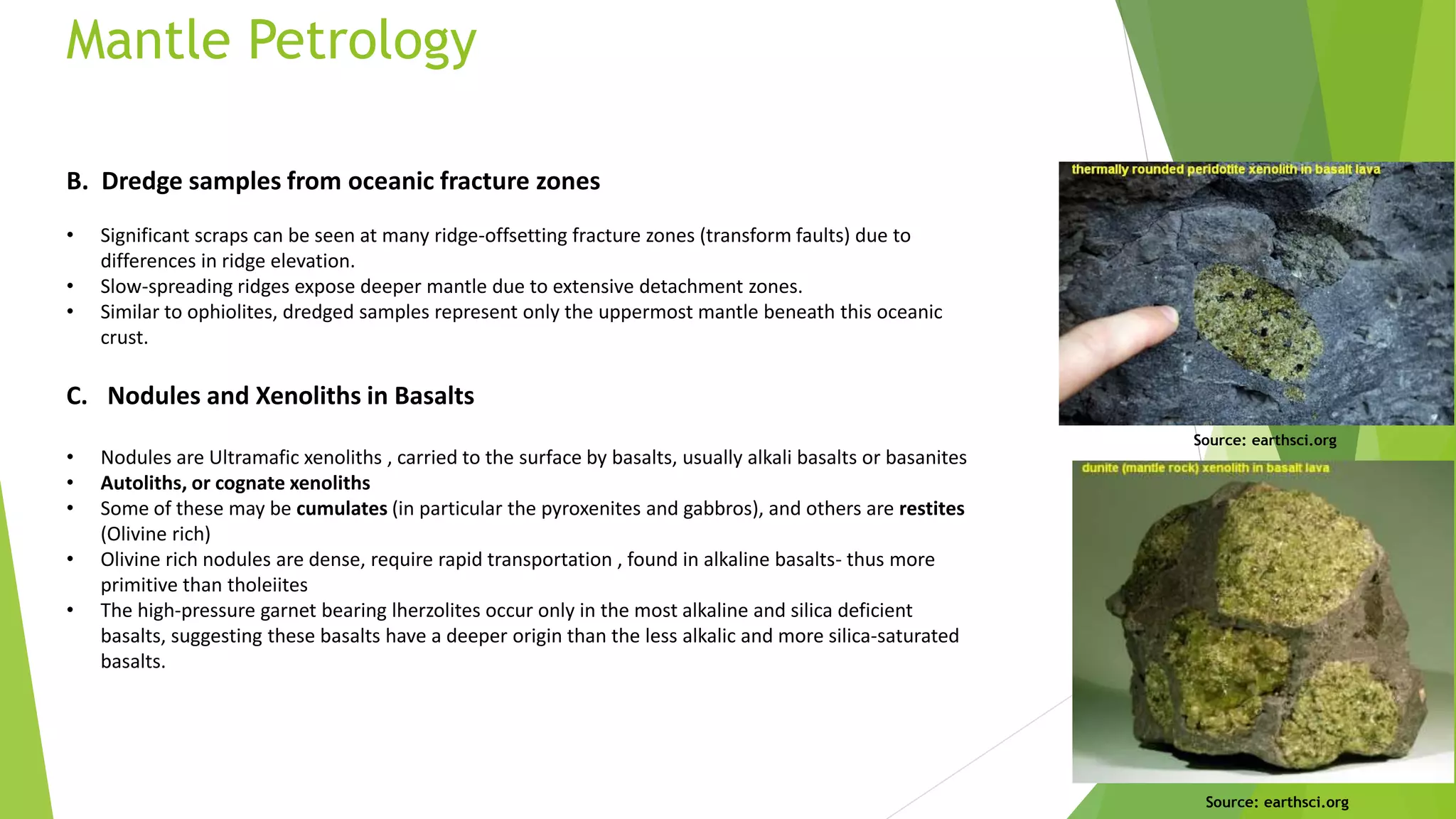
• Nodules are Ultramafic xenoliths , carried to the surface by basalts, usually alkali basalts or basanites
• Autoliths, or cognate xenoliths
• Some of these may be cumulates (in particular the pyroxenites and gabbros), and others are restites
(Olivine rich)
• Olivine rich nodules are dense, require rapid transportation , found in alkaline basalts- thus more
primitive than tholeiites
• The high-pressure garnet bearing lherzolites occur only in the most alkaline and silica deficient
basalts, suggesting these basalts have a deeper origin than the less alkalic and more silica-saturated
basalts.
Source: earthsci.org
Mantle Petrology
D. Kimberlite Xenoliths
• Derived from deep (250 to 350Km) upper mantle source, travel rapidly to the surface, and bring a
variety of mantle and crustal samples to the surface as xenoliths.
• Known to occur in continental areas, hence xenoliths represent continental crust and subcrustal
mantle, but since mantle at this depth is considered similar in both continental and oceanic areas, it
does not matter much.
• Diversity in ultramafic xenoliths suggests a heterogeneous upper mantle,
• Spinel lherzolite and garnet lherzolite are dominant among the unaltered deeper kimberlite samples
E. Diamond-bearing pipes blasted up, carrying numerous xenoliths from the
deep mantle
Diamond-bearing kimberlite rock, large green Cr-
diopside megacrysts .Source: Wikepedia
Garnet Lherzolite . Source: John,2014
Mantle composition
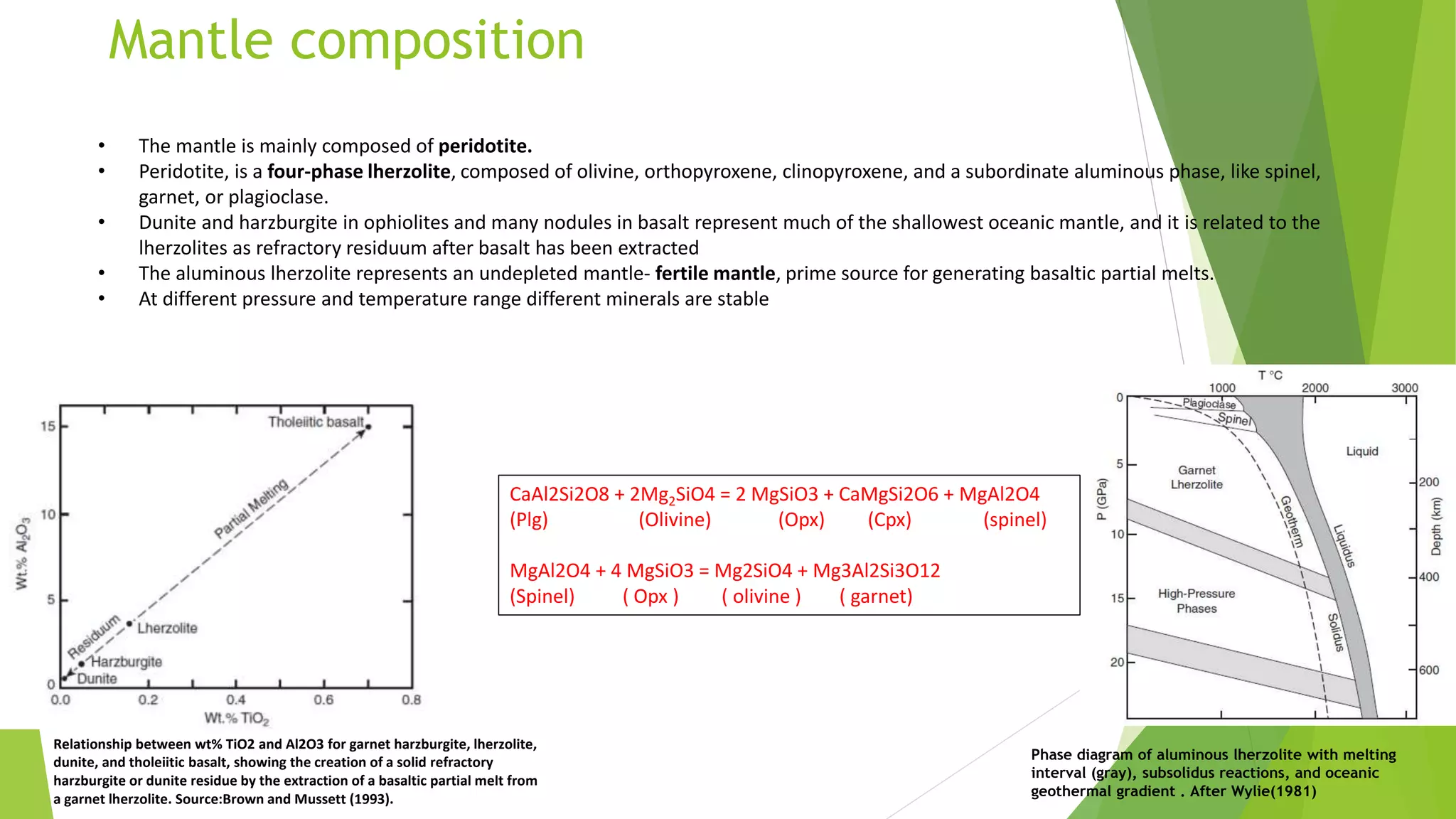
• The mantle is mainly composed of peridotite.
• Peridotite, is a four-phase lherzolite, composed of olivine, orthopyroxene, clinopyroxene, and a subordinate aluminous phase, like spinel,
garnet, or plagioclase.
• Dunite and harzburgite in ophiolites and many nodules in basalt represent much of the shallowest oceanic mantle, and it is related to the
lherzolites as refractory residuum after basalt has been extracted
• The aluminous lherzolite represents an undepleted mantle- fertile mantle, prime source for generating basaltic partial melts.
• At different pressure and temperature range different minerals are stable
Relationship between wt% TiO2 and Al2O3 for garnet harzburgite, lherzolite,
dunite, and tholeiitic basalt, showing the creation of a solid refractory
harzburgite or dunite residue by the extraction of a basaltic partial melt from
a garnet lherzolite. Source:Brown and Mussett (1993).
CaAl2Si2O8 + 2Mg2SiO4 = 2 MgSiO3 + CaMgSi2O6 + MgAl2O4
(Plg) (Olivine) (Opx) (Cpx) (spinel)
MgAl2O4 + 4 MgSiO3 = Mg2SiO4 + Mg3Al2Si3O12
(Spinel) ( Opx ) ( olivine ) ( garnet)
Phase diagram of aluminous lherzolite with melting
interval (gray), subsolidus reactions, and oceanic
geothermal gradient . After Wylie(1981)
Mantle Melting
The mantle is largely solid, thus magma must form by melting of the mantle. There are three main ways to
melt the mantle:
1. Rising the temperature (Heat induced melting)
• The rate at which temperature increases with depth is called the geothermal gradient.
• Average geothermal gradient in the upper 100 km (62 mi) of the crust =25°C /Km.
• Melting could be done by heating the mantle above normal geotherm.
• Heat accumulation by decay of radioactive elements- U,Th,K
• Low concentration hence low hear produced (10-8 J g-1 a-1), which is much less than the specific heat of
typical rock (1 Jg-1a-1 deg-1)
• So even if achieved and mantle is heated to solidus, the heat required for melting must supply latent
heat of fusion of the minerals.
• Even if 2-3% of melt produced, the U, K, Th are highly incompatible and concentrate in melt and escape,
leaving the peridotite too depleted to produce any further melts.
• Hotspots add extra heat to the mantle and produce basalts ,locally restricted and cannot produce
basalts at places like mid-oceanic ridges.
Geothermal Gradient. Source: geo.libretexts.org
Melting of Mantle. Source: Winter,2014
Mantle Melting
2. Lowering the pressure (Adiabatic Decompression melting )
• Mantle melting by can be achieved by reducing pressure at constant temperature
• Mantle rocks rise to shallower level rapidly, maintaining stored heat content (only heat loss due to volume
expansion )
• Continuous upwelling of mantle material due to convectional currents beneath extensional areas, allowing
lower pressure and adiabatic rise to shallower levels, follows a much steeper slope than solidus P-T path
(~130°C/GPa), eventually intersecting the solidus and initiating melting.
• After melting begins, the heat from the rising magma absorbed by the latent heat of fusion, causing the
adiabatic path to follow a shallower P/T slope closer to the solidus, thus traversing the melting interval
more obliquely.
• As a result, upwelling mantle material will diverge from the solidus slowly, producing limited quantities of
melt. This process is called decompression partial melting.
Progression from rift to the mid-ocean ridge, the divergent boundary
types. Note the rising material in the center. Source: geo.libretexts.org
Decompression melting by (adiabatic) pressure reduction.
Source: Winter,2014
Mantle Melting
3. Adding volatiles (H2O or CO2)
• Flux melting or fluid-induced melting occurs in island arcs and subduction zones when volatile gases are added to mantle material
• The subducting slab contains oceanic lithosphere and hydrated minerals.
• As the slab descends into the hot mantle, the increased temperature causes the hydrated minerals to emit water vapor and other volatile gases.
• The volatiles dissolve into the overlying asthenospheric mantle and decrease its melting point.
• Here applied P and T not changed, instead the mantle’s melting point has been lowered by the addition of volatile substances causing solidus to shift
below the normal geothermal.
• The three common hydrous phases stable in ultramafic systems are phlogopite, an amphibole, and serpentine.
Ocean-continent subduction. Source: : geo.libretexts.org
Mantle melting in different tectonic settings
Four P-T diagrams represents temperature and pressure regime at which melting begins , associated with a different tectonic
(Cross –section view). Source: geo.libretexts.org
Decompression
melting
No melting Decompression +
addition of heat Flux Melting
Magmatic Processes
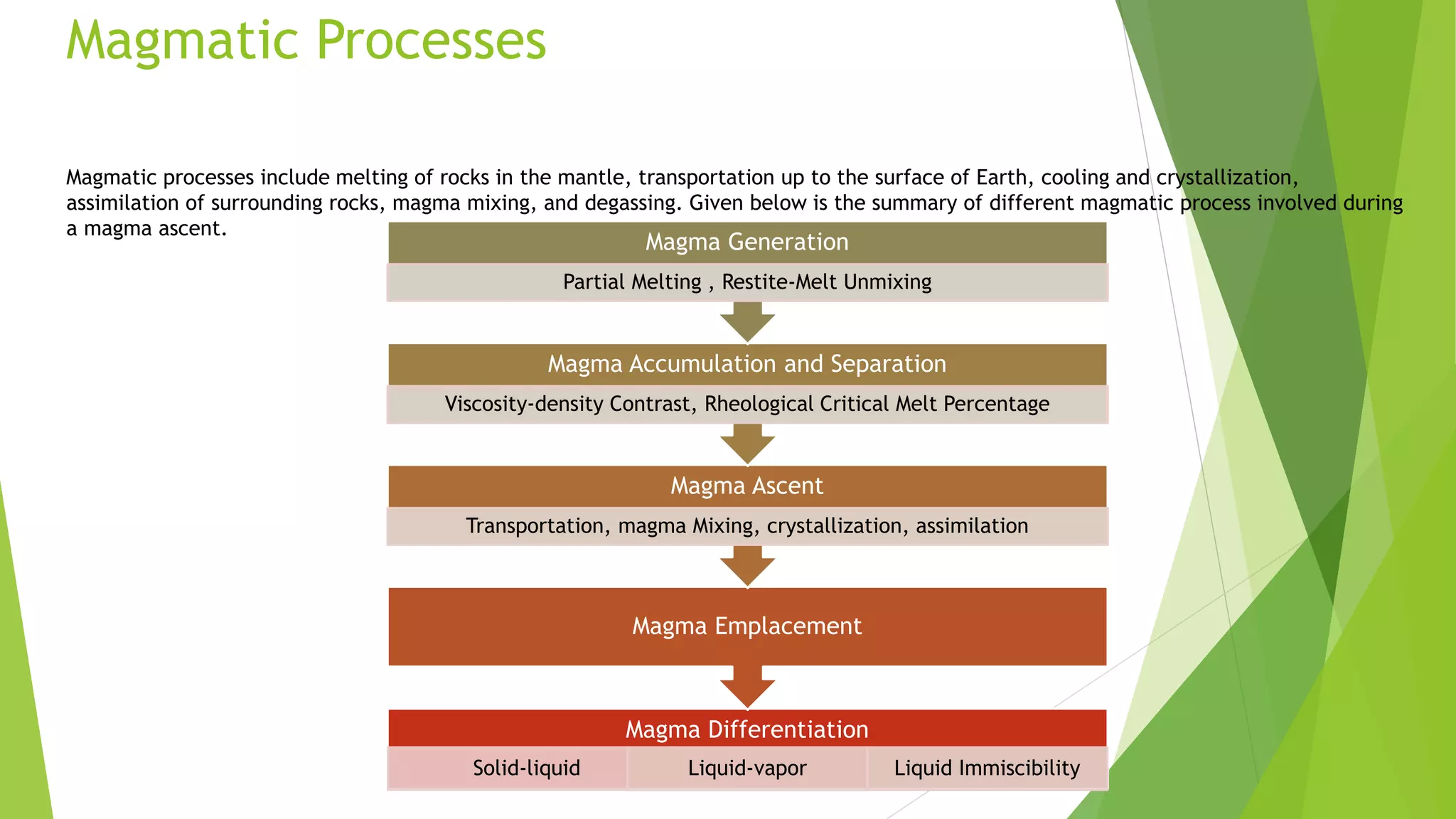
Magmatic processes include melting of rocks in the mantle, transportation up to the surface of Earth, cooling and crystallization,
assimilation of surrounding rocks, magma mixing, and degassing. Given below is the summary of different magmatic process involved during
a magma ascent.
Magma Differentiation
Solid-liquid Liquid-vapor Liquid Immiscibility
Magma Emplacement
Magma Ascent
Transportation, magma Mixing, crystallization, assimilation
Magma Accumulation and Separation
Viscosity-density Contrast, Rheological Critical Melt Percentage
Magma Generation
Partial Melting , Restite-Melt Unmixing
Magma Generation
• Magma can be derived by melting of mantle or re-melting of the crust.
• Magmas derived from crustal material – Felsic higher content of oxygen, silicon, aluminum, sodium, and potassium than the magma
from mantle material.
• Magmas derived from the mantle – Mafic higher levels of magnesium, iron and calcium
1. Partial Melting
• Mantle rocks consists of peridotite which is ultramafic, low in silicates and high in Fe and Mg. When peridotite begins to melt, the silica-
rich portions melt first due to lower melting point. With continued melting, the magma becomes increasingly silica-rich, turning
ultramafic mantle into mafic magma, and mafic mantle into intermediate magma.
• This is known as partial melting which creates magma with a different composition than the original mantle material. With slow rise of
magma it cools into solid rock ,undergoes physical and chemical changes in a process of magmatic differentiation.
• Separation of a liquid from the partially melted solid residue is a form of diversification as it involves partitioning and separation of
chemical constituents, and can produce a variety of melt compositions from a single source.
• With respect to mantle, Partial melting is the process by which mantle lherzolite fractionates to produce a range of primary basaltic
magma.
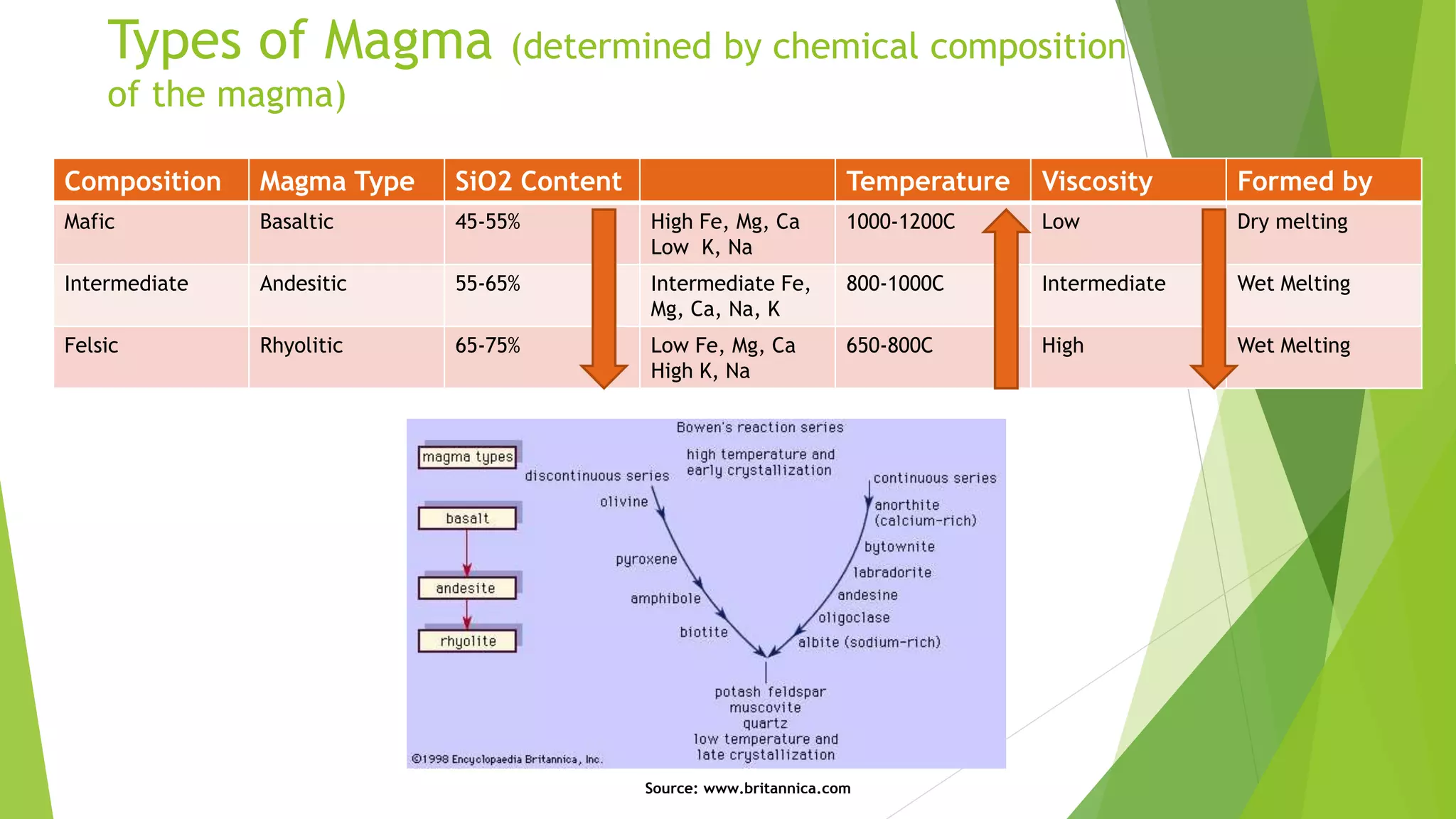
Composition Magma Type SiO2 Content Temperature Viscosity Formed by
Mafic Basaltic 45-55% High Fe, Mg, Ca
Low K, Na
1000-1200C Low Dry melting
Intermediate Andesitic 55-65% Intermediate Fe,
Mg, Ca, Na, K
800-1000C Intermediate Wet Melting
Felsic Rhyolitic 65-75% Low Fe, Mg, Ca
High K, Na
650-800C High Wet Melting
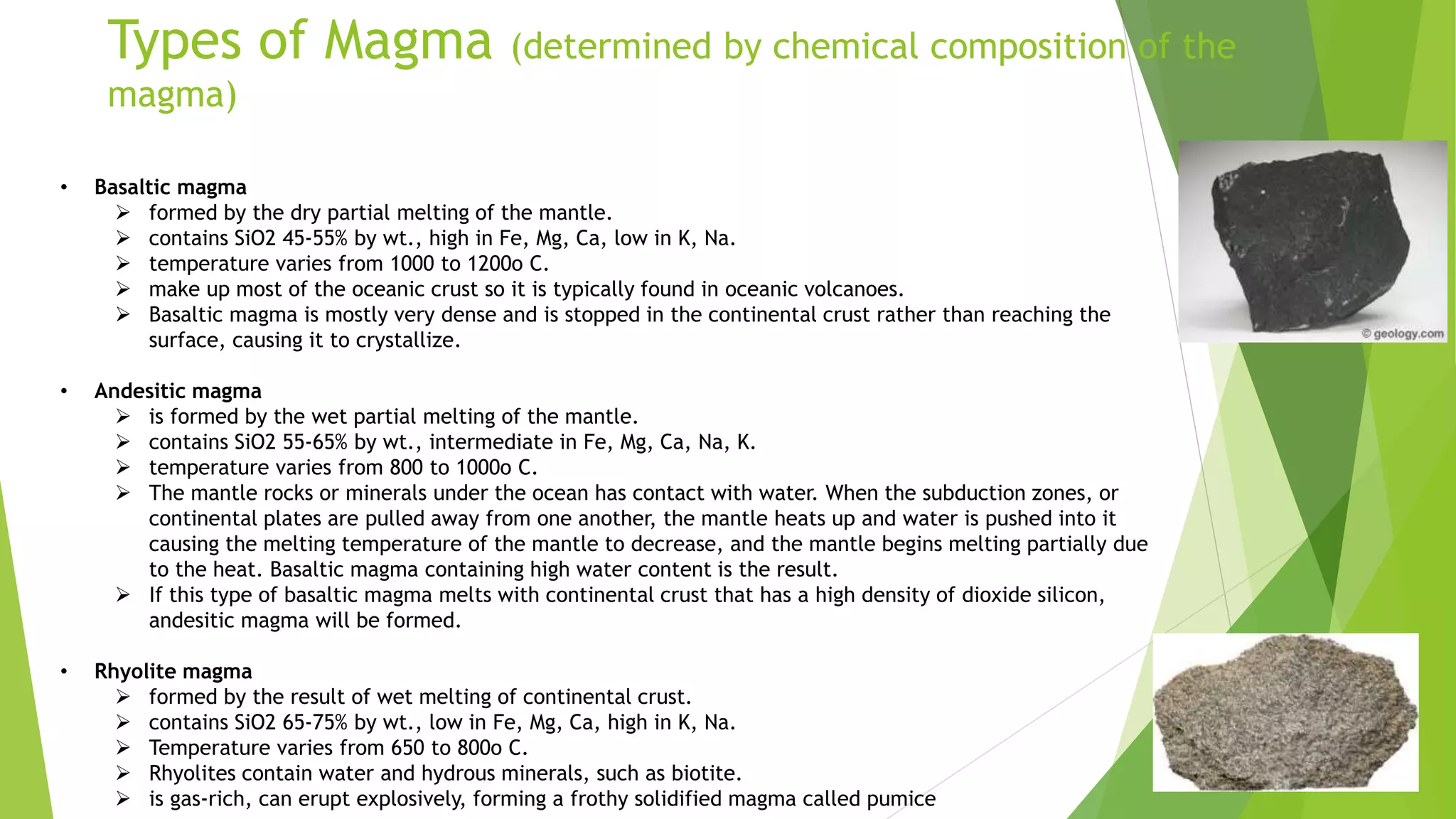
Types of Magma (determined by chemical composition
of the magma)
Source: www.britannica.com
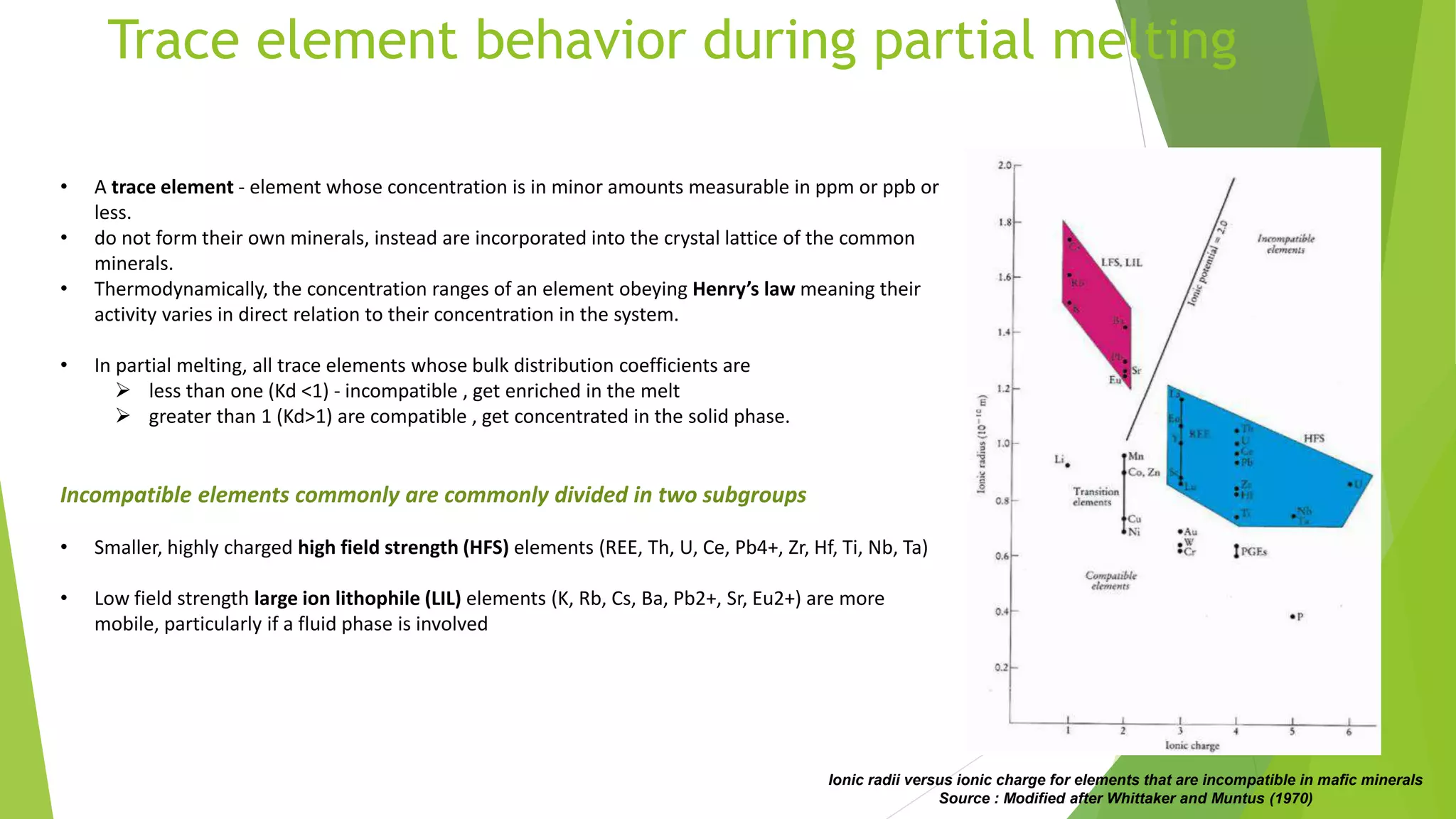
Trace element behavior during partial melting
• A trace element - element whose concentration is in minor amounts measurable in ppm or ppb or
less.
• do not form their own minerals, instead are incorporated into the crystal lattice of the common
minerals.
• Thermodynamically, the concentration ranges of an element obeying Henry’s law meaning their
activity varies in direct relation to their concentration in the system.
• In partial melting, all trace elements whose bulk distribution coefficients are
 less than one (Kd <1) - incompatible , get enriched in the melt
 greater than 1 (Kd>1) are compatible , get concentrated in the solid phase.
Incompatible elements commonly are commonly divided in two subgroups
• Smaller, highly charged high field strength (HFS) elements (REE, Th, U, Ce, Pb4+, Zr, Hf, Ti, Nb, Ta)
• Low field strength large ion lithophile (LIL) elements (K, Rb, Cs, Ba, Pb2+, Sr, Eu2+) are more
mobile, particularly if a fluid phase is involved
Ionic radii versus ionic charge for elements that are incompatible in mafic minerals
Source : Modified after Whittaker and Muntus (1970)
Models of Magma Evolution
1. Batch Melting:
• It is the simplest model for equilibrium process that involve solid and liquid.
• The melt remains resident (in equilibrium) until at some point it is released and moves upward from
the residue as independent system.
• So it is Equilibrium melting process with variable % melting
• Equation to model batch melting derived by Shaw (1970):
Where:
Co = original concentration of the trace element
F = weight fraction of melt produced [ melt/(melt + rock)]
3 possible cases
• When D<1 (Highly incomaptib)
• When D>1 (Compatible )
• As F->1 , CL/CO = 1 Variation in the relative concentration of a trace element in a
liquid versus source rock as a function of and the
fraction melted
C
C
1
Di (1 F) F
L
O
=
- +
Models of Magma Evolution
2. Rayleigh fractional melting
• All the crystals formed by progressive cooling of the melt remains in equilibrium with the residual melt and so batch melting equation is applied
• The difference will be that F here is the proportion of the remaining liquid after extraction and not the amount formed due to melting.
• The other extreme: separation of each crystal as it formed representative of perfectly continuous fractional crystallization in a closed reservoir
(magma chamber).
• This model is called Rayleigh fractionation after the Rayleigh equation that is used to model .
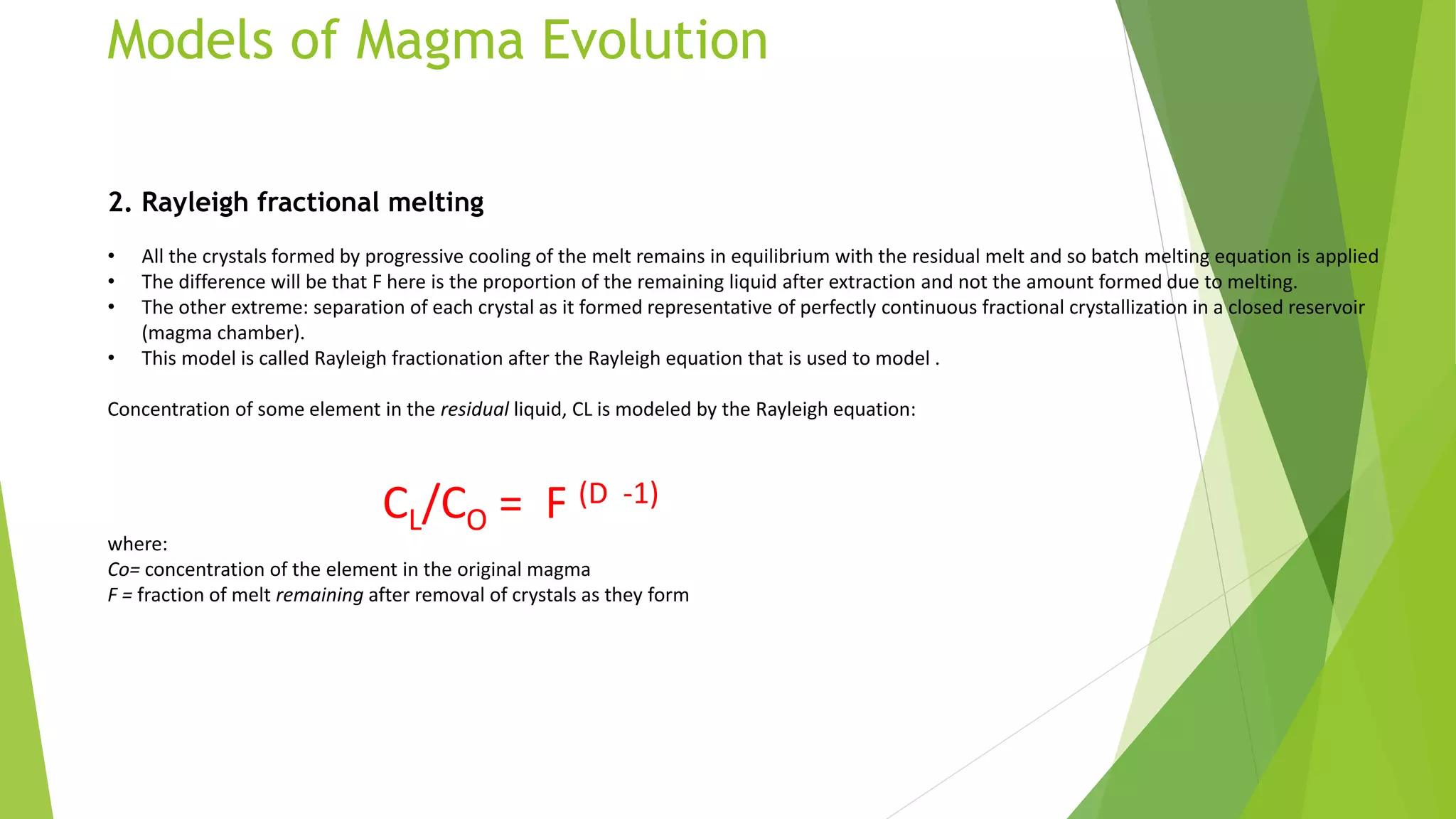
Concentration of some element in the residual liquid, CL is modeled by the Rayleigh equation:
CL/CO = F (D -1)
where:
Co= concentration of the element in the original magma
F = fraction of melt remaining after removal of crystals as they form
Magma Accumulation and Separation
Restite-melt Unmixing
• As rock begins to melt, a tiny fraction of initial melt forms discrete liquid drops at the
junctions of mineral grains, at the points where three or four grains meet
• Only after a critical quantity of melt has been produced, will there be a sufficient liquid
volume that:
 The liquid forms an interconnected network.
 The internal body of the liquid can be free from the restraining effects of crystal
surface adsorption.
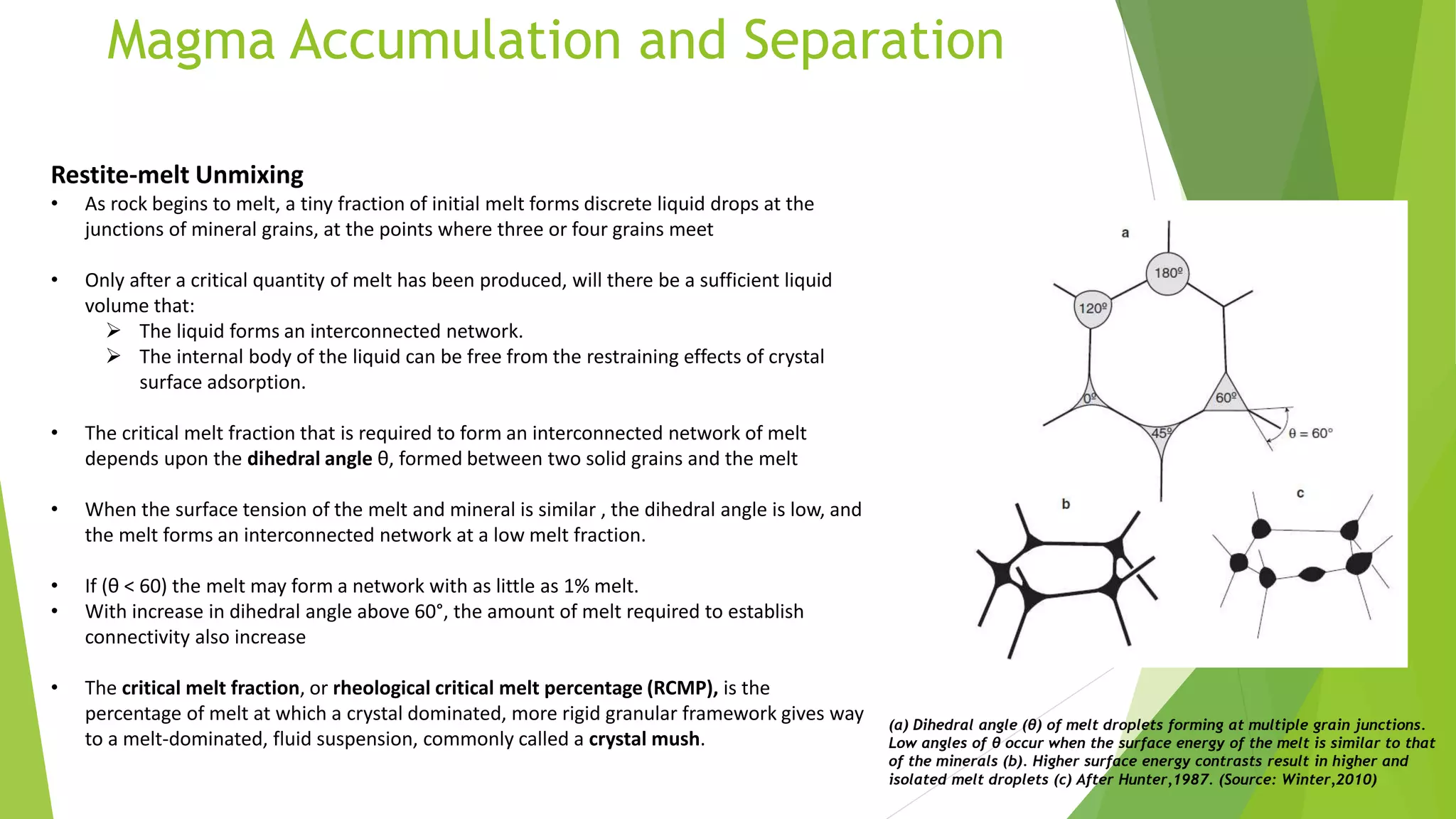
• The critical melt fraction that is required to form an interconnected network of melt
depends upon the dihedral angle θ, formed between two solid grains and the melt
• When the surface tension of the melt and mineral is similar , the dihedral angle is low, and
the melt forms an interconnected network at a low melt fraction.
• If (θ < 60) the melt may form a network with as little as 1% melt.
• With increase in dihedral angle above 60°, the amount of melt required to establish
connectivity also increase
• The critical melt fraction, or rheological critical melt percentage (RCMP), is the
percentage of melt at which a crystal dominated, more rigid granular framework gives way
to a melt-dominated, fluid suspension, commonly called a crystal mush.
(a) Dihedral angle (θ) of melt droplets forming at multiple grain junctions.
Low angles of θ occur when the surface energy of the melt is similar to that
of the minerals (b). Higher surface energy contrasts result in higher and
isolated melt droplets (c) After Hunter,1987. (Source: Winter,2010)
Magma Ascent
• Proposed mechanism of convection within the Earth's mantle is through mantle plume. The magma ascent rates than in turn are control the mass eruption
rates.
• Magma ascent can be divided into four different zones according to Scandone,2007:
1. The Supply System:
 The Supply System may not directly participate in eruptive activity of many small eruptions. Long-lived eruptions, on other hand may require episodic
input from the Supply System
2. The Intermediate Storage System:
 Lies at mid- to shallow crustal depths (typically 5–10 km).
 Magma arriving from the Supply system reside for very long time( years to centuries),cooling and differentiating.
 The top of intermediate system lies at or above the depth at which magma becomes H2O saturated.
 Magma rises from this storage as discrete batches, or as continuous supply.
3. The Transport System:
 It connects the storage system to the surface and is imaged using seismic data.
 Initial fracturing caused by either due to stress field variation or by internal volcano structure failure
 After the fracture network is created, buoyant magma from below can enter the system.
 If ascent rate is greater than the supply rate, magma ascends as magma batch
4. The Eruptive System:
 It is the shallow region from which magma is erupted.
 If most of magma's volatiles are lost during ascent through the transport system eruption is effusive, otherwise it is explosive.
Magma Mixing
• Reverse of Liquid immiscibility.
• Basalts and rhyolites are two primary , intermediate magmas created by mixing of these 2 end members in different proportions.
• Mixing of hotter basaltic liquid and cooler silicic liquid invariably leads to cooling and crystallization of basaltic liquid.
• Magma mixing mechanism dependent on the contrasting physical properties, such as temperature, density, composition, volatile content, viscosity, location
and turbulence of magma intermixing.
• Gas-charged or pressure induced fountaining may considerably mix magmas, whereas latent injection of dense magmas may collect at the bottom of a silicic
magma chamber and result in stratification with little mixing.
• If basalt main composition, mixing occurs readily under a variety of conditions. Two magmas can commonly be seen as commingled swirls of contrasting
colors
• Basaltic magmas entering granitic chambers forming pillow-like structures and glassy quenched marginal textures, accumulate at the bottom of the chamber
Commingled basaltic and rhyolitic magmas,
Mt. McLoughlin, Oregon. Sample courtesy Stan
Mertzman
As basaltic magma is injected into a granitic magma chamber, pillow-like blobs created. With
the hotter, denser basalt being partially quenched, and the blobs accumulate at the bottom
of the chamber, trapping some of the interstitial silicic liquid. Vinalhaven Island, Maine
Magma Emplacement
1. Plutonic Environment
a. Zone melting:
 This is a method of pluton emplacement and involves considerable assimilation of the
country rock .
 a magma melts its way upward by crystallizing an amount of igneous material at the base
of the pluton equivalent to the amount melted at the top, transferring heat between the
two zones by convection.
 The process is similar to zone refining which is an industrial process. A rising magma can
concentrate incompatible trace elements
b. Stoping
• refers to the process by which country rock is broken up and removed by upward
movement of magma.
• The mechanical disintegration of the surrounding host/country typically through
fracturing due to pressure increases with the thermal expansion of the host rock in
proximity of the interface with the melt.
• melt or volatiles invade and widen the fracture promoting the foundering of host rock
blocks
• Characteristic : discordant pluton contacts. Presence of xenoliths in plutons, magma
contamination
White granite intruding and stoping black basalt at Whale Cove, Nunavut.
Source: Mike Beauregard,2010
llustrating upward movement of magma along with disintegration of
country rock. Source Writeopinions.com
Magma Emplacement
1. Plutonic Environment
c. Ballooning
• emplacement mechanism describing the in situ inflation of the magma chamber
of roughly spherical plutons.
• The magma rises until it loses heat and its outermost margin crystallizes, the
hotter tail of the magma continues to ascend and expand the already
crystallized outer margin.
d. Diapirism
• occurs when a hot fluid mass of magma moves by softening a thin region of wall
rock nearest to the body.
• It is thought to be limited to the mantle and lower crust which have high
temperatures and ductile rocks.
e. Doming
• Overpressured magma may make a roof for itself
• May form laccolith
• Begins as sills and then inflate towards the surface
Laccolith Source: Wikepedia
Magma Differentiation
• Magmatic differentiation is defined as the process by which magma diversify and produce a magma or rock of different composition.
• Involves separation and partitioning of chemical constituents or different phases, to produce a variety of melt compositions from a single source.
• Two essential processes:
 Creation of compositional difference : determines the trend of differentiation
 Preserving these differences in chemical composition by segregating the chemically distinct portions
 Fractionation is the process by which distinct phases are mechanically separated. Its effectiveness determines the extent to which differentiation
proceed along particular trend.
• Fractionated phases in magmatic system can be liquid- solid, liquid-liquid or liquid-vapor.
1. Crystal-Melt Separation( Solid-liquid separation)
Fractional Crystallization
• is the removal of early formed crystals from an originally homogeneous magma so that these crystals are prevented from further reaction with the
residual melt.
• The composition of the remaining melt becomes relatively depleted in some components and enriched in others, resulting in the precipitation of a
sequence of different minerals
• Related texture : Intergranular ( intercumulus) textures that develop wherever a mineral crystallizes later than the surrounding matrix, hence filling
the left-over interstitial space
1: olivine crystallizes;
2: olivine and pyroxene crystallize;
3: pyroxene and plagioclase crystallize;
4: plagioclase crystallizes.
At the bottom of the magma reservoir,
a cumulate rock forms.
Source : Wikipedia
Magma Differentiation
a. Gravity Separation
• The most dominant mechanism of fractional crystallization
• Involves differential movement of crystals and liquid under the effect of gravity due to difference in density.
• Common texture: cumulate texture is the result of crystal fractionation and accumulation. In this mutually
touching phenocrysts are embedded in an interstitial matrix.
• Quantitative modelling: Stoke’s Law
b. Filter Pressing
• Filter pressing or compaction w.r.t mantle partial melting occurs in crystal mushes that form as cumulates or
crystal separation .
• The trapped amount of liquid within the cumulus can be as high as 60 vol.%
• As the further accumulation continues, the added weight compacts the crystal mush, squeezing much of the
interstitial liquid into the main magma body.
• Another mechanism of filter pressing involves the movement of phenocryst-laden crystal mush. Crystals
interfere and slows down with respect to liquid if any constriction occurs in the conduit.
Source : By Singh,Jitendra ,2019
Magma Differentiation
c. Flow segregation
• Crystal can be segregated from the liquid when crystal rich magmas flow in a laminar fashion near
the walls of the magma body. This process is called flow segregation (flow separation or flow
segregation).
• Flow of magma adjacent to a wall of country rock results in differential motion and shear in the
magma.
• Where such shear is constricted, as between adjacent phenocrysts or between phenocrysts and the
contact, a force (called grain-dispersive pressure) is generated and pushes the phenocrysts apart
and away from the contact
• Thus to mitigate the pressure buildup, phenocrysts concentrate away from the walls.
• Eg: In dikes or sills, where coarse phenocryst concentrate at the center
Increase in size and concentration of olivine phenocrysts toward the center of small dikes by flow differentiation. Isle
of Skye, Scotland.
After Drever andJohnston (1958).
Flow segregation . Source: Winter,2014
Magma Differentiation
2. Volatile Transport (liquid – vapor separation )
• Chemical differentiation can also be accomplished when a separate vapor phase coexists with a magma and liquid–vapor fractionation takes place.
• A vapor phase may be introduced in any of three principal ways:
i. fluid released by heating of hydrated or carbonated wall rocks
ii. as a volatile-bearing, undersaturated magma rises and pressure is reduced, the magma may eventually become saturated in the vapor, and a
free vapor phase is released.
iii. Late stage fractionation: early-formed igneous minerals are anhydrous , their segregation from a hydrous melt enriches the melt in H2O and
other volatile phases.
• Eventually the magma reaches the saturation point, and a hydrous vapor phase is produced.
• This paradoxical “boiling off” of water as a magma cools has been called retrograde (or resurgent) boiling.
• Resurgent boiling momentarily increase the pressure at the top of intrusion and fracture the roof rocks in shallow intrusion.
• Both vapor phase and late silicate melt escape though these fractures.
• Silicate melt crytalise to a mixture of quartz and feldspar, in small dikes forming sugar-like textures, called aplite.
• Vapor phase concentrate as dikes or pods, to form pegmatite.
Source: epod.usra.edu
Asymmetric zoned pegmatite dike with aplitic base (several tens of centimeters across Source: Jahns and
Burnham(1969)
Non-granitic rocks
Aplite
Pegmatite
Magma Differentiation
3. Liquid State Differentiation (Liquid Immiscibility)
• An initially homogeneous magma may separate into two or more compositionally distinct magmas by the processes of liquid immiscibility.
• Three natural magmatic systems are recognized as having immiscible liquids in some portion of their compositional range.
i. Fe-rich tholeiitic basalts
• An initial trend in this system is towards iron enrichment.
• In the later stages of fractionation, a "granitic“ melt (>75% SiO2) separates from a basaltic melt (~40% SiO2).
• After separation, the silicic liquid having a much lower density than the Fe-rich mafic liquid, is expected to rise and collect near the top of the
magma chamber.
• By the time liquid separation occurs crystallization of the magma must be advanced and both liquids are likely to become trapped in the already-
formed crystal network.
• Fe-rich Hawaiian basalts texture: small droplets of the two immiscible liquids are mingled in the interstitial glass trapped between plagioclase
and augite crystals.
ii. Separation of sulphide rich liquid from sulphide saturated silicate magma
• A saturated silicate magma contains less than one-tenth of a percent of sulfur and release an iron– sulfide melt that is also rich in Ni,Cu and other
chalcophile elements.
• Small, rounded, immiscible sulfide droplets in a silicate glass matrix.
• Economically important massive sulfide segregations in large, layered mafic complexes are formed by separation and accumulation of immiscible
sulfide melts.
iii. High alkaline magma
• A third liquid immiscibility gap occurs in highly alkaline magmas rich in CO2.
• These liquids separate into two fractions, one enriched in carbonates and other in silica and alkalis.
• These give rise to the nephelinite – carbonatite association.
REFERENCES
• Ganguly, J.(2010) Thermodynamics in Earth and Planetary Sciences, Springer, 2010.
• Kushiro, Ikuo, Fuji, T. (1977). Floatation of Plagioclase in Magma at High Pressures and its Bearing on the Origin of
Anorthosite. Proceedings of the Japan Academy. Ser. B: Physical and Biological Sciences, 53(7), 262–266.
• Petfort N, Cruden AR, McCaffrey KJW, Vigneresse J-L (2000) Granite magma formation, transport and
emplacement in the earth’s crust. Nature 408:669–673
• Ringwood, A.E. and Green,D.H (1966). An experimental investigation of the Gabbro-Eclogite transformation and
some geophysical implications, 3(5), 383–427.
• Shaw, Denis M.(1979) Trace element melting models, Physics and Chemistry of the Earth, Volume 11,Pages 577-586
• Sheinmann Y.M. (1971) Primary Magmas. In: Tectonics and the Formation of Magmas. Springer, Boston, MA.
• Winter, John D. (2014) Principles of Igneous and Metamorphic Petrology, Second Edition
Types of Magma (determined by chemical composition of the
magma)
• Basaltic magma
 formed by the dry partial melting of the mantle.
 contains SiO2 45-55% by wt., high in Fe, Mg, Ca, low in K, Na.
 temperature varies from 1000 to 1200o C.
 make up most of the oceanic crust so it is typically found in oceanic volcanoes.
 Basaltic magma is mostly very dense and is stopped in the continental crust rather than reaching the
surface, causing it to crystallize.
• Andesitic magma
 is formed by the wet partial melting of the mantle.
 contains SiO2 55-65% by wt., intermediate in Fe, Mg, Ca, Na, K.
 temperature varies from 800 to 1000o C.
 The mantle rocks or minerals under the ocean has contact with water. When the subduction zones, or
continental plates are pulled away from one another, the mantle heats up and water is pushed into it
causing the melting temperature of the mantle to decrease, and the mantle begins melting partially due
to the heat. Basaltic magma containing high water content is the result.
 If this type of basaltic magma melts with continental crust that has a high density of dioxide silicon,
andesitic magma will be formed.
• Rhyolite magma
 formed by the result of wet melting of continental crust.
 contains SiO2 65-75% by wt., low in Fe, Mg, Ca, high in K, Na.
 Temperature varies from 650 to 800o C.
 Rhyolites contain water and hydrous minerals, such as biotite.
 is gas-rich, can erupt explosively, forming a frothy solidified magma called pumice
Magma Emplacement
1. Sub-Volcanic Environment
c. Ballooning
• emplacement mechanism describing the in situ inflation of the magma chamber
of roughly spherical plutons.
• The magma rises until it loses heat and its outermost margin crystallizes, the
hotter tail of the magma continues to ascend and expand the already
crystallized outer margin.
d. Diapirism
• occurs when a hot fluid mass of magma moves by softening a thin region of wall
rock nearest to the body.
• It is thought to be limited to the mantle and lower crust which have high
temperatures and ductile rocks.
e. Doming
• Overpressured magma may make a roof for itself
• May form laccolith
• Begins as sills and then inflate towards the surface
White granite intruding and stoping black basalt at Whale Cove, Nunavut.
Source: Mike Beauregard,2010
llustrating upward movement of magma along with disintegration of
country rock. Source Writeopinions.com
Magma Emplacement
1. Volcanic Environment
c. Ballooning
• emplacement mechanism describing the in situ inflation of the magma chamber
of roughly spherical plutons.
• The magma rises until it loses heat and its outermost margin crystallizes, the
hotter tail of the magma continues to ascend and expand the already
crystallized outer margin.
d. Diapirism
• occurs when a hot fluid mass of magma moves by softening a thin region of wall
rock nearest to the body.
• It is thought to be limited to the mantle and lower crust which have high
temperatures and ductile rocks.
e. Doming
• Overpressured magma may make a roof for itself
• May form laccolith
• Begins as sills and then inflate towards the surface
White granite intruding and stoping black basalt at Whale Cove, Nunavut.
Source: Mike Beauregard,2010
llustrating upward movement of magma along with disintegration of
country rock. Source Writeopinions.com

Mantle melting and Magmatic processes

  • 1.
    Mantle melting And Magmaticprocess Presented by : Ananya Mittal 5th year , IMT Geological Technology
  • 2.
    CONTENTS 1. Mantle Petrologyand Composition 2. Mantle melting  Mantle heating 3. Magmatic processes  Partial melting  Magma Accumulation and Separation  Magma Mixing  Magma Emplacement  Magma Differentiation
  • 3.
    Mantle Petrology 1. Seismology Seismicstudies define changes in the physical properties of mantle rock with depth. Important boundaries include: • the Moho – boundary between low density felsic and mafic rocks of the crust and high density ultramafic rocks of the mantle • lithosphere-asthenosphere – boundary between the rigid outer layer of the Earth and a mechanically weak layer that acts like a viscous fluid • 400 km discontinuity – increase in seismic velocity (density) caused by a change in olivine structure to that of spinel • 670 km discontinuity – change in spinel structure of olivine to that of perovskite Earth's Interior and Geophysical Properties by Dwight Bishop
  • 4.
    Mantle Petrology 2. Compositionof the mantle Direct samples offer a peep into the sub-lithospheric mantle, thus giving accurate idea of mineralogy and composition Sources of mantle Origin A. Ophiolites : • suites of temporally and spatially associated ultramafic, mafic, and felsic rocks ,interpreted as the remnants of ancient oceanic crust and upper mantle • Obducted-uplifted and exposed above sea level and are often emplaced on top of the continental lithosphere • Ophio- is Greek for "snake” and - lite means "stone" from the Greek lithos. The rock looks like snake skin • Occurrence: collision orogens, indicating the existence of former ocean basins, now been absorbed by thrusts, subduction zone, and plate tectonics. • Emplaced either from the downgoing oceanic lithosphere via subduction-accretion or from the upper plate in a subduction zone through trench–continent collision. Intrusive complex of the Nidar Ophiolite: amphibole-gabbro (Source: Buchs and Epard, 2019) Ophiolites formation, Source: DiPietro , 2013 Ophiolite sequence, Northern Apennines, Italy. Source: Wikimedia
  • 5.
    Mantle Petrology B. Dredgesamples from oceanic fracture zones • Significant scraps can be seen at many ridge-offsetting fracture zones (transform faults) due to differences in ridge elevation. • Slow-spreading ridges expose deeper mantle due to extensive detachment zones. • Similar to ophiolites, dredged samples represent only the uppermost mantle beneath this oceanic crust. C. Nodules and Xenoliths in Basalts • Nodules are Ultramafic xenoliths , carried to the surface by basalts, usually alkali basalts or basanites • Autoliths, or cognate xenoliths • Some of these may be cumulates (in particular the pyroxenites and gabbros), and others are restites (Olivine rich) • Olivine rich nodules are dense, require rapid transportation , found in alkaline basalts- thus more primitive than tholeiites • The high-pressure garnet bearing lherzolites occur only in the most alkaline and silica deficient basalts, suggesting these basalts have a deeper origin than the less alkalic and more silica-saturated basalts. Source: earthsci.org Source: earthsci.org
  • 6.
    Mantle Petrology D. KimberliteXenoliths • Derived from deep (250 to 350Km) upper mantle source, travel rapidly to the surface, and bring a variety of mantle and crustal samples to the surface as xenoliths. • Known to occur in continental areas, hence xenoliths represent continental crust and subcrustal mantle, but since mantle at this depth is considered similar in both continental and oceanic areas, it does not matter much. • Diversity in ultramafic xenoliths suggests a heterogeneous upper mantle, • Spinel lherzolite and garnet lherzolite are dominant among the unaltered deeper kimberlite samples E. Diamond-bearing pipes blasted up, carrying numerous xenoliths from the deep mantle Diamond-bearing kimberlite rock, large green Cr- diopside megacrysts .Source: Wikepedia Garnet Lherzolite . Source: John,2014
  • 7.
    Mantle composition • Themantle is mainly composed of peridotite. • Peridotite, is a four-phase lherzolite, composed of olivine, orthopyroxene, clinopyroxene, and a subordinate aluminous phase, like spinel, garnet, or plagioclase. • Dunite and harzburgite in ophiolites and many nodules in basalt represent much of the shallowest oceanic mantle, and it is related to the lherzolites as refractory residuum after basalt has been extracted • The aluminous lherzolite represents an undepleted mantle- fertile mantle, prime source for generating basaltic partial melts. • At different pressure and temperature range different minerals are stable Relationship between wt% TiO2 and Al2O3 for garnet harzburgite, lherzolite, dunite, and tholeiitic basalt, showing the creation of a solid refractory harzburgite or dunite residue by the extraction of a basaltic partial melt from a garnet lherzolite. Source:Brown and Mussett (1993). CaAl2Si2O8 + 2Mg2SiO4 = 2 MgSiO3 + CaMgSi2O6 + MgAl2O4 (Plg) (Olivine) (Opx) (Cpx) (spinel) MgAl2O4 + 4 MgSiO3 = Mg2SiO4 + Mg3Al2Si3O12 (Spinel) ( Opx ) ( olivine ) ( garnet) Phase diagram of aluminous lherzolite with melting interval (gray), subsolidus reactions, and oceanic geothermal gradient . After Wylie(1981)
  • 8.
    Mantle Melting The mantleis largely solid, thus magma must form by melting of the mantle. There are three main ways to melt the mantle: 1. Rising the temperature (Heat induced melting) • The rate at which temperature increases with depth is called the geothermal gradient. • Average geothermal gradient in the upper 100 km (62 mi) of the crust =25°C /Km. • Melting could be done by heating the mantle above normal geotherm. • Heat accumulation by decay of radioactive elements- U,Th,K • Low concentration hence low hear produced (10-8 J g-1 a-1), which is much less than the specific heat of typical rock (1 Jg-1a-1 deg-1) • So even if achieved and mantle is heated to solidus, the heat required for melting must supply latent heat of fusion of the minerals. • Even if 2-3% of melt produced, the U, K, Th are highly incompatible and concentrate in melt and escape, leaving the peridotite too depleted to produce any further melts. • Hotspots add extra heat to the mantle and produce basalts ,locally restricted and cannot produce basalts at places like mid-oceanic ridges. Geothermal Gradient. Source: geo.libretexts.org Melting of Mantle. Source: Winter,2014
  • 9.
    Mantle Melting 2. Loweringthe pressure (Adiabatic Decompression melting ) • Mantle melting by can be achieved by reducing pressure at constant temperature • Mantle rocks rise to shallower level rapidly, maintaining stored heat content (only heat loss due to volume expansion ) • Continuous upwelling of mantle material due to convectional currents beneath extensional areas, allowing lower pressure and adiabatic rise to shallower levels, follows a much steeper slope than solidus P-T path (~130°C/GPa), eventually intersecting the solidus and initiating melting. • After melting begins, the heat from the rising magma absorbed by the latent heat of fusion, causing the adiabatic path to follow a shallower P/T slope closer to the solidus, thus traversing the melting interval more obliquely. • As a result, upwelling mantle material will diverge from the solidus slowly, producing limited quantities of melt. This process is called decompression partial melting. Progression from rift to the mid-ocean ridge, the divergent boundary types. Note the rising material in the center. Source: geo.libretexts.org Decompression melting by (adiabatic) pressure reduction. Source: Winter,2014
  • 10.
    Mantle Melting 3. Addingvolatiles (H2O or CO2) • Flux melting or fluid-induced melting occurs in island arcs and subduction zones when volatile gases are added to mantle material • The subducting slab contains oceanic lithosphere and hydrated minerals. • As the slab descends into the hot mantle, the increased temperature causes the hydrated minerals to emit water vapor and other volatile gases. • The volatiles dissolve into the overlying asthenospheric mantle and decrease its melting point. • Here applied P and T not changed, instead the mantle’s melting point has been lowered by the addition of volatile substances causing solidus to shift below the normal geothermal. • The three common hydrous phases stable in ultramafic systems are phlogopite, an amphibole, and serpentine. Ocean-continent subduction. Source: : geo.libretexts.org
  • 11.
    Mantle melting indifferent tectonic settings Four P-T diagrams represents temperature and pressure regime at which melting begins , associated with a different tectonic (Cross –section view). Source: geo.libretexts.org Decompression melting No melting Decompression + addition of heat Flux Melting
  • 12.
    Magmatic Processes Magmatic processesinclude melting of rocks in the mantle, transportation up to the surface of Earth, cooling and crystallization, assimilation of surrounding rocks, magma mixing, and degassing. Given below is the summary of different magmatic process involved during a magma ascent. Magma Differentiation Solid-liquid Liquid-vapor Liquid Immiscibility Magma Emplacement Magma Ascent Transportation, magma Mixing, crystallization, assimilation Magma Accumulation and Separation Viscosity-density Contrast, Rheological Critical Melt Percentage Magma Generation Partial Melting , Restite-Melt Unmixing
  • 13.
    Magma Generation • Magmacan be derived by melting of mantle or re-melting of the crust. • Magmas derived from crustal material – Felsic higher content of oxygen, silicon, aluminum, sodium, and potassium than the magma from mantle material. • Magmas derived from the mantle – Mafic higher levels of magnesium, iron and calcium 1. Partial Melting • Mantle rocks consists of peridotite which is ultramafic, low in silicates and high in Fe and Mg. When peridotite begins to melt, the silica- rich portions melt first due to lower melting point. With continued melting, the magma becomes increasingly silica-rich, turning ultramafic mantle into mafic magma, and mafic mantle into intermediate magma. • This is known as partial melting which creates magma with a different composition than the original mantle material. With slow rise of magma it cools into solid rock ,undergoes physical and chemical changes in a process of magmatic differentiation. • Separation of a liquid from the partially melted solid residue is a form of diversification as it involves partitioning and separation of chemical constituents, and can produce a variety of melt compositions from a single source. • With respect to mantle, Partial melting is the process by which mantle lherzolite fractionates to produce a range of primary basaltic magma.
  • 14.
    Composition Magma TypeSiO2 Content Temperature Viscosity Formed by Mafic Basaltic 45-55% High Fe, Mg, Ca Low K, Na 1000-1200C Low Dry melting Intermediate Andesitic 55-65% Intermediate Fe, Mg, Ca, Na, K 800-1000C Intermediate Wet Melting Felsic Rhyolitic 65-75% Low Fe, Mg, Ca High K, Na 650-800C High Wet Melting Types of Magma (determined by chemical composition of the magma) Source: www.britannica.com
  • 15.
    Trace element behaviorduring partial melting • A trace element - element whose concentration is in minor amounts measurable in ppm or ppb or less. • do not form their own minerals, instead are incorporated into the crystal lattice of the common minerals. • Thermodynamically, the concentration ranges of an element obeying Henry’s law meaning their activity varies in direct relation to their concentration in the system. • In partial melting, all trace elements whose bulk distribution coefficients are  less than one (Kd <1) - incompatible , get enriched in the melt  greater than 1 (Kd>1) are compatible , get concentrated in the solid phase. Incompatible elements commonly are commonly divided in two subgroups • Smaller, highly charged high field strength (HFS) elements (REE, Th, U, Ce, Pb4+, Zr, Hf, Ti, Nb, Ta) • Low field strength large ion lithophile (LIL) elements (K, Rb, Cs, Ba, Pb2+, Sr, Eu2+) are more mobile, particularly if a fluid phase is involved Ionic radii versus ionic charge for elements that are incompatible in mafic minerals Source : Modified after Whittaker and Muntus (1970)
  • 16.
    Models of MagmaEvolution 1. Batch Melting: • It is the simplest model for equilibrium process that involve solid and liquid. • The melt remains resident (in equilibrium) until at some point it is released and moves upward from the residue as independent system. • So it is Equilibrium melting process with variable % melting • Equation to model batch melting derived by Shaw (1970): Where: Co = original concentration of the trace element F = weight fraction of melt produced [ melt/(melt + rock)] 3 possible cases • When D<1 (Highly incomaptib) • When D>1 (Compatible ) • As F->1 , CL/CO = 1 Variation in the relative concentration of a trace element in a liquid versus source rock as a function of and the fraction melted C C 1 Di (1 F) F L O = - +
  • 17.
    Models of MagmaEvolution 2. Rayleigh fractional melting • All the crystals formed by progressive cooling of the melt remains in equilibrium with the residual melt and so batch melting equation is applied • The difference will be that F here is the proportion of the remaining liquid after extraction and not the amount formed due to melting. • The other extreme: separation of each crystal as it formed representative of perfectly continuous fractional crystallization in a closed reservoir (magma chamber). • This model is called Rayleigh fractionation after the Rayleigh equation that is used to model . Concentration of some element in the residual liquid, CL is modeled by the Rayleigh equation: CL/CO = F (D -1) where: Co= concentration of the element in the original magma F = fraction of melt remaining after removal of crystals as they form
  • 18.
    Magma Accumulation andSeparation Restite-melt Unmixing • As rock begins to melt, a tiny fraction of initial melt forms discrete liquid drops at the junctions of mineral grains, at the points where three or four grains meet • Only after a critical quantity of melt has been produced, will there be a sufficient liquid volume that:  The liquid forms an interconnected network.  The internal body of the liquid can be free from the restraining effects of crystal surface adsorption. • The critical melt fraction that is required to form an interconnected network of melt depends upon the dihedral angle θ, formed between two solid grains and the melt • When the surface tension of the melt and mineral is similar , the dihedral angle is low, and the melt forms an interconnected network at a low melt fraction. • If (θ < 60) the melt may form a network with as little as 1% melt. • With increase in dihedral angle above 60°, the amount of melt required to establish connectivity also increase • The critical melt fraction, or rheological critical melt percentage (RCMP), is the percentage of melt at which a crystal dominated, more rigid granular framework gives way to a melt-dominated, fluid suspension, commonly called a crystal mush. (a) Dihedral angle (θ) of melt droplets forming at multiple grain junctions. Low angles of θ occur when the surface energy of the melt is similar to that of the minerals (b). Higher surface energy contrasts result in higher and isolated melt droplets (c) After Hunter,1987. (Source: Winter,2010)
  • 19.
    Magma Ascent • Proposedmechanism of convection within the Earth's mantle is through mantle plume. The magma ascent rates than in turn are control the mass eruption rates. • Magma ascent can be divided into four different zones according to Scandone,2007: 1. The Supply System:  The Supply System may not directly participate in eruptive activity of many small eruptions. Long-lived eruptions, on other hand may require episodic input from the Supply System 2. The Intermediate Storage System:  Lies at mid- to shallow crustal depths (typically 5–10 km).  Magma arriving from the Supply system reside for very long time( years to centuries),cooling and differentiating.  The top of intermediate system lies at or above the depth at which magma becomes H2O saturated.  Magma rises from this storage as discrete batches, or as continuous supply. 3. The Transport System:  It connects the storage system to the surface and is imaged using seismic data.  Initial fracturing caused by either due to stress field variation or by internal volcano structure failure  After the fracture network is created, buoyant magma from below can enter the system.  If ascent rate is greater than the supply rate, magma ascends as magma batch 4. The Eruptive System:  It is the shallow region from which magma is erupted.  If most of magma's volatiles are lost during ascent through the transport system eruption is effusive, otherwise it is explosive.
  • 20.
    Magma Mixing • Reverseof Liquid immiscibility. • Basalts and rhyolites are two primary , intermediate magmas created by mixing of these 2 end members in different proportions. • Mixing of hotter basaltic liquid and cooler silicic liquid invariably leads to cooling and crystallization of basaltic liquid. • Magma mixing mechanism dependent on the contrasting physical properties, such as temperature, density, composition, volatile content, viscosity, location and turbulence of magma intermixing. • Gas-charged or pressure induced fountaining may considerably mix magmas, whereas latent injection of dense magmas may collect at the bottom of a silicic magma chamber and result in stratification with little mixing. • If basalt main composition, mixing occurs readily under a variety of conditions. Two magmas can commonly be seen as commingled swirls of contrasting colors • Basaltic magmas entering granitic chambers forming pillow-like structures and glassy quenched marginal textures, accumulate at the bottom of the chamber Commingled basaltic and rhyolitic magmas, Mt. McLoughlin, Oregon. Sample courtesy Stan Mertzman As basaltic magma is injected into a granitic magma chamber, pillow-like blobs created. With the hotter, denser basalt being partially quenched, and the blobs accumulate at the bottom of the chamber, trapping some of the interstitial silicic liquid. Vinalhaven Island, Maine
  • 21.
    Magma Emplacement 1. PlutonicEnvironment a. Zone melting:  This is a method of pluton emplacement and involves considerable assimilation of the country rock .  a magma melts its way upward by crystallizing an amount of igneous material at the base of the pluton equivalent to the amount melted at the top, transferring heat between the two zones by convection.  The process is similar to zone refining which is an industrial process. A rising magma can concentrate incompatible trace elements b. Stoping • refers to the process by which country rock is broken up and removed by upward movement of magma. • The mechanical disintegration of the surrounding host/country typically through fracturing due to pressure increases with the thermal expansion of the host rock in proximity of the interface with the melt. • melt or volatiles invade and widen the fracture promoting the foundering of host rock blocks • Characteristic : discordant pluton contacts. Presence of xenoliths in plutons, magma contamination White granite intruding and stoping black basalt at Whale Cove, Nunavut. Source: Mike Beauregard,2010 llustrating upward movement of magma along with disintegration of country rock. Source Writeopinions.com
  • 22.
    Magma Emplacement 1. PlutonicEnvironment c. Ballooning • emplacement mechanism describing the in situ inflation of the magma chamber of roughly spherical plutons. • The magma rises until it loses heat and its outermost margin crystallizes, the hotter tail of the magma continues to ascend and expand the already crystallized outer margin. d. Diapirism • occurs when a hot fluid mass of magma moves by softening a thin region of wall rock nearest to the body. • It is thought to be limited to the mantle and lower crust which have high temperatures and ductile rocks. e. Doming • Overpressured magma may make a roof for itself • May form laccolith • Begins as sills and then inflate towards the surface Laccolith Source: Wikepedia
  • 23.
    Magma Differentiation • Magmaticdifferentiation is defined as the process by which magma diversify and produce a magma or rock of different composition. • Involves separation and partitioning of chemical constituents or different phases, to produce a variety of melt compositions from a single source. • Two essential processes:  Creation of compositional difference : determines the trend of differentiation  Preserving these differences in chemical composition by segregating the chemically distinct portions  Fractionation is the process by which distinct phases are mechanically separated. Its effectiveness determines the extent to which differentiation proceed along particular trend. • Fractionated phases in magmatic system can be liquid- solid, liquid-liquid or liquid-vapor. 1. Crystal-Melt Separation( Solid-liquid separation) Fractional Crystallization • is the removal of early formed crystals from an originally homogeneous magma so that these crystals are prevented from further reaction with the residual melt. • The composition of the remaining melt becomes relatively depleted in some components and enriched in others, resulting in the precipitation of a sequence of different minerals • Related texture : Intergranular ( intercumulus) textures that develop wherever a mineral crystallizes later than the surrounding matrix, hence filling the left-over interstitial space 1: olivine crystallizes; 2: olivine and pyroxene crystallize; 3: pyroxene and plagioclase crystallize; 4: plagioclase crystallizes. At the bottom of the magma reservoir, a cumulate rock forms. Source : Wikipedia
  • 24.
    Magma Differentiation a. GravitySeparation • The most dominant mechanism of fractional crystallization • Involves differential movement of crystals and liquid under the effect of gravity due to difference in density. • Common texture: cumulate texture is the result of crystal fractionation and accumulation. In this mutually touching phenocrysts are embedded in an interstitial matrix. • Quantitative modelling: Stoke’s Law b. Filter Pressing • Filter pressing or compaction w.r.t mantle partial melting occurs in crystal mushes that form as cumulates or crystal separation . • The trapped amount of liquid within the cumulus can be as high as 60 vol.% • As the further accumulation continues, the added weight compacts the crystal mush, squeezing much of the interstitial liquid into the main magma body. • Another mechanism of filter pressing involves the movement of phenocryst-laden crystal mush. Crystals interfere and slows down with respect to liquid if any constriction occurs in the conduit. Source : By Singh,Jitendra ,2019
  • 25.
    Magma Differentiation c. Flowsegregation • Crystal can be segregated from the liquid when crystal rich magmas flow in a laminar fashion near the walls of the magma body. This process is called flow segregation (flow separation or flow segregation). • Flow of magma adjacent to a wall of country rock results in differential motion and shear in the magma. • Where such shear is constricted, as between adjacent phenocrysts or between phenocrysts and the contact, a force (called grain-dispersive pressure) is generated and pushes the phenocrysts apart and away from the contact • Thus to mitigate the pressure buildup, phenocrysts concentrate away from the walls. • Eg: In dikes or sills, where coarse phenocryst concentrate at the center Increase in size and concentration of olivine phenocrysts toward the center of small dikes by flow differentiation. Isle of Skye, Scotland. After Drever andJohnston (1958). Flow segregation . Source: Winter,2014
  • 26.
    Magma Differentiation 2. VolatileTransport (liquid – vapor separation ) • Chemical differentiation can also be accomplished when a separate vapor phase coexists with a magma and liquid–vapor fractionation takes place. • A vapor phase may be introduced in any of three principal ways: i. fluid released by heating of hydrated or carbonated wall rocks ii. as a volatile-bearing, undersaturated magma rises and pressure is reduced, the magma may eventually become saturated in the vapor, and a free vapor phase is released. iii. Late stage fractionation: early-formed igneous minerals are anhydrous , their segregation from a hydrous melt enriches the melt in H2O and other volatile phases. • Eventually the magma reaches the saturation point, and a hydrous vapor phase is produced. • This paradoxical “boiling off” of water as a magma cools has been called retrograde (or resurgent) boiling. • Resurgent boiling momentarily increase the pressure at the top of intrusion and fracture the roof rocks in shallow intrusion. • Both vapor phase and late silicate melt escape though these fractures. • Silicate melt crytalise to a mixture of quartz and feldspar, in small dikes forming sugar-like textures, called aplite. • Vapor phase concentrate as dikes or pods, to form pegmatite. Source: epod.usra.edu Asymmetric zoned pegmatite dike with aplitic base (several tens of centimeters across Source: Jahns and Burnham(1969) Non-granitic rocks Aplite Pegmatite
  • 27.
    Magma Differentiation 3. LiquidState Differentiation (Liquid Immiscibility) • An initially homogeneous magma may separate into two or more compositionally distinct magmas by the processes of liquid immiscibility. • Three natural magmatic systems are recognized as having immiscible liquids in some portion of their compositional range. i. Fe-rich tholeiitic basalts • An initial trend in this system is towards iron enrichment. • In the later stages of fractionation, a "granitic“ melt (>75% SiO2) separates from a basaltic melt (~40% SiO2). • After separation, the silicic liquid having a much lower density than the Fe-rich mafic liquid, is expected to rise and collect near the top of the magma chamber. • By the time liquid separation occurs crystallization of the magma must be advanced and both liquids are likely to become trapped in the already- formed crystal network. • Fe-rich Hawaiian basalts texture: small droplets of the two immiscible liquids are mingled in the interstitial glass trapped between plagioclase and augite crystals. ii. Separation of sulphide rich liquid from sulphide saturated silicate magma • A saturated silicate magma contains less than one-tenth of a percent of sulfur and release an iron– sulfide melt that is also rich in Ni,Cu and other chalcophile elements. • Small, rounded, immiscible sulfide droplets in a silicate glass matrix. • Economically important massive sulfide segregations in large, layered mafic complexes are formed by separation and accumulation of immiscible sulfide melts. iii. High alkaline magma • A third liquid immiscibility gap occurs in highly alkaline magmas rich in CO2. • These liquids separate into two fractions, one enriched in carbonates and other in silica and alkalis. • These give rise to the nephelinite – carbonatite association.
  • 28.
    REFERENCES • Ganguly, J.(2010)Thermodynamics in Earth and Planetary Sciences, Springer, 2010. • Kushiro, Ikuo, Fuji, T. (1977). Floatation of Plagioclase in Magma at High Pressures and its Bearing on the Origin of Anorthosite. Proceedings of the Japan Academy. Ser. B: Physical and Biological Sciences, 53(7), 262–266. • Petfort N, Cruden AR, McCaffrey KJW, Vigneresse J-L (2000) Granite magma formation, transport and emplacement in the earth’s crust. Nature 408:669–673 • Ringwood, A.E. and Green,D.H (1966). An experimental investigation of the Gabbro-Eclogite transformation and some geophysical implications, 3(5), 383–427. • Shaw, Denis M.(1979) Trace element melting models, Physics and Chemistry of the Earth, Volume 11,Pages 577-586 • Sheinmann Y.M. (1971) Primary Magmas. In: Tectonics and the Formation of Magmas. Springer, Boston, MA. • Winter, John D. (2014) Principles of Igneous and Metamorphic Petrology, Second Edition
  • 29.
    Types of Magma(determined by chemical composition of the magma) • Basaltic magma  formed by the dry partial melting of the mantle.  contains SiO2 45-55% by wt., high in Fe, Mg, Ca, low in K, Na.  temperature varies from 1000 to 1200o C.  make up most of the oceanic crust so it is typically found in oceanic volcanoes.  Basaltic magma is mostly very dense and is stopped in the continental crust rather than reaching the surface, causing it to crystallize. • Andesitic magma  is formed by the wet partial melting of the mantle.  contains SiO2 55-65% by wt., intermediate in Fe, Mg, Ca, Na, K.  temperature varies from 800 to 1000o C.  The mantle rocks or minerals under the ocean has contact with water. When the subduction zones, or continental plates are pulled away from one another, the mantle heats up and water is pushed into it causing the melting temperature of the mantle to decrease, and the mantle begins melting partially due to the heat. Basaltic magma containing high water content is the result.  If this type of basaltic magma melts with continental crust that has a high density of dioxide silicon, andesitic magma will be formed. • Rhyolite magma  formed by the result of wet melting of continental crust.  contains SiO2 65-75% by wt., low in Fe, Mg, Ca, high in K, Na.  Temperature varies from 650 to 800o C.  Rhyolites contain water and hydrous minerals, such as biotite.  is gas-rich, can erupt explosively, forming a frothy solidified magma called pumice
  • 30.
    Magma Emplacement 1. Sub-VolcanicEnvironment c. Ballooning • emplacement mechanism describing the in situ inflation of the magma chamber of roughly spherical plutons. • The magma rises until it loses heat and its outermost margin crystallizes, the hotter tail of the magma continues to ascend and expand the already crystallized outer margin. d. Diapirism • occurs when a hot fluid mass of magma moves by softening a thin region of wall rock nearest to the body. • It is thought to be limited to the mantle and lower crust which have high temperatures and ductile rocks. e. Doming • Overpressured magma may make a roof for itself • May form laccolith • Begins as sills and then inflate towards the surface White granite intruding and stoping black basalt at Whale Cove, Nunavut. Source: Mike Beauregard,2010 llustrating upward movement of magma along with disintegration of country rock. Source Writeopinions.com
  • 31.
    Magma Emplacement 1. VolcanicEnvironment c. Ballooning • emplacement mechanism describing the in situ inflation of the magma chamber of roughly spherical plutons. • The magma rises until it loses heat and its outermost margin crystallizes, the hotter tail of the magma continues to ascend and expand the already crystallized outer margin. d. Diapirism • occurs when a hot fluid mass of magma moves by softening a thin region of wall rock nearest to the body. • It is thought to be limited to the mantle and lower crust which have high temperatures and ductile rocks. e. Doming • Overpressured magma may make a roof for itself • May form laccolith • Begins as sills and then inflate towards the surface White granite intruding and stoping black basalt at Whale Cove, Nunavut. Source: Mike Beauregard,2010 llustrating upward movement of magma along with disintegration of country rock. Source Writeopinions.com

Editor's Notes

  • #5 Although seismic and gravity/ angular momentum data can place physical constraints on the composition and mineralogy of the mantle, and our theories of the origin of the Earth can add some geochemical constraints, only by observing direct samples can we get a more accurate idea of what is there An ophiolite is a section of the Earth's oceanic crust and the underlying upper mantle (oceanic lithosphere) that has been obducted and exposed above sea level and often emplaced onto continental crustal rocks. Ophio- is Greek for "snake” and - lite means "stone" from the Greek lithos. The rock looks like snake Skin Dating of events indicates that obduction of many ophiolites occurred very soon after their creation while young and hot. Continental collision, however, normally occurs a long time after the formation of a mid-ocean ridge, so that the age of the sea floor obducted should be considerably greater than that of the collisional orogeny. Both forearc and backarc type basin also produce ophiolites as evidenced by the geochemistry of rocks associated. Ophiolites usually occur in collisional orogens and their association of deep-sea sediments, basalts, gabbros, and ultramafic rocks suggests that they originated as oceanic lithosphere and were subsequently thrust up into their continental setting by a process known as obduction
  • #6 not picked up from wall rocks far from the magma source and are genetically related to the magma. Although seismic and gravity/ angular momentum data can place physical constraints on the composition and mineralogy of the mantle, and our theories of the origin of the Earth can add some geochemical constraints, only by observing direct samples can we get a more accurate idea of what is there are restites (Olivine rich), a refractory (high-melting-point) residuum left behind after partial melts have been extracted.
  • #8 at different pressure and temperature range different minerals are stable. At low pressure (below 30Km) plagioclase is stable, then from 30 – 80km, spinel is stable, and finally 80 – 400Km garnet is stable. At greater depths, high- pressure phase occurs. At 600km, the transition from Si+4 to Si+6 occurs, and a silicate structure similar to perovskite exists beyond this depth. The transitions from plagioclase to spinel peridotite and from spinel to garnet peridotite are achieved by the following metamorphic reactions: with a composition close to the original mantle-
  • #9 So for every kilometer of depth, the temperature increases by about 25°C. enough heat by the decay of radioactive elements because this is the only known source of heat other than that escaping from the primordial differeDue to thermal conductivity, the heat would dissipate before any rock start melting (responsible for creating geotherms) ntiation process the local concentration factor is unrealistically very high. .
  • #10 So for every kilometer of depth, the temperature increases by about 25°C. enough heat by the decay of radioactive elements because this is the only known source of heat other than that escaping from the primordial differentiation process. This implies it would require 107 years for radioactive decay to raise the temperature of the peridotites by 1°C. Adiabatic : No heat loss process Setting B is at a mid-ocean ridge (decompression melting) where reduction of pressure carries the rock at its temperature across the solidus Reduced pressure shifts the geotherm to the right of the solidus, causing decompression melting. Strong convection currents cause the solid asthenosphere to slowly flow beneath the lithosphere. Crust is a poor heat conductor, so the temperature remains about the same throughout the underlying mantle material. Where the convection currents cause mantle material to rise, the pressure decreases, causing the melting point to drop. When the adiabat crosses the solidus and traverses the shaded melting interval, melting begins. Dashed lines represent the approximate percentage of melting. In this situation, the rock at the temperature of the geothermal gradient is rising toward the surface, thus hotter rock is now shallower, at a lower pressure, and the rock, still at the temperature of the geothermal gradient at its old location, shifts past the its melting point (shown as the red line crossing over the solidus or green line in example B in previous figure) and partial melting starts. As this magma continues to rise, it cools and crystallizes to form new lithospheric crust.
  • #11 Note water vapor driven out of hydrated minerals in the descending oceanic slab which are expelled from the slab-like water being squeezed out of a sponge. Hydrous phases in the mantle – phlogopite, amphibole and serpentine This is analogous to adding salt to an icy roadway. The salt lowers the freezing temperature of the solid ice so it turns into liquid water. The effect of adding H2O is to dramatically lower the solidus temperature, especially at higher pressure, where more of the volatile species can be accommodated in the melt.
  • #12 Setting A is a situation (called “normal”) in the middle of a stable plate in which no magma is generated Setting B is at a mid-ocean ridge (decompression melting) where reduction of pressure carries the rock at its temperature across the solidus etting C is a hotspot where decompression melting plus the addition of heat carries the rock across the solidus Z show a subduction zone, where an addition of volatiles lowers the melting point, shifting the solidus to the left of the geothermal gradient.
  • #13 Note water vapor driven out of hydrated minerals in the descending oceanic slab which are expelled from the slab-like water being squeezed out of a sponge. Hydrous phases in the mantle – phlogopite, amphibole and serpentine This is analogous to adding salt to an icy roadway. The salt lowers the freezing temperature of the solid ice so it turns into liquid water. The effect of adding H2O is to dramatically lower the solidus temperature, especially at higher pressure, where more of the volatile species can be accommodated in the melt.
  • #14 When existing crustal rocks melt in the presence of heat from magmas, partial melting occurs. In this process, existing rocks melt, allowing the magma formed to be more felsic than the pre-existing rock. During the early histoy of Earth when the continents were forming, Si-rich magmas formed, rose to the surface and solidified into granitic continents. Mantle is composed of many different minerals so does not melt uniformly.
  • #16  The bulk distribution coefficient is a sum of individual mineral versus melt partition coefficients of the minerals present in the parent rock (considering the mass fraction in which they are present). LIL are indeed larger than other cations. They are lithophile in the sense that they are incompatible and usually end up enriched in the crust (also lithosphere). The HFS are also enriched in the crust (eventually) but their name derives from their small radius compared to their high cationic charge: the z/r ratio. As a result, their bonding to nearby anions is very strong, that is - they have a high electrical field strength. division between the two groups has been defined at z/r = 2.0, Even though both the LILE and HFSE behave in an incompatible way during mantle melting, their response to post-magmatic processes differ. The HFSE are usually immobile: that is, they are mostly resistant to metamorphism and hydrothermal alteration. On the other hand, the LILE are fluid-mobile and hydrothermal alteration may change their contents in the studied rock
  • #17 Co = original concentration of the trace element in the original assemblage before melting began When D=1, there is no fractionation and concentration of trace elements is same in both liquid and source(Horizontal line in fig.14 ). Highly incompatible elements (D<<1) become greatly concentrated in the initial small fraction of melt produced by partial melting, and get subsequently diluted with increasing F.
  • #18 It is the idealized model for crystal fractionation.
  • #19 And only when both the above conditions are fulfilled, melt can be separated from the solids.
  • #20 Initial fracturing caused by either due to stress field variation or by internal volcano structure failure due to interaction of volatiles and heat from the storage system. After the fracture network is created, buoyant magma from below can enter the system. If ascent rate is greater than the supply rate, magma ascends as magma batch Because the plume head partially melts on reaching shallow depths, a plume is often invoked as the cause of volcanic hotspots, such as Hawaii or Iceland, and large igneous provinces such as the Deccan and Siberian traps. The magma ascent rate is a function of the pressure in the magma storage region, its density, viscosity and crystallinity, and the resistance to flow in the conduit that connects the magma storage zone to the surface.
  • #21 Basalts and rhyolites/granites are two primary magmas–one derived from the partial melting of mantle and other from crust. The intermediate magmas created by mixing of these 2 end members in different proportions
  • #22 Magmatic emplacement can be found in mainly three types of environments- Plutonic, Subvolcanic and Volcanic. Here detailed discussion about each of these environments and the mechanisms involved will be presented. First let's discuss about Plutonic types of emplacement. There are many different pluton emplacement mechanisms that are proposed. toping is a process accommodating the ascent of magmatic bodies from their sources in the mantle or lower crust to the surface.
  • #23 Magmatic emplacement can be found in mainly three types of environments- Plutonic, Subvolcanic and Volcanic. Here detailed discussion about each of these environments and the mechanisms involved will be presented. First let's discuss about Plutonic types of emplacement. There are many different pluton emplacement mechanisms that are proposed. toping is a process accommodating the ascent of magmatic bodies from their sources in the mantle or lower crust to the surface.
  • #24 Creation of compositional difference between one or more phase as elements partition themselves in response to change in variables like temperature, pressure and composition. The trend of differentiation is determined in this way. Preserving these differences in chemical composition by segregating the chemically distinct portion, which then evolve as separate systems. One example concerns crystallization of melts that form mafic and ultramafic rocks. MgO and SiO2 concentrations in melts are among the variables that determine whether forsterite olivine or enstatite pyroxene is precipitated,[10] but the water content and pressure are also important. In some compositions, at high pressures without water crystallization of enstatite is favored, but in the presence of water at high pressures, olivine is favored. knowledge of the crystallization sequence is critical in understanding how melt compositions evolve. Textures of rocks provide insights, as documented in the early 1900s by Bowen's reaction series.[14] An example of such texture, related to fractioned crystallization, is intergranular (also known as intercumulus) textures that develop wherever a mineral crystallizes later than the surrounding matrix, hence filling the left-over interstitial space. Various oxides of chromium, iron and titanium show such textures, such as intergranular chromite in a siliceous matrix.
  • #25 occurs is by gravity settling for eg Setting down of olivine minerals as they are the first to be crytallized in any melt system (Bowen reaction series). Quantitave modelling of gravity settling of minerals can be done by assuming the minerals to be of spherical shape and the magma is a Newtonian fluid (a fluid with no yield stress, deforming as soon as differential stress is applied). Gravity settling is governed by the Stoke’s Law:
  • #26 occurs is by gravity settling for eg Setting down of olivine minerals as they are the first to be crytallized in any melt system (Bowen reaction series). Quantitave modelling of gravity settling of minerals can be done by assuming the minerals to be of spherical shape and the magma is a Newtonian fluid (a fluid with no yield stress, deforming as soon as differential stress is applied). Gravity settling is governed by the Stoke’s Law: This concentration is most apparent in dikes and sills, where the volume affected by the contact comprises a substantial proportion of the body, resulting in a distinct concentration of coarse phenocrysts toward the center (Figure 5)
  • #27 Because the vapor phase has a lower density than the melt, it rises, diffusing through the magma, and concentrates near the top of the magma chamber. Such concentrated fluid may even permeate into the roof rocks. This process usually involves an H2O-rich fluid, and it produces a variety of hydrothermal alteration effects. For example, the alkali metasomatism known as fenitization above nephelinite– carbonatite bodies has been attributed to alkali-rich fluids derived from the highly alkaline intrusives. The large grain size in the pegmatites is not due to slow cooling rate , but because of poor nucleation and high diffusivity in the H2O-rich phase which adds to rapidly growing minerals. Pegmatites are important economic resources and are mined for Be,Li,W, the rare earths, Zr, and a host of others elements that are rarely concentrated in other environments. Pegmatites are also a major source of gems.
  • #29 Buchs, Nicolas & Epard, Jean-Luc (2019) Geology of the eastern part of the Tso Morari nappe, the Nidar Ophiolite and the surrounding tectonic units (NW Himalaya, India), Journal of Maps, 15:2, 38- 48
  • #30 Basalt is a dark-colored, fine-grained, igneous rock composed mainly of plagioclase and pyroxene minerals. It most commonly forms as an extrusive rock, such as a lava flow, but can also form in small intrusive bodies, such as an igneous dike or a thin sill. It has a composition similar to gabbro. The difference between basalt and gabbro is that basalt is a fine-grained rock while gabbro is a coarse-grained rock. RHYOLOITE- groundmass generally of quartz and plagioclase, with lesser amounts of orthoclase, biotite, amphibole ( augite), pyroxene ( hornblende), and glass; phenocrysts of plagioclase and quartz, often with amphibole and / or biotite, sometimes orthoclase. Silica (SiO 2) content - 69%-77%. (a very lightweight, light-colored, vesicular form of rhyolite) along with ash deposits, and/or ignimbrite.
  • #31 Magmatic emplacement can be found in mainly three types of environments- Plutonic, Subvolcanic and Volcanic. Here detailed discussion about each of these environments and the mechanisms involved will be presented. First let's discuss about Plutonic types of emplacement. There are many different pluton emplacement mechanisms that are proposed. toping is a process accommodating the ascent of magmatic bodies from their sources in the mantle or lower crust to the surface.
  • #32 Magmatic emplacement can be found in mainly three types of environments- Plutonic, Subvolcanic and Volcanic. Here detailed discussion about each of these environments and the mechanisms involved will be presented. First let's discuss about Plutonic types of emplacement. There are many different pluton emplacement mechanisms that are proposed. toping is a process accommodating the ascent of magmatic bodies from their sources in the mantle or lower crust to the surface.