FLUIDS & ELECTROLYTES
16 May,2017
SPEAKER –
Dr. Ankit Kaura
Post Graduate
Dept. of Surgery
MODERATOR –
Dr. Tanveer Karim
Professor
Dept. of Surgery
FLUIDS
FLUID & ELECTROLYTE DISORDER
FLUID THERAPY
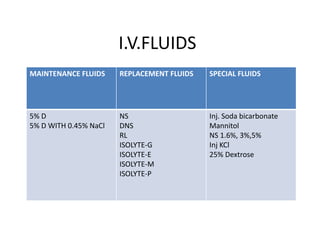
I.V.FLUIDS
MAINTENANCE FLUIDS REPLACEMENT FLUIDS SPECIAL FLUIDS
5% D
5% D WITH 0.45% NaCl
NS
DNS
RL
ISOLYTE-G
ISOLYTE-E
ISOLYTE-M
ISOLYTE-P
Inj. Soda bicarbonate
Mannitol
NS 1.6%, 3%,5%
Inj KCl
25% Dextrose
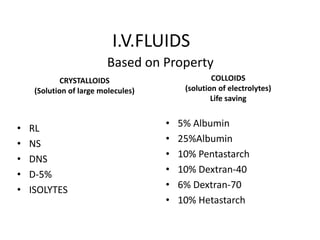
Based on Property
CRYSTALLOIDS
(Solution of large molecules)
• RL
• NS
• DNS
• D-5%
• ISOLYTES
COLLOIDS
(solution of electrolytes)
Life saving
• 5% Albumin
• 25%Albumin
• 10% Pentastarch
• 10% Dextran-40
• 6% Dextran-70
• 10% Hetastarch
I.V.FLUIDS
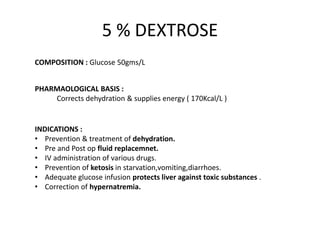
5 % DEXTROSE
COMPOSITION : Glucose 50gms/L
PHARMAOLOGICAL BASIS :
Corrects dehydration & supplies energy ( 170Kcal/L )
INDICATIONS :
• Prevention & treatment of dehydration.
• Pre and Post op fluid replacemnet.
• IV administration of various drugs.
• Prevention of ketosis in starvation,vomiting,diarrhoes.
• Adequate glucose infusion protects liver against toxic substances .
• Correction of hypernatremia.
CONTRAINDICATIONS :
• Cerebral edema, neuro surgical procedures.
• Acute ischaemia stroke
• Hypovolemic shock
• Hyponatremia , water intoxication.
• Same i.v. line blood transfusion- hemolysis, clumping occurs.
• Uncontrolled DM , severe hyperglycemia.
RATE OF ADMINISTRATION :
0.5gm/KgBW/hr or 666ml/hr 5% D or 333ml/hr 10% D
ISOTONIC SALINE ( 0.9% NS )
COMPOSITION : Na+ 154mEq , Cl- 154 mEq
PHARMACOLOGICAL BASIS :
• Provides major ECF electrolytes.
• Corrects both water & electrolyte deficits
• Increase the i.v. volume substantially.
CONTRAINDICATIONS :
• Avoid in pre-eclamptic patients, CHF , renal disease and cirrhosis.
• Dehydration with severe hypokalemia- deficit of ICF potassium.
• Large volume may lead to hyperchloremic acidosis..
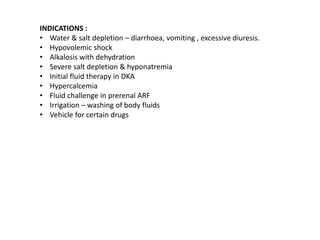
INDICATIONS :
• Water & salt depletion – diarrhoea, vomiting , excessive diuresis.
• Hypovolemic shock
• Alkalosis with dehydration
• Severe salt depletion & hyponatremia
• Initial fluid therapy in DKA
• Hypercalcemia
• Fluid challenge in prerenal ARF
• Irrigation – washing of body fluids
• Vehicle for certain drugs
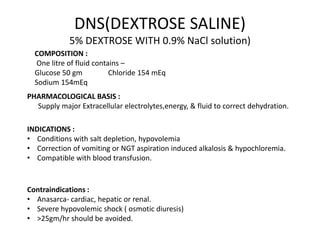
DNS(DEXTROSE SALINE)
5% DEXTROSE WITH 0.9% NaCl solution)
PHARMACOLOGICAL BASIS :
Supply major Extracellular electrolytes,energy, & fluid to correct dehydration.
INDICATIONS :
• Conditions with salt depletion, hypovolemia
• Correction of vomiting or NGT aspiration induced alkalosis & hypochloremia.
• Compatible with blood transfusion.
Contraindications :
• Anasarca- cardiac, hepatic or renal.
• Severe hypovolemic shock ( osmotic diuresis)
• >25gm/hr should be avoided.
COMPOSITION :
One litre of fluid contains –
Glucose 50 gm Chloride 154 mEq
Sodium 154mEq
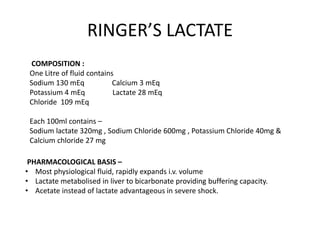
RINGER’S LACTATE
PHARMACOLOGICAL BASIS –
• Most physiological fluid, rapidly expands i.v. volume
• Lactate metabolised in liver to bicarbonate providing buffering capacity.
• Acetate instead of lactate advantageous in severe shock.
COMPOSITION :
One Litre of fluid contains
Sodium 130 mEq Calcium 3 mEq
Potassium 4 mEq Lactate 28 mEq
Chloride 109 mEq
Each 100ml contains –
Sodium lactate 320mg , Sodium Chloride 600mg , Potassium Chloride 40mg &
Calcium chloride 27 mg
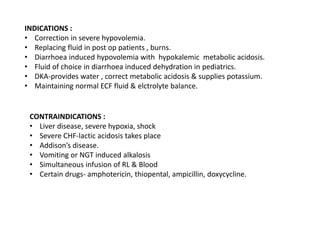
INDICATIONS :
• Correction in severe hypovolemia.
• Replacing fluid in post op patients , burns.
• Diarrhoea induced hypovolemia with hypokalemic metabolic acidosis.
• Fluid of choice in diarrhoea induced dehydration in pediatrics.
• DKA-provides water , correct metabolic acidosis & supplies potassium.
• Maintaining normal ECF fluid & elctrolyte balance.
CONTRAINDICATIONS :
• Liver disease, severe hypoxia, shock
• Severe CHF-lactic acidosis takes place
• Addison’s disease.
• Vomiting or NGT induced alkalosis
• Simultaneous infusion of RL & Blood
• Certain drugs- amphotericin, thiopental, ampicillin, doxycycline.
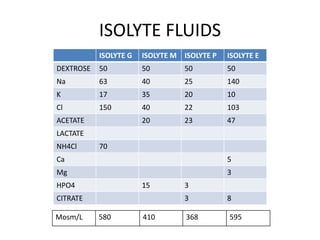
ISOLYTE FLUIDS
ISOLYTE G ISOLYTE M ISOLYTE P ISOLYTE E
DEXTROSE 50 50 50 50
Na 63 40 25 140
K 17 35 20 10
Cl 150 40 22 103
ACETATE 20 23 47
LACTATE
NH4Cl 70
Ca 5
Mg 3
HPO4 15 3
CITRATE 3 8
Mosm/L 580 410 368 595
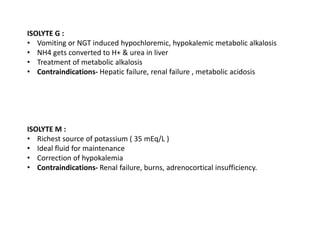
ISOLYTE G :
• Vomiting or NGT induced hypochloremic, hypokalemic metabolic alkalosis
• NH4 gets converted to H+ & urea in liver
• Treatment of metabolic alkalosis
• Contraindications- Hepatic failure, renal failure , metabolic acidosis
ISOLYTE M :
• Richest source of potassium ( 35 mEq/L )
• Ideal fluid for maintenance
• Correction of hypokalemia
• Contraindications- Renal failure, burns, adrenocortical insufficiency.
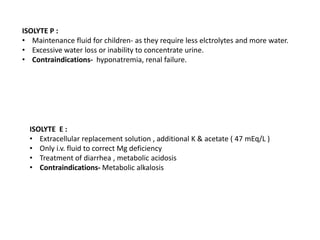
ISOLYTE P :
• Maintenance fluid for children- as they require less elctrolytes and more water.
• Excessive water loss or inability to concentrate urine.
• Contraindications- hyponatremia, renal failure.
ISOLYTE E :
• Extracellular replacement solution , additional K & acetate ( 47 mEq/L )
• Only i.v. fluid to correct Mg deficiency
• Treatment of diarrhea , metabolic acidosis
• Contraindications- Metabolic alkalosis
Effects of large volume cystalloid
infusion
• Extravascular accumulation in skin,
connective tissue, lungs & kidney.
• Inhibition of GI motility
• Delayed healing of anastomosis
• Large volume , rapid infusion
crystalloids causes
hypercoagulability.
COLLOIDS
• Large molecular weight substances that
largely remains in intravascular
compartment thereby generating oncotic
pressure.
• 3 times more potent
• 1 ml blood loss = 1 ml colloid = 3ml
crystalloid
TYPE OF FLUID Effective Plasma volume
expansion/100ml
DURATION
5% ALBUMIN 70-130 ml 16 hrs
25% ALBUMIN 400-500 ml 16 hrs
6% HETASTARCH 100-130 ml 24 hrs
10% PENTASTARCH 150 ml 8 hrs
10% DEXTRAN 40 100-150 ml 6 hrs
6% DEXTRAN 70 80 ml 12 hrs
ALBUMIN
• Maintain Plasma Oncotic Pressure – 75-80%
• Heat treated preparation of Albumin- 5%, 20%, 25% comercially available.
PHARMACOLOGICAL BASIS :
• 5% Albumin- COP of 20 mmHg
• 25% Albumin- COP of 70 mmHg, expands plasma volume to 4-5 times the volume
infused within 4-5 min.
RATE OF INFUSION :
• Adults- initial infusion of 25 gm
• 1-2 ml/min- 5% albumin
• 1 ml/min- 25% albumin
INDICATIONS :
• Plasma volume expansion in acute hypovolemic shock, burns, severe
hypoalbuminemia
• Hypoproteinemia- liver disease, Diuretic resistant in nephrotic syndrome
• Oligourea
• In therapeutic plasmapheresis, as an exchange fluid.
CONTRAINDICATIONS :
• Severe anemia , cardiac failure.
• Hypersensitive reaction.
DEXTRAN
Dextran are glucose polymers produced by bacteria ( leuconostoc mesenteroides )
2 forms : Dextran 70 (MW 70,000) & Dextran 40(MW 40,000)
PHARMACOLOGICAL BASIS :
• Effectively expand i.v. volume, but not suitable for blood transfusion
• Dextran 40 as 10% sol greater expansion, short duration (6hrs)- rapid ranal
excretion
• Anti thrombotic , inhibits platlet aggregation.
• Improves micro circulatory flow as preventing thromboembolism.
INDICATIONS :
• Hypovolemic correction
• Prophylaxis of DVT & post operative thromboembolism
• Improves blood flow & micro circulation in threatened vascular gangrene.
• Myocardial ischemia, cerebral ischemia as maintaining vascular graft patency.
ADVERSE EFFECTS :
• Acute renal failure
• Interfere with blood grouping & cross matching.
• Hypersensitivity reaction.
PRECAUTIONS/CONTRAINDICATIONS :
• Severe Oligo-anuria
• CHF, circulatory overload
• Bleeding disorders like thrombocytopenia
• Severe dehydration
• Anticoagulant effect of heparin enhanced
• Hypersensitivity to dextran
ADMINISTRATION :
• Adult patient in shock- rapid 500ml iv infusion.
• First 24 hrs- dose should not exceed 20ml/kg
• Next 5 days- 10ml/kg/day.
GELATIN POLYMERS( HAEMACCEL)
• 500ml sterile, pyrogen free 3.5% solution.
• Polymer of degraded gelatin with electrolytes.
• 2 types- Succinylated gelatin (modified fluid gelatin)
Urea cross linked gelatin ( polygeline)
COMPOSITION :
Na 145mEq, Cl 145mEq , Ca 12.5 mEq , K 5.1 mEq
INDICATIONS :
• Rapid plasma volume expansion in hypovolemia.
• Volume pre loading in general anesthesia.
• Priming of heart lung machines.
ADVANTAGES :
• Does not interfere with coagulation, blood grouping
• Remains in blood for 4 to 5 hrs
• Expands plasma volume by 50 %
SIDE EFFECTS :
• Hypersensitivity reaction
• Bronchospasm, hypotension
• Should not be mixed with citrated blood
HYDROXYETHYL STARCH
(HETASTARCH)
• It is composed of more than 90% esterified amylopectin.
• Esterification retards degradation leading to longer plasma expansion
• 6% starch – MW 4,50,000
PHARMACOLOGICAL BASIS :
• Osmolality – 310 mOsm/L
• Higher colloidal osmotic pressure
• LMW substances excreted in urine in 24 ht
ADVANTAGES :
• Non antigenic
• Does not interfere with blood grouping
• Greater plasma volume expansion
• Preserve intestinal microvascular perfusion in endotoxaemia
• Duration 24hr
DISADVANTAGES :
• Increase in S.amylase concentration upto 5 days after discontinuation
• Affects coagulation by prolonging PTT, PT & Bleeding time by lowering fibrinogen
• Decrease platlet aggregation, vWF , factor VIII
CONTRAINDICATION :
• Bleeding disorders , CHF
• Impaired Renal function
ADMINISTRATION :
• Adult dose 6% solution – 500ml to 1 L
• Total daily dose should not exceed 20 ml/kg

Fluids

  • 1.
    FLUIDS & ELECTROLYTES 16May,2017 SPEAKER – Dr. Ankit Kaura Post Graduate Dept. of Surgery MODERATOR – Dr. Tanveer Karim Professor Dept. of Surgery
  • 2.
    FLUIDS FLUID & ELECTROLYTEDISORDER FLUID THERAPY
  • 3.
    I.V.FLUIDS MAINTENANCE FLUIDS REPLACEMENTFLUIDS SPECIAL FLUIDS 5% D 5% D WITH 0.45% NaCl NS DNS RL ISOLYTE-G ISOLYTE-E ISOLYTE-M ISOLYTE-P Inj. Soda bicarbonate Mannitol NS 1.6%, 3%,5% Inj KCl 25% Dextrose
  • 4.
    Based on Property CRYSTALLOIDS (Solutionof large molecules) • RL • NS • DNS • D-5% • ISOLYTES COLLOIDS (solution of electrolytes) Life saving • 5% Albumin • 25%Albumin • 10% Pentastarch • 10% Dextran-40 • 6% Dextran-70 • 10% Hetastarch I.V.FLUIDS
  • 5.
    5 % DEXTROSE COMPOSITION: Glucose 50gms/L PHARMAOLOGICAL BASIS : Corrects dehydration & supplies energy ( 170Kcal/L ) INDICATIONS : • Prevention & treatment of dehydration. • Pre and Post op fluid replacemnet. • IV administration of various drugs. • Prevention of ketosis in starvation,vomiting,diarrhoes. • Adequate glucose infusion protects liver against toxic substances . • Correction of hypernatremia.
  • 6.
    CONTRAINDICATIONS : • Cerebraledema, neuro surgical procedures. • Acute ischaemia stroke • Hypovolemic shock • Hyponatremia , water intoxication. • Same i.v. line blood transfusion- hemolysis, clumping occurs. • Uncontrolled DM , severe hyperglycemia. RATE OF ADMINISTRATION : 0.5gm/KgBW/hr or 666ml/hr 5% D or 333ml/hr 10% D
  • 7.
    ISOTONIC SALINE (0.9% NS ) COMPOSITION : Na+ 154mEq , Cl- 154 mEq PHARMACOLOGICAL BASIS : • Provides major ECF electrolytes. • Corrects both water & electrolyte deficits • Increase the i.v. volume substantially. CONTRAINDICATIONS : • Avoid in pre-eclamptic patients, CHF , renal disease and cirrhosis. • Dehydration with severe hypokalemia- deficit of ICF potassium. • Large volume may lead to hyperchloremic acidosis..
  • 8.
    INDICATIONS : • Water& salt depletion – diarrhoea, vomiting , excessive diuresis. • Hypovolemic shock • Alkalosis with dehydration • Severe salt depletion & hyponatremia • Initial fluid therapy in DKA • Hypercalcemia • Fluid challenge in prerenal ARF • Irrigation – washing of body fluids • Vehicle for certain drugs
  • 9.
    DNS(DEXTROSE SALINE) 5% DEXTROSEWITH 0.9% NaCl solution) PHARMACOLOGICAL BASIS : Supply major Extracellular electrolytes,energy, & fluid to correct dehydration. INDICATIONS : • Conditions with salt depletion, hypovolemia • Correction of vomiting or NGT aspiration induced alkalosis & hypochloremia. • Compatible with blood transfusion. Contraindications : • Anasarca- cardiac, hepatic or renal. • Severe hypovolemic shock ( osmotic diuresis) • >25gm/hr should be avoided. COMPOSITION : One litre of fluid contains – Glucose 50 gm Chloride 154 mEq Sodium 154mEq
  • 10.
    RINGER’S LACTATE PHARMACOLOGICAL BASIS– • Most physiological fluid, rapidly expands i.v. volume • Lactate metabolised in liver to bicarbonate providing buffering capacity. • Acetate instead of lactate advantageous in severe shock. COMPOSITION : One Litre of fluid contains Sodium 130 mEq Calcium 3 mEq Potassium 4 mEq Lactate 28 mEq Chloride 109 mEq Each 100ml contains – Sodium lactate 320mg , Sodium Chloride 600mg , Potassium Chloride 40mg & Calcium chloride 27 mg
  • 11.
    INDICATIONS : • Correctionin severe hypovolemia. • Replacing fluid in post op patients , burns. • Diarrhoea induced hypovolemia with hypokalemic metabolic acidosis. • Fluid of choice in diarrhoea induced dehydration in pediatrics. • DKA-provides water , correct metabolic acidosis & supplies potassium. • Maintaining normal ECF fluid & elctrolyte balance. CONTRAINDICATIONS : • Liver disease, severe hypoxia, shock • Severe CHF-lactic acidosis takes place • Addison’s disease. • Vomiting or NGT induced alkalosis • Simultaneous infusion of RL & Blood • Certain drugs- amphotericin, thiopental, ampicillin, doxycycline.
  • 12.
    ISOLYTE FLUIDS ISOLYTE GISOLYTE M ISOLYTE P ISOLYTE E DEXTROSE 50 50 50 50 Na 63 40 25 140 K 17 35 20 10 Cl 150 40 22 103 ACETATE 20 23 47 LACTATE NH4Cl 70 Ca 5 Mg 3 HPO4 15 3 CITRATE 3 8 Mosm/L 580 410 368 595
  • 13.
    ISOLYTE G : •Vomiting or NGT induced hypochloremic, hypokalemic metabolic alkalosis • NH4 gets converted to H+ & urea in liver • Treatment of metabolic alkalosis • Contraindications- Hepatic failure, renal failure , metabolic acidosis ISOLYTE M : • Richest source of potassium ( 35 mEq/L ) • Ideal fluid for maintenance • Correction of hypokalemia • Contraindications- Renal failure, burns, adrenocortical insufficiency.
  • 14.
    ISOLYTE P : •Maintenance fluid for children- as they require less elctrolytes and more water. • Excessive water loss or inability to concentrate urine. • Contraindications- hyponatremia, renal failure. ISOLYTE E : • Extracellular replacement solution , additional K & acetate ( 47 mEq/L ) • Only i.v. fluid to correct Mg deficiency • Treatment of diarrhea , metabolic acidosis • Contraindications- Metabolic alkalosis
  • 15.
    Effects of largevolume cystalloid infusion • Extravascular accumulation in skin, connective tissue, lungs & kidney. • Inhibition of GI motility • Delayed healing of anastomosis • Large volume , rapid infusion crystalloids causes hypercoagulability.
  • 16.
    COLLOIDS • Large molecularweight substances that largely remains in intravascular compartment thereby generating oncotic pressure. • 3 times more potent • 1 ml blood loss = 1 ml colloid = 3ml crystalloid
  • 17.
    TYPE OF FLUIDEffective Plasma volume expansion/100ml DURATION 5% ALBUMIN 70-130 ml 16 hrs 25% ALBUMIN 400-500 ml 16 hrs 6% HETASTARCH 100-130 ml 24 hrs 10% PENTASTARCH 150 ml 8 hrs 10% DEXTRAN 40 100-150 ml 6 hrs 6% DEXTRAN 70 80 ml 12 hrs
  • 18.
    ALBUMIN • Maintain PlasmaOncotic Pressure – 75-80% • Heat treated preparation of Albumin- 5%, 20%, 25% comercially available. PHARMACOLOGICAL BASIS : • 5% Albumin- COP of 20 mmHg • 25% Albumin- COP of 70 mmHg, expands plasma volume to 4-5 times the volume infused within 4-5 min. RATE OF INFUSION : • Adults- initial infusion of 25 gm • 1-2 ml/min- 5% albumin • 1 ml/min- 25% albumin
  • 19.
    INDICATIONS : • Plasmavolume expansion in acute hypovolemic shock, burns, severe hypoalbuminemia • Hypoproteinemia- liver disease, Diuretic resistant in nephrotic syndrome • Oligourea • In therapeutic plasmapheresis, as an exchange fluid. CONTRAINDICATIONS : • Severe anemia , cardiac failure. • Hypersensitive reaction.
  • 20.
    DEXTRAN Dextran are glucosepolymers produced by bacteria ( leuconostoc mesenteroides ) 2 forms : Dextran 70 (MW 70,000) & Dextran 40(MW 40,000) PHARMACOLOGICAL BASIS : • Effectively expand i.v. volume, but not suitable for blood transfusion • Dextran 40 as 10% sol greater expansion, short duration (6hrs)- rapid ranal excretion • Anti thrombotic , inhibits platlet aggregation. • Improves micro circulatory flow as preventing thromboembolism.
  • 21.
    INDICATIONS : • Hypovolemiccorrection • Prophylaxis of DVT & post operative thromboembolism • Improves blood flow & micro circulation in threatened vascular gangrene. • Myocardial ischemia, cerebral ischemia as maintaining vascular graft patency. ADVERSE EFFECTS : • Acute renal failure • Interfere with blood grouping & cross matching. • Hypersensitivity reaction.
  • 22.
    PRECAUTIONS/CONTRAINDICATIONS : • SevereOligo-anuria • CHF, circulatory overload • Bleeding disorders like thrombocytopenia • Severe dehydration • Anticoagulant effect of heparin enhanced • Hypersensitivity to dextran ADMINISTRATION : • Adult patient in shock- rapid 500ml iv infusion. • First 24 hrs- dose should not exceed 20ml/kg • Next 5 days- 10ml/kg/day.
  • 23.
    GELATIN POLYMERS( HAEMACCEL) •500ml sterile, pyrogen free 3.5% solution. • Polymer of degraded gelatin with electrolytes. • 2 types- Succinylated gelatin (modified fluid gelatin) Urea cross linked gelatin ( polygeline) COMPOSITION : Na 145mEq, Cl 145mEq , Ca 12.5 mEq , K 5.1 mEq INDICATIONS : • Rapid plasma volume expansion in hypovolemia. • Volume pre loading in general anesthesia. • Priming of heart lung machines.
  • 24.
    ADVANTAGES : • Doesnot interfere with coagulation, blood grouping • Remains in blood for 4 to 5 hrs • Expands plasma volume by 50 % SIDE EFFECTS : • Hypersensitivity reaction • Bronchospasm, hypotension • Should not be mixed with citrated blood
  • 25.
    HYDROXYETHYL STARCH (HETASTARCH) • Itis composed of more than 90% esterified amylopectin. • Esterification retards degradation leading to longer plasma expansion • 6% starch – MW 4,50,000 PHARMACOLOGICAL BASIS : • Osmolality – 310 mOsm/L • Higher colloidal osmotic pressure • LMW substances excreted in urine in 24 ht
  • 26.
    ADVANTAGES : • Nonantigenic • Does not interfere with blood grouping • Greater plasma volume expansion • Preserve intestinal microvascular perfusion in endotoxaemia • Duration 24hr DISADVANTAGES : • Increase in S.amylase concentration upto 5 days after discontinuation • Affects coagulation by prolonging PTT, PT & Bleeding time by lowering fibrinogen • Decrease platlet aggregation, vWF , factor VIII
  • 27.
    CONTRAINDICATION : • Bleedingdisorders , CHF • Impaired Renal function ADMINISTRATION : • Adult dose 6% solution – 500ml to 1 L • Total daily dose should not exceed 20 ml/kg