FLUID
THERAPY
DR MUKESH SHUKLA , MD
SENIOR RESIDENT
MEDICINE, KGMU
LUCKNOW
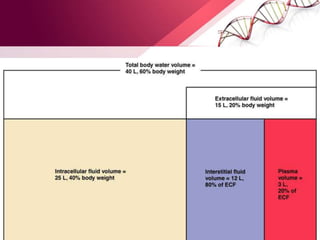
Body Water Compartments
• Intracellular water: 2/ 3 (40%)of TBW
• Extracellular water: 1/3 (20%)of TBW
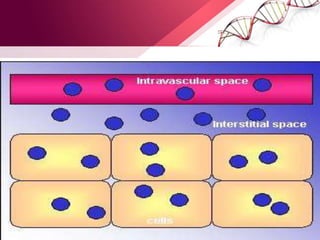
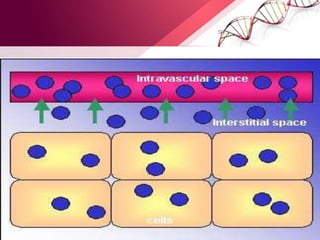
- Extravascular water[interstitial]: 3/4 (15%)of extracellular water
- Intravascular water[plasma]: 1/4 (5%)of extracellular water
Why patients need
intravenous fluid therapy
?
Patient needs IV fluid therapy for
Maintenance ( to supply daily needs ) ,
Replacement ( to replace deficit and on-going losses )
Resuscitation ( to correct an IV or extracellular deficit )
Practical Fluid
Balance
H2
O H2
O H2
O
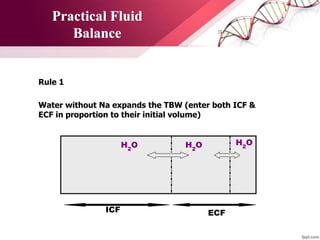
Rule 1
Water without Na expands the TBW (enter both ICF &
ECF in proportion to their initial volume)
ECFICF
Practical Fluid
Balance
Na
+
Na
+
Na
+
Na
+
Na
+
Na
+
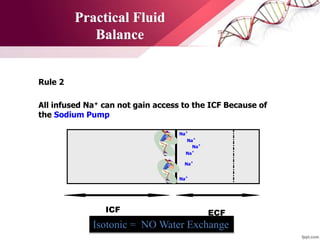
Rule 2
All infused Na+ can not gain access to the ICF Because of
the Sodium Pump
ECFICF
Isotonic = NO Water Exchange
Total body water
ECF=1 liter ICF=0
Intravascular
=1/4 ECF=250 ml
1 Liter 0.9% saline
Interstitial=3/4 of
ECF=750ml
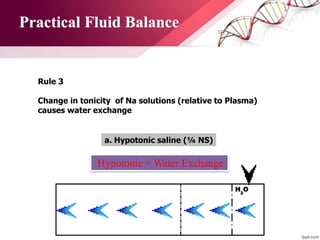
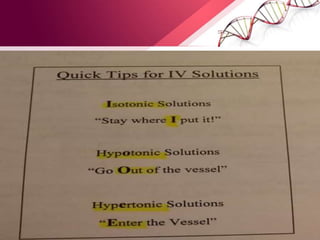
Hypotonic = Water Exchange
a. Hypotonic saline (¼ NS)
H2
O
Rule 3
Change in tonicity of Na solutions (relative to Plasma)
causes water exchange
Practical Fluid Balance
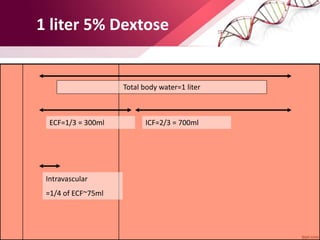
1 liter 5% Dextose
Total body water=1 liter
ECF=1/3 = 300ml ICF=2/3 = 700ml
Intravascular
=1/4 of ECF~75ml
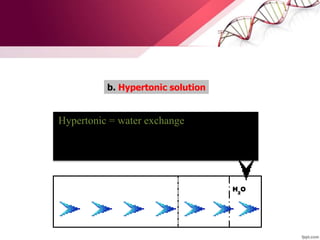
Hypertonic = water exchange
b. Hypertonic solution
H2
O
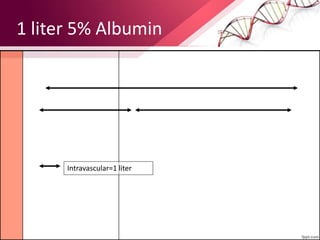
1 liter 5% Albumin
Intravascular=1 liter
Clinical characteristic of iv fluids
 Ringer lactate is the most physiological iv fluid
 Isotonic saline and DNS have maximum sodium
 Isotonic saline ,DNS and ISO-G have maximum chloride
 ISO – E,P,M directly correct acidosis
 ISO-G only iv fluid which directly correct metabolic
alkalosis.
 ISO-M,P,G,E and Ringer lactate are usually avoided in renal
failure.
 ISO-G and Ringer lactate are avoided in patients with liver
failure.
• Isotonic saline and Ringer Lactate do not contain
glucose so preferred fluid for diabetic patients.
• 5,10 and 20 D are only fluids which do not contain
Na and Cl. Iso-M and P have low Na and Cl.
• NS , DNS and dextrose containing fluids do not
contain potassium and they do not correct
metabolic acidosis and alkalosis directly.
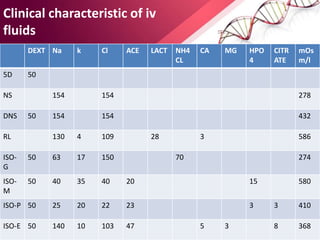
Clinical characteristic of iv
fluids
DEXT Na k Cl ACE LACT NH4
CL
CA MG HPO
4
CITR
ATE
mOs
m/l
5D 50
NS 154 154 278
DNS 50 154 154 432
RL 130 4 109 28 3 586
ISO-
G
50 63 17 150 70 274
ISO-
M
50 40 35 40 20 15 580
ISO-P 50 25 20 22 23 3 3 410
ISO-E 50 140 10 103 47 5 3 8 368
Characteristics of
intravenous fluids
Characteristic Intravenous fluids Characteristic Intravenous fluids
Most physiological RL Glucose free Saline, RL
Rich in sodium NS,DNS,RL Sodium free Dextrose solutions
Rich in chloride NS,DNS,Iso-G Potassium free NS/DNS,dextrose solution
Rich in potassium Iso-M,P and G Avoid in liver failure RL, Iso-G, 5% D
Corrects acidosis RL, all isolyte Except Iso-G Avoid in renal failure NS, RL, all isolyte
Corrects alkalosis Isolyte-G, NS Provides phosphorous Isolyte-M
SUMMARY
CHARACTERISTIC TYPE OF FLUID
Most physiological Ringers lactate (RL)
Rich in sodium NS, DNS
Rich in Chloride NS, DNS,ISO - G
Rich in potassium Isolyte - M, P, G
Correct Acidosis Ringers Lactate, Iso-E,P,M
Correct alkalosis Isolyte-G
Caution in renal failure Ringer lactate , Isolyte-M,G,P and E
Avoided in liver failure Ringer lactate , Isolyte-G
Glucose free NS, Ringers lactate
Sodium free 5,10,20 and 25 D
Potassium free NS, DNS and Dextrose fluids
Daily Electrolyte Requirements
• - Sodium: 100-250meq (western diet)
– mostly excreted in urine
• - Potassium: 50-100meq
– mostly excreted in urine, 5% in feces
• - Chloride: 60-150meq
– Example: 1/2NS @ 100cc/hr provides ~180mEq of sodium and chloride/day!
- this is why NS should not be used for maintenance fluid in patients with
normal renal function- risk of hyperchloremic metabolic acidosis
• - Bicarb: 1 meq/kg/day
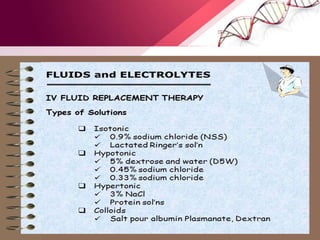
Crystalloids
 Combination of water and electrolytes
Balanced salt solution: electrolyte composition and osmolality similar to
plasma; example: lactated Ringer’s, Plasmlyte, Normosol.
- Hypotonic salt solution: electrolyte composition lower than that of plasma;
example: D5W.
 True solution, No particulate
 Expands IVC adequately (less than colloids), however Small increase in
plasma volume
 Replenishes interstitial compartment
 It leaves IVC faster ( t/2 20-30 minutes)
 Cheap
 Increase GFR
 No risk of allergic reaction
 Suspension of particle rather than a solution
 High Molecular Weight: Unable to pass through semi permeable
membrane
 Remains confined to intra-vascular compartment (at least initially)
 Do not correct water and electrolyte deficiencies
 Examples: hetastarch (Hespan), albumin, dextran
Colloids
 Antigenicity & Anaphylactic Reaction
 Blood typing
 Coagulopathy
 Never exceed 1 – 1.5 liter/day (20 ml/kg/day)
Colloids
colloids
Colloids
 Most logical choice for intravascular expansion
 Since greater portion remains in IVC & for longer time
( t/2 3-6 hours)
 Less volume is required& initial resuscitation is rapid
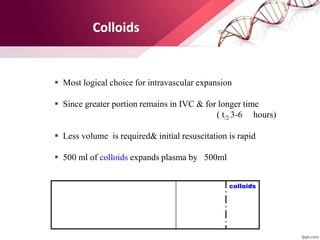
 500 ml of colloids expands plasma by 500ml
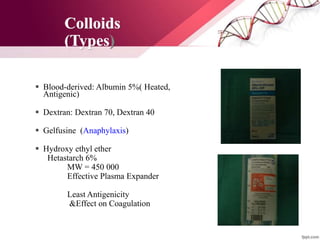
 Blood-derived: Albumin 5%( Heated,
Antigenic)
 Dextran: Dextran 70, Dextran 40
 Gelfusine (Anaphylaxis)
 Hydroxy ethyl ether
Hetastarch 6%
MW = 450 000
Effective Plasma Expander
Least Antigenicity
&Effect on Coagulation
Colloids
(Types)
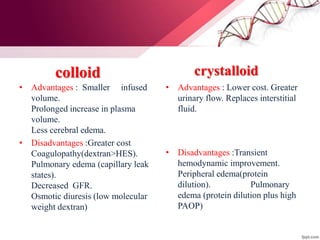
colloid
• Advantages : Smaller infused
volume.
Prolonged increase in plasma
volume.
Less cerebral edema.
• Disadvantages :Greater cost
Coagulopathy(dextran>HES).
Pulmonary edema (capillary leak
states).
Decreased GFR.
Osmotic diuresis (low molecular
weight dextran)
crystalloid
• Advantages : Lower cost. Greater
urinary flow. Replaces interstitial
fluid.
• Disadvantages :Transient
hemodynamic improvement.
Peripheral edema(protein
dilution). Pulmonary
edema (protein dilution plus high
PAOP)
CRYSTALOID CLASSIFICATION
1. Maintenance
fluid
2. Replacement
fluid
3. Special fluid
5% DEXTROSE NORMAL SALINE 25% DEXTROSE
DEXTROSE WITH .45%
NORMAL SALINE
DNS SODIUM BICARBONATE
RINGER LACTATE POTASSIUM CHLORIDE
ISOLYTE – M,P,G
5% DEXTROSE
COMPOSITION –
 One litre of fluid contains 50 gram of glucose .
 PHARMACOLOGICAL BASIS –
 Correct dehydration and supplies energy
 Best agent to correct intracellular dehydration
 Used where there is need of water but not electrolytes
 INDICATIONS –
 Dehydration due to inadequate water intake or excessive water loss
 Pre and post operative fluid management
 IV administration of various drugs
 Prevention of ketosis in starvation , diarrhea , vomiting and high grade fever
 Correction of hyperntremia due to pure water loss
 Hypernatremia due to salt poisoning or excessive use of electrolyte solution
CONTRAINDICATIONS –
Cerebral oedema
Neurosurgical procedures
Acute ischemic stroke
Hypovolemic shock
Hyponatremia and water intoxication
Hypernatremia
Blood transfusion
Uncontrolled diabetes and severe hyperglycemia
 PRECAUTIONS –
 May cause local pain , irritation and
thrombophlebitis.
 Can cause hypokalemia, hypomagnesaemia and
hypophosphatemia
RATE OF ADMINISTRATION –
 Can be given .5gm/kg body weight/hour without
causing glycosuria .
ISOTONIC SALINE
COMPOSITION –
One litre of normal saline contains 154 meq sodium
and 154 meq chloride
PHARMACOLOGICAL BASIS –
 Used to provide major extracellular electrolytes
Very useful to correct fluid and electrolyte deficit
Very useful to raise blood pressure in patient with
hupovolemic shock
INDICATIONS –
 Water and salt depletion as in diarrhoea, vomiting,excessive diuresis
or excessive persppiration
 Treatment of hypovolemic shock
 Treatment of alkalosis with dehydration
 Severe salt depletion and hyponatremia
 Inicial fluid therapy in DKA
 Treatment of hypercalcemia
 Fluid challenge in prerenal ARF
 Irrigation for washing of body fluids
 Vehicle for certain drugs
 Can be given safely with blood
 Hypertonic saline(3% nacl) is used in treatment of
hyponatremia due to SIADH or water intoxication
along with diuretic .
Contraindications :
 Hypertensive or preeclampsia patients
 Patient with edema due to CHF , renal disease and cirrhosis
 Very young and elderly patients
 Dehydration with severe hypokalemia
DEXTROSE SALINE (DNS)
COMPOSITION –
 One litre fluid contains 50gm glucose,154meq sodium and 154
meq chloride.
Pharmacological basis –
 useful to supply major extracellular electrolytes and
energy along with fluid to correct dehydration .
 Unlike 5D it is not hypotonic (due to Nacl) and hence it
is compatible with blood transfusion.
INDICATIONS –
 Correction of salt depletion and hypovolemia with supply
of energy
 Correction of vomiting and nasogastric aspiration induced
alkalosis and hypochlremia along with supply of energy
 Fluid compatible with blood transfusion
CONTRAINDICATIONS –
 Anasarca of cardiac, hepatic and renal disease
 Hypovolemic shock
RINGER LACTATE
 Most physiological fluid
 Rapidly expands intravascular volume so very effective in severe
hypovolemia
 Provide bicarbonate so useful in correction of metabolic acidisis
 INDICATIONS-
 Correction of severe hypovolemia
 Postoperative patients ,burns ,fracture and peritoneal irrigation
 Diarrhoea induced hypovolemia with hupokalemic metabolic acidosis
 Diabetic ketoacidosis
 For maintaing normal ECF fluid and elecrolyte balance during and
after surgery
 Contraindications –
 Liver disease , severe hypoxia and shock
 CHF
 Addison's disease
 Severe metabolic acidosis
 Vomiting and continuous nasogastric aspiration
 Infusion of RL and blood product in one IV line
contraindicated
 Calcium in RL binds with certain drugs like amphotercin and
reduces their bioavailability and efficiency
ISOLYTE -M
• ISO-M is the richest source of potassium.
• Also correct acidosis and supplies energy so ideal fluid for
maintenance fluid therapy
 INDICATIONS-
 For parenteral fluid therapy, it is the ideal maintenance fluid.
 To correct hypokalemia
 CONTRAINDICATIONS –
 Renal failure
 Hyponatremia and water intoxication
 Adrenocortical deficiency
 Burns
OTHER’s
ISOLYTE-G- only fluid to correct metabolic alkalosis.Used to
replace fluid loss due to vomiting or continuous nasogastri
aspiration .
ISOLYTE- P- Provide less electrolytes(half of isolyte –M)
and more water .Useful in pediatric patients.
ISOLYTE – E – Correct all ecf electrolytes, acidosis and
supplies glucose .
SODIUM
BICARBONATE
• Commonaly available preparation contains 7.5% , 25ml ampoule
• Each ampule contains 22.5 meq sodium and 22.5 meq bicarbonte
 INDICATIONS –
 Treatment of metabolic acidosis
 For cardiopulmonary resuscitation and shock
 Treatment of hyperkalemia
 Alkaline forced diuresis in treatment of acute poisoning of
barbiturate and salicylates
 When to use –
In severe metabolic acidosis
 How much to give –
 Always under corrected
 Amount in meq /l= .5xweight in kg x(desired bicarbonate – actual
bicarbonate )
 How to infuse –
 50% corrected in 4 hours and rest gradually over 24 hours
 To avoid irritation of vein and sudden sodium loading added to 5D
 Special precations –
 Should not be given in bolus except in emergency
 Establish proper IV line for infusion as it is very irritant
 Avoid overdose and alkalosis
 Never treat acidosis without treating etiology
 In renal failure bicarb correction may cause tetany and
pulmonary oedema so prefer dialysis if acidosis and renal
failure are severe
 Never correct acidosis without correcting assosiated
hypokalemia
 Never mix sodabicarb with injection calcium as
combination can precipitate calcium carbonate as white
crystals
 Avoid mixing of sodabicarb with ionotropes
 Complications –
 Overshoot , post treatment metabolic alkalosis
 Hypokalemia
 Volume overload
 Hypocalcemia – tetany
 Contraindications –
 Respiratory alkalosis , metabolic alakalosis and hypokalemia
 Correct dehydration, hypokalemia and hypocalcemia prior to bicarb
treatment
 Cautious use in congestive heart failure , chronic renal failure
,cirrhosis of liver or hypertension
POTASSIUM CHLORIDE
 One amp of 10ml contains 1.5 gm or 20 meq potassium .
 INDICATION-
 Prevention and treatment of hypokalemia
 Added in potassium free peritoneal dialysis
 During cardiac bypass surgery
 PRECAUTIONS-
 Never give direct iv injection
 Never add more than 40 mEq potassium/litre
 Never infuse more than 10mEq potassim /hour
 Never add potassium chloride in ISO-M
 Monitor potassium level closely and if possible also monitor by ECG
 CONTRAINDICATIONS-
 Cautious use in renal failure
 Never use injection Kcl without knowing potassium
status
25D
• 100 ml of 25D contains 25gm of glucose.
• Dextrose supplies energy and prevents , used when faster
replacement of glucose is needed like in hypoglycemic coma.
• In fluid restricted state like CHF provides larger glucose in smaller
volume.
INDICATIONS-
 Rapid correction of hypoglycemia
 Provide nutrition to the patient
 For treatment of hyperkalemia
CONTAINDICATIONS-
 Dehydrated patient with anuria
 Intracranial and intraspinal hemorrhage
 Delerium tremens
 Avoided in diabetic patients
CAUTION –
 Rapid infusion of 25D can cause glycosuria secondary
to hyperglycemia ,should be infused slowly
ALBUMIN
 Physiologic plasma protein
 Maintain plasma oncotic pressure
 Binding and transport of low molecular weight substances
 25% albumin expands the plasma volume by 4-5 times the
volume infused
 Plasma volume expansion occurs at the expense of
interstitial volume
 Oncotic pressure lasts for 12 to 18 hrs
 Preferred in case of hypoproteinemia with anasarca with
oedema
 INDICATIONS –
 Plasma volume expansion
 Correction of hypoproteinemia
 As an exchange fluid in therapeutic plasmapheresis
 Adverse effects –
 Nausea
 Vomiting
 Febrile reaction
 Allergic reaction including anaphylactic shock
Precautions and contraindications –
 Fast infusion may cause vascular overload and pulmonary
oedema
 Severe anemia and CHF
 Low cardiac reserve and cardiac insfficiency
 Dehydrated patients
 Should not be used for parenteral nutrition
 How much to give-
 Infusion of 25 gm of albumin is suggested at 1-2 ml /minute
(5% alba )and 1 ml /minute (25 % albumin)
 High rates may be needed in treatment of shock
HEMACCEL
• Sterile,pyrogen free,colloid plasma volume substitute
contain a polymer degraded gelatin and elecro
electrolytes
INDICATIONS-
Rapid expansion of intravascular volume
Prophylactic use in major surgery
Primig of heart lung machine
PRECAUTIONS –
 Contain no preservative so ensure clear solution before
infusion
 Contains calcium so should not be mixed with citrated
blood
 Monitor for adverse reactions
SIDE EFFECTS-
 Hypersensitivity reaction
 Bronchospasm and fall in blood pressure
MONITORING
 Weight
 Skin and tongue
 Sensorium
 Urine out put
 Pulse rate
 Blood pressure
 Hematocrit
 Metabolic acidosis
 CVP and PAWP
Calculation Of Fluid
Infusion
For routine IV set –
 15 drops = 1 ml
 Rule of ten for fluid calculation for 24 hours :
iv fluid in litre/24 hrsx10=Drop rate / minute
Drop rate per minute /10= IV fluid in litre in24 hrs
 Rule of Four for fluid calculation for one hour:
Volume in ml per hr/4= Drop rate per minute
Drop rate per min x4 = Volume in ml per hour
• Drop rate calculation by any parameter :
Volume to be infused in ml Drop rate
Duration of infusion in hours minute
For micro Drip set :
 For micro drip set 1 ml = 60 drops
 Number of micro drops /minute = volume in ml per
hr

Principles of fluid therapy

  • 1.
    FLUID THERAPY DR MUKESH SHUKLA, MD SENIOR RESIDENT MEDICINE, KGMU LUCKNOW
  • 2.
    Body Water Compartments •Intracellular water: 2/ 3 (40%)of TBW • Extracellular water: 1/3 (20%)of TBW - Extravascular water[interstitial]: 3/4 (15%)of extracellular water - Intravascular water[plasma]: 1/4 (5%)of extracellular water
  • 4.
    Why patients need intravenousfluid therapy ? Patient needs IV fluid therapy for Maintenance ( to supply daily needs ) , Replacement ( to replace deficit and on-going losses ) Resuscitation ( to correct an IV or extracellular deficit )
  • 7.
    Practical Fluid Balance H2 O H2 OH2 O Rule 1 Water without Na expands the TBW (enter both ICF & ECF in proportion to their initial volume) ECFICF
  • 8.
    Practical Fluid Balance Na + Na + Na + Na + Na + Na + Rule 2 Allinfused Na+ can not gain access to the ICF Because of the Sodium Pump ECFICF Isotonic = NO Water Exchange
  • 10.
    Total body water ECF=1liter ICF=0 Intravascular =1/4 ECF=250 ml 1 Liter 0.9% saline Interstitial=3/4 of ECF=750ml
  • 11.
    Hypotonic = WaterExchange a. Hypotonic saline (¼ NS) H2 O Rule 3 Change in tonicity of Na solutions (relative to Plasma) causes water exchange Practical Fluid Balance
  • 13.
    1 liter 5%Dextose Total body water=1 liter ECF=1/3 = 300ml ICF=2/3 = 700ml Intravascular =1/4 of ECF~75ml
  • 14.
    Hypertonic = waterexchange b. Hypertonic solution H2 O
  • 16.
    1 liter 5%Albumin Intravascular=1 liter
  • 18.
    Clinical characteristic ofiv fluids  Ringer lactate is the most physiological iv fluid  Isotonic saline and DNS have maximum sodium  Isotonic saline ,DNS and ISO-G have maximum chloride  ISO – E,P,M directly correct acidosis  ISO-G only iv fluid which directly correct metabolic alkalosis.  ISO-M,P,G,E and Ringer lactate are usually avoided in renal failure.  ISO-G and Ringer lactate are avoided in patients with liver failure.
  • 19.
    • Isotonic salineand Ringer Lactate do not contain glucose so preferred fluid for diabetic patients. • 5,10 and 20 D are only fluids which do not contain Na and Cl. Iso-M and P have low Na and Cl. • NS , DNS and dextrose containing fluids do not contain potassium and they do not correct metabolic acidosis and alkalosis directly.
  • 20.
    Clinical characteristic ofiv fluids DEXT Na k Cl ACE LACT NH4 CL CA MG HPO 4 CITR ATE mOs m/l 5D 50 NS 154 154 278 DNS 50 154 154 432 RL 130 4 109 28 3 586 ISO- G 50 63 17 150 70 274 ISO- M 50 40 35 40 20 15 580 ISO-P 50 25 20 22 23 3 3 410 ISO-E 50 140 10 103 47 5 3 8 368
  • 21.
    Characteristics of intravenous fluids CharacteristicIntravenous fluids Characteristic Intravenous fluids Most physiological RL Glucose free Saline, RL Rich in sodium NS,DNS,RL Sodium free Dextrose solutions Rich in chloride NS,DNS,Iso-G Potassium free NS/DNS,dextrose solution Rich in potassium Iso-M,P and G Avoid in liver failure RL, Iso-G, 5% D Corrects acidosis RL, all isolyte Except Iso-G Avoid in renal failure NS, RL, all isolyte Corrects alkalosis Isolyte-G, NS Provides phosphorous Isolyte-M
  • 22.
    SUMMARY CHARACTERISTIC TYPE OFFLUID Most physiological Ringers lactate (RL) Rich in sodium NS, DNS Rich in Chloride NS, DNS,ISO - G Rich in potassium Isolyte - M, P, G Correct Acidosis Ringers Lactate, Iso-E,P,M Correct alkalosis Isolyte-G Caution in renal failure Ringer lactate , Isolyte-M,G,P and E Avoided in liver failure Ringer lactate , Isolyte-G Glucose free NS, Ringers lactate Sodium free 5,10,20 and 25 D Potassium free NS, DNS and Dextrose fluids
  • 23.
    Daily Electrolyte Requirements •- Sodium: 100-250meq (western diet) – mostly excreted in urine • - Potassium: 50-100meq – mostly excreted in urine, 5% in feces • - Chloride: 60-150meq – Example: 1/2NS @ 100cc/hr provides ~180mEq of sodium and chloride/day! - this is why NS should not be used for maintenance fluid in patients with normal renal function- risk of hyperchloremic metabolic acidosis • - Bicarb: 1 meq/kg/day
  • 24.
    Crystalloids  Combination ofwater and electrolytes Balanced salt solution: electrolyte composition and osmolality similar to plasma; example: lactated Ringer’s, Plasmlyte, Normosol. - Hypotonic salt solution: electrolyte composition lower than that of plasma; example: D5W.  True solution, No particulate  Expands IVC adequately (less than colloids), however Small increase in plasma volume  Replenishes interstitial compartment  It leaves IVC faster ( t/2 20-30 minutes)  Cheap  Increase GFR  No risk of allergic reaction
  • 25.
     Suspension ofparticle rather than a solution  High Molecular Weight: Unable to pass through semi permeable membrane  Remains confined to intra-vascular compartment (at least initially)  Do not correct water and electrolyte deficiencies  Examples: hetastarch (Hespan), albumin, dextran Colloids
  • 26.
     Antigenicity &Anaphylactic Reaction  Blood typing  Coagulopathy  Never exceed 1 – 1.5 liter/day (20 ml/kg/day) Colloids
  • 27.
    colloids Colloids  Most logicalchoice for intravascular expansion  Since greater portion remains in IVC & for longer time ( t/2 3-6 hours)  Less volume is required& initial resuscitation is rapid  500 ml of colloids expands plasma by 500ml
  • 28.
     Blood-derived: Albumin5%( Heated, Antigenic)  Dextran: Dextran 70, Dextran 40  Gelfusine (Anaphylaxis)  Hydroxy ethyl ether Hetastarch 6% MW = 450 000 Effective Plasma Expander Least Antigenicity &Effect on Coagulation Colloids (Types)
  • 29.
    colloid • Advantages :Smaller infused volume. Prolonged increase in plasma volume. Less cerebral edema. • Disadvantages :Greater cost Coagulopathy(dextran>HES). Pulmonary edema (capillary leak states). Decreased GFR. Osmotic diuresis (low molecular weight dextran) crystalloid • Advantages : Lower cost. Greater urinary flow. Replaces interstitial fluid. • Disadvantages :Transient hemodynamic improvement. Peripheral edema(protein dilution). Pulmonary edema (protein dilution plus high PAOP)
  • 30.
    CRYSTALOID CLASSIFICATION 1. Maintenance fluid 2.Replacement fluid 3. Special fluid 5% DEXTROSE NORMAL SALINE 25% DEXTROSE DEXTROSE WITH .45% NORMAL SALINE DNS SODIUM BICARBONATE RINGER LACTATE POTASSIUM CHLORIDE ISOLYTE – M,P,G
  • 31.
    5% DEXTROSE COMPOSITION – One litre of fluid contains 50 gram of glucose .  PHARMACOLOGICAL BASIS –  Correct dehydration and supplies energy  Best agent to correct intracellular dehydration  Used where there is need of water but not electrolytes  INDICATIONS –  Dehydration due to inadequate water intake or excessive water loss  Pre and post operative fluid management  IV administration of various drugs  Prevention of ketosis in starvation , diarrhea , vomiting and high grade fever  Correction of hyperntremia due to pure water loss  Hypernatremia due to salt poisoning or excessive use of electrolyte solution
  • 32.
    CONTRAINDICATIONS – Cerebral oedema Neurosurgicalprocedures Acute ischemic stroke Hypovolemic shock Hyponatremia and water intoxication Hypernatremia Blood transfusion Uncontrolled diabetes and severe hyperglycemia
  • 33.
     PRECAUTIONS – May cause local pain , irritation and thrombophlebitis.  Can cause hypokalemia, hypomagnesaemia and hypophosphatemia RATE OF ADMINISTRATION –  Can be given .5gm/kg body weight/hour without causing glycosuria .
  • 34.
    ISOTONIC SALINE COMPOSITION – Onelitre of normal saline contains 154 meq sodium and 154 meq chloride PHARMACOLOGICAL BASIS –  Used to provide major extracellular electrolytes Very useful to correct fluid and electrolyte deficit Very useful to raise blood pressure in patient with hupovolemic shock
  • 35.
    INDICATIONS –  Waterand salt depletion as in diarrhoea, vomiting,excessive diuresis or excessive persppiration  Treatment of hypovolemic shock  Treatment of alkalosis with dehydration  Severe salt depletion and hyponatremia  Inicial fluid therapy in DKA  Treatment of hypercalcemia  Fluid challenge in prerenal ARF  Irrigation for washing of body fluids  Vehicle for certain drugs
  • 36.
     Can begiven safely with blood  Hypertonic saline(3% nacl) is used in treatment of hyponatremia due to SIADH or water intoxication along with diuretic .
  • 37.
    Contraindications :  Hypertensiveor preeclampsia patients  Patient with edema due to CHF , renal disease and cirrhosis  Very young and elderly patients  Dehydration with severe hypokalemia
  • 38.
    DEXTROSE SALINE (DNS) COMPOSITION–  One litre fluid contains 50gm glucose,154meq sodium and 154 meq chloride. Pharmacological basis –  useful to supply major extracellular electrolytes and energy along with fluid to correct dehydration .  Unlike 5D it is not hypotonic (due to Nacl) and hence it is compatible with blood transfusion.
  • 39.
    INDICATIONS –  Correctionof salt depletion and hypovolemia with supply of energy  Correction of vomiting and nasogastric aspiration induced alkalosis and hypochlremia along with supply of energy  Fluid compatible with blood transfusion CONTRAINDICATIONS –  Anasarca of cardiac, hepatic and renal disease  Hypovolemic shock
  • 40.
    RINGER LACTATE  Mostphysiological fluid  Rapidly expands intravascular volume so very effective in severe hypovolemia  Provide bicarbonate so useful in correction of metabolic acidisis  INDICATIONS-  Correction of severe hypovolemia  Postoperative patients ,burns ,fracture and peritoneal irrigation  Diarrhoea induced hypovolemia with hupokalemic metabolic acidosis  Diabetic ketoacidosis  For maintaing normal ECF fluid and elecrolyte balance during and after surgery
  • 41.
     Contraindications – Liver disease , severe hypoxia and shock  CHF  Addison's disease  Severe metabolic acidosis  Vomiting and continuous nasogastric aspiration  Infusion of RL and blood product in one IV line contraindicated  Calcium in RL binds with certain drugs like amphotercin and reduces their bioavailability and efficiency
  • 42.
    ISOLYTE -M • ISO-Mis the richest source of potassium. • Also correct acidosis and supplies energy so ideal fluid for maintenance fluid therapy  INDICATIONS-  For parenteral fluid therapy, it is the ideal maintenance fluid.  To correct hypokalemia  CONTRAINDICATIONS –  Renal failure  Hyponatremia and water intoxication  Adrenocortical deficiency  Burns
  • 43.
    OTHER’s ISOLYTE-G- only fluidto correct metabolic alkalosis.Used to replace fluid loss due to vomiting or continuous nasogastri aspiration . ISOLYTE- P- Provide less electrolytes(half of isolyte –M) and more water .Useful in pediatric patients. ISOLYTE – E – Correct all ecf electrolytes, acidosis and supplies glucose .
  • 44.
    SODIUM BICARBONATE • Commonaly availablepreparation contains 7.5% , 25ml ampoule • Each ampule contains 22.5 meq sodium and 22.5 meq bicarbonte  INDICATIONS –  Treatment of metabolic acidosis  For cardiopulmonary resuscitation and shock  Treatment of hyperkalemia  Alkaline forced diuresis in treatment of acute poisoning of barbiturate and salicylates
  • 45.
     When touse – In severe metabolic acidosis  How much to give –  Always under corrected  Amount in meq /l= .5xweight in kg x(desired bicarbonate – actual bicarbonate )  How to infuse –  50% corrected in 4 hours and rest gradually over 24 hours  To avoid irritation of vein and sudden sodium loading added to 5D  Special precations –  Should not be given in bolus except in emergency  Establish proper IV line for infusion as it is very irritant
  • 46.
     Avoid overdoseand alkalosis  Never treat acidosis without treating etiology  In renal failure bicarb correction may cause tetany and pulmonary oedema so prefer dialysis if acidosis and renal failure are severe  Never correct acidosis without correcting assosiated hypokalemia  Never mix sodabicarb with injection calcium as combination can precipitate calcium carbonate as white crystals  Avoid mixing of sodabicarb with ionotropes
  • 47.
     Complications – Overshoot , post treatment metabolic alkalosis  Hypokalemia  Volume overload  Hypocalcemia – tetany  Contraindications –  Respiratory alkalosis , metabolic alakalosis and hypokalemia  Correct dehydration, hypokalemia and hypocalcemia prior to bicarb treatment  Cautious use in congestive heart failure , chronic renal failure ,cirrhosis of liver or hypertension
  • 48.
    POTASSIUM CHLORIDE  Oneamp of 10ml contains 1.5 gm or 20 meq potassium .  INDICATION-  Prevention and treatment of hypokalemia  Added in potassium free peritoneal dialysis  During cardiac bypass surgery  PRECAUTIONS-  Never give direct iv injection  Never add more than 40 mEq potassium/litre  Never infuse more than 10mEq potassim /hour  Never add potassium chloride in ISO-M  Monitor potassium level closely and if possible also monitor by ECG
  • 49.
     CONTRAINDICATIONS-  Cautioususe in renal failure  Never use injection Kcl without knowing potassium status
  • 50.
    25D • 100 mlof 25D contains 25gm of glucose. • Dextrose supplies energy and prevents , used when faster replacement of glucose is needed like in hypoglycemic coma. • In fluid restricted state like CHF provides larger glucose in smaller volume. INDICATIONS-  Rapid correction of hypoglycemia  Provide nutrition to the patient  For treatment of hyperkalemia
  • 51.
    CONTAINDICATIONS-  Dehydrated patientwith anuria  Intracranial and intraspinal hemorrhage  Delerium tremens  Avoided in diabetic patients CAUTION –  Rapid infusion of 25D can cause glycosuria secondary to hyperglycemia ,should be infused slowly
  • 52.
    ALBUMIN  Physiologic plasmaprotein  Maintain plasma oncotic pressure  Binding and transport of low molecular weight substances  25% albumin expands the plasma volume by 4-5 times the volume infused  Plasma volume expansion occurs at the expense of interstitial volume  Oncotic pressure lasts for 12 to 18 hrs  Preferred in case of hypoproteinemia with anasarca with oedema
  • 53.
     INDICATIONS – Plasma volume expansion  Correction of hypoproteinemia  As an exchange fluid in therapeutic plasmapheresis  Adverse effects –  Nausea  Vomiting  Febrile reaction  Allergic reaction including anaphylactic shock
  • 54.
    Precautions and contraindications–  Fast infusion may cause vascular overload and pulmonary oedema  Severe anemia and CHF  Low cardiac reserve and cardiac insfficiency  Dehydrated patients  Should not be used for parenteral nutrition  How much to give-  Infusion of 25 gm of albumin is suggested at 1-2 ml /minute (5% alba )and 1 ml /minute (25 % albumin)  High rates may be needed in treatment of shock
  • 55.
    HEMACCEL • Sterile,pyrogen free,colloidplasma volume substitute contain a polymer degraded gelatin and elecro electrolytes INDICATIONS- Rapid expansion of intravascular volume Prophylactic use in major surgery Primig of heart lung machine
  • 56.
    PRECAUTIONS –  Containno preservative so ensure clear solution before infusion  Contains calcium so should not be mixed with citrated blood  Monitor for adverse reactions SIDE EFFECTS-  Hypersensitivity reaction  Bronchospasm and fall in blood pressure
  • 57.
    MONITORING  Weight  Skinand tongue  Sensorium  Urine out put  Pulse rate  Blood pressure  Hematocrit  Metabolic acidosis  CVP and PAWP
  • 58.
    Calculation Of Fluid Infusion Forroutine IV set –  15 drops = 1 ml  Rule of ten for fluid calculation for 24 hours : iv fluid in litre/24 hrsx10=Drop rate / minute Drop rate per minute /10= IV fluid in litre in24 hrs  Rule of Four for fluid calculation for one hour: Volume in ml per hr/4= Drop rate per minute Drop rate per min x4 = Volume in ml per hour
  • 59.
    • Drop ratecalculation by any parameter : Volume to be infused in ml Drop rate Duration of infusion in hours minute For micro Drip set :  For micro drip set 1 ml = 60 drops  Number of micro drops /minute = volume in ml per hr