Alhad Naragude
Final Year M.B.B.S [BJMC PUNE]
Guided By
Dr. Pawan Chumbale
M.S, MCh Plastic Surgery [SASSOON HOSPITAL, PUNE]
BURNS
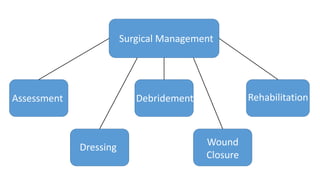
Surgical Management
Assessment
Dressing
Debridement
Wound
Closure
Rehabilitation
Assessment Dressing Debridement Wound Closure Rehabilitation
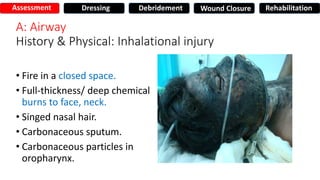
A: Airway
History & Physical: Inhalational injury
• Fire in a closed space.
• Full-thickness/ deep chemical
burns to face, neck.
• Singed nasal hair.
• Carbonaceous sputum.
• Carbonaceous particles in
oropharynx.
Assessment Dressing Debridement Wound Closure Rehabilitation
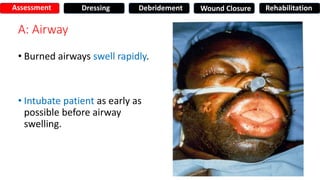
A: Airway
• Burned airways swell rapidly.
• Intubate patient as early as
possible before airway
swelling.
Assessment Dressing Debridement Wound Closure Rehabilitation
A: Airway
• Indications for intubation:
• Oropharyngeal erythema/ swelling on direct visualization.
• Change in voice, harsh cough.
• Stridor.
• Dyspnea, tachypnea.
Assessment Dressing Debridement Wound Closure Rehabilitation
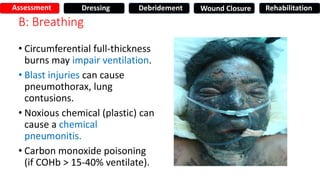
B: Breathing
• Circumferential full-thickness
burns may impair ventilation.
• Blast injuries can cause
pneumothorax, lung
contusions.
• Noxious chemical (plastic) can
cause a chemical
pneumonitis.
• Carbon monoxide poisoning
(if COHb > 15-40% ventilate).
Assessment Dressing Debridement Wound Closure Rehabilitation
C: Circulation
• BP, HR, color of unburnt skin
• 2 large bore I.V.s
• Draw blood sample
• Insert urinary catheter
• Insert nasogastric tube
• Clinical Examination of Extremities
• Doppler exam of circumferentially burnt extremities
Assessment Dressing Debridement Wound Closure Rehabilitation
Assessment Of Burns
• TBSA(Total body surface area)
• Decides fluid requirements and nutritional needs
• Wallace’s rule of nines
• Lund and Browder chart
• DEPTH
• Dictates local and surgical wound management
Assessment Dressing Debridement Wound Closure Rehabilitation
Assessment Of Burn Wound Depth
• Clinical-wound appearance, blanching, capillary return,
degree of fixed capillary staining, evaluation of retained light
touch and sensation
• Wound biopsy
• Measurement of tissue perfusion-Laser Doppler Flowmetry,
Indocyanine Green Video Angiography, Fluroscein
Fluoresecence
• Photooptical measurements—Reflection-optical
Multispectral Imaging, Fibreoptic Confocal Imaging,
Polarisation Sensitive Optical Coherence Tomography
• Thermography
• Radioisotopes and Nuclear Magnetic Resonance
Assessment Dressing Debridement Wound Closure Rehabilitation
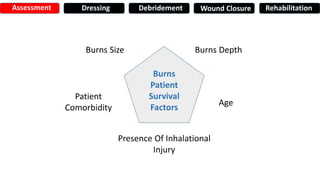
Burns
Patient
Survival
Factors
Burns Size Burns Depth
Age
Presence Of Inhalational
Injury
Patient
Comorbidity
Assessment Dressing Debridement Wound Closure Rehabilitation
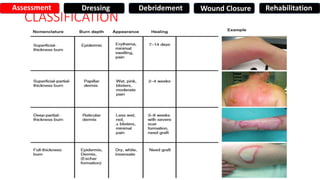
CLASSIFICATION
Assessment Dressing Debridement Wound Closure Rehabilitation
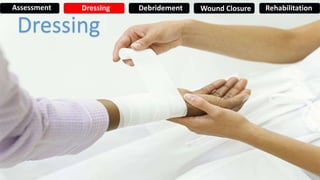
Dressing
Assessment Dressing Debridement Wound Closure Rehabilitation
Principles of dressing
• Full thickness and deep dermal burns require
antibacterial dressings to prevent infections prior to
surgery.
• Superficial burns require simple dressings as they heal
completely within 3 weeks
• Optimal dressings environment can make significant
difference in healing.
Assessment Dressing Debridement Wound Closure Rehabilitation
Healing
Prevent
Infection
Initial Focus
Assessment Dressing Debridement Wound Closure Rehabilitation
Tetanus
Prophylaxis
Assessment Dressing Debridement Wound Closure Rehabilitation
Debride Bullae
Excise Adherent Necrotic Tissue
Assessment Dressing Debridement Wound Closure Rehabilitation
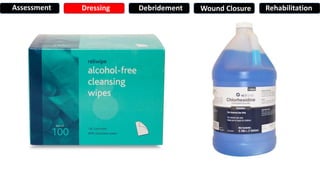
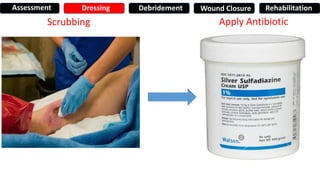
Scrubbing Apply Antibiotic
Assessment Dressing Debridement Wound Closure Rehabilitation
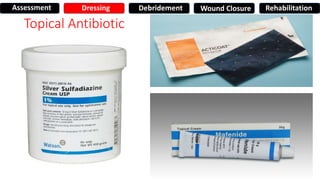
Topical Antibiotic
Assessment Dressing Debridement Wound Closure Rehabilitation
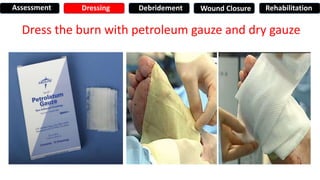
Dress the burn with petroleum gauze and dry gauze
Assessment Dressing Debridement Wound Closure Rehabilitation
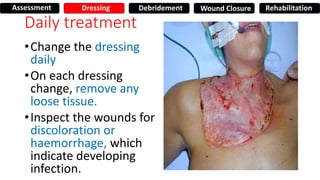
Daily treatment
•Change the dressing
daily
•On each dressing
change, remove any
loose tissue.
•Inspect the wounds for
discoloration or
haemorrhage, which
indicate developing
infection.
Assessment Dressing Debridement Wound Closure Rehabilitation
Types of Dressings For Different Degrees of
Burns
Superficial Burn
Protect the wound & Encourage
Re-epithelialization
• Topical Analgesic Cream
• Moisturising Cream
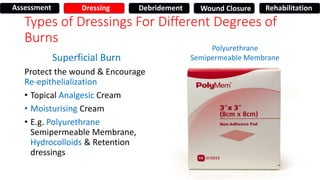
• E.g. Polyurethrane
Semipermeable Membrane,
Hydrocolloids & Retention
dressings
Polyurethrane
Semipermeable Membrane
Assessment Dressing Debridement Wound Closure Rehabilitation
Partial thickness burn
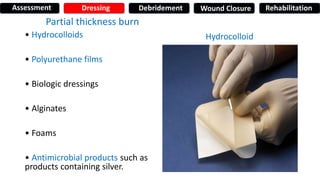
• Hydrocolloids
• Polyurethane films
• Biologic dressings
• Alginates
• Foams
• Antimicrobial products such as
products containing silver.
Hydrocolloid
Assessment Dressing Debridement Wound Closure Rehabilitation
Full thickness burn injuries
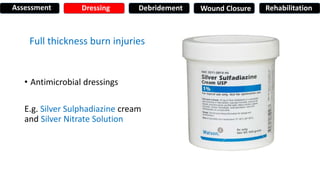
• Antimicrobial dressings
E.g. Silver Sulphadiazine cream
and Silver Nitrate Solution
Assessment Dressing Debridement Wound Closure Rehabilitation
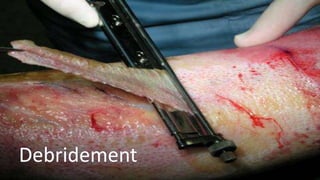
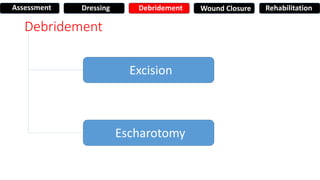
Debridement
Debridement
Excision
Escharotomy
Assessment Dressing Debridement Wound Closure Rehabilitation
Excision
Early excision Vs Delayed excision
• Always early excision if patient comes early enough and
facilities exist.
• Early enough is upto 72 hrs postburn
• Early excision decreases the chances of Sepsis and facilitates
early moblisation and better and more predictable functional
recovery.
• Delayed excision is generally at 3 weeks or later
Assessment Dressing Debridement Wound Closure Rehabilitation
Early Excision
• Within the first 3-5days
• After 5 days chances of Sepsis higher and bleeding more
• 15% of BSA is excised at a time
• Spaced apart (every 2 or 3 days)
• By one estimate excision of 1% burn area can result in 100
ccs blood loss
• The goal of early excision is to remove all de- vitalized tissue
and prepare the wound for skin grafting
Assessment Dressing Debridement Wound Closure Rehabilitation
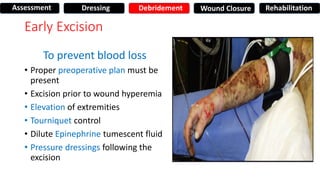
Early Excision
To prevent blood loss
• Proper preoperative plan must be
present
• Excision prior to wound hyperemia
• Elevation of extremities
• Tourniquet control
• Dilute Epinephrine tumescent fluid
• Pressure dressings following the
excision
Assessment Dressing Debridement Wound Closure Rehabilitation
Early Excision
•Indications:
• deep burns (dermal and
sub-dermal)
• significant size
• clinical diagnosis
•Surgical principles
• preservation of life
• prevention of infection
• conservation of viable
tissue
• maintenance of function
• timely closure
Assessment Dressing Debridement Wound Closure Rehabilitation
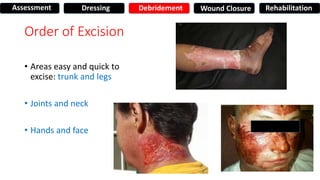
Order of Excision
• Areas easy and quick to
excise: trunk and legs
• Joints and neck
• Hands and face
Assessment Dressing Debridement Wound Closure Rehabilitation
Special Care
• Neck
• Eyelids
• Lips
• Ears
• Hand & fingers
• Perineum & Gentials
Assessment Dressing Debridement Wound Closure Rehabilitation
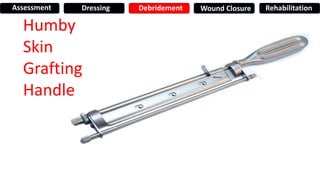
Humby
Skin
Grafting
Handle
Assessment Dressing Debridement Wound Closure Rehabilitation
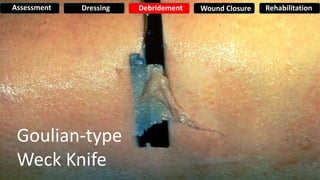
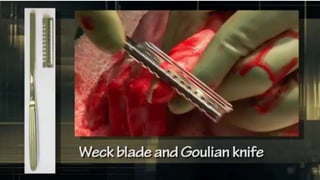
Goulian-type
Weck Knife
Assessment Dressing Debridement Wound Closure Rehabilitation
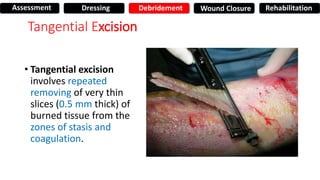
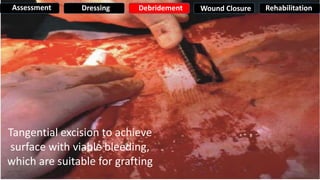
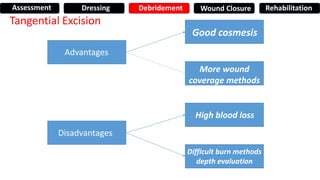
Tangential Excision
• Tangential excision
involves repeated
removing of very thin
slices (0.5 mm thick) of
burned tissue from the
zones of stasis and
coagulation.
Assessment Dressing Debridement Wound Closure Rehabilitation
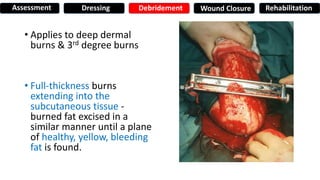
• Applies to deep dermal
burns & 3rd degree burns
• Full-thickness burns
extending into the
subcutaneous tissue -
burned fat excised in a
similar manner until a plane
of healthy, yellow, bleeding
fat is found.
Assessment Dressing Debridement Wound Closure Rehabilitation
Tangential excision to achieve
surface with viable bleeding,
which are suitable for grafting
Assessment Dressing Debridement Wound Closure Rehabilitation
Advantages
Disadvantages
Good cosmesis
More wound
coverage methods
High blood loss
Difficult burn methods
depth evaluation
Tangential Excision
Assessment Dressing Debridement Wound Closure Rehabilitation
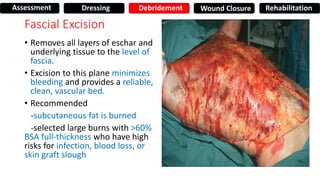
Fascial Excision
• Removes all layers of eschar and
underlying tissue to the level of
fascia.
• Excision to this plane minimizes
bleeding and provides a reliable,
clean, vascular bed.
• Recommended
-subcutaneous fat is burned
-selected large burns with >60%
BSA full-thickness who have high
risks for infection, blood loss, or
skin graft slough
Assessment Dressing Debridement Wound Closure Rehabilitation
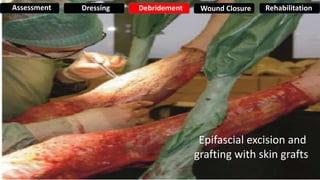
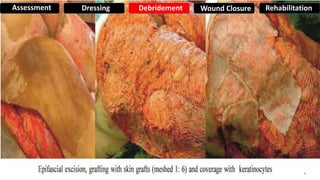
Epifascial excision and
grafting with skin grafts
Assessment Dressing Debridement Wound Closure Rehabilitation
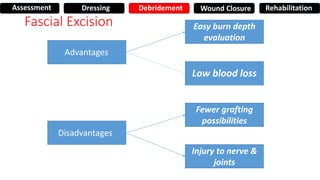
Fascial Excision
Advantages
Disadvantages
Easy burn depth
evaluation
Low blood loss
Fewer grafting
possibilities
Injury to nerve &
joints
Assessment Dressing Debridement Wound Closure Rehabilitation
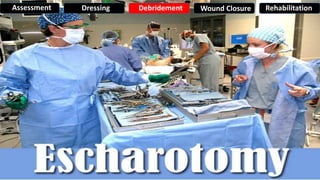
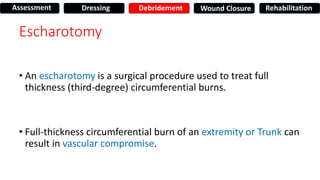
Escharotomy
• An escharotomy is a surgical procedure used to treat full
thickness (third-degree) circumferential burns.
• Full-thickness circumferential burn of an extremity or Trunk can
result in vascular compromise.
Assessment Dressing Debridement Wound Closure Rehabilitation
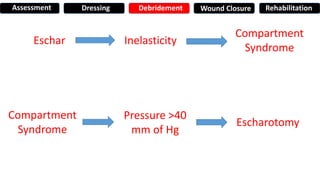
Eschar Inelasticity
Compartment
Syndrome
Compartment
Syndrome
Pressure >40
mm of Hg
Escharotomy
Assessment Dressing Debridement Wound Closure Rehabilitation
Indications
1. Pain on passive extension
2. Pallor
3. Paresthesia
4. Poikilothermia
5. Paresis
6. Pulselessness
Assessment Dressing Debridement Wound Closure Rehabilitation
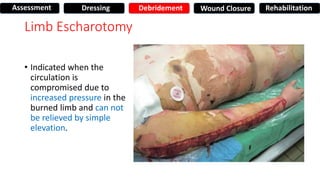
Limb Escharotomy
• Indicated when the
circulation is
compromised due to
increased pressure in the
burned limb and can not
be relieved by simple
elevation.
Assessment Dressing Debridement Wound Closure Rehabilitation
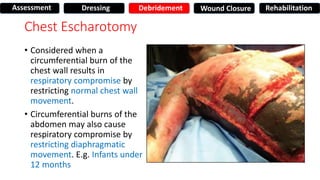
Chest Escharotomy
• Considered when a
circumferential burn of the
chest wall results in
respiratory compromise by
restricting normal chest wall
movement.
• Circumferential burns of the
abdomen may also cause
respiratory compromise by
restricting diaphragmatic
movement. E.g. Infants under
12 months
Assessment Dressing Debridement Wound Closure Rehabilitation
Escharotomy Procedure
Anasthesia for children, Sedative & Analgesic for
adults
Incision 1 cm into unburned healthy tissue where
possible.
Upper limb should be in the supine position and the lower limb in the
neutral position
Assessment Dressing Debridement Wound Closure Rehabilitation
Escharotomy Procedure (continued)
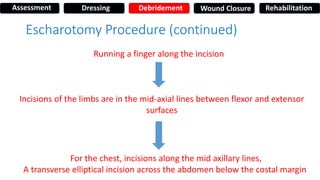
Incisions of the limbs are in the mid-axial lines between flexor and extensor
surfaces
For the chest, incisions along the mid axillary lines,
A transverse elliptical incision across the abdomen below the costal margin
Running a finger along the incision
Assessment Dressing Debridement Wound Closure Rehabilitation
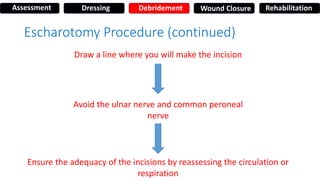
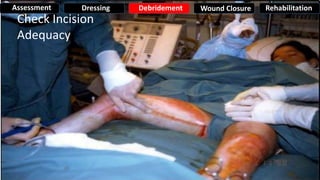
Ensure the adequacy of the incisions by reassessing the circulation or
respiration
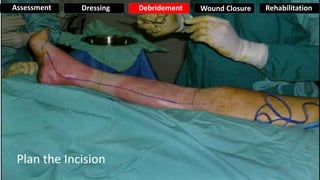
Draw a line where you will make the incision
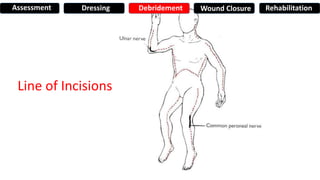
Avoid the ulnar nerve and common peroneal
nerve
Escharotomy Procedure (continued)
Assessment Dressing Debridement Wound Closure Rehabilitation
Line of Incisions
Assessment Dressing Debridement Wound Closure Rehabilitation
Plan the Incision
Assessment Dressing Debridement Wound Closure Rehabilitation
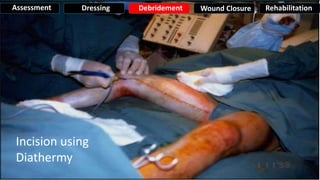
Incision using
Diathermy
Assessment Dressing Debridement Wound Closure Rehabilitation
Check Incision
Adequacy
Assessment Dressing Debridement Wound Closure Rehabilitation
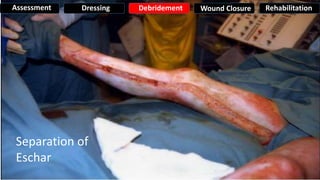
Separation of
Eschar
Assessment Dressing Debridement Wound Closure Rehabilitation
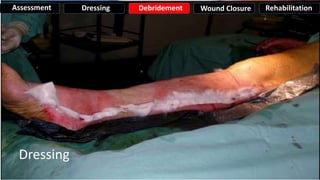
Dressing
Assessment Dressing Debridement Wound Closure Rehabilitation
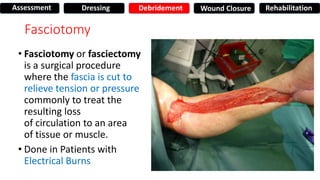
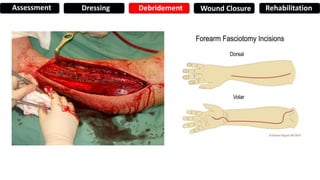
Fasciotomy
• Fasciotomy or fasciectomy
is a surgical procedure
where the fascia is cut to
relieve tension or pressure
commonly to treat the
resulting loss
of circulation to an area
of tissue or muscle.
• Done in Patients with
Electrical Burns
Assessment Dressing Debridement Wound Closure Rehabilitation
Wound Closure
• After excision the wound, there is wound closure.
• Goals:
• Reestablish barrier (epidermis) to prevent bacterial invasion and
evaporative water loss
• Reconstitute the dermis to provide durability, pliability and
acceptable cosmetics.
Assessment Dressing Debridement Wound Closure Rehabilitation
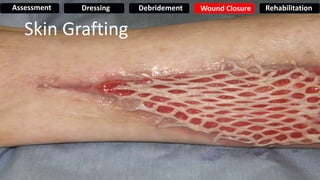
Skin Grafting
Assessment Dressing Debridement Wound Closure Rehabilitation
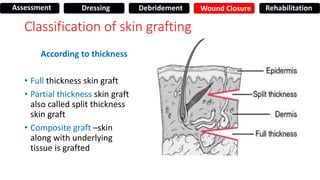
Classification of skin grafting
According to thickness
• Full thickness skin graft
• Partial thickness skin graft
also called split thickness
skin graft
• Composite graft –skin
along with underlying
tissue is grafted
Assessment Dressing Debridement Wound Closure Rehabilitation
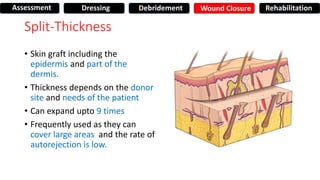
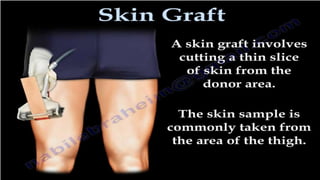
Split-Thickness
• Skin graft including the
epidermis and part of the
dermis.
• Thickness depends on the donor
site and needs of the patient
• Can expand upto 9 times
• Frequently used as they can
cover large areas and the rate of
autorejection is low.
Assessment Dressing Debridement Wound Closure Rehabilitation
Indications
• Immediate coverage of clean soft tissue defects
• Immediate coverage of burn defects
• Prevention of scar contracture.
Assessment Dressing Debridement Wound Closure Rehabilitation
Contraindications
• Need to place the graft in areas where good cosmesis
or durability is essential
• Significant wound contraction could compromise
function.
Assessment Dressing Debridement Wound Closure Rehabilitation
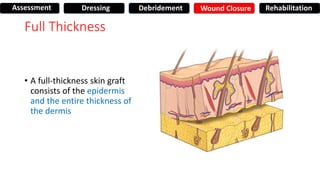
Full Thickness
• A full-thickness skin graft
consists of the epidermis
and the entire thickness of
the dermis
Assessment Dressing Debridement Wound Closure Rehabilitation
Indications
• Deep burn injuries
Assessment Dressing Debridement Wound Closure Rehabilitation
Contraindications
• Recipient bed cannot sustain the graft.
• On avascular tissues
• Uncontrolled bleeding in the recipient bed
Assessment Dressing Debridement Wound Closure Rehabilitation
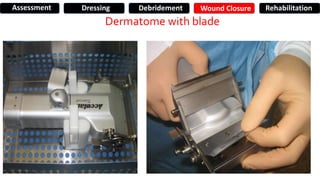
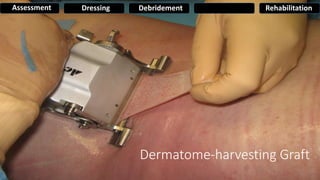
Dermatome with blade
Assessment Dressing Debridement Wound Closure Rehabilitation
Dermatome-harvesting Graft
Assessment Dressing Debridement Rehabilitation
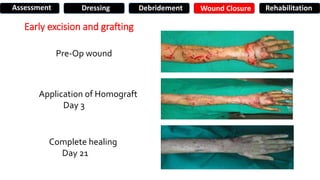
Early excision and grafting
Pre-Op wound
Application of Homograft
Day 3
Complete healing
Day 21
Assessment Dressing Debridement Wound Closure Rehabilitation
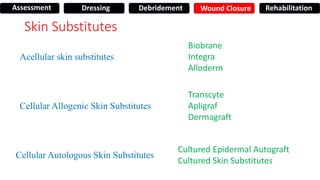
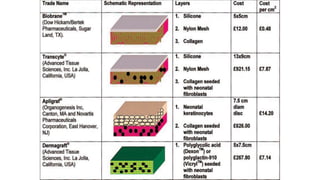
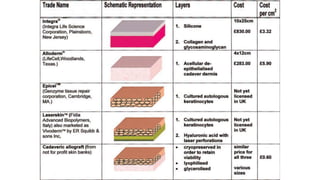
Skin Substitutes
Acellular skin substitutes
Cellular Allogenic Skin Substitutes
Cellular Autologous Skin Substitutes
Biobrane
Integra
Alloderm
Transcyte
Apligraf
Dermagraft
Cultured Epidermal Autograft
Cultured Skin Substitutes
Assessment Dressing Debridement Wound Closure Rehabilitation
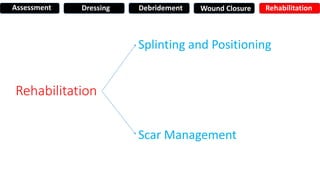
Rehabilitation
Splinting and Positioning
Scar Management
Assessment Dressing Debridement Wound Closure Rehabilitation
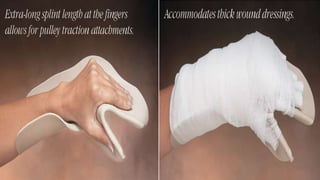
Splinting & Positioning
• Done to Prevent Contracture
• The positioning of the burn patient is vital in
bringing about the best functional outcomes in
rehabilitation
• Begin immediately after the injury occurs
• Positioning should be designed for the specific
individual’s needs
• Should not compromise mobility and function
Assessment Dressing Debridement Wound Closure Rehabilitation
Types Of Splinting
Primary Splints
• acute phase and pre
grafting period
• used to position the
involved joints during
sleep, inactivity, or periods
of unresponsiveness.
Postural Splints
• Immediate post graft
phase
• Worn continuously for 5 to
14 days until the graft is
secure.
Assessment Dressing Debridement Wound Closure Rehabilitation
Follow up Splints:
• Chronic phase of burn care begins with wound closure.
• Dynamic splints (movable parts) are used to increase function.
• Provide slow steady force to stretch a skin contracture, or provide
resistive force for exercise.
Assessment Dressing Debridement Wound Closure Rehabilitation
Positioning Must Be
Designed In A Way That It:
• Reduces edema
• Maintains joint
alignment
• Maintains tissues
elongated
• Prevents contracture
formation
• Promotes wound healing
• Relieves pressure
• Protects joints, exposed
tendons and new
grafts/flaps
Assessment Dressing Debridement Wound Closure Rehabilitation
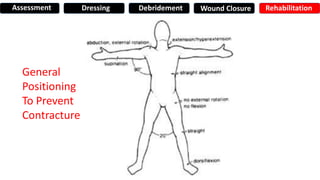
General
Positioning
To Prevent
Contracture
Assessment Dressing Debridement Wound Closure Rehabilitation
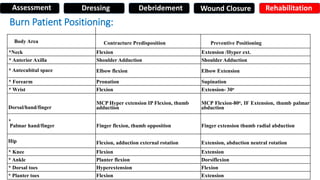
Burn Patient Positioning:
Body Area Contracture Predisposition Preventive Positioning
*Neck Flexion Extension /Hyper ext.
* Anterior Axilla Shoulder Adduction Shoulder Adduction
* Antecubital space Elbow flexion Elbow Extension
* Forearm Pronation Supination
* Wrist Flexion Extension- 30o
Dorsal/hand/finger
MCP Hyper extension IP Flexion, thumb
adduction
MCP Flexion-80o, IF Extension, thumb palmar
abduction
*
Palmar hand/finger Finger flexion, thumb opposition Finger extension thumb radial abduction
Hip Flexion, adduction external rotation Extension, abduction neutral rotation
* Knee Flexion Extension
* Ankle Planter flexion Dorsiflexion
* Dorsal toes Hyperextension Flexion
* Planter toes Flexion Extension
Assessment Dressing Debridement Wound Closure Rehabilitation
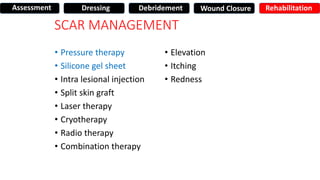
SCAR MANAGEMENT
• Pressure therapy
• Silicone gel sheet
• Intra lesional injection
• Split skin graft
• Laser therapy
• Cryotherapy
• Radio therapy
• Combination therapy
• Elevation
• Itching
• Redness
Assessment Dressing Debridement Wound Closure Rehabilitation
Anesthesiologist in Management of Burns
• Initial resuscitation of burns
• ICU management - sepsis/MOF
• General Anesthesia
-Early debridement
-Excision of granulation tissue/Skin Graft
-Change of Dressings
-Reconstructive plastic surgery: Post Burn Contracture
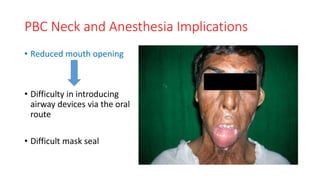
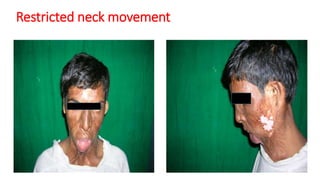
PBC Neck and Anesthesia Implications
• Reduced mouth opening
• Difficulty in introducing
airway devices via the oral
route
• Difficult mask seal
Restricted neck movement
Acknowledgement
•Dr. Pawan Chumbale
•Dr. Nikhil Panse
•Dr. kalpana kelkar
•Dr. Surekha Shinde
Biblography
•The New England Journal Of Medicine
•Schwartz Manual Of Surgery
•Wikipedia
•Medsacpe
THANK YOU

BURNS: Surgical Management

  • 1.
    Alhad Naragude Final YearM.B.B.S [BJMC PUNE] Guided By Dr. Pawan Chumbale M.S, MCh Plastic Surgery [SASSOON HOSPITAL, PUNE] BURNS
  • 2.
  • 3.
    Assessment Dressing DebridementWound Closure Rehabilitation
  • 4.
    A: Airway History &Physical: Inhalational injury • Fire in a closed space. • Full-thickness/ deep chemical burns to face, neck. • Singed nasal hair. • Carbonaceous sputum. • Carbonaceous particles in oropharynx. Assessment Dressing Debridement Wound Closure Rehabilitation
  • 5.
    A: Airway • Burnedairways swell rapidly. • Intubate patient as early as possible before airway swelling. Assessment Dressing Debridement Wound Closure Rehabilitation
  • 6.
    A: Airway • Indicationsfor intubation: • Oropharyngeal erythema/ swelling on direct visualization. • Change in voice, harsh cough. • Stridor. • Dyspnea, tachypnea. Assessment Dressing Debridement Wound Closure Rehabilitation
  • 7.
    B: Breathing • Circumferentialfull-thickness burns may impair ventilation. • Blast injuries can cause pneumothorax, lung contusions. • Noxious chemical (plastic) can cause a chemical pneumonitis. • Carbon monoxide poisoning (if COHb > 15-40% ventilate). Assessment Dressing Debridement Wound Closure Rehabilitation
  • 8.
    C: Circulation • BP,HR, color of unburnt skin • 2 large bore I.V.s • Draw blood sample • Insert urinary catheter • Insert nasogastric tube • Clinical Examination of Extremities • Doppler exam of circumferentially burnt extremities Assessment Dressing Debridement Wound Closure Rehabilitation
  • 9.
    Assessment Of Burns •TBSA(Total body surface area) • Decides fluid requirements and nutritional needs • Wallace’s rule of nines • Lund and Browder chart • DEPTH • Dictates local and surgical wound management Assessment Dressing Debridement Wound Closure Rehabilitation
  • 10.
    Assessment Of BurnWound Depth • Clinical-wound appearance, blanching, capillary return, degree of fixed capillary staining, evaluation of retained light touch and sensation • Wound biopsy • Measurement of tissue perfusion-Laser Doppler Flowmetry, Indocyanine Green Video Angiography, Fluroscein Fluoresecence • Photooptical measurements—Reflection-optical Multispectral Imaging, Fibreoptic Confocal Imaging, Polarisation Sensitive Optical Coherence Tomography • Thermography • Radioisotopes and Nuclear Magnetic Resonance Assessment Dressing Debridement Wound Closure Rehabilitation
  • 11.
    Burns Patient Survival Factors Burns Size BurnsDepth Age Presence Of Inhalational Injury Patient Comorbidity Assessment Dressing Debridement Wound Closure Rehabilitation
  • 12.
  • 13.
    Dressing Assessment Dressing DebridementWound Closure Rehabilitation
  • 14.
    Principles of dressing •Full thickness and deep dermal burns require antibacterial dressings to prevent infections prior to surgery. • Superficial burns require simple dressings as they heal completely within 3 weeks • Optimal dressings environment can make significant difference in healing. Assessment Dressing Debridement Wound Closure Rehabilitation
  • 15.
    Healing Prevent Infection Initial Focus Assessment DressingDebridement Wound Closure Rehabilitation
  • 16.
  • 17.
    Debride Bullae Excise AdherentNecrotic Tissue Assessment Dressing Debridement Wound Closure Rehabilitation
  • 18.
    Assessment Dressing DebridementWound Closure Rehabilitation
  • 19.
    Scrubbing Apply Antibiotic AssessmentDressing Debridement Wound Closure Rehabilitation
  • 20.
    Topical Antibiotic Assessment DressingDebridement Wound Closure Rehabilitation
  • 21.
    Dress the burnwith petroleum gauze and dry gauze Assessment Dressing Debridement Wound Closure Rehabilitation
  • 22.
    Daily treatment •Change thedressing daily •On each dressing change, remove any loose tissue. •Inspect the wounds for discoloration or haemorrhage, which indicate developing infection. Assessment Dressing Debridement Wound Closure Rehabilitation
  • 23.
    Types of DressingsFor Different Degrees of Burns Superficial Burn Protect the wound & Encourage Re-epithelialization • Topical Analgesic Cream • Moisturising Cream • E.g. Polyurethrane Semipermeable Membrane, Hydrocolloids & Retention dressings Polyurethrane Semipermeable Membrane Assessment Dressing Debridement Wound Closure Rehabilitation
  • 24.
    Partial thickness burn •Hydrocolloids • Polyurethane films • Biologic dressings • Alginates • Foams • Antimicrobial products such as products containing silver. Hydrocolloid Assessment Dressing Debridement Wound Closure Rehabilitation
  • 25.
    Full thickness burninjuries • Antimicrobial dressings E.g. Silver Sulphadiazine cream and Silver Nitrate Solution Assessment Dressing Debridement Wound Closure Rehabilitation
  • 26.
  • 27.
  • 28.
    Excision Early excision VsDelayed excision • Always early excision if patient comes early enough and facilities exist. • Early enough is upto 72 hrs postburn • Early excision decreases the chances of Sepsis and facilitates early moblisation and better and more predictable functional recovery. • Delayed excision is generally at 3 weeks or later Assessment Dressing Debridement Wound Closure Rehabilitation
  • 29.
    Early Excision • Withinthe first 3-5days • After 5 days chances of Sepsis higher and bleeding more • 15% of BSA is excised at a time • Spaced apart (every 2 or 3 days) • By one estimate excision of 1% burn area can result in 100 ccs blood loss • The goal of early excision is to remove all de- vitalized tissue and prepare the wound for skin grafting Assessment Dressing Debridement Wound Closure Rehabilitation
  • 30.
    Early Excision To preventblood loss • Proper preoperative plan must be present • Excision prior to wound hyperemia • Elevation of extremities • Tourniquet control • Dilute Epinephrine tumescent fluid • Pressure dressings following the excision Assessment Dressing Debridement Wound Closure Rehabilitation
  • 31.
    Early Excision •Indications: • deepburns (dermal and sub-dermal) • significant size • clinical diagnosis •Surgical principles • preservation of life • prevention of infection • conservation of viable tissue • maintenance of function • timely closure Assessment Dressing Debridement Wound Closure Rehabilitation
  • 32.
    Order of Excision •Areas easy and quick to excise: trunk and legs • Joints and neck • Hands and face Assessment Dressing Debridement Wound Closure Rehabilitation
  • 33.
    Special Care • Neck •Eyelids • Lips • Ears • Hand & fingers • Perineum & Gentials Assessment Dressing Debridement Wound Closure Rehabilitation
  • 34.
  • 35.
    Goulian-type Weck Knife Assessment DressingDebridement Wound Closure Rehabilitation
  • 36.
    Tangential Excision • Tangentialexcision involves repeated removing of very thin slices (0.5 mm thick) of burned tissue from the zones of stasis and coagulation. Assessment Dressing Debridement Wound Closure Rehabilitation
  • 37.
    • Applies todeep dermal burns & 3rd degree burns • Full-thickness burns extending into the subcutaneous tissue - burned fat excised in a similar manner until a plane of healthy, yellow, bleeding fat is found. Assessment Dressing Debridement Wound Closure Rehabilitation
  • 39.
    Tangential excision toachieve surface with viable bleeding, which are suitable for grafting Assessment Dressing Debridement Wound Closure Rehabilitation
  • 40.
    Advantages Disadvantages Good cosmesis More wound coveragemethods High blood loss Difficult burn methods depth evaluation Tangential Excision Assessment Dressing Debridement Wound Closure Rehabilitation
  • 41.
    Fascial Excision • Removesall layers of eschar and underlying tissue to the level of fascia. • Excision to this plane minimizes bleeding and provides a reliable, clean, vascular bed. • Recommended -subcutaneous fat is burned -selected large burns with >60% BSA full-thickness who have high risks for infection, blood loss, or skin graft slough Assessment Dressing Debridement Wound Closure Rehabilitation
  • 42.
    Epifascial excision and graftingwith skin grafts Assessment Dressing Debridement Wound Closure Rehabilitation
  • 43.
    Assessment Dressing DebridementWound Closure Rehabilitation
  • 44.
    Fascial Excision Advantages Disadvantages Easy burndepth evaluation Low blood loss Fewer grafting possibilities Injury to nerve & joints Assessment Dressing Debridement Wound Closure Rehabilitation
  • 45.
    Assessment Dressing DebridementWound Closure Rehabilitation
  • 46.
    Escharotomy • An escharotomyis a surgical procedure used to treat full thickness (third-degree) circumferential burns. • Full-thickness circumferential burn of an extremity or Trunk can result in vascular compromise. Assessment Dressing Debridement Wound Closure Rehabilitation
  • 47.
    Eschar Inelasticity Compartment Syndrome Compartment Syndrome Pressure >40 mmof Hg Escharotomy Assessment Dressing Debridement Wound Closure Rehabilitation
  • 48.
    Indications 1. Pain onpassive extension 2. Pallor 3. Paresthesia 4. Poikilothermia 5. Paresis 6. Pulselessness Assessment Dressing Debridement Wound Closure Rehabilitation
  • 49.
    Limb Escharotomy • Indicatedwhen the circulation is compromised due to increased pressure in the burned limb and can not be relieved by simple elevation. Assessment Dressing Debridement Wound Closure Rehabilitation
  • 50.
    Chest Escharotomy • Consideredwhen a circumferential burn of the chest wall results in respiratory compromise by restricting normal chest wall movement. • Circumferential burns of the abdomen may also cause respiratory compromise by restricting diaphragmatic movement. E.g. Infants under 12 months Assessment Dressing Debridement Wound Closure Rehabilitation
  • 51.
    Escharotomy Procedure Anasthesia forchildren, Sedative & Analgesic for adults Incision 1 cm into unburned healthy tissue where possible. Upper limb should be in the supine position and the lower limb in the neutral position Assessment Dressing Debridement Wound Closure Rehabilitation
  • 52.
    Escharotomy Procedure (continued) Incisionsof the limbs are in the mid-axial lines between flexor and extensor surfaces For the chest, incisions along the mid axillary lines, A transverse elliptical incision across the abdomen below the costal margin Running a finger along the incision Assessment Dressing Debridement Wound Closure Rehabilitation
  • 53.
    Ensure the adequacyof the incisions by reassessing the circulation or respiration Draw a line where you will make the incision Avoid the ulnar nerve and common peroneal nerve Escharotomy Procedure (continued) Assessment Dressing Debridement Wound Closure Rehabilitation
  • 54.
    Line of Incisions AssessmentDressing Debridement Wound Closure Rehabilitation
  • 55.
    Plan the Incision AssessmentDressing Debridement Wound Closure Rehabilitation
  • 56.
    Incision using Diathermy Assessment DressingDebridement Wound Closure Rehabilitation
  • 57.
    Check Incision Adequacy Assessment DressingDebridement Wound Closure Rehabilitation
  • 58.
    Separation of Eschar Assessment DressingDebridement Wound Closure Rehabilitation
  • 59.
    Dressing Assessment Dressing DebridementWound Closure Rehabilitation
  • 60.
    Fasciotomy • Fasciotomy orfasciectomy is a surgical procedure where the fascia is cut to relieve tension or pressure commonly to treat the resulting loss of circulation to an area of tissue or muscle. • Done in Patients with Electrical Burns Assessment Dressing Debridement Wound Closure Rehabilitation
  • 61.
    Assessment Dressing DebridementWound Closure Rehabilitation
  • 62.
    Wound Closure • Afterexcision the wound, there is wound closure. • Goals: • Reestablish barrier (epidermis) to prevent bacterial invasion and evaporative water loss • Reconstitute the dermis to provide durability, pliability and acceptable cosmetics. Assessment Dressing Debridement Wound Closure Rehabilitation
  • 63.
    Skin Grafting Assessment DressingDebridement Wound Closure Rehabilitation
  • 64.
    Classification of skingrafting According to thickness • Full thickness skin graft • Partial thickness skin graft also called split thickness skin graft • Composite graft –skin along with underlying tissue is grafted Assessment Dressing Debridement Wound Closure Rehabilitation
  • 65.
    Split-Thickness • Skin graftincluding the epidermis and part of the dermis. • Thickness depends on the donor site and needs of the patient • Can expand upto 9 times • Frequently used as they can cover large areas and the rate of autorejection is low. Assessment Dressing Debridement Wound Closure Rehabilitation
  • 66.
    Indications • Immediate coverageof clean soft tissue defects • Immediate coverage of burn defects • Prevention of scar contracture. Assessment Dressing Debridement Wound Closure Rehabilitation
  • 67.
    Contraindications • Need toplace the graft in areas where good cosmesis or durability is essential • Significant wound contraction could compromise function. Assessment Dressing Debridement Wound Closure Rehabilitation
  • 68.
    Full Thickness • Afull-thickness skin graft consists of the epidermis and the entire thickness of the dermis Assessment Dressing Debridement Wound Closure Rehabilitation
  • 69.
    Indications • Deep burninjuries Assessment Dressing Debridement Wound Closure Rehabilitation
  • 70.
    Contraindications • Recipient bedcannot sustain the graft. • On avascular tissues • Uncontrolled bleeding in the recipient bed Assessment Dressing Debridement Wound Closure Rehabilitation
  • 71.
    Dermatome with blade AssessmentDressing Debridement Wound Closure Rehabilitation
  • 72.
  • 74.
    Early excision andgrafting Pre-Op wound Application of Homograft Day 3 Complete healing Day 21 Assessment Dressing Debridement Wound Closure Rehabilitation
  • 75.
    Skin Substitutes Acellular skinsubstitutes Cellular Allogenic Skin Substitutes Cellular Autologous Skin Substitutes Biobrane Integra Alloderm Transcyte Apligraf Dermagraft Cultured Epidermal Autograft Cultured Skin Substitutes Assessment Dressing Debridement Wound Closure Rehabilitation
  • 78.
    Assessment Dressing DebridementWound Closure Rehabilitation
  • 79.
    Rehabilitation Splinting and Positioning ScarManagement Assessment Dressing Debridement Wound Closure Rehabilitation
  • 80.
    Splinting & Positioning •Done to Prevent Contracture • The positioning of the burn patient is vital in bringing about the best functional outcomes in rehabilitation • Begin immediately after the injury occurs • Positioning should be designed for the specific individual’s needs • Should not compromise mobility and function Assessment Dressing Debridement Wound Closure Rehabilitation
  • 81.
    Types Of Splinting PrimarySplints • acute phase and pre grafting period • used to position the involved joints during sleep, inactivity, or periods of unresponsiveness. Postural Splints • Immediate post graft phase • Worn continuously for 5 to 14 days until the graft is secure. Assessment Dressing Debridement Wound Closure Rehabilitation
  • 82.
    Follow up Splints: •Chronic phase of burn care begins with wound closure. • Dynamic splints (movable parts) are used to increase function. • Provide slow steady force to stretch a skin contracture, or provide resistive force for exercise. Assessment Dressing Debridement Wound Closure Rehabilitation
  • 84.
    Positioning Must Be DesignedIn A Way That It: • Reduces edema • Maintains joint alignment • Maintains tissues elongated • Prevents contracture formation • Promotes wound healing • Relieves pressure • Protects joints, exposed tendons and new grafts/flaps Assessment Dressing Debridement Wound Closure Rehabilitation
  • 85.
  • 86.
    Burn Patient Positioning: BodyArea Contracture Predisposition Preventive Positioning *Neck Flexion Extension /Hyper ext. * Anterior Axilla Shoulder Adduction Shoulder Adduction * Antecubital space Elbow flexion Elbow Extension * Forearm Pronation Supination * Wrist Flexion Extension- 30o Dorsal/hand/finger MCP Hyper extension IP Flexion, thumb adduction MCP Flexion-80o, IF Extension, thumb palmar abduction * Palmar hand/finger Finger flexion, thumb opposition Finger extension thumb radial abduction Hip Flexion, adduction external rotation Extension, abduction neutral rotation * Knee Flexion Extension * Ankle Planter flexion Dorsiflexion * Dorsal toes Hyperextension Flexion * Planter toes Flexion Extension Assessment Dressing Debridement Wound Closure Rehabilitation
  • 87.
    SCAR MANAGEMENT • Pressuretherapy • Silicone gel sheet • Intra lesional injection • Split skin graft • Laser therapy • Cryotherapy • Radio therapy • Combination therapy • Elevation • Itching • Redness Assessment Dressing Debridement Wound Closure Rehabilitation
  • 88.
    Anesthesiologist in Managementof Burns • Initial resuscitation of burns • ICU management - sepsis/MOF • General Anesthesia -Early debridement -Excision of granulation tissue/Skin Graft -Change of Dressings -Reconstructive plastic surgery: Post Burn Contracture
  • 89.
    PBC Neck andAnesthesia Implications • Reduced mouth opening • Difficulty in introducing airway devices via the oral route • Difficult mask seal
  • 90.
  • 91.
    Acknowledgement •Dr. Pawan Chumbale •Dr.Nikhil Panse •Dr. kalpana kelkar •Dr. Surekha Shinde
  • 92.
    Biblography •The New EnglandJournal Of Medicine •Schwartz Manual Of Surgery •Wikipedia •Medsacpe
  • 93.