DRYING
Dr. Ibtihal O. Alkarim
Definition
Dr. Ibtihal O. Alkarim
 Vaporization and removal of water and/or other
liquid from a solution, suspension or other
solid-liquid mixture to form a dry solid.
DON’T CONFUSED DRYING WITH
EVAPORIZATION
 EVAPORIZATION is
more often applied to
the concentration of
solution.
 But drying associated
with the removal of
relatively small
quantities of liquid to
give a dry product. Dr. Ibtihal O. Alkarim
IMPORTANCE
Dr. Ibtihal O. Alkarim
1. Preservation
2. Preliminary to size reduction
3. Improve Properties of final product
4. eliminate moisture which may lead to corrosion and
decrease the product or drug stability.
5. good properties of a material, e.g. flow-ability,
compressibility.
6. reduce the cost of transportation of large volume materials
(liquids)
7. material easy or more suitable for handling.
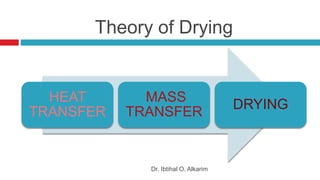
Theory of Drying
Dr. Ibtihal O. Alkarim
HEAT
TRANSFER
MASS
TRANSFER
DRYING
Dr. Ibtihal O. Alkarim
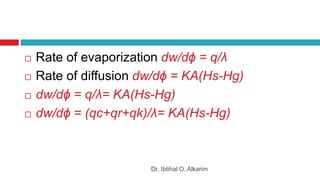
 Rate of evaporization dw/dϕ = q/λ
 Rate of diffusion dw/dϕ = KA(Hs-Hg)
 dw/dϕ = q/λ= KA(Hs-Hg)
 dw/dϕ = (qc+qr+qk)/λ= KA(Hs-Hg)
GENERAL PRINCIPLES
Dr. Ibtihal O. Alkarim
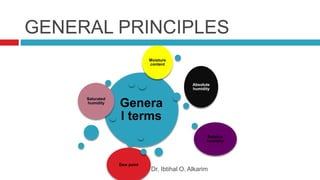
Genera
l terms
Saturated
humidity
Absolute
humidity
Relative
humidity
Dew point
Moisture
content
GENERAL PRINCIPLES
Dr. Ibtihal O. Alkarim
 ABSOLUTE HUMIDITY: weight of water vapor per
unit weight of dry air.
 SATURATION HUMIDITY: is the absolute
humidity at which the partial pressure of water
vapor in the air is equal to the vapor pressure of
free water at the same temperature.
 RELATIVE HUMIDITY: expresses the degree of
saturation
PRINCIPLES…
Dr. Ibtihal O. Alkarim
 MOISTURE CONTENT: usually determined by
measuring the los of weight of a sample when
heated in an oven
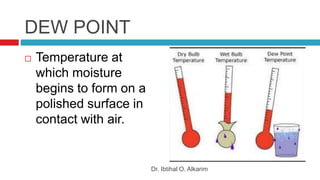
 DEW POINT: is temperature to which a given
mixture of air and water vapor must be cooled
to became saturated.
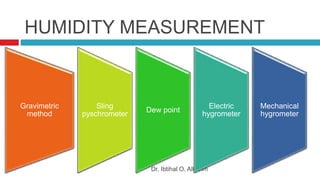
HUMIDITY MEASUREMENT
Dr. Ibtihal O. Alkarim
Gravimetric
method
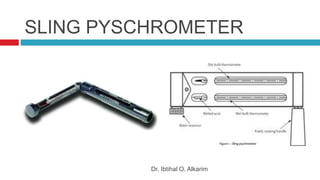
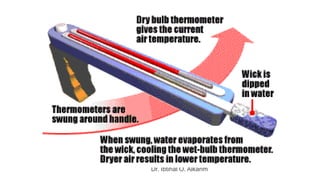
Sling
pyschrometer
Dew point
Electric
hygrometer
Mechanical
hygrometer
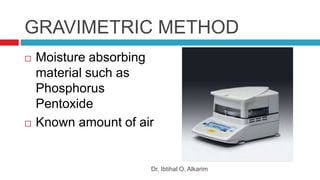
GRAVIMETRIC METHOD
 Moisture absorbing
material such as
Phosphorus
Pentoxide
 Known amount of air
Dr. Ibtihal O. Alkarim
SLING PYSCHROMETER
Dr. Ibtihal O. Alkarim
DEW POINT
 Temperature at
which moisture
begins to form on a
polished surface in
contact with air.
Dr. Ibtihal O. Alkarim
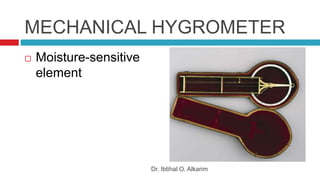
MECHANICAL HYGROMETER
 Moisture-sensitive
element
Dr. Ibtihal O. Alkarim
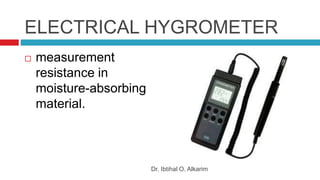
ELECTRICAL HYGROMETER
 measurement
resistance in
moisture-absorbing
material.
Dr. Ibtihal O. Alkarim
Equilibrium moisture content
(E.M.C)
 Exposure to air at a
definite temperature
and humidity will
cause a material to
lose or gain moisture
until an E.M.C is
attained.
 Starch /Talc
 OVERDRYING!!!!! Dr. Ibtihal O. Alkarim
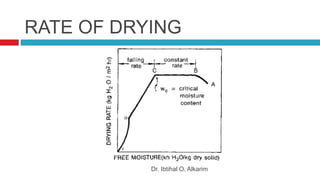
RATE OF DRYING
Dr. Ibtihal O. Alkarim
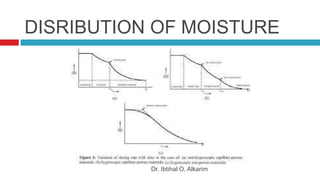
 A-B initial adjustment
 B-C constant rate period
 C-D first falling rate period
 D-E second falling rate period
DISRIBUTION OF MOISTURE
Dr. Ibtihal O. Alkarim
DISRIBUTION OF MOISTURE
Dr. Ibtihal O. Alkarim
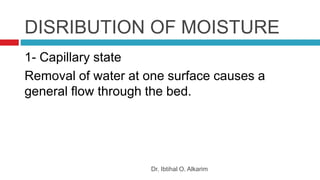
1- Capillary state
Removal of water at one surface causes a
general flow through the bed.
DISRIBUTION OF MOISTURE….
Dr. Ibtihal O. Alkarim
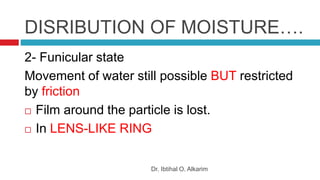
2- Funicular state
Movement of water still possible BUT restricted
by friction
 Film around the particle is lost.
 In LENS-LIKE RING
DISRIBUTION OF MOISTURE…
Dr. Ibtihal O. Alkarim
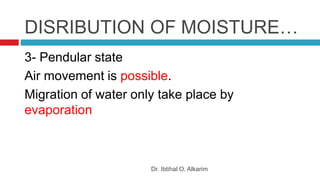
3- Pendular state
Air movement is possible.
Migration of water only take place by
evaporation
CLASSIFICATION OF DRYERS
Dr. Ibtihal O. Alkarim
Nature of material
Absence or presence of agitation
BASED ON THE METHOD OF SOLID
HANDELING
Dr. Ibtihal O. Alkarim
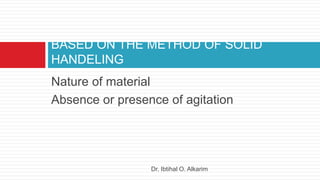
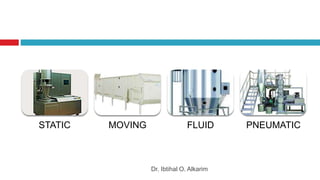
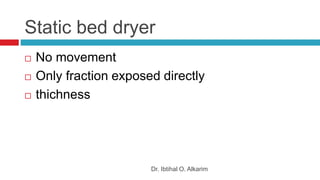
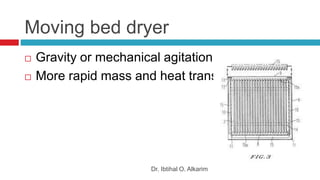
STATIC MOVING FLUID PNEUMATIC
Static bed dryer
Dr. Ibtihal O. Alkarim
 No movement
 Only fraction exposed directly
 thichness
Moving bed dryer
Dr. Ibtihal O. Alkarim
 Gravity or mechanical agitation
 More rapid mass and heat transfer
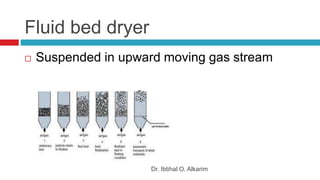
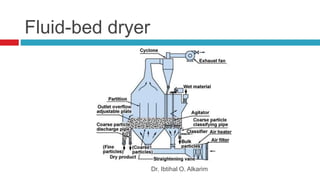
Fluid bed dryer
Dr. Ibtihal O. Alkarim
 Suspended in upward moving gas stream
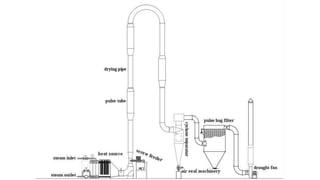
Pneumatic bed dryer
Dr. Ibtihal O. Alkarim
 Entrain and conveyed in high velocity gas
stream
 Very rapid mass and heat transfer
 Shortening drying time
Dr. Ibtihal O. Alkarim
Demonstrate major differences in dryer
design, operation, and energy
requirement
BASED ON METHOD OF HEAT
TRANSFER
Dr. Ibtihal O. Alkarim
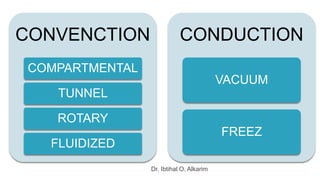
CONVENCTION
COMPARTMENTAL
TUNNEL
ROTARY
FLUIDIZED
CONDUCTION
VACUUM
FREEZ
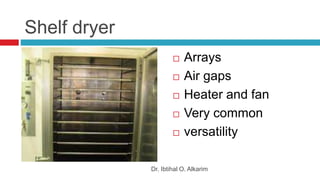
Shelf dryer
 Arrays
 Air gaps
 Heater and fan
 Very common
 versatility
Dr. Ibtihal O. Alkarim
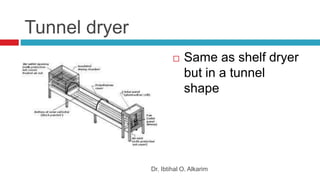
Tunnel dryer
 Same as shelf dryer
but in a tunnel
shape
Dr. Ibtihal O. Alkarim
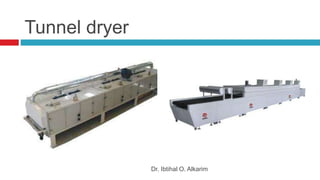
Tunnel dryer
Dr. Ibtihal O. Alkarim
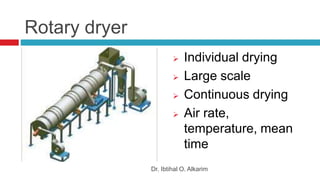
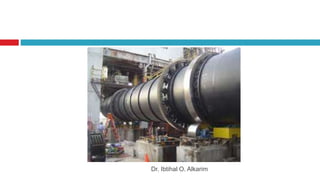
Rotary dryer
 Individual drying
 Large scale
 Continuous drying
 Air rate,
temperature, mean
time
Dr. Ibtihal O. Alkarim
Fluid-bed dryer
Dr. Ibtihal O. Alkarim
Fluid-bed dryer
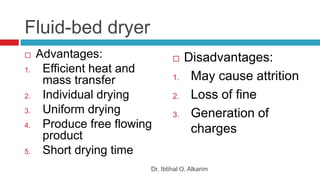
 Advantages:
1. Efficient heat and
mass transfer
2. Individual drying
3. Uniform drying
4. Produce free flowing
product
5. Short drying time
 Disadvantages:
1. May cause attrition
2. Loss of fine
3. Generation of
charges
Dr. Ibtihal O. Alkarim
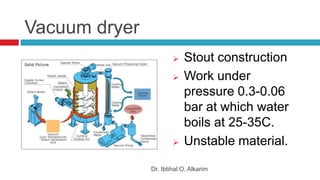
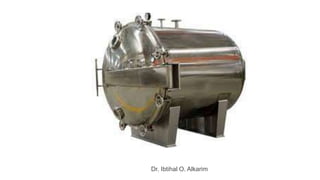
Vacuum dryer
 Stout construction
 Work under
pressure 0.3-0.06
bar at which water
boils at 25-35C.
 Unstable material.
Dr. Ibtihal O. Alkarim
Freeze dryer
Dr. Ibtihal O. Alkarim

Drying