


Fluid and electrolyte imbalance MONIKA NANDA 20/2/2009
Things to consider: Normal changes in TBW, ECF Changes in salt and water balance Normal changes in renal function Insensible water losses
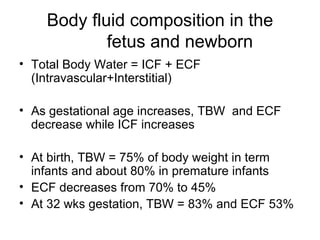
Body fluid composition in the   fetus and newborn Total Body Water = ICF + ECF (Intravascular+Interstitial) As gestational age increases, TBW  and ECF decrease while ICF increases At birth, TBW = 75% of body weight in term infants and about 80% in premature infants ECF decreases from 70% to 45% At 32 wks gestation, TBW = 83% and ECF 53%
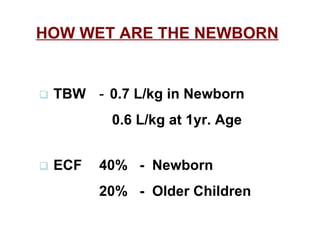
HOW WET ARE THE NEWBORN        TBW   -   0.7 L/kg in Newborn   0.6 L/kg at 1yr. Age        ECF 40%  -  Newborn 20%  -  Older Children
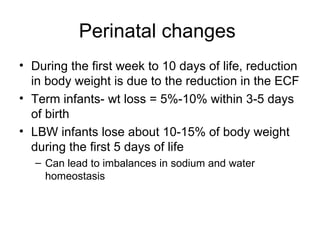
Perinatal changes  During the first week to 10 days of life, reduction in body weight is due to the reduction in the ECF Term infants- wt loss = 5%-10% within 3-5 days of birth LBW infants lose about 10-15% of body weight during the first 5 days of life Can lead to imbalances in sodium and water homeostasis
Sodium balance in    the  newborn Renal  sodium losses are inversely proportional to gestational age Term infants have Fractional excretion of sodium = 1% with transient increases on day 2 and  At 28 weeks- Fractional excretion of Sodium = 5% to 6% Preterm infants <35wks display negative sodium balance and hyponatremia during first 2-3 wks of life
Sodium balance in the   newborn Preterm infants may need 4-5mEq/kg of sodium per day to offset high renal losses Increased urinary sodium losses hypoxia  respiratory distress  hyperbilirubinemia  ATN  polycythemia  diuretics.
Sodium balance in the   newborn  Pharmacologic agents like dopamine,  increase urinary sodium losses Fetal and postnatal kidneys exhibit diminished responsiveness to aldosterone compared to adult kidneys
Water balance in the newborn Primarily controlled by ADH which enables water to be reabsorbed by the distal nephron collecting duct Stimulation of ADH occurs when blood volume is diminished or when serum osmolality increases above 285mOsm/kg Intravascular volume has a greater influence on ADH secretion than serum osmolality
Renal concentration and diluting capacity Adults can concentrate urine up to 1500mOsm/kg of plasma water and dilute as low as 50mOsm/kg of plasma water Concentrating capacity is 800 mOsm/kg in term infants and 600 mOsm/kg in preterm Diluting capacity is 50 mOsm/kg in term and 70 mOsm/kg in preterm Newborns have reduction in GFR and decreased activity of transporters in the early distal tubule
Factors affecting insensible water losses in the neonate Level of maturity  Elevated body temperature increases loss by 10% Radiant warmer - increased by 50% compared to thermo-neutral with high humidity Phototherapy increases losses by 50% High ambient or inspired humidity - reduced by 30% Double walled isolette or plastic shield reduces losses by 10-30%
WHO REQUIRE FLUID        Infant  < 30 wks.  & <1250 gm.        Sick Term Newborns -  Severe birth asphyxia - Apnoea - RDS - Sepsis - Seizure
HOW MUCH FLUID TO BE GIVEN   <1 kg 1-1.5 kg. >1.5 kg. 1 st  day  100 ml/kg. 80 ml/kg.   60 ml/kg. 7 th  day  190/ml/kg 170 ml/kg   150 ml/kg.    increase 15 ml/kg/day upto 6 th  day    Add     20 ml/kg/day for Phototherapy & Warmer.
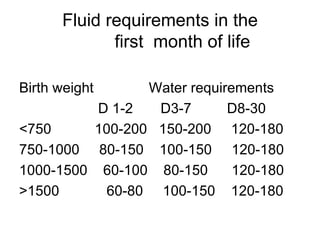
Fluid requirements in the   first  month of life Birth weight  Water requirements D 1-2  D3-7  D8-30 <750  100-200  150-200  120-180 750-1000  80-150  100-150  120-180 1000-1500  60-100  80-150  120-180 >1500  60-80  100-150  120-180
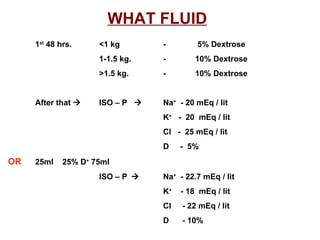
WHAT FLUID   1 st  48 hrs. <1 kg -   5% Dextrose 1-1.5 kg. -  10% Dextrose >1.5 kg. -  10% Dextrose After that   ISO – P   Na +   - 20 mEq / lit K +   -  20  mEq / lit Cl  -  25 mEq / lit D  -  5% OR   25ml  25% D +  75ml  ISO – P    Na +   - 22.7 mEq / lit K +   - 18  mEq / lit Cl  - 22 mEq / lit D  - 10%
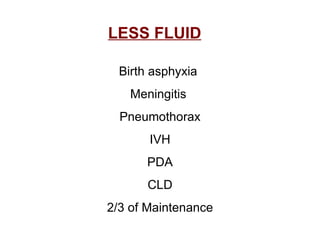
LESS FLUID   Birth asphyxia Meningitis  Pneumothorax IVH PDA CLD 2/3 of Maintenance  
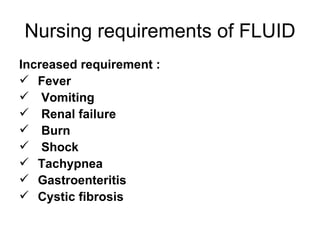
Nursing requirements of FLUID Increased requirement : Fever  Vomiting  Renal failure Burn Shock Tachypnea  Gastroenteritis Cystic fibrosis
EXTRA FLUID      NEC & other condition with loss in 3 rd  space    May require upto 200ml / kg – repeated 10ml / kg RL/NS bolus.    ELBW / VLBW  neonates – Due to high IWL.
KEY POINTS TO REMEMBER  IN FLUID THERAPY   Term  –  1% Per day    Allow a wt. Loss   Preterm –  2% Per day    1 st  48 hrs – no electrolyte required
Pediatric Fluid Therapy Principles Maintenance H 2 O needs: Weight in Kg H 2 O fluid needs 1-10 100cc /kg /day 11-20  1000+50cc/kg/day > 20 1500 + 20cc/kg/day Add 12 % for every  0 C
Premature 1.25 kg. day 1 give fluid direction    10% Dextrose    100 ml / day    25 ml  6 hourly    10% Dextrose 4 ml / hr = 4drops / min
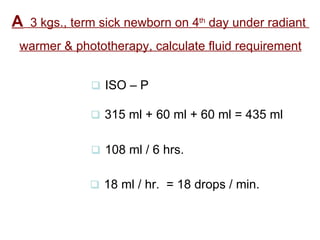
A   3 kgs., term sick newborn on 4 th  day under radiant  warmer & phototherapy, calculate fluid requirement    ISO – P    315 ml + 60 ml + 60 ml = 435 ml    108 ml / 6 hrs.    18 ml / hr.  = 18 drops / min.
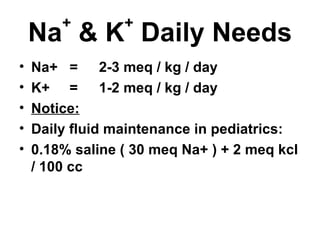
Na +  & K +  Daily Needs Na+  =   2-3 meq / kg / day K+  =    1-2 meq / kg / day Notice: Daily fluid maintenance in pediatrics: 0.18% saline ( 30 meq Na+ ) + 2 meq kcl / 100 cc
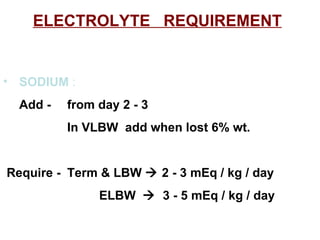
ELECTROLYTE  REQUIREMENT SODIUM  :   Add - from day 2 - 3 In VLBW  add when lost 6% wt. Require - Term & LBW    2 - 3 mEq / kg / day ELBW     3 - 5 mEq / kg / day
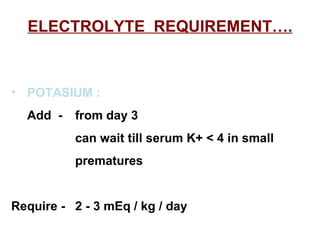
ELECTROLYTE  REQUIREMENT…. POTASIUM :   Add  - from day 3  can wait till serum K+ < 4 in small  prematures Require - 2 - 3 mEq / kg / day
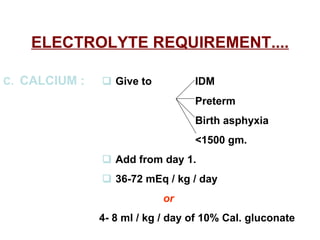
ELECTROLYTE REQUIREMENT.... C.   CALCIUM :     Give to  IDM   Preterm   Birth asphyxia   <1500 gm.      Add from day 1.      36-72 mEq / kg / day  or   4- 8 ml / kg / day of 10% Cal. gluconate  
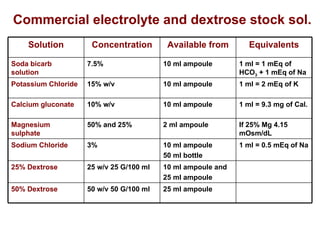
Commercial electrolyte and dextrose stock sol. 25 ml ampoule 50 w/v 50 G/100 ml 50% Dextrose 10 ml ampoule and 25 ml ampoule 25 w/v 25 G/100 ml 25% Dextrose 1 ml = 0.5 mEq of Na 10 ml ampoule 50 ml bottle 3% Sodium Chloride If 25% Mg 4.15 mOsm/dL 2 ml ampoule 50% and 25% Magnesium sulphate 1 ml = 9.3 mg of Cal. 10 ml ampoule 10% w/v Calcium gluconate 1 ml = 2 mEq of K 10 ml ampoule 15% w/v Potassium Chloride 1 ml = 1 mEq of HCO 3  + 1 mEq of Na 10 ml ampoule 7.5% Soda bicarb solution Equivalents Available from Concentration Solution
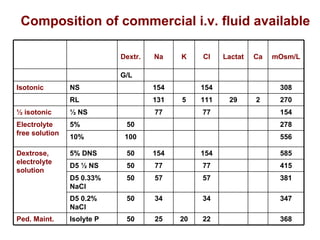
Composition of commercial i.v. fluid available 368 22 20 25 50 Isolyte P Ped. Maint. 347 34 34 50 D5 0.2% NaCl 381 57 57 50 D5 0.33% NaCl 415 77 77 50 D5 ½ NS 585 154 154 50 5% DNS Dextrose, electrolyte solution 556 100 10% 278 50 5% Electrolyte free solution 154 77 77 ½ NS ½ isotonic 270 2 29 111 5 131 RL 308 154 154 NS Isotonic G/L mOsm/L Ca Lactat Cl K Na Dextr.
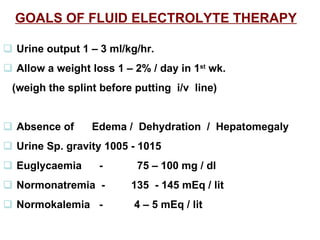
GOALS OF FLUID ELECTROLYTE THERAPY      Urine output 1 – 3 ml/kg/hr.    Allow a weight loss 1 – 2% / day in 1 st  wk.  (weigh the splint before putting  i/v  line)    Absence of  Edema /  Dehydration  /  Hepatomegaly     Urine Sp. gravity 1005 - 1015    Euglycaemia  -   75 – 100 mg / dl    Normonatremia  - 135  - 145 mEq / lit     Normokalemia  -  4 – 5 mEq / lit  
Monitoring fluid and electrolyte    balance Oral mucosal integrity Heart rate and blood pressure Capillary refill Sunken anterior fontanelle
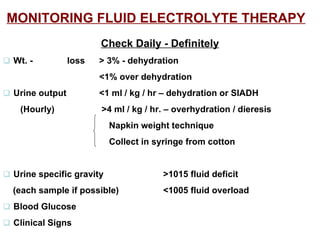
MONITORING FLUID ELECTROLYTE THERAPY   Check Daily - Definitely    Wt. -  loss  > 3% - dehydration   <1% over dehydration    Urine output  <1 ml / kg / hr – dehydration or SIADH (Hourly)  >4 ml / kg / hr. – overhydration / dieresis    Napkin weight technique    Collect in syringe from cotton      Urine specific gravity    >1015 fluid deficit  (each sample if possible)  <1005 fluid overload    Blood Glucose    Clinical Signs
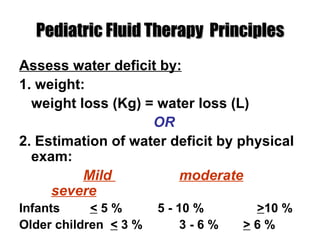
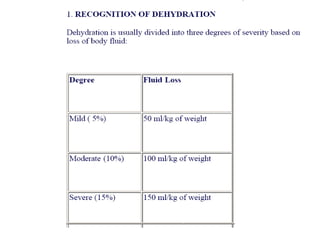
Pediatric Fluid Therapy  Principles Assess water deficit by: 1. weight: weight loss (Kg) = water loss (L) OR 2. Estimation of water deficit by physical exam: Mild  moderate severe Infants   <  5 %   5 - 10 %   > 10 % Older children  <  3 %  3 - 6 % >  6 %
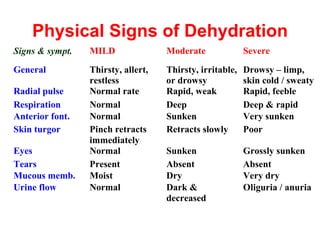
Physical Signs   of Dehydration
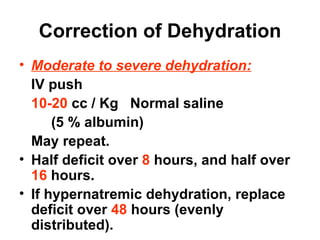
Correction of Dehydration Moderate to severe dehydration: IV push 10-20  cc / Kg  Normal saline (5 % albumin) May repeat. Half deficit over  8  hours, and half over  16   hours. If hypernatremic dehydration, replace deficit over  48  hours (evenly distributed).
 
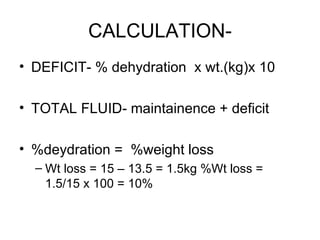
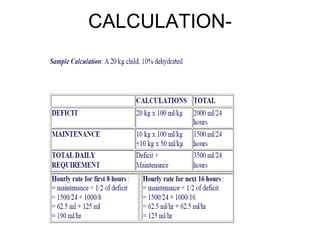
CALCULATION- DEFICIT- % dehydration  x wt.(kg)x 10 TOTAL FLUID- maintainence + deficit  %deydration =  %weight loss  Wt loss = 15 – 13.5 = 1.5kg %Wt loss = 1.5/15 x 100 = 10%
CALCULATION-
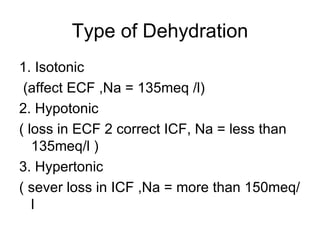
Type of Dehydration 1. Isotonic (affect ECF ,Na = 135meq /l) 2. Hypotonic ( loss in ECF 2 correct ICF, Na = less than 135meq/l ) 3. Hypertonic  ( sever loss in ICF ,Na = more than 150meq/l
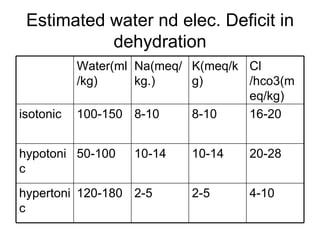
Estimated water nd elec. Deficit in dehydration 4-10 2-5 2-5 120-180 hypertonic 20-28 10-14 10-14 50-100 hypotonic 16-20 8-10 8-10 100-150 isotonic Cl /hco3(meq/kg) K(meq/kg) Na(meq/kg.) Water(ml/kg)
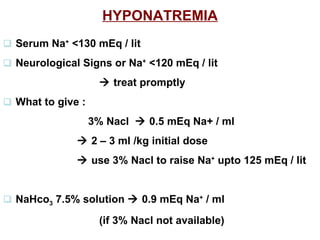
HYPONATREMIA    Serum Na +  <130 mEq / lit     Neurological Signs or Na +  <120 mEq / lit     treat  promptly    What to give :    3% Nacl    0.5 mEq Na+ / ml       2 – 3 ml /kg initial dose      use 3% Nacl to raise Na +  upto 125 mEq / lit       NaHco 3  7.5% solution    0.9 mEq Na +  / ml  (if 3% Nacl not available)
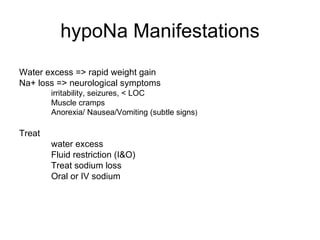
hypoNa Manifestations Water excess => rapid weight gain Na+ loss => neurological symptoms irritability, seizures, < LOC Muscle cramps Anorexia/ Nausea/Vomiting (subtle signs ) Treat  water excess Fluid restriction (I&O) Treat sodium loss Oral or IV sodium
HYPONATREMIA…….      How to calculate deficit      Na +  deficit (mEq) = (desired Na +  - obs Na + ) x wt x 0.6      Add next 2 days daily requirement 2-3 mEq / kg /    day      correct in 48 hrs.      Thumb rule  - correct 1/3 rd   8hr   1/3 rd   16 hr     1/3 rd   24 - 48 hr.  
Male baby of  7 days wt. 1.5 kgs., serum Na+ obs. 122 mEq. / lt.  How to correct the hyponatremia  ?    Deficit of Na+ = (135 – 122) x 1.5 x 0.6 = 11.7 mEq.     Maintenance Na+ = 3 x 1.5 x 2 ( correction made in 48 hrs .)   = 9 mEq.     Total requirements = 11.7 +9 = 20.7 mEq. = 21 mEq.     Fluid requirements for 48 hrs. = 1.5 x 150 x 2 = 450 ml.    21 mEq Na+ in 450 ml. fluid = 50 mEq. Na+ in 1 lit.    Fluid required  = 450 ml. N/3 Solution.
HYPERNATREMIA      Serum Na> 150 mEq / lit    Excess free water loss than Na + (mc in ELBW infants)      Do not treat with Na +  free water     Fluid therapy  --   2/3 maintenance with N 2  / N 5   sol. + 5% D.   --  correct Na +  over 24 – 48 hrs. Do not drop  >1 mEq / kg / hour.   --   May require 3% NaCl if over correction leads to CNS signs.   
POTASSIUM  2 meq/kg/day The total body potassium deficit cannot be calculated from the serum potassium. l g of KCl contains 13.4 mEq K and 13.4 mEq Cl. 1ml KCl = 2 Meq The  MAXIMUM  safe rate of K infusion IV =  0.3 mEq/kg/hour  (beware of K concentrations over 4 g/litre in IV fluid). Eg: For an 8 kg child with hypokalaemia, with IV fluid at 25 ml/hour:  8 x 0.3 = 2.4 mEq K MAXIMUM in 25 ml 2.4 mEq in 25 ml = 2.4 x 1000/25 or 96 mEq/l. 96 mEq K  = 96/13.4 or  7g KCl per litre.= 48ml = max 4 ampules per pint To be safe, add only half this amount (3.5 g) to each litre.
K+  DISORDERS HYPOKALEMIA Nasogastric D  Ileostomy D Renal tubular defects Chronic DU use HYPERKALEMIA Trauma Hypothermia IVH Renal failure Medication error
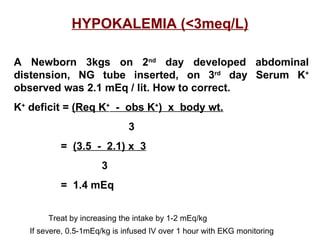
HYPOKALEMIA  (<3meq/L) A Newborn 3kgs on 2 nd  day developed abdominal distension, NG tube inserted, on 3 rd  day Serum K +  observed was 2.1 mEq / lit. How to correct. K +  deficit =  (Req K +   -  obs K + )  x  body wt.     3   =  (3.5  -  2.1) x  3   3   =  1.4 mEq   Treat by increasing the intake by 1-2 mEq/kg If severe, 0.5-1mEq/kg is infused IV over 1 hour with EKG monitoring
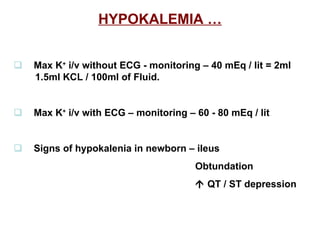
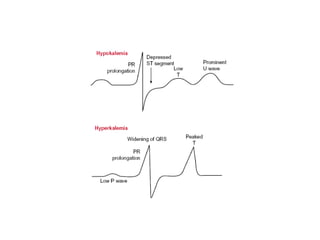
HYPOKALEMIA …    Max K +  i/v without ECG - monitoring – 40 mEq / lit = 2ml  1.5ml KCL / 100ml of Fluid.    Max K +  i/v with ECG – monitoring – 60 - 80 mEq / lit    Signs of hypokalenia in newborn – ileus  Obtundation    QT / ST depression
 
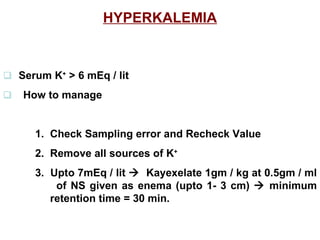
HYPERKALEMIA    Serum K +  > 6 mEq / lit   How to manage 1.  Check Sampling error and Recheck Value 2.  Remove all sources of K + 3.  Upto 7mEq / lit     Kayexelate 1gm / kg at 0.5gm / ml    of NS given as enema (upto 1- 3 cm)    minimum    retention time = 30 min.
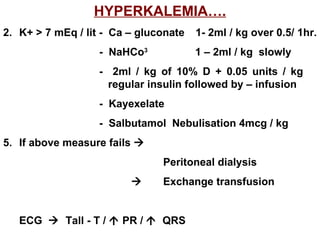
HYPERKALEMIA…. K+ > 7 mEq / lit -  Ca – gluconate  1- 2ml / kg over 0.5/ 1hr.  -  NaHCo 3 1 – 2ml / kg  slowly  -  2ml / kg of 10% D + 0.05 units / kg    regular insulin followed by – infusion -  Kayexelate -  Salbutamol  Nebulisation 4mcg / kg 5. If above measure fails     Peritoneal dialysis    Exchange transfusion ECG     Tall - T /    PR /     QRS
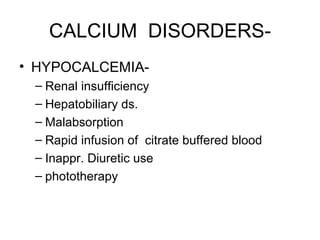
CALCIUM  DISORDERS- HYPOCALCEMIA- Renal insufficiency Hepatobiliary ds. Malabsorption Rapid infusion of  citrate buffered blood Inappr. Diuretic use phototherapy
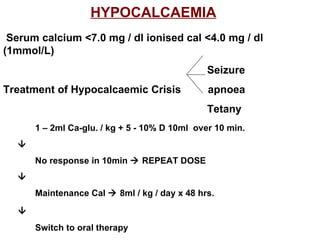
HYPOCALCAEMIA   Serum calcium <7.0 mg / dl ionised cal <4.0 mg / dl (1mmol/L)   Seizure Treatment of Hypocalcaemic Crisis  apnoea   Tetany 1 – 2ml Ca-glu. / kg + 5 - 10% D 10ml  over 10 min.  No response in 10min    REPEAT DOSE  Maintenance Cal    8ml / kg / day x 48 hrs.  Switch to oral therapy
HYPOCALCAEMIA … Refractory hypocalcaemia    think hypomagnesaemia(0.8 mg/dl)    0.2ml of 50% mgso 4   2 doses 12hr. Apart i/v or deep im  Caution in Ca ++  therapy      Rapid i/v infusion  -  dysrythmia / bradycardia      Extravasation of Ca ++  Solution     S/C necrosis &    Calcification
HYPERCALCEMIA CAUSES- Hyperparthyroidism Hyperthyroidism Hypervitaminosis A Thiazide DU Total S ca >11mg/dl Ionized ca level>5mg/dl Hypotonia, lethargy,constipation Rx- volume expansion with isotonic saline sol. frusemide
Common fluid problems Oliguria :  UOP< 1cc/kg/hr. Prerenal, Renal, or Postrenal causes. Most normal term babies pee by 24-48 hrs. Don’t wait that long in sick l’il babies! Check Baby, urine, FBP. Try fluid challenge, then lasix. Get USG if no response Common fluid problems
Dehydration:  Wt loss, oliguria + , urine sp. gravity >1.012.  Correct deficits, then maintenance + ongoing losses Fluid overload:  Wt gain, often hyponatremia. Fluid+ sodium restriction
Thank  U

Fluid Electrolyte By Monica N

  • 1.
    Fluid and electrolyteimbalance MONIKA NANDA 20/2/2009
  • 2.
    Things to consider:Normal changes in TBW, ECF Changes in salt and water balance Normal changes in renal function Insensible water losses
  • 3.
    Body fluid compositionin the fetus and newborn Total Body Water = ICF + ECF (Intravascular+Interstitial) As gestational age increases, TBW and ECF decrease while ICF increases At birth, TBW = 75% of body weight in term infants and about 80% in premature infants ECF decreases from 70% to 45% At 32 wks gestation, TBW = 83% and ECF 53%
  • 4.
    HOW WET ARETHE NEWBORN  TBW - 0.7 L/kg in Newborn 0.6 L/kg at 1yr. Age    ECF 40% - Newborn 20% - Older Children
  • 5.
    Perinatal changes During the first week to 10 days of life, reduction in body weight is due to the reduction in the ECF Term infants- wt loss = 5%-10% within 3-5 days of birth LBW infants lose about 10-15% of body weight during the first 5 days of life Can lead to imbalances in sodium and water homeostasis
  • 6.
    Sodium balance in the newborn Renal sodium losses are inversely proportional to gestational age Term infants have Fractional excretion of sodium = 1% with transient increases on day 2 and At 28 weeks- Fractional excretion of Sodium = 5% to 6% Preterm infants <35wks display negative sodium balance and hyponatremia during first 2-3 wks of life
  • 7.
    Sodium balance inthe newborn Preterm infants may need 4-5mEq/kg of sodium per day to offset high renal losses Increased urinary sodium losses hypoxia respiratory distress hyperbilirubinemia ATN polycythemia diuretics.
  • 8.
    Sodium balance inthe newborn Pharmacologic agents like dopamine, increase urinary sodium losses Fetal and postnatal kidneys exhibit diminished responsiveness to aldosterone compared to adult kidneys
  • 9.
    Water balance inthe newborn Primarily controlled by ADH which enables water to be reabsorbed by the distal nephron collecting duct Stimulation of ADH occurs when blood volume is diminished or when serum osmolality increases above 285mOsm/kg Intravascular volume has a greater influence on ADH secretion than serum osmolality
  • 10.
    Renal concentration anddiluting capacity Adults can concentrate urine up to 1500mOsm/kg of plasma water and dilute as low as 50mOsm/kg of plasma water Concentrating capacity is 800 mOsm/kg in term infants and 600 mOsm/kg in preterm Diluting capacity is 50 mOsm/kg in term and 70 mOsm/kg in preterm Newborns have reduction in GFR and decreased activity of transporters in the early distal tubule
  • 11.
    Factors affecting insensiblewater losses in the neonate Level of maturity Elevated body temperature increases loss by 10% Radiant warmer - increased by 50% compared to thermo-neutral with high humidity Phototherapy increases losses by 50% High ambient or inspired humidity - reduced by 30% Double walled isolette or plastic shield reduces losses by 10-30%
  • 12.
    WHO REQUIRE FLUID  Infant < 30 wks. & <1250 gm.    Sick Term Newborns - Severe birth asphyxia - Apnoea - RDS - Sepsis - Seizure
  • 13.
    HOW MUCH FLUIDTO BE GIVEN <1 kg 1-1.5 kg. >1.5 kg. 1 st day 100 ml/kg. 80 ml/kg. 60 ml/kg. 7 th day 190/ml/kg 170 ml/kg 150 ml/kg.  increase 15 ml/kg/day upto 6 th day  Add  20 ml/kg/day for Phototherapy & Warmer.
  • 14.
    Fluid requirements inthe first month of life Birth weight Water requirements D 1-2 D3-7 D8-30 <750 100-200 150-200 120-180 750-1000 80-150 100-150 120-180 1000-1500 60-100 80-150 120-180 >1500 60-80 100-150 120-180
  • 15.
    WHAT FLUID 1 st 48 hrs. <1 kg - 5% Dextrose 1-1.5 kg. - 10% Dextrose >1.5 kg. - 10% Dextrose After that  ISO – P  Na + - 20 mEq / lit K + - 20 mEq / lit Cl - 25 mEq / lit D - 5% OR 25ml 25% D + 75ml ISO – P  Na + - 22.7 mEq / lit K + - 18 mEq / lit Cl - 22 mEq / lit D - 10%
  • 16.
    LESS FLUID Birth asphyxia Meningitis Pneumothorax IVH PDA CLD 2/3 of Maintenance  
  • 17.
    Nursing requirements ofFLUID Increased requirement : Fever Vomiting Renal failure Burn Shock Tachypnea Gastroenteritis Cystic fibrosis
  • 18.
    EXTRA FLUID  NEC & other condition with loss in 3 rd space  May require upto 200ml / kg – repeated 10ml / kg RL/NS bolus.  ELBW / VLBW neonates – Due to high IWL.
  • 19.
    KEY POINTS TOREMEMBER IN FLUID THERAPY Term – 1% Per day  Allow a wt. Loss Preterm – 2% Per day  1 st 48 hrs – no electrolyte required
  • 20.
    Pediatric Fluid TherapyPrinciples Maintenance H 2 O needs: Weight in Kg H 2 O fluid needs 1-10 100cc /kg /day 11-20 1000+50cc/kg/day > 20 1500 + 20cc/kg/day Add 12 % for every 0 C
  • 21.
    Premature 1.25 kg.day 1 give fluid direction  10% Dextrose  100 ml / day  25 ml 6 hourly  10% Dextrose 4 ml / hr = 4drops / min
  • 22.
    A 3 kgs., term sick newborn on 4 th day under radiant warmer & phototherapy, calculate fluid requirement  ISO – P  315 ml + 60 ml + 60 ml = 435 ml  108 ml / 6 hrs.  18 ml / hr. = 18 drops / min.
  • 23.
    Na + & K + Daily Needs Na+ = 2-3 meq / kg / day K+ = 1-2 meq / kg / day Notice: Daily fluid maintenance in pediatrics: 0.18% saline ( 30 meq Na+ ) + 2 meq kcl / 100 cc
  • 24.
    ELECTROLYTE REQUIREMENTSODIUM : Add - from day 2 - 3 In VLBW add when lost 6% wt. Require - Term & LBW  2 - 3 mEq / kg / day ELBW  3 - 5 mEq / kg / day
  • 25.
    ELECTROLYTE REQUIREMENT….POTASIUM : Add - from day 3 can wait till serum K+ < 4 in small prematures Require - 2 - 3 mEq / kg / day
  • 26.
    ELECTROLYTE REQUIREMENT.... C. CALCIUM :  Give to IDM Preterm Birth asphyxia <1500 gm.  Add from day 1.  36-72 mEq / kg / day or 4- 8 ml / kg / day of 10% Cal. gluconate  
  • 27.
    Commercial electrolyte anddextrose stock sol. 25 ml ampoule 50 w/v 50 G/100 ml 50% Dextrose 10 ml ampoule and 25 ml ampoule 25 w/v 25 G/100 ml 25% Dextrose 1 ml = 0.5 mEq of Na 10 ml ampoule 50 ml bottle 3% Sodium Chloride If 25% Mg 4.15 mOsm/dL 2 ml ampoule 50% and 25% Magnesium sulphate 1 ml = 9.3 mg of Cal. 10 ml ampoule 10% w/v Calcium gluconate 1 ml = 2 mEq of K 10 ml ampoule 15% w/v Potassium Chloride 1 ml = 1 mEq of HCO 3 + 1 mEq of Na 10 ml ampoule 7.5% Soda bicarb solution Equivalents Available from Concentration Solution
  • 28.
    Composition of commerciali.v. fluid available 368 22 20 25 50 Isolyte P Ped. Maint. 347 34 34 50 D5 0.2% NaCl 381 57 57 50 D5 0.33% NaCl 415 77 77 50 D5 ½ NS 585 154 154 50 5% DNS Dextrose, electrolyte solution 556 100 10% 278 50 5% Electrolyte free solution 154 77 77 ½ NS ½ isotonic 270 2 29 111 5 131 RL 308 154 154 NS Isotonic G/L mOsm/L Ca Lactat Cl K Na Dextr.
  • 29.
    GOALS OF FLUIDELECTROLYTE THERAPY  Urine output 1 – 3 ml/kg/hr.  Allow a weight loss 1 – 2% / day in 1 st wk. (weigh the splint before putting i/v line)  Absence of Edema / Dehydration / Hepatomegaly  Urine Sp. gravity 1005 - 1015  Euglycaemia - 75 – 100 mg / dl  Normonatremia - 135 - 145 mEq / lit  Normokalemia - 4 – 5 mEq / lit  
  • 30.
    Monitoring fluid andelectrolyte balance Oral mucosal integrity Heart rate and blood pressure Capillary refill Sunken anterior fontanelle
  • 31.
    MONITORING FLUID ELECTROLYTETHERAPY Check Daily - Definitely  Wt. - loss > 3% - dehydration <1% over dehydration  Urine output <1 ml / kg / hr – dehydration or SIADH (Hourly) >4 ml / kg / hr. – overhydration / dieresis Napkin weight technique Collect in syringe from cotton    Urine specific gravity >1015 fluid deficit (each sample if possible) <1005 fluid overload  Blood Glucose  Clinical Signs
  • 32.
    Pediatric Fluid Therapy Principles Assess water deficit by: 1. weight: weight loss (Kg) = water loss (L) OR 2. Estimation of water deficit by physical exam: Mild moderate severe Infants < 5 % 5 - 10 % > 10 % Older children < 3 % 3 - 6 % > 6 %
  • 33.
    Physical Signs of Dehydration
  • 34.
    Correction of DehydrationModerate to severe dehydration: IV push 10-20 cc / Kg Normal saline (5 % albumin) May repeat. Half deficit over 8 hours, and half over 16 hours. If hypernatremic dehydration, replace deficit over 48 hours (evenly distributed).
  • 35.
  • 36.
    CALCULATION- DEFICIT- %dehydration x wt.(kg)x 10 TOTAL FLUID- maintainence + deficit %deydration =  %weight loss Wt loss = 15 – 13.5 = 1.5kg %Wt loss = 1.5/15 x 100 = 10%
  • 37.
  • 38.
    Type of Dehydration1. Isotonic (affect ECF ,Na = 135meq /l) 2. Hypotonic ( loss in ECF 2 correct ICF, Na = less than 135meq/l ) 3. Hypertonic ( sever loss in ICF ,Na = more than 150meq/l
  • 39.
    Estimated water ndelec. Deficit in dehydration 4-10 2-5 2-5 120-180 hypertonic 20-28 10-14 10-14 50-100 hypotonic 16-20 8-10 8-10 100-150 isotonic Cl /hco3(meq/kg) K(meq/kg) Na(meq/kg.) Water(ml/kg)
  • 40.
    HYPONATREMIA  Serum Na + <130 mEq / lit  Neurological Signs or Na + <120 mEq / lit  treat promptly  What to give : 3% Nacl  0.5 mEq Na+ / ml  2 – 3 ml /kg initial dose  use 3% Nacl to raise Na + upto 125 mEq / lit    NaHco 3 7.5% solution  0.9 mEq Na + / ml (if 3% Nacl not available)
  • 41.
    hypoNa Manifestations Waterexcess => rapid weight gain Na+ loss => neurological symptoms irritability, seizures, < LOC Muscle cramps Anorexia/ Nausea/Vomiting (subtle signs ) Treat water excess Fluid restriction (I&O) Treat sodium loss Oral or IV sodium
  • 42.
    HYPONATREMIA…….  How to calculate deficit  Na + deficit (mEq) = (desired Na + - obs Na + ) x wt x 0.6  Add next 2 days daily requirement 2-3 mEq / kg / day    correct in 48 hrs.    Thumb rule - correct 1/3 rd 8hr 1/3 rd 16 hr 1/3 rd 24 - 48 hr.  
  • 43.
    Male baby of 7 days wt. 1.5 kgs., serum Na+ obs. 122 mEq. / lt. How to correct the hyponatremia ?  Deficit of Na+ = (135 – 122) x 1.5 x 0.6 = 11.7 mEq.  Maintenance Na+ = 3 x 1.5 x 2 ( correction made in 48 hrs .) = 9 mEq.  Total requirements = 11.7 +9 = 20.7 mEq. = 21 mEq.  Fluid requirements for 48 hrs. = 1.5 x 150 x 2 = 450 ml.  21 mEq Na+ in 450 ml. fluid = 50 mEq. Na+ in 1 lit.  Fluid required = 450 ml. N/3 Solution.
  • 44.
    HYPERNATREMIA  Serum Na> 150 mEq / lit  Excess free water loss than Na + (mc in ELBW infants)  Do not treat with Na + free water  Fluid therapy -- 2/3 maintenance with N 2 / N 5 sol. + 5% D. -- correct Na + over 24 – 48 hrs. Do not drop >1 mEq / kg / hour. -- May require 3% NaCl if over correction leads to CNS signs.  
  • 45.
    POTASSIUM 2meq/kg/day The total body potassium deficit cannot be calculated from the serum potassium. l g of KCl contains 13.4 mEq K and 13.4 mEq Cl. 1ml KCl = 2 Meq The MAXIMUM safe rate of K infusion IV = 0.3 mEq/kg/hour (beware of K concentrations over 4 g/litre in IV fluid). Eg: For an 8 kg child with hypokalaemia, with IV fluid at 25 ml/hour: 8 x 0.3 = 2.4 mEq K MAXIMUM in 25 ml 2.4 mEq in 25 ml = 2.4 x 1000/25 or 96 mEq/l. 96 mEq K = 96/13.4 or 7g KCl per litre.= 48ml = max 4 ampules per pint To be safe, add only half this amount (3.5 g) to each litre.
  • 46.
    K+ DISORDERSHYPOKALEMIA Nasogastric D Ileostomy D Renal tubular defects Chronic DU use HYPERKALEMIA Trauma Hypothermia IVH Renal failure Medication error
  • 47.
    HYPOKALEMIA (<3meq/L)A Newborn 3kgs on 2 nd day developed abdominal distension, NG tube inserted, on 3 rd day Serum K + observed was 2.1 mEq / lit. How to correct. K + deficit = (Req K + - obs K + ) x body wt. 3 = (3.5 - 2.1) x 3 3 = 1.4 mEq Treat by increasing the intake by 1-2 mEq/kg If severe, 0.5-1mEq/kg is infused IV over 1 hour with EKG monitoring
  • 48.
    HYPOKALEMIA …   Max K + i/v without ECG - monitoring – 40 mEq / lit = 2ml 1.5ml KCL / 100ml of Fluid.    Max K + i/v with ECG – monitoring – 60 - 80 mEq / lit    Signs of hypokalenia in newborn – ileus Obtundation  QT / ST depression
  • 49.
  • 50.
    HYPERKALEMIA  Serum K + > 6 mEq / lit   How to manage 1. Check Sampling error and Recheck Value 2. Remove all sources of K + 3. Upto 7mEq / lit  Kayexelate 1gm / kg at 0.5gm / ml of NS given as enema (upto 1- 3 cm)  minimum retention time = 30 min.
  • 51.
    HYPERKALEMIA…. K+ >7 mEq / lit - Ca – gluconate 1- 2ml / kg over 0.5/ 1hr. - NaHCo 3 1 – 2ml / kg slowly - 2ml / kg of 10% D + 0.05 units / kg regular insulin followed by – infusion - Kayexelate - Salbutamol Nebulisation 4mcg / kg 5. If above measure fails  Peritoneal dialysis  Exchange transfusion ECG  Tall - T /  PR /  QRS
  • 52.
    CALCIUM DISORDERS-HYPOCALCEMIA- Renal insufficiency Hepatobiliary ds. Malabsorption Rapid infusion of citrate buffered blood Inappr. Diuretic use phototherapy
  • 53.
    HYPOCALCAEMIA   Serumcalcium <7.0 mg / dl ionised cal <4.0 mg / dl (1mmol/L) Seizure Treatment of Hypocalcaemic Crisis apnoea Tetany 1 – 2ml Ca-glu. / kg + 5 - 10% D 10ml over 10 min.  No response in 10min  REPEAT DOSE  Maintenance Cal  8ml / kg / day x 48 hrs.  Switch to oral therapy
  • 54.
    HYPOCALCAEMIA … Refractoryhypocalcaemia  think hypomagnesaemia(0.8 mg/dl)  0.2ml of 50% mgso 4 2 doses 12hr. Apart i/v or deep im Caution in Ca ++ therapy  Rapid i/v infusion - dysrythmia / bradycardia  Extravasation of Ca ++ Solution  S/C necrosis & Calcification
  • 55.
    HYPERCALCEMIA CAUSES- HyperparthyroidismHyperthyroidism Hypervitaminosis A Thiazide DU Total S ca >11mg/dl Ionized ca level>5mg/dl Hypotonia, lethargy,constipation Rx- volume expansion with isotonic saline sol. frusemide
  • 56.
    Common fluid problemsOliguria : UOP< 1cc/kg/hr. Prerenal, Renal, or Postrenal causes. Most normal term babies pee by 24-48 hrs. Don’t wait that long in sick l’il babies! Check Baby, urine, FBP. Try fluid challenge, then lasix. Get USG if no response Common fluid problems
  • 57.
    Dehydration: Wtloss, oliguria + , urine sp. gravity >1.012. Correct deficits, then maintenance + ongoing losses Fluid overload: Wt gain, often hyponatremia. Fluid+ sodium restriction
  • 58.