Transfusion andTransfusion and
CoagulopathyCoagulopathy
Anthony Holley
Intensivist
Royal Brisbane & Women’s Hospital
ExsanguinationExsanguination
 Haemorrhage remains a major and
potentially reversible cause of all trauma
deaths.
 More pronounced in the setting of
penetrating trauma.
 Mortality in this group is 20-50%
Rev Gonsky
@coolholdenv8R
The MissionThe Mission
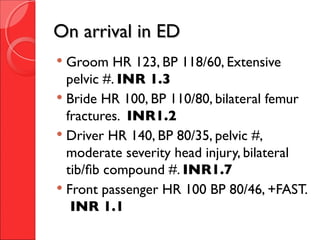
On arrival in EDOn arrival in ED
 Groom HR 123, BP 118/60, Extensive
pelvic #. INR 1.3
 Bride HR 100, BP 110/80, bilateral femur
fractures. INR1.2
 Driver HR 140, BP 80/35, pelvic #,
moderate severity head injury, bilateral
tib/fib compound #. INR1.7
 Front passenger HR 100 BP 80/46, +FAST.
INR 1.1
Coagulopathy is present atCoagulopathy is present at
admission in 25% of traumaadmission in 25% of trauma
patients.patients.
Associated with a 5-fold increaseAssociated with a 5-fold increase
in mortality.in mortality.
Early coagulopathy in trauma patients: anEarly coagulopathy in trauma patients: an
on-scene and hospital admission study.on-scene and hospital admission study.
 Prospective, observational study
investigating the on-scene coagulation
profile and its time course.
 N = 45 patients
 At the scene of the accident, before fluid
administration.
 to hypoperfusion.
MeasuredMeasured
 Prothrombin time
 Activated partial thromboplastin time
Fibrinogen concentration
 Factors II, V and VII activity,
 Fibrin degradation products
 Antithrombin and protein C activities
 Platelet counts and base deficit.
 On-scene coagulation status was abnormal
in 56% of patients.
 Protein C activities were decreased
 Factor V levels decreased significantly
with the severity of the trauma.
Why?Why?
Acute Coagulopathy ofTraumaAcute Coagulopathy ofTrauma
 Syndrome of non-surgical bleeding from mucosal
lesions, serosal surfaces, wound and vascular access
sites associated with serious injury
 INR > 1.5 reliably predicts those who will require
massive transfusion
 Seen in most severely injured upon admission to ED
◦ Coagulopathy correlates with ISS
 Also associated with:
◦ Hypothermia (temp < 35o
C)
◦ Acidosis (pH < 7.2 or BD > 6)
◦ Haemodilution
A Time to ConsiderA Time to Consider
 Mechanism of coagulopathy
 Strategies to best manage patients
 Best modality to assess coagulopathy
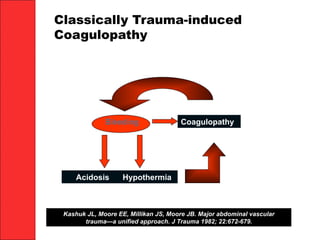
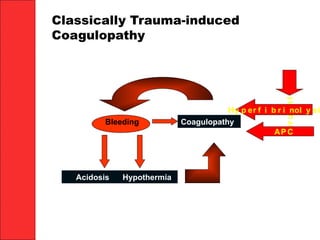
Coagulopathy
Acidosis Hypothermia
Bleeding
Kashuk JL, Moore EE, Millikan JS, Moore JB. Major abdominal vascular
trauma—a unified approach. J Trauma 1982; 22:672-679.
Classically Trauma-induced
Coagulopathy
Time to Challenge theTime to Challenge the
Dogma?Dogma?
“None of these appears to be responsible for
acute coagulopathy, and it appears that
shock is the prime initiator of the process!"
“Trauma-induced coagulopathy can develop in
24.4% of patients independent of acidosis and
hypothermia but secondary to trauma by itself”
– JTrauma,Aug 08, p272
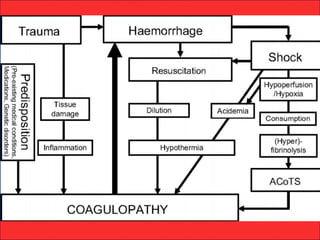
Coagulopathy
Acidosis Hypothermia
Bleeding
Injury
Hy p er f i b r i nol y si
Classically Trauma-induced
Coagulopathy
AP C
Dilution?Dilution?
 Little or no dilutional effect of crystalloid therapy on
the standard tests of coagulation either in vitro or in
healthy volunteers
 London study ~ median fluid 500 ml
 German study ~ median fluid 2.2 L
 Colloid vs Crystalloid
 Coagulopathy was present in 10% of patients who
received less than 500 ml of fluid
 ? Alternative mechanism
 Moderate/severe hypothermia present < 9% of trauma
patients
 Relationship between hypothermia, shock and injury
severity a weak independent predictor of mortality (OR
1.19)
 Very little effect of moderate hypothermia on coagulation
proteases.
 Significant effects on function and clinical bleeding only at
temperatures < 33°C.
Hypothermia?
 Effects of IV HCL acid on human volunteers.
 Definite dose–response of acidaemia on clotting function
by thromboelastometry.
 Little clinically significant effect on protease function down
to a pH of 7.2 in in-vitro studies
 Animal studies: pH of 7.1 produces only a 20%
prolongation of the PT & APTT.
Acidaemia?
 Consumption regarded as a primary cause of traumatic
coagulopathy
 Little evidence for consumption of clotting factors as a
relevant mechanism
 In patients without shock coagulation times are never
prolonged, regardless of the amount of thrombin generated
Consumption?
 Shock and systemic hypoperfusion?
 Dose-dependent prolongation of clotting
times with increasing systemic
hypoperfusion.
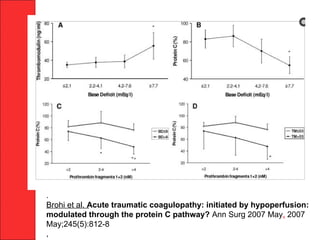
 Base deficit (BD) as a surrogate for
perfusion
 2% of patients with a BD < 6 mEq/l had
prolonged clotting times
 20% of patients with a BD > 6 mEq/l.
Drivers of Traumatic
Coagulopathy?
 Acute coagulopathy in massive transfusion
appears to be due to activation of
anticoagulant and fibrinolytic pathways.
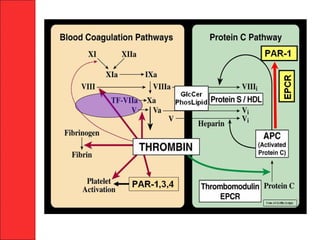
 Thrombomodulin–protein C pathway is
implicated.
Mechanism of Acute
Traumatic Coagulopathy
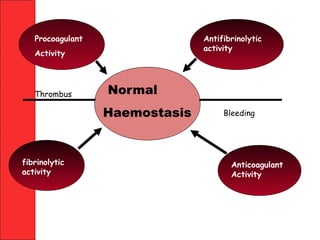
Normal
Haemostasis
Procoagulant
Activity
Antifibrinolytic
activity
Anticoagulant
Activity
fibrinolytic
activity
Thrombus
Bleeding
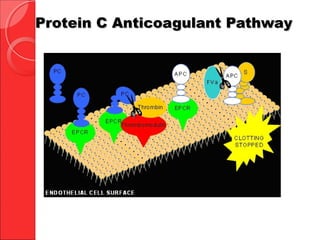
 With tissue hypoperfusion the endothelium
expresses thrombomodulin which complexes
with thrombin.
 Less thrombin is available to cleave fibrinogen
 Thrombin complexed to thrombomodulin
activates protein C, which inhibits cofactorsV
andVIII
Protein C Activation
Protein C Anticoagulant PathwayProtein C Anticoagulant Pathway
.
Brohi et al. Acute traumatic coagulopathy: initiated by hypoperfusion:
modulated through the protein C pathway? Ann Surg 2007 May. 2007
May;245(5):812-8
,
Biological Response PathologicalBiological Response Pathological
in Shockin Shock
 Tissues subjected to low-flow states
generate an anticoagulant milieu
 Avoids thrombosis of vascular beds.
 Trauma is associated with increased
fibrinolytic activity.
 Tissue plasminogen activator (tPA) is released
from the endothelium following injury and
ischaemia.
 Local control mechanism to reduce
propagation of clot to normal vasculature
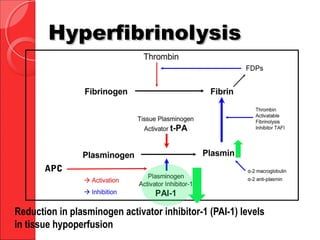
Hyperfibrinolysis
HyperfibrinolysisHyperfibrinolysis
Reduction in plasminogen activator inhibitor-1 (PAI-1) levels
in tissue hypoperfusion
APC
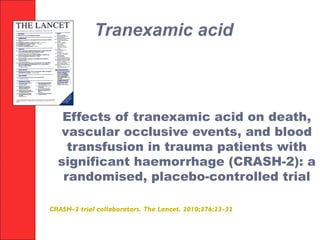
CRASH-2 trial collaborators. The Lancet. 2010;376:23-32
Effects of tranexamic acid on death,
vascular occlusive events, and blood
transfusion in trauma patients with
significant haemorrhage (CRASH-2): a
randomised, placebo-controlled trial
Tranexamic acid
ACEM ASM 2010
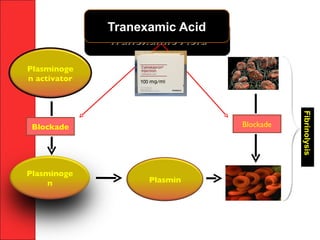
Plasminoge
n activator
Plasmin
Plasminoge
n
Blockade Blockade
Tranexamic AcidTranexamic Acid
Fibrinolysis
The StudyThe Study
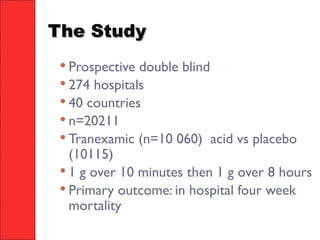
 Prospective double blind
 274 hospitals
 40 countries
 n=20211
 Tranexamic (n=10 060) acid vs placebo
(10115)
 1 g over 10 minutes then 1 g over 8 hours
 Primary outcome: in hospital four week
mortality
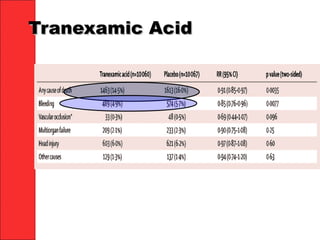
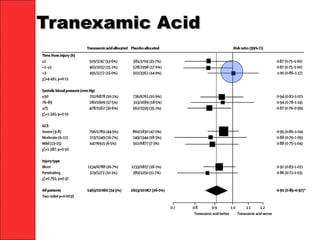
Tranexamic AcidTranexamic Acid
But............But............
 Entrance criteria soft (HR>110 bpm, SBP<90
mmHg)
 70% of patients SBP > 90 mmHg
 Only 16% of patients SBP <75 mmHg
 No reduction in blood transfusion observed
 Median no. of RBC units transfused = 3 in
both groups
 Needs to be given within three hours of
injury
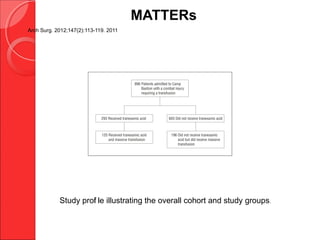
Arch Surg. 2012;147(2):113-119. 2011
Study profi le illustrating the overall cohort and study groups.
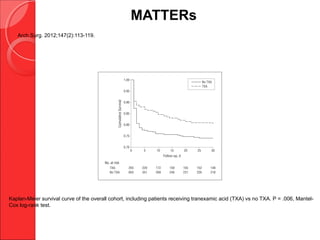
MATTERs
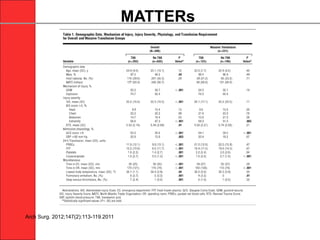
Arch Surg. 2012;147(2):113-119.2011
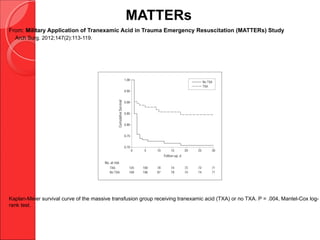
MATTERs
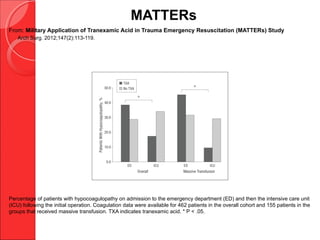
From: Military Application of Tranexamic Acid in Trauma Emergency Resuscitation (MATTERs) Study
Arch Surg. 2012;147(2):113-119.
Percentage of patients with hypocoagulopathy on admission to the emergency department (ED) and then the intensive care unit
(ICU) following the initial operation. Coagulation data were available for 462 patients in the overall cohort and 155 patients in the
groups that received massive transfusion. TXA indicates tranexamic acid. * P < .05.
MATTERs
Arch Surg. 2012;147(2):113-119.
Kaplan-Meier survival curve of the overall cohort, including patients receiving tranexamic acid (TXA) vs no TXA. P = .006, Mantel-
Cox log-rank test.
MATTERs
From: Military Application of Tranexamic Acid in Trauma Emergency Resuscitation (MATTERs) Study
Arch Surg. 2012;147(2):113-119.
Kaplan-Meier survival curve of the massive transfusion group receiving tranexamic acid (TXA) or no TXA. P = .004, Mantel-Cox log-
rank test.
MATTERs
Tranexamic acid safely reduces the
risk of death in bleeding trauma
patients!
The Old Question of Ratios?The Old Question of Ratios?
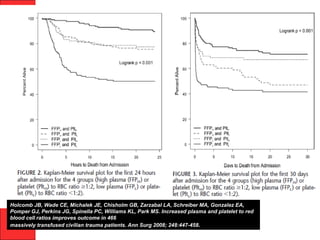
Holcomb JB, Wade CE, Michalek JE, Chisholm GB, Zarzabal LA, Schreiber MA, Gonzalez EA,
Pomper GJ, Perkins JG, Spinella PC, Williams KL, Park MS. Increased plasma and platelet to red
blood cell ratios improves outcome in 466
massively transfused civilian trauma patients. Ann Surg 2008; 248:447-458.
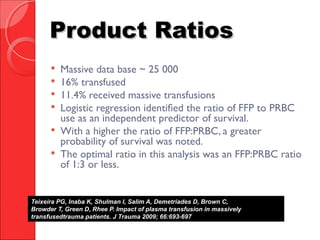
Product RatiosProduct Ratios
 Massive data base ~ 25 000
 16% transfused
 11.4% received massive transfusions
 Logistic regression identified the ratio of FFP to PRBC
use as an independent predictor of survival.
 With a higher the ratio of FFP:PRBC, a greater
probability of survival was noted.
 The optimal ratio in this analysis was an FFP:PRBC ratio
of 1:3 or less.
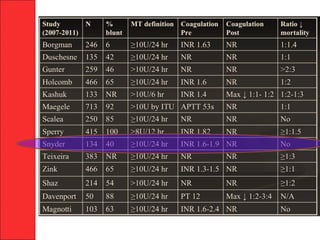
Teixeira PG, Inaba K, Shulman I, Salim A, Demetriades D, Brown C,
Browder T, Green D, Rhee P. Impact of plasma transfusion in massively
transfusedtrauma patients. J Trauma 2009; 66:693-697.
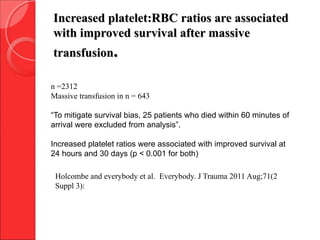
n =2312
Massive transfusion in n = 643
“To mitigate survival bias, 25 patients who died within 60 minutes of
arrival were excluded from analysis”.
Increased platelet ratios were associated with improved survival at
24 hours and 30 days (p < 0.001 for both)
Holcombe and everybody et al. Everybody. J Trauma 2011 Aug;71(2
Suppl 3):
Increased platelet:RBC ratios are associatedIncreased platelet:RBC ratios are associated
with improved survival after massivewith improved survival after massive
transfusiontransfusion..
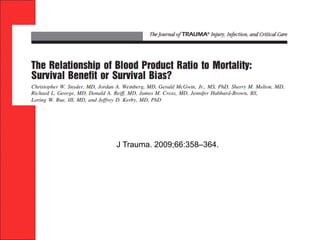
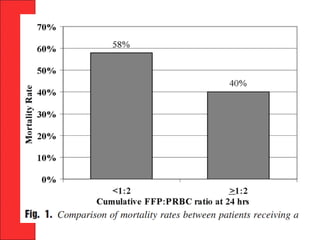
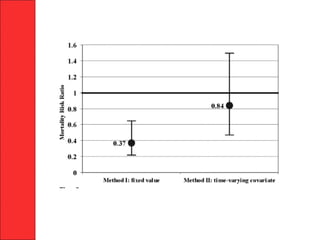
J Trauma. 2009;66:358–364.
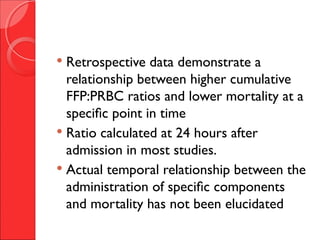
 Retrospective data demonstrate a
relationship between higher cumulative
FFP:PRBC ratios and lower mortality at a
specific point in time
 Ratio calculated at 24 hours after
admission in most studies.
 Actual temporal relationship between the
administration of specific components
and mortality has not been elucidated
http://www.nba.gov.au/guidelines/order/index.html
http://www.nba.gov.au/guidelines/review.html
National BloodNational Blood
AuthorityAuthority
2001 National Health and Medical Research Council/
Australasian Society of Blood Transfusion
(NHMRC/ASBT)
Clinical practice guidelines on the use of blood components
Now replaced by NBA:
Patient Blood Management Guidelines: Modules 1-6
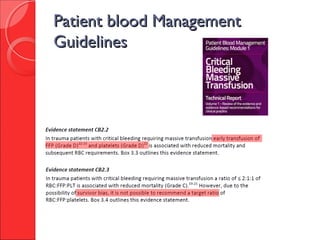
Patient blood ManagementPatient blood Management
GuidelinesGuidelines
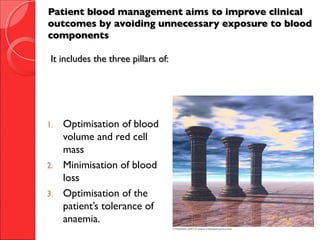
Patient blood management aims to improve clinicalPatient blood management aims to improve clinical
outcomes by avoiding unnecessary exposure to bloodoutcomes by avoiding unnecessary exposure to blood
componentscomponents
It includes the three pillars of:It includes the three pillars of:
1. Optimisation of blood
volume and red cell
mass
2. Minimisation of blood
loss
3. Optimisation of the
patient’s tolerance of
anaemia.
Crash 2Crash 2
In trauma patients with or at risk of
significant haemorrhage, tranexamic acid
(loading dose 1 g over 10 minutes,
followed by infusion of 1 g over 8 hours)
should be considered.
No systematic review was conducted on
tranexamic acid in critical bleeding/massive
transfusion.The study population was not
restricted to critical bleeding requiring
massive transfusion.
So in patients with critical bleedingSo in patients with critical bleeding
requiring massive transfusion, whichrequiring massive transfusion, which
parameters should be measured earlyparameters should be measured early
and frequently?and frequently?
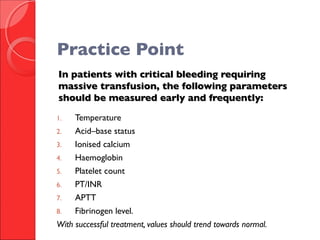
In patients with critical bleeding requiringIn patients with critical bleeding requiring
massive transfusion, the following parametersmassive transfusion, the following parameters
should be measured early and frequently:should be measured early and frequently:
1. Temperature
2. Acid–base status
3. Ionised calcium
4. Haemoglobin
5. Platelet count
6. PT/INR
7. APTT
8. Fibrinogen level.
With successful treatment, values should trend towards normal.
Practice Point
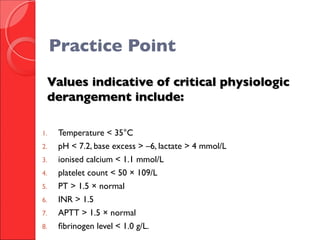
Values indicative of critical physiologicValues indicative of critical physiologic
derangement include:derangement include:
1. Temperature < 35°C
2. pH < 7.2, base excess > –6, lactate > 4 mmol/L
3. ionised calcium < 1.1 mmol/L
4. platelet count < 50 × 109/L
5. PT > 1.5 × normal
6. INR > 1.5
7. APTT > 1.5 × normal
8. fibrinogen level < 1.0 g/L.
Practice Point
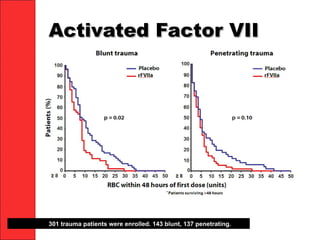
Activated Factor VIIActivated Factor VII
301 trauma patients were enrolled. 143 blunt, 137 penetrating.
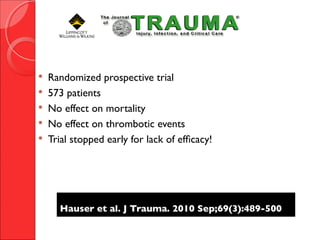
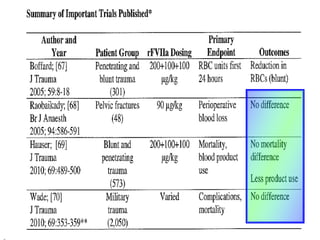
Hauser et al. J Trauma. 2010 Sep;69(3):489-500Hauser et al. J Trauma. 2010 Sep;69(3):489-500
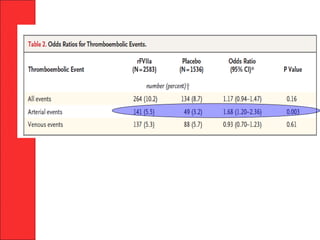
 Randomized prospective trial
 573 patients
 No effect on mortality
 No effect on thrombotic events
 Trial stopped early for lack of efficacy!
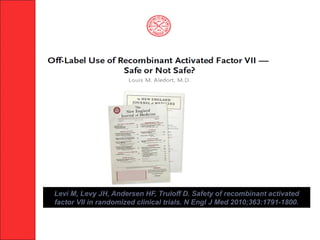
Levi M, Levy JH, Andersen HF, Truloff D. Safety of recombinant activated
factor VII in randomized clinical trials. N Engl J Med 2010;363:1791-1800.
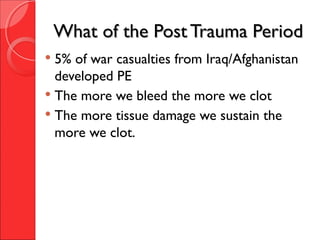
What of the Post Trauma PeriodWhat of the Post Trauma Period
 5% of war casualties from Iraq/Afghanistan
developed PE
 The more we bleed the more we clot
 The more tissue damage we sustain the
more we clot.
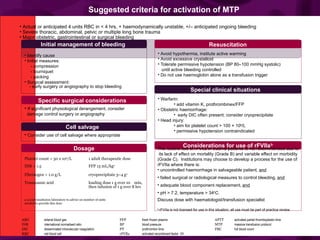
The routine use of rFVIIa in trauma patients is not recommended due to
its lack of effect on mortality (Grade B) and variable effect on morbidity
(Grade C). Institutions may choose to develop a process for the use of
rFVIIa where there is:
• uncontrolled haemorrhage in salvageable patient, and
• failed surgical or radiological measures to control bleeding, and
• adequate blood component replacement, and
• pH > 7.2, temperature > 340
C.
Discuss dose with haematologist/transfusion specialist
b
rFVIIa is not licensed for use in this situation; all use must be part of practice review.
• Warfarin:
• add vitamin K, prothrombinex/FFP
• Obstetric haemorrhage:
• early DIC often present; consider cryoprecipitate
• Head injury:
• aim for platelet count > 100 × 109
/L
• permissive hypotension contraindicated
• Avoid hypothermia, institute active warming
• Avoid excessive crystalloid
• Tolerate permissive hypotension (BP 80–100 mmHg systolic)
until active bleeding controlled
• Do not use haemoglobin alone as a transfusion trigger
• Identify cause
• Initial measures:
- compression
- tourniquet
- packing
• Surgical assessment:
- early surgery or angiography to stop bleeding
• If significant physiological derangement, consider
damage control surgery or angiography
• Consider use of cell salvage where appropriate
• Actual or anticipated 4 units RBC in < 4 hrs, + haemodynamically unstable, +/– anticipated ongoing bleeding
• Severe thoracic, abdominal, pelvic or multiple long bone trauma
• Major obstetric, gastrointestinal or surgical bleeding
Specific surgical considerations
ResuscitationInitial management of bleeding
Dosage
Cell salvage
Considerations for use of rFVIIab
Special clinical situations
Suggested criteria for activation of MTP
ABG arterial blood gas FFP fresh frozen plasma APTT activated partial thromboplastin time
INR international normalised ratio BP blood pressure MTP massive transfusion protocol
DIC disseminated intravascular coagulation PT prothrombin time FBC full blood count
RBC red blood cell rFVlla activated recombinant factor VII
Platelet count < 50 x 109
/L 1 adult therapeutic dose
INR > 1.5 FFP 15 mL/kga
Fibrinogen < 1.0 g/L cryoprecipitate 3–4 ga
Tranexamic acid loading dose 1 g over 10 min,
then infusion of 1 g over 8 hrs
a Local transfusion laboratory to advise on number of units
needed to provide this dose
Thank YouThank You

Holley: Transfusion and Coagulopathy

  • 1.
    Transfusion andTransfusion and CoagulopathyCoagulopathy AnthonyHolley Intensivist Royal Brisbane & Women’s Hospital
  • 2.
    ExsanguinationExsanguination  Haemorrhage remainsa major and potentially reversible cause of all trauma deaths.  More pronounced in the setting of penetrating trauma.  Mortality in this group is 20-50%
  • 5.
  • 7.
  • 8.
    On arrival inEDOn arrival in ED  Groom HR 123, BP 118/60, Extensive pelvic #. INR 1.3  Bride HR 100, BP 110/80, bilateral femur fractures. INR1.2  Driver HR 140, BP 80/35, pelvic #, moderate severity head injury, bilateral tib/fib compound #. INR1.7  Front passenger HR 100 BP 80/46, +FAST. INR 1.1
  • 9.
    Coagulopathy is presentatCoagulopathy is present at admission in 25% of traumaadmission in 25% of trauma patients.patients. Associated with a 5-fold increaseAssociated with a 5-fold increase in mortality.in mortality.
  • 10.
    Early coagulopathy intrauma patients: anEarly coagulopathy in trauma patients: an on-scene and hospital admission study.on-scene and hospital admission study.  Prospective, observational study investigating the on-scene coagulation profile and its time course.  N = 45 patients  At the scene of the accident, before fluid administration.  to hypoperfusion.
  • 11.
    MeasuredMeasured  Prothrombin time Activated partial thromboplastin time Fibrinogen concentration  Factors II, V and VII activity,  Fibrin degradation products  Antithrombin and protein C activities  Platelet counts and base deficit.
  • 12.
     On-scene coagulationstatus was abnormal in 56% of patients.  Protein C activities were decreased  Factor V levels decreased significantly with the severity of the trauma.
  • 13.
  • 14.
    Acute Coagulopathy ofTraumaAcuteCoagulopathy ofTrauma  Syndrome of non-surgical bleeding from mucosal lesions, serosal surfaces, wound and vascular access sites associated with serious injury  INR > 1.5 reliably predicts those who will require massive transfusion  Seen in most severely injured upon admission to ED ◦ Coagulopathy correlates with ISS  Also associated with: ◦ Hypothermia (temp < 35o C) ◦ Acidosis (pH < 7.2 or BD > 6) ◦ Haemodilution
  • 15.
    A Time toConsiderA Time to Consider  Mechanism of coagulopathy  Strategies to best manage patients  Best modality to assess coagulopathy
  • 16.
    Coagulopathy Acidosis Hypothermia Bleeding Kashuk JL,Moore EE, Millikan JS, Moore JB. Major abdominal vascular trauma—a unified approach. J Trauma 1982; 22:672-679. Classically Trauma-induced Coagulopathy
  • 17.
    Time to ChallengetheTime to Challenge the Dogma?Dogma? “None of these appears to be responsible for acute coagulopathy, and it appears that shock is the prime initiator of the process!" “Trauma-induced coagulopathy can develop in 24.4% of patients independent of acidosis and hypothermia but secondary to trauma by itself” – JTrauma,Aug 08, p272
  • 18.
    Coagulopathy Acidosis Hypothermia Bleeding Injury Hy per f i b r i nol y si Classically Trauma-induced Coagulopathy AP C
  • 19.
    Dilution?Dilution?  Little orno dilutional effect of crystalloid therapy on the standard tests of coagulation either in vitro or in healthy volunteers  London study ~ median fluid 500 ml  German study ~ median fluid 2.2 L  Colloid vs Crystalloid  Coagulopathy was present in 10% of patients who received less than 500 ml of fluid  ? Alternative mechanism
  • 20.
     Moderate/severe hypothermiapresent < 9% of trauma patients  Relationship between hypothermia, shock and injury severity a weak independent predictor of mortality (OR 1.19)  Very little effect of moderate hypothermia on coagulation proteases.  Significant effects on function and clinical bleeding only at temperatures < 33°C. Hypothermia?
  • 21.
     Effects ofIV HCL acid on human volunteers.  Definite dose–response of acidaemia on clotting function by thromboelastometry.  Little clinically significant effect on protease function down to a pH of 7.2 in in-vitro studies  Animal studies: pH of 7.1 produces only a 20% prolongation of the PT & APTT. Acidaemia?
  • 22.
     Consumption regardedas a primary cause of traumatic coagulopathy  Little evidence for consumption of clotting factors as a relevant mechanism  In patients without shock coagulation times are never prolonged, regardless of the amount of thrombin generated Consumption?
  • 23.
     Shock andsystemic hypoperfusion?  Dose-dependent prolongation of clotting times with increasing systemic hypoperfusion.  Base deficit (BD) as a surrogate for perfusion  2% of patients with a BD < 6 mEq/l had prolonged clotting times  20% of patients with a BD > 6 mEq/l. Drivers of Traumatic Coagulopathy?
  • 24.
     Acute coagulopathyin massive transfusion appears to be due to activation of anticoagulant and fibrinolytic pathways.  Thrombomodulin–protein C pathway is implicated. Mechanism of Acute Traumatic Coagulopathy
  • 25.
  • 26.
     With tissuehypoperfusion the endothelium expresses thrombomodulin which complexes with thrombin.  Less thrombin is available to cleave fibrinogen  Thrombin complexed to thrombomodulin activates protein C, which inhibits cofactorsV andVIII Protein C Activation
  • 27.
    Protein C AnticoagulantPathwayProtein C Anticoagulant Pathway
  • 28.
    . Brohi et al.Acute traumatic coagulopathy: initiated by hypoperfusion: modulated through the protein C pathway? Ann Surg 2007 May. 2007 May;245(5):812-8 ,
  • 29.
    Biological Response PathologicalBiologicalResponse Pathological in Shockin Shock  Tissues subjected to low-flow states generate an anticoagulant milieu  Avoids thrombosis of vascular beds.
  • 30.
     Trauma isassociated with increased fibrinolytic activity.  Tissue plasminogen activator (tPA) is released from the endothelium following injury and ischaemia.  Local control mechanism to reduce propagation of clot to normal vasculature Hyperfibrinolysis
  • 31.
    HyperfibrinolysisHyperfibrinolysis Reduction in plasminogenactivator inhibitor-1 (PAI-1) levels in tissue hypoperfusion APC
  • 33.
    CRASH-2 trial collaborators.The Lancet. 2010;376:23-32 Effects of tranexamic acid on death, vascular occlusive events, and blood transfusion in trauma patients with significant haemorrhage (CRASH-2): a randomised, placebo-controlled trial Tranexamic acid
  • 34.
    ACEM ASM 2010 Plasminoge nactivator Plasmin Plasminoge n Blockade Blockade Tranexamic AcidTranexamic Acid Tranexamic AcidTranexamic Acid Fibrinolysis
  • 35.
    The StudyThe Study Prospective double blind  274 hospitals  40 countries  n=20211  Tranexamic (n=10 060) acid vs placebo (10115)  1 g over 10 minutes then 1 g over 8 hours  Primary outcome: in hospital four week mortality
  • 37.
  • 38.
  • 39.
    But............But............  Entrance criteriasoft (HR>110 bpm, SBP<90 mmHg)  70% of patients SBP > 90 mmHg  Only 16% of patients SBP <75 mmHg  No reduction in blood transfusion observed  Median no. of RBC units transfused = 3 in both groups  Needs to be given within three hours of injury
  • 40.
    Arch Surg. 2012;147(2):113-119.2011 Study profi le illustrating the overall cohort and study groups. MATTERs
  • 41.
  • 42.
    From: Military Applicationof Tranexamic Acid in Trauma Emergency Resuscitation (MATTERs) Study Arch Surg. 2012;147(2):113-119. Percentage of patients with hypocoagulopathy on admission to the emergency department (ED) and then the intensive care unit (ICU) following the initial operation. Coagulation data were available for 462 patients in the overall cohort and 155 patients in the groups that received massive transfusion. TXA indicates tranexamic acid. * P < .05. MATTERs
  • 43.
    Arch Surg. 2012;147(2):113-119. Kaplan-Meiersurvival curve of the overall cohort, including patients receiving tranexamic acid (TXA) vs no TXA. P = .006, Mantel- Cox log-rank test. MATTERs
  • 44.
    From: Military Applicationof Tranexamic Acid in Trauma Emergency Resuscitation (MATTERs) Study Arch Surg. 2012;147(2):113-119. Kaplan-Meier survival curve of the massive transfusion group receiving tranexamic acid (TXA) or no TXA. P = .004, Mantel-Cox log- rank test. MATTERs
  • 45.
    Tranexamic acid safelyreduces the risk of death in bleeding trauma patients!
  • 46.
    The Old Questionof Ratios?The Old Question of Ratios?
  • 47.
    Holcomb JB, WadeCE, Michalek JE, Chisholm GB, Zarzabal LA, Schreiber MA, Gonzalez EA, Pomper GJ, Perkins JG, Spinella PC, Williams KL, Park MS. Increased plasma and platelet to red blood cell ratios improves outcome in 466 massively transfused civilian trauma patients. Ann Surg 2008; 248:447-458.
  • 48.
    Product RatiosProduct Ratios Massive data base ~ 25 000  16% transfused  11.4% received massive transfusions  Logistic regression identified the ratio of FFP to PRBC use as an independent predictor of survival.  With a higher the ratio of FFP:PRBC, a greater probability of survival was noted.  The optimal ratio in this analysis was an FFP:PRBC ratio of 1:3 or less. Teixeira PG, Inaba K, Shulman I, Salim A, Demetriades D, Brown C, Browder T, Green D, Rhee P. Impact of plasma transfusion in massively transfusedtrauma patients. J Trauma 2009; 66:693-697.
  • 50.
    n =2312 Massive transfusionin n = 643 “To mitigate survival bias, 25 patients who died within 60 minutes of arrival were excluded from analysis”. Increased platelet ratios were associated with improved survival at 24 hours and 30 days (p < 0.001 for both) Holcombe and everybody et al. Everybody. J Trauma 2011 Aug;71(2 Suppl 3): Increased platelet:RBC ratios are associatedIncreased platelet:RBC ratios are associated with improved survival after massivewith improved survival after massive transfusiontransfusion..
  • 51.
  • 52.
     Retrospective datademonstrate a relationship between higher cumulative FFP:PRBC ratios and lower mortality at a specific point in time  Ratio calculated at 24 hours after admission in most studies.  Actual temporal relationship between the administration of specific components and mortality has not been elucidated
  • 55.
  • 56.
    National BloodNational Blood AuthorityAuthority 2001National Health and Medical Research Council/ Australasian Society of Blood Transfusion (NHMRC/ASBT) Clinical practice guidelines on the use of blood components Now replaced by NBA: Patient Blood Management Guidelines: Modules 1-6
  • 57.
    Patient blood ManagementPatientblood Management GuidelinesGuidelines
  • 58.
    Patient blood managementaims to improve clinicalPatient blood management aims to improve clinical outcomes by avoiding unnecessary exposure to bloodoutcomes by avoiding unnecessary exposure to blood componentscomponents It includes the three pillars of:It includes the three pillars of: 1. Optimisation of blood volume and red cell mass 2. Minimisation of blood loss 3. Optimisation of the patient’s tolerance of anaemia.
  • 59.
    Crash 2Crash 2 Intrauma patients with or at risk of significant haemorrhage, tranexamic acid (loading dose 1 g over 10 minutes, followed by infusion of 1 g over 8 hours) should be considered. No systematic review was conducted on tranexamic acid in critical bleeding/massive transfusion.The study population was not restricted to critical bleeding requiring massive transfusion.
  • 60.
    So in patientswith critical bleedingSo in patients with critical bleeding requiring massive transfusion, whichrequiring massive transfusion, which parameters should be measured earlyparameters should be measured early and frequently?and frequently?
  • 61.
    In patients withcritical bleeding requiringIn patients with critical bleeding requiring massive transfusion, the following parametersmassive transfusion, the following parameters should be measured early and frequently:should be measured early and frequently: 1. Temperature 2. Acid–base status 3. Ionised calcium 4. Haemoglobin 5. Platelet count 6. PT/INR 7. APTT 8. Fibrinogen level. With successful treatment, values should trend towards normal. Practice Point
  • 62.
    Values indicative ofcritical physiologicValues indicative of critical physiologic derangement include:derangement include: 1. Temperature < 35°C 2. pH < 7.2, base excess > –6, lactate > 4 mmol/L 3. ionised calcium < 1.1 mmol/L 4. platelet count < 50 × 109/L 5. PT > 1.5 × normal 6. INR > 1.5 7. APTT > 1.5 × normal 8. fibrinogen level < 1.0 g/L. Practice Point
  • 64.
    Activated Factor VIIActivatedFactor VII 301 trauma patients were enrolled. 143 blunt, 137 penetrating.
  • 65.
    Hauser et al.J Trauma. 2010 Sep;69(3):489-500Hauser et al. J Trauma. 2010 Sep;69(3):489-500  Randomized prospective trial  573 patients  No effect on mortality  No effect on thrombotic events  Trial stopped early for lack of efficacy!
  • 67.
    Levi M, LevyJH, Andersen HF, Truloff D. Safety of recombinant activated factor VII in randomized clinical trials. N Engl J Med 2010;363:1791-1800.
  • 69.
    What of thePost Trauma PeriodWhat of the Post Trauma Period  5% of war casualties from Iraq/Afghanistan developed PE  The more we bleed the more we clot  The more tissue damage we sustain the more we clot.
  • 70.
    The routine useof rFVIIa in trauma patients is not recommended due to its lack of effect on mortality (Grade B) and variable effect on morbidity (Grade C). Institutions may choose to develop a process for the use of rFVIIa where there is: • uncontrolled haemorrhage in salvageable patient, and • failed surgical or radiological measures to control bleeding, and • adequate blood component replacement, and • pH > 7.2, temperature > 340 C. Discuss dose with haematologist/transfusion specialist b rFVIIa is not licensed for use in this situation; all use must be part of practice review. • Warfarin: • add vitamin K, prothrombinex/FFP • Obstetric haemorrhage: • early DIC often present; consider cryoprecipitate • Head injury: • aim for platelet count > 100 × 109 /L • permissive hypotension contraindicated • Avoid hypothermia, institute active warming • Avoid excessive crystalloid • Tolerate permissive hypotension (BP 80–100 mmHg systolic) until active bleeding controlled • Do not use haemoglobin alone as a transfusion trigger • Identify cause • Initial measures: - compression - tourniquet - packing • Surgical assessment: - early surgery or angiography to stop bleeding • If significant physiological derangement, consider damage control surgery or angiography • Consider use of cell salvage where appropriate • Actual or anticipated 4 units RBC in < 4 hrs, + haemodynamically unstable, +/– anticipated ongoing bleeding • Severe thoracic, abdominal, pelvic or multiple long bone trauma • Major obstetric, gastrointestinal or surgical bleeding Specific surgical considerations ResuscitationInitial management of bleeding Dosage Cell salvage Considerations for use of rFVIIab Special clinical situations Suggested criteria for activation of MTP ABG arterial blood gas FFP fresh frozen plasma APTT activated partial thromboplastin time INR international normalised ratio BP blood pressure MTP massive transfusion protocol DIC disseminated intravascular coagulation PT prothrombin time FBC full blood count RBC red blood cell rFVlla activated recombinant factor VII Platelet count < 50 x 109 /L 1 adult therapeutic dose INR > 1.5 FFP 15 mL/kga Fibrinogen < 1.0 g/L cryoprecipitate 3–4 ga Tranexamic acid loading dose 1 g over 10 min, then infusion of 1 g over 8 hrs a Local transfusion laboratory to advise on number of units needed to provide this dose
  • 71.