




13/2/14Geetanjli NINE, PGIMER
 Scientific understanding of physiological
changes and management in order to
calculate correct amount of fluid and
electrolytes
 Individual rhythms of suck, swallow, and
respiration
 Explain the physiological changes and need
of fluid management in neonate
 Identify the babies who need IV fluids
 Calculate daily fluid requirement of baby
 Monitor babies receiving IV fluids
 Adjusting IV fluids with enteral feeding
 Body composition and surface area:
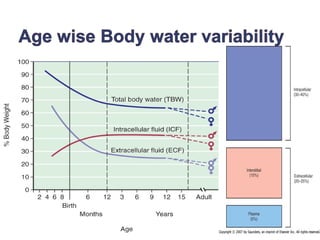
 More total body water (TBW)
 preterm have larger surface area,
 thin skin, and fast breathing
More loss of TBW + insensible water
loss
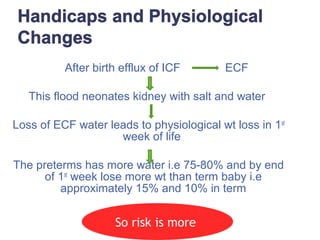
After birth efflux of ICF ECF
This flood neonates kidney with salt and water
Loss of ECF water leads to physiological wt loss in 1st
week of life
The preterms has more water i.e 75-80% and by end
of 1st
week lose more wt than term baby i.e
approximately 15% and 10% in term
So risk is more
 Immature kidney (25% functional) and hormonal effect
(Concentrate urine 600 -700 mOsm/L≃ )
 Activated Renin-angiotensin, aldosterone
 Arginine vasopressin (AVP, ADH) in response to stress, such as
birth, asphyxia, RDS, positive pressure ventilation,
pneumothorax and intracranial haemorrhage.
 Glomerular filtration rate and distal tubular reabsorption of
sodium and initially kidneys are unable to excrete sodium.
Limited capacity :
Patent ductus arteriosus
Necrotizing enterocolitis
Chronic lung disease.
 Neonatal kidney
 Has a limited capacity both to excrete and to conserve
sodium.
 Diurise water and sodium in the first 48-72 hours of life
Fluid of choice for
1st
48-72 hours of
life is 10% D
 Also remember
 Preterm neonates (<34 week) have a limited tubular
capacity to reabsorb as well as excrete sodium
 Failure to supplement sodium will result in low body
stores of sodium.
 Failure to give adequate sodium is associated with poor
weight gain
 Very low birth weight infants on exclusive breast-
feeding may need sodium
So it is important to
give Sodium (Na) after
diuresis
 Ensure initial diuresis by
 Decrease in serum sodium
 At least by 5-6% weight loss then only give fluids
with Na.
 Sodium requirement ranges from 3-5
mEq/kg/day in preterm neonates after the first
week of life.
 Calcium: <1500g (day 1: 36-37mg/kg/day=
4ml/kg/day 10% calcium gluconate)
 Supplementation in addition to breast milk
until 32-34 weeks corrected age.
 After 48-72 hours, administer Isolyte P
 If not available, and baby requires higher
infusion rate prepare solution as follow:
Add NS 20ml/kg body weight which is
equal to 3mEq of Na/kg to the required
volume of 10% dextrose and add 1 ml
KCL/100 ml prepared fluid.
 Extremely/very preterm and LBW
 Hemodynamically unstable
 In Shock and severe asphyxia
 Lethargic and have refusal to feed
 In moderate to severe breathing difficulty
 Having abdominal distension with bilious or blood
stained vomiting
 Having metabolic abnormalities (hypoglycemia,
electrolyte derangements),
 Dehydrated
 In Post surgical condition necessitating
contraindication to oral feed.
 Skin :70%
 Respiration: 30%
 Causes of increased loss
 increased respiration & activity, crying lead to
50-70% in IWL
 Skin injury
 Surgical malformation e.g gastrochisis,
omphalocele
 Increased body & environmental temp
 Use of radiant warmer & Photherapy
 transparent plastic barriers (cling wrap) reduce
the IWL by 50-70%/ incubator use
 Increase humidity
 Limit air movement
 Better thermal control
 coconut oil application
 caps and socks
 Adequate fluid/ feeding
when under radiant warmer/phototherapy
 Give humidified oxygen
 Prevent and treat for high temp
 Use micro drip set or infusion pump
 Check
 Date
 Clarity
 Seal of the bottle
 Calculate, set and ensure that it is going well
 Change IV set and bag/syringe every 24
hourly even if it still contains IV fluid
 If 2 hours fluid goes within 1 hour, do not stop
the fluid for next 1 hour, infuse the remaining
fluid equally in the remaining hours
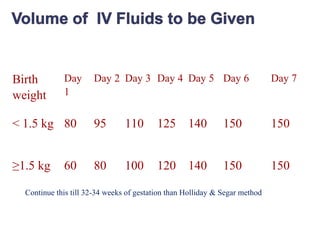
Birth
weight
Day
1
Day 2 Day 3 Day 4 Day 5 Day 6 Day 7
< 1.5 kg 80 95 110 125 140 150 150
≥1.5 kg 60 80 100 120 140 150 150
Continue this till 32-34 weeks of gestation than Holliday & Segar method
 Allow breastfeeding as soon as possible
 If BF not possible, give EBM by NG or paladai
 If tolerates feed, keep increasing enteral feed
 Increase feed @ of 10 ml/kg/day up to 20-30
ml/kg/day
 Feed baby 2-3 hourly
 Keep decreasing the total amount of enteral
feed from the total fluid requirement of day
 Discontinue IV fluid when the baby has
started taking > 2/3 of the total fluid
requirement enterally
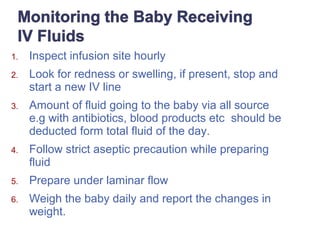
1. Inspect infusion site hourly
2. Look for redness or swelling, if present, stop and
start a new IV line
3. Amount of fluid going to the baby via all source
e.g with antibiotics, blood products etc should be
deducted form total fluid of the day.
4. Follow strict aseptic precaution while preparing
fluid
5. Prepare under laminar flow
6. Weigh the baby daily and report the changes in
weight.
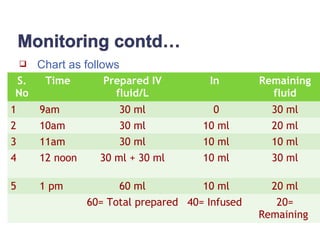
 Chart as follows
S.
No
Time Prepared IV
fluid/L
In Remaining
fluid
1 9am 30 ml 0 30 ml
2 10am 30 ml 10 ml 20 ml
3 11am 30 ml 10 ml 10 ml
4 12 noon 30 ml + 30 ml 10 ml 30 ml
5 1 pm 60 ml 10 ml 20 ml
60= Total prepared 40= Infused 20=
Remaining
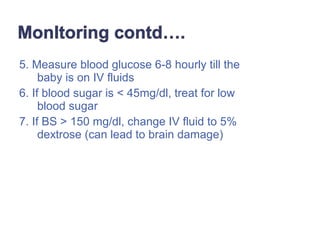
5. Measure blood glucose 6-8 hourly till the
baby is on IV fluids
6. If blood sugar is < 45mg/dl, treat for low
blood sugar
7. If BS > 150 mg/dl, change IV fluid to 5%
dextrose (can lead to brain damage)
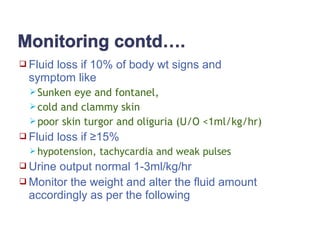
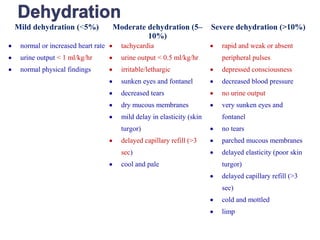
 Fluid loss if 10% of body wt signs and
symptom like
Sunken eye and fontanel,
cold and clammy skin
poor skin turgor and oliguria (U/O <1ml/kg/hr)
 Fluid loss if ≥15%
 hypotension, tachycardia and weak pulses
 Urine output normal 1-3ml/kg/hr
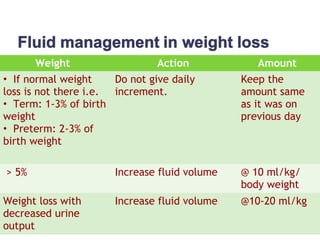
 Monitor the weight and alter the fluid amount
accordingly as per the following
Weight Action Amount
• If normal weight
loss is not there i.e.
• Term: 1-3% of birth
weight
• Preterm: 2-3% of
birth weight
Do not give daily
increment.
Keep the
amount same
as it was on
previous day
> 5% Increase fluid volume @ 10 ml/kg/
body weight
Weight loss with
decreased urine
output
Increase fluid volume @10-20 ml/kg
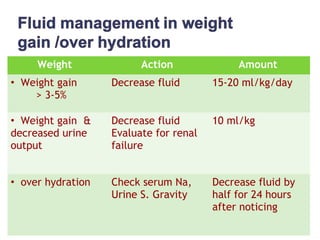
Weight Action Amount
• Weight gain
> 3-5%
Decrease fluid 15-20 ml/kg/day
• Weight gain &
decreased urine
output
Decrease fluid
Evaluate for renal
failure
10 ml/kg
• over hydration Check serum Na,
Urine S. Gravity
Decrease fluid by
half for 24 hours
after noticing
Mild dehydration (<5%) Moderate dehydration (5–
10%)
Severe dehydration (>10%)
• normal or increased heart rate
• urine output < 1 ml/kg/hr
• normal physical findings
• tachycardia
• urine output < 0.5 ml/kg/hr
• irritable/lethargic
• sunken eyes and fontanel
• decreased tears
• dry mucous membranes
• mild delay in elasticity (skin
turgor)
• delayed capillary refill (>3
sec)
• cool and pale
• rapid and weak or absent
peripheral pulses
• depressed consciousness
• decreased blood pressure
• no urine output
• very sunken eyes and
fontanel
• no tears
• parched mucous membranes
• delayed elasticity (poor skin
turgor)
• delayed capillary refill (>3
sec)
• cold and mottled
• limp
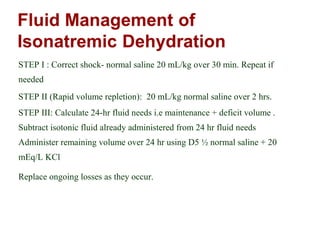
STEP I : Correct shock- normal saline 20 mL/kg over 30 min. Repeat if
needed
STEP II (Rapid volume repletion): 20 mL/kg normal saline over 2 hrs.
STEP III: Calculate 24-hr fluid needs i.e maintenance + deficit volume .
Subtract isotonic fluid already administered from 24 hr fluid needs
Administer remaining volume over 24 hr using D5 ½ normal saline + 20
mEq/L KCl
Replace ongoing losses as they occur.
 Volume by volume replacement is needed (in addition to
maintenance requirements) for
 diarrhea with dehydration
 chest tube drainage
 excess GI aspirates
 surgical wound drainage
 excessive urine losses from osmotic diuresis.
 Estimate losses over past 6-12 hrs. Replace
losses (only if total loss ≥ 5 ml/kg in 12 hrs period)
volume by volume over next 6-12 hrs.
 Vomiting, Nasogastric aspirations and excess
urine output in polyuria (>4 ml/kg/hour)
 with N/2 saline with + 10 mEq/L KCl (1 ml KCl added
per every 100 ml of fluid)
 Ileostomy losses
Normal saline +10 mEq/L KCl (1 ml KCl added
per every 100 ml of fluid)
 Chest tube drainage and third space losses
normal saline
 Diarrheal losses (10-20 ml per stool)
 0.2 NS in D5 + 20 mEq/L KCl (2 ml KCl added
per every 100 ml of fluid)
 Serum sodium values should be between
135-145 meq/L.
 Hyponatremia + weight loss= sodium
depletion : replace sodium
 Hyponatremia + weight gain= suggests water
excess: restrict fluid
.
 Hypernatremia + weight loss= dehydration-
correct fluid over 48 hours.
 Hypernatremia + weight gain= salt and water
load- restrict fluid and sodium
Look for hyper-excitability and hyper-reflexia
1. Murat I, Humblot A, Girault L, Piana F. Neonatal fluid management. Best Pract Res Clin
Anaesthesiol. 2010 Sep;24(3):365–74.
2. Chawla D, Agarwal R, Deorari AK, Paul VK. Fluid and electrolyte management in term and preterm
neonates. Indian J Pediatr. 2008 Mar 1;75(3):255.
3. Jalan Anup. Practical approach to fulid and electrolyte management in newborns. In: Advances in
pediatrics. 2nd ed. JP Medical Ltd; p. 16–23.
4. Fluid and electrolyte management in term and preterm neonates | SpringerLink [Internet]. [cited 2017
Dec 12]. Available from: https://link.springer.com/article/10.1007/s12098-008-0055-0
5. Fluid and Electrolyte Management in the Newborn [Internet]. University of Iowa Children’s Hospital.
2012 [cited 2017 Dec 12]. Available from: https://uichildrens.org/health-library/fluid-and-electrolyte-
management-newborn
6. Fluid, Electrolyte, and Nutrition Management of the Newborn: Overview, Prevalence and Loss of
Body Water, Assessing Fluid and Electrolyte Status. 2017 May 2 [cited 2017 Dec 12]; Available
from: https://emedicine.medscape.com/article/976386-overvie
7. Lonnqvist PA. Fluid management in association with neonatal surgery: even tiny guys need their
salt. British Journal of Anaesthesia, Volume 112, Issue 3, 1 March 2014, Pages 404–
406, https://doi.org/10.1093/bja/aet436
8. Ciccarelli S, Stolfi I, Caramia G. Management strategies in the treatment of neonatal and pediatric
gastroenteritis. Infect Drug Resist. 2013 Oct 29;6:133–61.
9. NNT, UNICEF. Participant Manual- Faclilty Based Care of Sick Neonate at Referral Health Facility.
Pg: 41-43. In.
Fluid and electrolyte management among neonates

Fluid and electrolyte management among neonates

  • 2.
  • 3.
  • 4.
     Scientific understandingof physiological changes and management in order to calculate correct amount of fluid and electrolytes  Individual rhythms of suck, swallow, and respiration
  • 5.
     Explain thephysiological changes and need of fluid management in neonate  Identify the babies who need IV fluids  Calculate daily fluid requirement of baby  Monitor babies receiving IV fluids  Adjusting IV fluids with enteral feeding
  • 8.
     Body compositionand surface area:  More total body water (TBW)  preterm have larger surface area,  thin skin, and fast breathing More loss of TBW + insensible water loss
  • 9.
    After birth effluxof ICF ECF This flood neonates kidney with salt and water Loss of ECF water leads to physiological wt loss in 1st week of life The preterms has more water i.e 75-80% and by end of 1st week lose more wt than term baby i.e approximately 15% and 10% in term So risk is more
  • 10.
     Immature kidney(25% functional) and hormonal effect (Concentrate urine 600 -700 mOsm/L≃ )  Activated Renin-angiotensin, aldosterone  Arginine vasopressin (AVP, ADH) in response to stress, such as birth, asphyxia, RDS, positive pressure ventilation, pneumothorax and intracranial haemorrhage.  Glomerular filtration rate and distal tubular reabsorption of sodium and initially kidneys are unable to excrete sodium. Limited capacity : Patent ductus arteriosus Necrotizing enterocolitis Chronic lung disease.
  • 11.
     Neonatal kidney Has a limited capacity both to excrete and to conserve sodium.  Diurise water and sodium in the first 48-72 hours of life Fluid of choice for 1st 48-72 hours of life is 10% D
  • 12.
     Also remember Preterm neonates (<34 week) have a limited tubular capacity to reabsorb as well as excrete sodium  Failure to supplement sodium will result in low body stores of sodium.  Failure to give adequate sodium is associated with poor weight gain  Very low birth weight infants on exclusive breast- feeding may need sodium So it is important to give Sodium (Na) after diuresis
  • 13.
     Ensure initialdiuresis by  Decrease in serum sodium  At least by 5-6% weight loss then only give fluids with Na.  Sodium requirement ranges from 3-5 mEq/kg/day in preterm neonates after the first week of life.  Calcium: <1500g (day 1: 36-37mg/kg/day= 4ml/kg/day 10% calcium gluconate)  Supplementation in addition to breast milk until 32-34 weeks corrected age.
  • 14.
     After 48-72hours, administer Isolyte P  If not available, and baby requires higher infusion rate prepare solution as follow: Add NS 20ml/kg body weight which is equal to 3mEq of Na/kg to the required volume of 10% dextrose and add 1 ml KCL/100 ml prepared fluid.
  • 15.
     Extremely/very pretermand LBW  Hemodynamically unstable  In Shock and severe asphyxia  Lethargic and have refusal to feed  In moderate to severe breathing difficulty  Having abdominal distension with bilious or blood stained vomiting  Having metabolic abnormalities (hypoglycemia, electrolyte derangements),  Dehydrated  In Post surgical condition necessitating contraindication to oral feed.
  • 16.
     Skin :70% Respiration: 30%  Causes of increased loss  increased respiration & activity, crying lead to 50-70% in IWL  Skin injury  Surgical malformation e.g gastrochisis, omphalocele  Increased body & environmental temp  Use of radiant warmer & Photherapy
  • 18.
     transparent plasticbarriers (cling wrap) reduce the IWL by 50-70%/ incubator use  Increase humidity  Limit air movement  Better thermal control  coconut oil application  caps and socks  Adequate fluid/ feeding when under radiant warmer/phototherapy  Give humidified oxygen  Prevent and treat for high temp
  • 19.
     Use microdrip set or infusion pump  Check  Date  Clarity  Seal of the bottle  Calculate, set and ensure that it is going well  Change IV set and bag/syringe every 24 hourly even if it still contains IV fluid  If 2 hours fluid goes within 1 hour, do not stop the fluid for next 1 hour, infuse the remaining fluid equally in the remaining hours
  • 20.
    Birth weight Day 1 Day 2 Day3 Day 4 Day 5 Day 6 Day 7 < 1.5 kg 80 95 110 125 140 150 150 ≥1.5 kg 60 80 100 120 140 150 150 Continue this till 32-34 weeks of gestation than Holliday & Segar method
  • 21.
     Allow breastfeedingas soon as possible  If BF not possible, give EBM by NG or paladai  If tolerates feed, keep increasing enteral feed  Increase feed @ of 10 ml/kg/day up to 20-30 ml/kg/day  Feed baby 2-3 hourly
  • 22.
     Keep decreasingthe total amount of enteral feed from the total fluid requirement of day  Discontinue IV fluid when the baby has started taking > 2/3 of the total fluid requirement enterally
  • 23.
    1. Inspect infusionsite hourly 2. Look for redness or swelling, if present, stop and start a new IV line 3. Amount of fluid going to the baby via all source e.g with antibiotics, blood products etc should be deducted form total fluid of the day. 4. Follow strict aseptic precaution while preparing fluid 5. Prepare under laminar flow 6. Weigh the baby daily and report the changes in weight.
  • 24.
     Chart asfollows S. No Time Prepared IV fluid/L In Remaining fluid 1 9am 30 ml 0 30 ml 2 10am 30 ml 10 ml 20 ml 3 11am 30 ml 10 ml 10 ml 4 12 noon 30 ml + 30 ml 10 ml 30 ml 5 1 pm 60 ml 10 ml 20 ml 60= Total prepared 40= Infused 20= Remaining
  • 25.
    5. Measure bloodglucose 6-8 hourly till the baby is on IV fluids 6. If blood sugar is < 45mg/dl, treat for low blood sugar 7. If BS > 150 mg/dl, change IV fluid to 5% dextrose (can lead to brain damage)
  • 26.
     Fluid lossif 10% of body wt signs and symptom like Sunken eye and fontanel, cold and clammy skin poor skin turgor and oliguria (U/O <1ml/kg/hr)  Fluid loss if ≥15%  hypotension, tachycardia and weak pulses  Urine output normal 1-3ml/kg/hr  Monitor the weight and alter the fluid amount accordingly as per the following
  • 27.
    Weight Action Amount •If normal weight loss is not there i.e. • Term: 1-3% of birth weight • Preterm: 2-3% of birth weight Do not give daily increment. Keep the amount same as it was on previous day > 5% Increase fluid volume @ 10 ml/kg/ body weight Weight loss with decreased urine output Increase fluid volume @10-20 ml/kg
  • 28.
    Weight Action Amount •Weight gain > 3-5% Decrease fluid 15-20 ml/kg/day • Weight gain & decreased urine output Decrease fluid Evaluate for renal failure 10 ml/kg • over hydration Check serum Na, Urine S. Gravity Decrease fluid by half for 24 hours after noticing
  • 29.
    Mild dehydration (<5%)Moderate dehydration (5– 10%) Severe dehydration (>10%) • normal or increased heart rate • urine output < 1 ml/kg/hr • normal physical findings • tachycardia • urine output < 0.5 ml/kg/hr • irritable/lethargic • sunken eyes and fontanel • decreased tears • dry mucous membranes • mild delay in elasticity (skin turgor) • delayed capillary refill (>3 sec) • cool and pale • rapid and weak or absent peripheral pulses • depressed consciousness • decreased blood pressure • no urine output • very sunken eyes and fontanel • no tears • parched mucous membranes • delayed elasticity (poor skin turgor) • delayed capillary refill (>3 sec) • cold and mottled • limp
  • 30.
    STEP I :Correct shock- normal saline 20 mL/kg over 30 min. Repeat if needed STEP II (Rapid volume repletion): 20 mL/kg normal saline over 2 hrs. STEP III: Calculate 24-hr fluid needs i.e maintenance + deficit volume . Subtract isotonic fluid already administered from 24 hr fluid needs Administer remaining volume over 24 hr using D5 ½ normal saline + 20 mEq/L KCl Replace ongoing losses as they occur.
  • 31.
     Volume byvolume replacement is needed (in addition to maintenance requirements) for  diarrhea with dehydration  chest tube drainage  excess GI aspirates  surgical wound drainage  excessive urine losses from osmotic diuresis.  Estimate losses over past 6-12 hrs. Replace losses (only if total loss ≥ 5 ml/kg in 12 hrs period) volume by volume over next 6-12 hrs.
  • 32.
     Vomiting, Nasogastricaspirations and excess urine output in polyuria (>4 ml/kg/hour)  with N/2 saline with + 10 mEq/L KCl (1 ml KCl added per every 100 ml of fluid)  Ileostomy losses Normal saline +10 mEq/L KCl (1 ml KCl added per every 100 ml of fluid)  Chest tube drainage and third space losses normal saline  Diarrheal losses (10-20 ml per stool)  0.2 NS in D5 + 20 mEq/L KCl (2 ml KCl added per every 100 ml of fluid)
  • 33.
     Serum sodiumvalues should be between 135-145 meq/L.  Hyponatremia + weight loss= sodium depletion : replace sodium  Hyponatremia + weight gain= suggests water excess: restrict fluid
  • 34.
    .  Hypernatremia +weight loss= dehydration- correct fluid over 48 hours.  Hypernatremia + weight gain= salt and water load- restrict fluid and sodium Look for hyper-excitability and hyper-reflexia
  • 35.
    1. Murat I,Humblot A, Girault L, Piana F. Neonatal fluid management. Best Pract Res Clin Anaesthesiol. 2010 Sep;24(3):365–74. 2. Chawla D, Agarwal R, Deorari AK, Paul VK. Fluid and electrolyte management in term and preterm neonates. Indian J Pediatr. 2008 Mar 1;75(3):255. 3. Jalan Anup. Practical approach to fulid and electrolyte management in newborns. In: Advances in pediatrics. 2nd ed. JP Medical Ltd; p. 16–23. 4. Fluid and electrolyte management in term and preterm neonates | SpringerLink [Internet]. [cited 2017 Dec 12]. Available from: https://link.springer.com/article/10.1007/s12098-008-0055-0 5. Fluid and Electrolyte Management in the Newborn [Internet]. University of Iowa Children’s Hospital. 2012 [cited 2017 Dec 12]. Available from: https://uichildrens.org/health-library/fluid-and-electrolyte- management-newborn 6. Fluid, Electrolyte, and Nutrition Management of the Newborn: Overview, Prevalence and Loss of Body Water, Assessing Fluid and Electrolyte Status. 2017 May 2 [cited 2017 Dec 12]; Available from: https://emedicine.medscape.com/article/976386-overvie 7. Lonnqvist PA. Fluid management in association with neonatal surgery: even tiny guys need their salt. British Journal of Anaesthesia, Volume 112, Issue 3, 1 March 2014, Pages 404– 406, https://doi.org/10.1093/bja/aet436 8. Ciccarelli S, Stolfi I, Caramia G. Management strategies in the treatment of neonatal and pediatric gastroenteritis. Infect Drug Resist. 2013 Oct 29;6:133–61. 9. NNT, UNICEF. Participant Manual- Faclilty Based Care of Sick Neonate at Referral Health Facility. Pg: 41-43. In.