LEAF
Fatima Zahra
LEAF
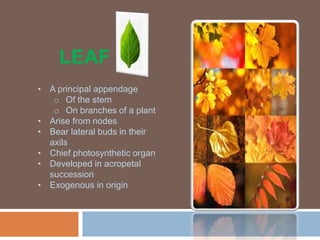
• A principal appendage
o Of the stem
o On branches of a plant
• Arise from nodes
• Bear lateral buds in their
axils
• Chief photosynthetic organ
• Developed in acropetal
succession
• Exogenous in origin
LEAF MORPHOLOGY
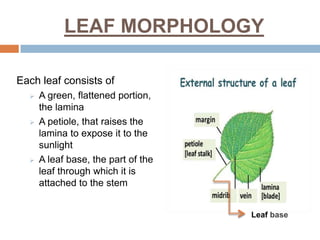
Each leaf consists of
 A green, flattened portion,
the lamina
 A petiole, that raises the
lamina to expose it to the
sunlight
 A leaf base, the part of the
leaf through which it is
attached to the stem
Leaf base
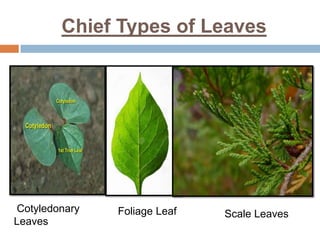
Chief Types of Leaves
 Foliage Leaves :
ordinary green leaves which carry out photosynthesis
 Cotyledonary Leaves :
 found in seeds and serve as food storage
 Absorb food from endosperms for the growing
embryo
 Scale Leaves :
 Small undeveloped leaves
 Usually sessile
 Rarely green
 Their function is usually protection
Chief Types of Leaves
Cotyledonary
Leaves
Foliage Leaf Scale Leaves
Chief Types of Leaves
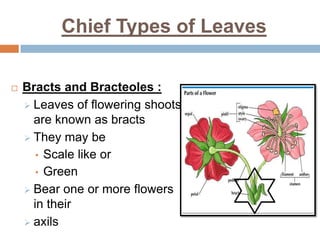
 Bracts and Bracteoles :
 Leaves of flowering shoots
are known as bracts
 They may be
• Scale like or
• Green
 Bear one or more flowers
in their
 axils
Chief Types of Leaves
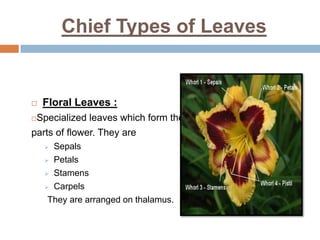
 Floral Leaves :
Specialized leaves which form the
parts of flower. They are
 Sepals
 Petals
 Stamens
 Carpels
They are arranged on thalamus.
Stipules
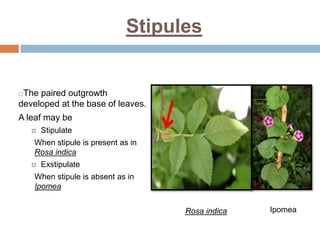
The paired outgrowth
developed at the base of leaves.
A leaf may be
 Stipulate
When stipule is present as in
Rosa indica
 Exstipulate
When stipule is absent as in
Ipomea
Ipomea
Rosa indica
Kinds of Stipules
 Scaly Stipules :
 Leafy Stipules :
 Free Lateral Stipules
:
 Petiolar or Adnate
Stipules :
 Axillary Stipules :
 Orcheate Stipules :
 Tendriller Stipules :
 Spinous Stipules:
as in peepal
as in pea
as in cotton
as in rose
as in Victoria
as in polygonum
as in smilax
as in Zizypus jujbe
1. Scaly Stipules
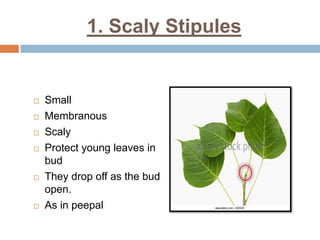
 Small
 Membranous
 Scaly
 Protect young leaves in
bud
 They drop off as the bud
open.
 As in peepal
2. Leafy Stipules
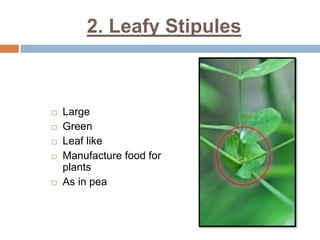
 Large
 Green
 Leaf like
 Manufacture food for
plants
 As in pea
3. Free Lateral Stipules
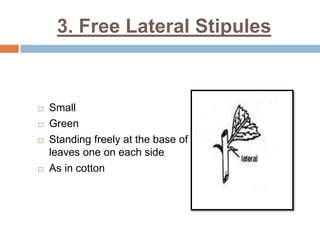
 Small
 Green
 Standing freely at the base of
leaves one on each side
 As in cotton
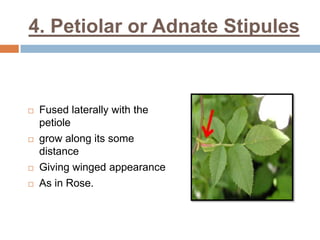
4. Petiolar or Adnate Stipules
 Fused laterally with the
petiole
 grow along its some
distance
 Giving winged appearance
 As in Rose.
5. Axillary Stipules
 Stipules are fuse to form a single
stipule
 Lie between stem and petiole
 As in Victoria
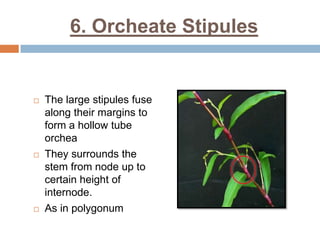
6. Orcheate Stipules
 The large stipules fuse
along their margins to
form a hollow tube
orchea
 They surrounds the
stem from node up to
certain height of
internode.
 As in polygonum
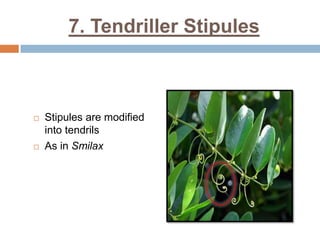
7. Tendriller Stipules
 Stipules are modified
into tendrils
 As in Smilax
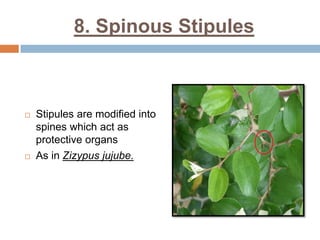
8. Spinous Stipules
 Stipules are modified into
spines which act as
protective organs
 As in Zizypus jujube.
Insertion
Attachment of leaves to the stem or branches is called
insertion.
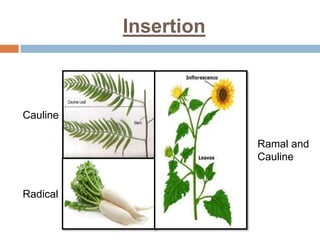
 Cauline :
If the leaves arise on main stem
 Ramal and Cauline :
If the leaves arise both on main stem and its branches,
e.g., in sunflower.
 Radical :
When leaves arise from a reduced stem e.g., in radish
and onion
Such leaves usually forms a rosette.
Insertion
Cauline
Radical
Ramal and
Cauline
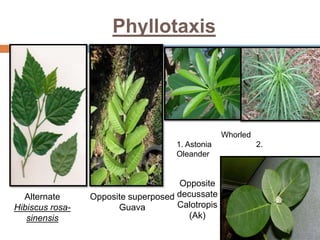
Phyllotaxis
 The arrangement of leaves on stem is called
phyllotaxis
 Helps to avoid overcrowding of the leaves so that
all leaves get maximum light for photosynthesis
 The phyllotaxis may be:
 Alternate: e.g., Hibiscus rosa-sinensis
 Opposite:
a. Opposite decussate: e.g., Calotropis, Ocimum
b. Opposite superposed: e.g., Guava
 Whorled: e.g., Oleander, Alstonia,
Phyllotaxis
Alternate
Hibiscus rosa-
sinensis
Opposite superposed
Guava
Opposite
decussate
Calotropis
(Ak)
Whorled
1. Astonia 2.
Oleander
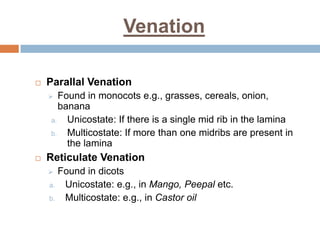
Venation
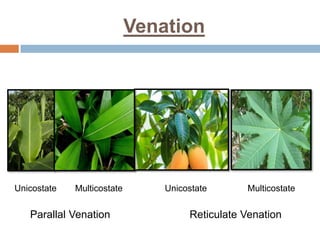
 Parallal Venation
 Found in monocots e.g., grasses, cereals, onion,
banana
a. Unicostate: If there is a single mid rib in the lamina
b. Multicostate: If more than one midribs are present in
the lamina
 Reticulate Venation
 Found in dicots
a. Unicostate: e.g., in Mango, Peepal etc.
b. Multicostate: e.g., in Castor oil
Venation
Unicostate Multicostate Unicostate Multicostate
Parallal Venation Reticulate Venation
Duration Of Leaves
 Caducuous:
If the leaves fall very early, as in Opentia
 Deciduous:
If the leaf fall at the end of growing season, as in
Dulbergia sissoo
 Persistent:
If the leaf remain functional on the plant for more
than one season, and the plant is called as
evergreen, as in mango etc.
Presence and Absence of
Petiole
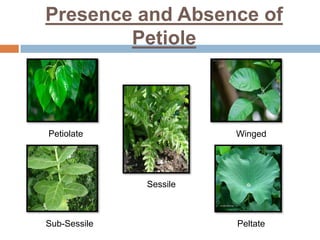
 Petiolate:
When a leaf stalk or petiole is present, as in peepal
 Sessile:
When the petiole is absent. As in poppy.
 Sub-Sessile:
When the petiole is extremely small, as in Calotropis.
 Winged:
When the petiole has a small blade on its either side and
has a wing like shape. As in Citrus
 Peltate:
When the petiole is inserted at or near the centre of
lamina, as in lotus
Presence and Absence of
Petiole
Petiolate
Sub-Sessile
Sessile
Winged
Peltate
Kinds of Leaf
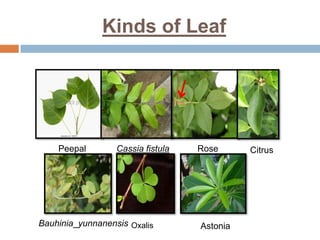
 Simple leaf:
When the leaf lamina is all in one piece e.g., in peepal
 Compound leaf:
 Pinnate Compound leaf
• Peripinnate: if the leaflets are even e.g., Cassia fistula
• Imperipinnate: when leaflets are odd e.g., Rosa indica
 Palmate Compound leaf
• Unifoliate: e.g., Citrus
• Bifoliate: e.g., Bauhinia yunnanensis
• Trifoliate: e.g., Oxalis
• Multifoliate: e.g., Alstonia
Kinds of Leaf
Peepal Rose
Cassia fistula
Bauhinia yunnanensis
Citrus
Astonia
Oxalis
Special Modification of
Leaves
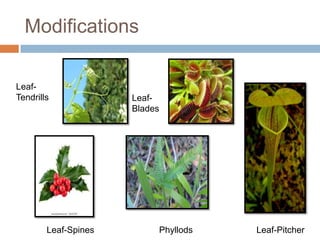
 Leaf-Tendrils: as in grapes and
sweet pea
 Leaf-Spines: as in Berry
 Leaf-Pitcher: as in pitcher plant
 Leaf-Blade: as in bladder wort
 Phyllods: as in Australian
Acacias
Modifications
Leaf-
Tendrills Leaf-
Blades
Leaf-Pitcher
Leaf-Spines Phyllods

Leaf (Botany)

  • 1.
  • 2.
    LEAF • A principalappendage o Of the stem o On branches of a plant • Arise from nodes • Bear lateral buds in their axils • Chief photosynthetic organ • Developed in acropetal succession • Exogenous in origin
  • 3.
    LEAF MORPHOLOGY Each leafconsists of  A green, flattened portion, the lamina  A petiole, that raises the lamina to expose it to the sunlight  A leaf base, the part of the leaf through which it is attached to the stem Leaf base
  • 4.
    Chief Types ofLeaves  Foliage Leaves : ordinary green leaves which carry out photosynthesis  Cotyledonary Leaves :  found in seeds and serve as food storage  Absorb food from endosperms for the growing embryo  Scale Leaves :  Small undeveloped leaves  Usually sessile  Rarely green  Their function is usually protection
  • 5.
    Chief Types ofLeaves Cotyledonary Leaves Foliage Leaf Scale Leaves
  • 6.
    Chief Types ofLeaves  Bracts and Bracteoles :  Leaves of flowering shoots are known as bracts  They may be • Scale like or • Green  Bear one or more flowers in their  axils
  • 7.
    Chief Types ofLeaves  Floral Leaves : Specialized leaves which form the parts of flower. They are  Sepals  Petals  Stamens  Carpels They are arranged on thalamus.
  • 8.
    Stipules The paired outgrowth developedat the base of leaves. A leaf may be  Stipulate When stipule is present as in Rosa indica  Exstipulate When stipule is absent as in Ipomea Ipomea Rosa indica
  • 9.
    Kinds of Stipules Scaly Stipules :  Leafy Stipules :  Free Lateral Stipules :  Petiolar or Adnate Stipules :  Axillary Stipules :  Orcheate Stipules :  Tendriller Stipules :  Spinous Stipules: as in peepal as in pea as in cotton as in rose as in Victoria as in polygonum as in smilax as in Zizypus jujbe
  • 10.
    1. Scaly Stipules Small  Membranous  Scaly  Protect young leaves in bud  They drop off as the bud open.  As in peepal
  • 11.
    2. Leafy Stipules Large  Green  Leaf like  Manufacture food for plants  As in pea
  • 12.
    3. Free LateralStipules  Small  Green  Standing freely at the base of leaves one on each side  As in cotton
  • 13.
    4. Petiolar orAdnate Stipules  Fused laterally with the petiole  grow along its some distance  Giving winged appearance  As in Rose.
  • 14.
    5. Axillary Stipules Stipules are fuse to form a single stipule  Lie between stem and petiole  As in Victoria
  • 15.
    6. Orcheate Stipules The large stipules fuse along their margins to form a hollow tube orchea  They surrounds the stem from node up to certain height of internode.  As in polygonum
  • 16.
    7. Tendriller Stipules Stipules are modified into tendrils  As in Smilax
  • 17.
    8. Spinous Stipules Stipules are modified into spines which act as protective organs  As in Zizypus jujube.
  • 18.
    Insertion Attachment of leavesto the stem or branches is called insertion.  Cauline : If the leaves arise on main stem  Ramal and Cauline : If the leaves arise both on main stem and its branches, e.g., in sunflower.  Radical : When leaves arise from a reduced stem e.g., in radish and onion Such leaves usually forms a rosette.
  • 19.
  • 20.
    Phyllotaxis  The arrangementof leaves on stem is called phyllotaxis  Helps to avoid overcrowding of the leaves so that all leaves get maximum light for photosynthesis  The phyllotaxis may be:  Alternate: e.g., Hibiscus rosa-sinensis  Opposite: a. Opposite decussate: e.g., Calotropis, Ocimum b. Opposite superposed: e.g., Guava  Whorled: e.g., Oleander, Alstonia,
  • 21.
  • 22.
    Venation  Parallal Venation Found in monocots e.g., grasses, cereals, onion, banana a. Unicostate: If there is a single mid rib in the lamina b. Multicostate: If more than one midribs are present in the lamina  Reticulate Venation  Found in dicots a. Unicostate: e.g., in Mango, Peepal etc. b. Multicostate: e.g., in Castor oil
  • 23.
    Venation Unicostate Multicostate UnicostateMulticostate Parallal Venation Reticulate Venation
  • 24.
    Duration Of Leaves Caducuous: If the leaves fall very early, as in Opentia  Deciduous: If the leaf fall at the end of growing season, as in Dulbergia sissoo  Persistent: If the leaf remain functional on the plant for more than one season, and the plant is called as evergreen, as in mango etc.
  • 25.
    Presence and Absenceof Petiole  Petiolate: When a leaf stalk or petiole is present, as in peepal  Sessile: When the petiole is absent. As in poppy.  Sub-Sessile: When the petiole is extremely small, as in Calotropis.  Winged: When the petiole has a small blade on its either side and has a wing like shape. As in Citrus  Peltate: When the petiole is inserted at or near the centre of lamina, as in lotus
  • 26.
    Presence and Absenceof Petiole Petiolate Sub-Sessile Sessile Winged Peltate
  • 27.
    Kinds of Leaf Simple leaf: When the leaf lamina is all in one piece e.g., in peepal  Compound leaf:  Pinnate Compound leaf • Peripinnate: if the leaflets are even e.g., Cassia fistula • Imperipinnate: when leaflets are odd e.g., Rosa indica  Palmate Compound leaf • Unifoliate: e.g., Citrus • Bifoliate: e.g., Bauhinia yunnanensis • Trifoliate: e.g., Oxalis • Multifoliate: e.g., Alstonia
  • 28.
    Kinds of Leaf PeepalRose Cassia fistula Bauhinia yunnanensis Citrus Astonia Oxalis
  • 29.
    Special Modification of Leaves Leaf-Tendrils: as in grapes and sweet pea  Leaf-Spines: as in Berry  Leaf-Pitcher: as in pitcher plant  Leaf-Blade: as in bladder wort  Phyllods: as in Australian Acacias
  • 30.