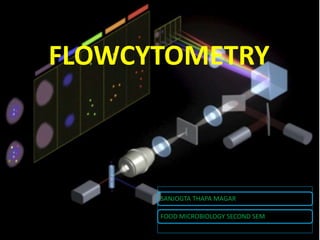
FLOWCYTOMETRY
SANJOGTA THAPA MAGAR
FOOD MICROBIOLOGY SECOND SEM
INTRODUCTION
 Flowcytometry is a laser based technology.
 It measures and analyses different physical and chemical properties
of the cells/particles flowing in a stream of fluid through a beam of
light.
 Flow Cytometry as the name suggests is a technique for cell counting
and measurement of different properties of the cell.
 It is a technique for the rapid analysis of multiparameters of
individual cells.
 The high-speed multiparametric data acquisition, analysis and cell
sorting allows characteristics of individual cells to be studied.
INTRODUCTION
 Flow cytometry is often associated with clinical applications, but it is
also applied within other areas such as the food industry.
 Flowcytometry has become a valuable tool in food microbiology.
 It analyses large numbers of cells individually using light-scattering
and fluorescence measurements.
 Flow cytometry has been developed to rapidly enumerate
microorganisms; to distinguish between viable, metabolically active
and dead cells.
 The basic principle of flow cytometry is the ability to analyse multiple
characteristics of a single cell within a heterogenous population, in a
short period of time.
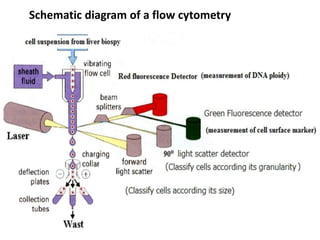
Schematic diagram of a flow cytometry
Components of flowcytometry
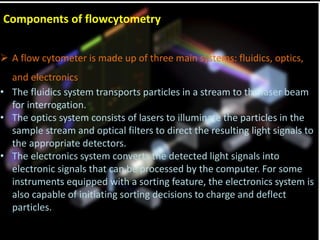
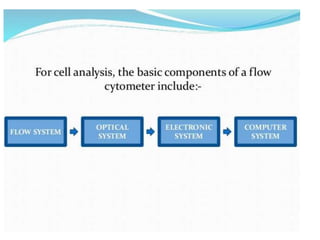
 A flow cytometer is made up of three main systems: fluidics, optics,
and electronics
• The fluidics system transports particles in a stream to the laser beam
for interrogation.
• The optics system consists of lasers to illuminate the particles in the
sample stream and optical filters to direct the resulting light signals to
the appropriate detectors.
• The electronics system converts the detected light signals into
electronic signals that can be processed by the computer. For some
instruments equipped with a sorting feature, the electronics system is
also capable of initiating sorting decisions to charge and deflect
particles.
Principle of flowcytometry
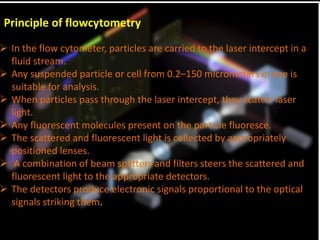
 In the flow cytometer, particles are carried to the laser intercept in a
fluid stream.
 Any suspended particle or cell from 0.2–150 micrometers in size is
suitable for analysis.
 When particles pass through the laser intercept, they scatter laser
light.
 Any fluorescent molecules present on the particle fluoresce.
 The scattered and fluorescent light is collected by appropriately
positioned lenses.
 A combination of beam splitters and filters steers the scattered and
fluorescent light to the appropriate detectors.
 The detectors produce electronic signals proportional to the optical
signals striking them.
Principle of flowcytometry
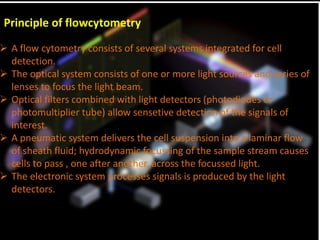
 A flow cytometry consists of several systems integrated for cell
detection.
 The optical system consists of one or more light sources and series of
lenses to focus the light beam.
 Optical filters combined with light detectors (photodiodes or
photomultiplier tube) allow sensetive detection of the signals of
interest.
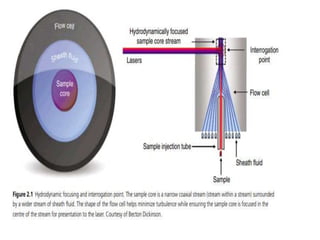
 A pneumatic system delivers the cell suspension into a laminar flow
of sheath fluid; hydrodynamic focussing of the sample stream causes
cells to pass , one after another, across the focussed light.
 The electronic system processes signals is produced by the light
detectors.
Flowcytometric measurements
 Due to difference between the refractive indices of cells and their
surrounding media, light impinging upon the cells is scattered.
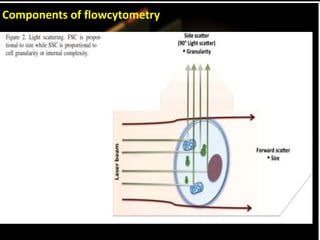
 The forward scatter light (FSC,light scattered at low angles) provides
information on cell size.
 Side scattered light(SSC) provides information about granularity and
cell morphology.
 Fluorescence produced by intracellular compounds with specific
flouorescence (NADPH) or specific compounds known as
fluorochromes is detected by photomultiplier tubes,allowing certain
cells components to be selectively assayed.
 Cytometric software usually presents data in the form of mono- or
biparametric histograms,although multivariate data analysis methods
have been used to obtain maximum information from multiple
labelling.
Flowcytometric measurements
 Software also allows data gating to focus on specific subpopulations,
as only part of the data is represented on the histrograms.
 A combination of light-scattering and fluorecsence measurements on
stained or unstained cells allows the detection of multiple cellular
parameters.
 Depending upon the dyes used, many of these measurements can be
done simultaneously on the same cells.
 In mutlilaser commercial instruments, it is quite common to find
more than ten fluorescence detectors.
Sorting
 Sorting allows us to capture and collect cells of interest for further
analysis. Once collected, the cells can be analyzed microscopically,
biochemically, or functionally.
 To sort particles or cells, the cytometer first needs to identify the cells
of interest, then separate out the individual cells.
 Once the population of interest has been identified on a data
acquisition plot, a region is drawn around that population.
 A logical gate is created from the regions which is then loaded into
the cytometer’s software as the sort gate.
 The sort gate identifies cells of interest to be sorted out of the
stream.
Sorting
 Different cytometers have different methods of capturing a particle of
interest.
 The BD FACSCalibur system, a benchtop analyzer, uses a mechanical
device called a catcher tube to sort cells.
 This catcher tube is located in the upper portion of the flow cell. It
moves in and out of the sample stream to collect a population of
desired cells at a rate of up to 300 cells per second.
Components of flowcytometry
APPLICATION OF FLOWCYTOMETRY IN FOOD INDUSTRY
 A Flow cytometry has been widely used in research since early 1975
for yeast and bacterial cell analysis, but the routine application of
FCM in industrial microbiology was nonexistent before 1988.
 The advantage of FCM is its ability to detect microorganisms at
relatively low concentrations in a short time.
 FCM is a commonly used technique for quantifying bacteria in milk,
milk powder and to monitor dairy starters during cheese ripening.
 Quantification of bacteria in these matrices are undertaken by several
commercial instruments such as the BactoCount .
 A range of FCM based technologies are also available from under the
Chemunex® brand, (Biomerieux, France) including the BactiFlow®,
BactiFlowALS® and DCount® for rapid viable cell analysis of bacteria,
yeast and molds in food processing environments.
 In addition, FCM-based methods have also been used for Gram-
typing bacteria in bulk milk by labelling with various fluorochromes
APPLICATION OF FLOWCYTOMETRY IN FOOD INDUSTRY
 FCM could be a very useful tool to study probiotics.
 The FCM viability assay could also be used to study the effect of
prolonged storage on probiotic product.
 single staining with CFDA, oxonol and PI in combination with FCM was
used to measure the esterase activity,membrane potential and
membrane integrity, espectively, of two Bifidobacterium probiotic
strains under bile salt stress conditions.
 Flow cytometry has been proven to be a useful tool for establishing
the efficacy of pressurisation by determining the percentages of
dead, living and metabolically inactive cells.
REFERENCES
 Aysun Adan, Günel Alizada, Yağmur Kiraz, Yusuf Baran & Ayten
Nalbant,” Flow cytometry: basic principles and applications”, Critical
Reviews in Biotechnology, 2016,pp 1–14
 Mike Leach, Mark Drummond and Allyson Doig,” Practical Flow
Cytometry in Haematology Diagnosis” 2013 . John Wiley & Sons, Ltd
pp 3-19
 “Introduction to Flow Cytometry: A Learning Guide” © 2002 Becton,
Dickinson and Company
 Antonello Paparella, Annalisa Serio and Clemencia Chaves López ,”
Flow Cytometry Applications in Food Safety Studies ‘Flow Cytometry -
Recent, M.Sc. Ingrid Schmid (Ed.)
 Jaume Comas-Riu · Núria Rius ,’’ Flow cytometry applications in the
food industry” Journal of Industrial Microbiology 36(8):999-
1011 · July 2009
REFERENCES
 Wojciech Juzwa , Katarzyna Czaczyk,” Flow cytometric analysis of
microbial contamination in food industry technological lines – initial
study” Acta Sci. Pol., Technol. Aliment. 11(2) 2012, 111-119
 Deirdre Kennedy1 and Martin G. Wilkinson2;” Application of Flow
Cytometry to the Detection of Pathogenic Bacteria”, Curr. Issues Mol.
Biol. (2017) 23: 21-38.

Flowcytometry

  • 1.
  • 2.
    INTRODUCTION  Flowcytometry isa laser based technology.  It measures and analyses different physical and chemical properties of the cells/particles flowing in a stream of fluid through a beam of light.  Flow Cytometry as the name suggests is a technique for cell counting and measurement of different properties of the cell.  It is a technique for the rapid analysis of multiparameters of individual cells.  The high-speed multiparametric data acquisition, analysis and cell sorting allows characteristics of individual cells to be studied.
  • 3.
    INTRODUCTION  Flow cytometryis often associated with clinical applications, but it is also applied within other areas such as the food industry.  Flowcytometry has become a valuable tool in food microbiology.  It analyses large numbers of cells individually using light-scattering and fluorescence measurements.  Flow cytometry has been developed to rapidly enumerate microorganisms; to distinguish between viable, metabolically active and dead cells.  The basic principle of flow cytometry is the ability to analyse multiple characteristics of a single cell within a heterogenous population, in a short period of time.
  • 4.
    Schematic diagram ofa flow cytometry
  • 5.
    Components of flowcytometry A flow cytometer is made up of three main systems: fluidics, optics, and electronics • The fluidics system transports particles in a stream to the laser beam for interrogation. • The optics system consists of lasers to illuminate the particles in the sample stream and optical filters to direct the resulting light signals to the appropriate detectors. • The electronics system converts the detected light signals into electronic signals that can be processed by the computer. For some instruments equipped with a sorting feature, the electronics system is also capable of initiating sorting decisions to charge and deflect particles.
  • 7.
    Principle of flowcytometry In the flow cytometer, particles are carried to the laser intercept in a fluid stream.  Any suspended particle or cell from 0.2–150 micrometers in size is suitable for analysis.  When particles pass through the laser intercept, they scatter laser light.  Any fluorescent molecules present on the particle fluoresce.  The scattered and fluorescent light is collected by appropriately positioned lenses.  A combination of beam splitters and filters steers the scattered and fluorescent light to the appropriate detectors.  The detectors produce electronic signals proportional to the optical signals striking them.
  • 8.
    Principle of flowcytometry A flow cytometry consists of several systems integrated for cell detection.  The optical system consists of one or more light sources and series of lenses to focus the light beam.  Optical filters combined with light detectors (photodiodes or photomultiplier tube) allow sensetive detection of the signals of interest.  A pneumatic system delivers the cell suspension into a laminar flow of sheath fluid; hydrodynamic focussing of the sample stream causes cells to pass , one after another, across the focussed light.  The electronic system processes signals is produced by the light detectors.
  • 9.
    Flowcytometric measurements  Dueto difference between the refractive indices of cells and their surrounding media, light impinging upon the cells is scattered.  The forward scatter light (FSC,light scattered at low angles) provides information on cell size.  Side scattered light(SSC) provides information about granularity and cell morphology.  Fluorescence produced by intracellular compounds with specific flouorescence (NADPH) or specific compounds known as fluorochromes is detected by photomultiplier tubes,allowing certain cells components to be selectively assayed.  Cytometric software usually presents data in the form of mono- or biparametric histograms,although multivariate data analysis methods have been used to obtain maximum information from multiple labelling.
  • 10.
    Flowcytometric measurements  Softwarealso allows data gating to focus on specific subpopulations, as only part of the data is represented on the histrograms.  A combination of light-scattering and fluorecsence measurements on stained or unstained cells allows the detection of multiple cellular parameters.  Depending upon the dyes used, many of these measurements can be done simultaneously on the same cells.  In mutlilaser commercial instruments, it is quite common to find more than ten fluorescence detectors.
  • 11.
    Sorting  Sorting allowsus to capture and collect cells of interest for further analysis. Once collected, the cells can be analyzed microscopically, biochemically, or functionally.  To sort particles or cells, the cytometer first needs to identify the cells of interest, then separate out the individual cells.  Once the population of interest has been identified on a data acquisition plot, a region is drawn around that population.  A logical gate is created from the regions which is then loaded into the cytometer’s software as the sort gate.  The sort gate identifies cells of interest to be sorted out of the stream.
  • 12.
    Sorting  Different cytometershave different methods of capturing a particle of interest.  The BD FACSCalibur system, a benchtop analyzer, uses a mechanical device called a catcher tube to sort cells.  This catcher tube is located in the upper portion of the flow cell. It moves in and out of the sample stream to collect a population of desired cells at a rate of up to 300 cells per second.
  • 14.
  • 17.
    APPLICATION OF FLOWCYTOMETRYIN FOOD INDUSTRY  A Flow cytometry has been widely used in research since early 1975 for yeast and bacterial cell analysis, but the routine application of FCM in industrial microbiology was nonexistent before 1988.  The advantage of FCM is its ability to detect microorganisms at relatively low concentrations in a short time.  FCM is a commonly used technique for quantifying bacteria in milk, milk powder and to monitor dairy starters during cheese ripening.  Quantification of bacteria in these matrices are undertaken by several commercial instruments such as the BactoCount .  A range of FCM based technologies are also available from under the Chemunex® brand, (Biomerieux, France) including the BactiFlow®, BactiFlowALS® and DCount® for rapid viable cell analysis of bacteria, yeast and molds in food processing environments.  In addition, FCM-based methods have also been used for Gram- typing bacteria in bulk milk by labelling with various fluorochromes
  • 18.
    APPLICATION OF FLOWCYTOMETRYIN FOOD INDUSTRY  FCM could be a very useful tool to study probiotics.  The FCM viability assay could also be used to study the effect of prolonged storage on probiotic product.  single staining with CFDA, oxonol and PI in combination with FCM was used to measure the esterase activity,membrane potential and membrane integrity, espectively, of two Bifidobacterium probiotic strains under bile salt stress conditions.  Flow cytometry has been proven to be a useful tool for establishing the efficacy of pressurisation by determining the percentages of dead, living and metabolically inactive cells.
  • 19.
    REFERENCES  Aysun Adan,Günel Alizada, Yağmur Kiraz, Yusuf Baran & Ayten Nalbant,” Flow cytometry: basic principles and applications”, Critical Reviews in Biotechnology, 2016,pp 1–14  Mike Leach, Mark Drummond and Allyson Doig,” Practical Flow Cytometry in Haematology Diagnosis” 2013 . John Wiley & Sons, Ltd pp 3-19  “Introduction to Flow Cytometry: A Learning Guide” © 2002 Becton, Dickinson and Company  Antonello Paparella, Annalisa Serio and Clemencia Chaves López ,” Flow Cytometry Applications in Food Safety Studies ‘Flow Cytometry - Recent, M.Sc. Ingrid Schmid (Ed.)  Jaume Comas-Riu · Núria Rius ,’’ Flow cytometry applications in the food industry” Journal of Industrial Microbiology 36(8):999- 1011 · July 2009
  • 20.
    REFERENCES  Wojciech Juzwa, Katarzyna Czaczyk,” Flow cytometric analysis of microbial contamination in food industry technological lines – initial study” Acta Sci. Pol., Technol. Aliment. 11(2) 2012, 111-119  Deirdre Kennedy1 and Martin G. Wilkinson2;” Application of Flow Cytometry to the Detection of Pathogenic Bacteria”, Curr. Issues Mol. Biol. (2017) 23: 21-38.