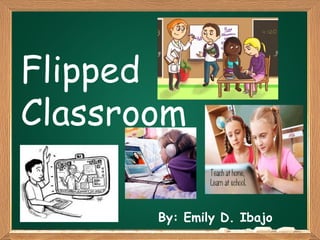
Flipped
Classroom
By: Emily D. Ibajo
What is Flipped
Classroom??
Flipped classroom or
flipped learning is a
methodology, an approach
to learning in which
technology is employed to
reverse the traditional role
of classroom time.
Several teachers now have
already stated using the
flipped classroom model in
their teaching and some are
still thinking about how to do
it.
Flipped learning or flipped
classroom is a learning concept that
has been making some huge uproar
within educational circles for the last
couple of years. Flipped classroom is
not a new concept as some would
argue but only the advance of
technology particularly the mobile and
handheld gadgetry brought it to the
surface and gave it more prominence
A flipped classroom is
sometimes the best
teaching/learning model some
teachers have to use with  their
students. The use of technology in
a flipped classroom should never
be regarded as a supplicant of the
teacher but only a complimentary
element that increases students
learning outcomes.
what is the difference
between Flipped
classroom and
traditional
classroom???
ws teachers to reflect on and develop quality and engaging learning opportunities and options for internalization, creation, and application of content rather than just flu

Flipped Classroom also "allows
teachers to reflect on and
develop quality and engaging
learning opportunities and
options for internalization,
creation, and application of
content rather than just fluff
or time filling assignments."
Flipped learning is much
more than just watching videos
as homework or about
teachers creating videos as
homework for students, it is
rather a learning process that
engages students through real
and authentic action.
Flipped Classroom
shifts the learning
responsibility and
ownership  from the
teacher's hands  into
the students'.
 Students tend to perform
better when they control
when, where and how they
learn.
Teachers no longer dispense
knowledge but rather guide
and direct while students are
the real active learners 
 Teachers create animated
videos and interactive lessons
and lectures and students
access them at home in
advance of class even. In this
way all students can re-watch
the video tutorials whenever
they want.
 Classroom time can be
geared towards data
collection, collaboration, and
application.
Class becomes a place for
students to work through
problems, advance concepts,
and engage in collaborative
learning.
The purpose is to maximize
learning through capitalizing on the
classroom instruction time.
Students watch lectures at home
at their own pace and communicate
with peers and teachers...
References:
http://www.educatorstechnolo
gy.com/
Thank
yOu
fo

R

Listening! 

Flipped education

  • 1.
  • 2.
  • 4.
    Flipped classroom or flippedlearning is a methodology, an approach to learning in which technology is employed to reverse the traditional role of classroom time.
  • 6.
    Several teachers nowhave already stated using the flipped classroom model in their teaching and some are still thinking about how to do it.
  • 7.
    Flipped learning orflipped classroom is a learning concept that has been making some huge uproar within educational circles for the last couple of years. Flipped classroom is not a new concept as some would argue but only the advance of technology particularly the mobile and handheld gadgetry brought it to the surface and gave it more prominence
  • 8.
    A flipped classroomis sometimes the best teaching/learning model some teachers have to use with  their students. The use of technology in a flipped classroom should never be regarded as a supplicant of the teacher but only a complimentary element that increases students learning outcomes.
  • 9.
    what is thedifference between Flipped classroom and traditional classroom???
  • 12.
    ws teachers toreflect on and develop quality and engaging learning opportunities and options for internalization, creation, and application of content rather than just flu Flipped Classroom also "allows teachers to reflect on and develop quality and engaging learning opportunities and options for internalization, creation, and application of content rather than just fluff or time filling assignments."
  • 14.
    Flipped learning ismuch more than just watching videos as homework or about teachers creating videos as homework for students, it is rather a learning process that engages students through real and authentic action.
  • 15.
    Flipped Classroom shifts thelearning responsibility and ownership  from the teacher's hands  into the students'.
  • 16.
     Students tend toperform better when they control when, where and how they learn. Teachers no longer dispense knowledge but rather guide and direct while students are the real active learners 
  • 17.
     Teachers create animated videosand interactive lessons and lectures and students access them at home in advance of class even. In this way all students can re-watch the video tutorials whenever they want.
  • 18.
     Classroom time canbe geared towards data collection, collaboration, and application. Class becomes a place for students to work through problems, advance concepts, and engage in collaborative learning.
  • 19.
    The purpose isto maximize learning through capitalizing on the classroom instruction time. Students watch lectures at home at their own pace and communicate with peers and teachers...
  • 20.
  • 21.