SUBMITTED
BY:-
SUPRIYA
SHARMA
RITESH
LANGER
URVASHI
ENVIRONMENT
SCANNING
Environment scanning is a process of gathering ,
analyzing and dispensing of information for
tactical or strategic purposes. Careful monitoring
of an organization's internal and external
environments for detecting early signs of
opportunities and threats that may influence its
current and future plans. In comparison,
surveillance is confined to a specific objective or
a narrow sector.
NEED TO SCAN THE BUSINESS
ENVIRONMENT
• Environmental analysis will help the firm to understand
what is happening both inside and outside the
organization and to increase the probability that the
organisational strategies developed will appropriately
reflect the organizational environment.
• Environmental scanning is necessary because there are
rapid changes taking place in the environment that has
a great impact on the working of the business firm.
Analysis of business environment helps to identify
strength weakness, opportunities and threats. SWOT
analysis is necessary for the survival and growth of
every business enterprise.
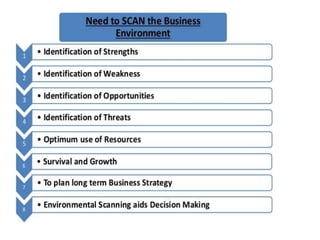
The following is the need and importance of environmental
scanning:
1. Identification of strength:
Strength of the business firm means capacity of the firm to gain
advantage over its competitors. Analysis of internal business
environment helps to identify strength of the firm. After
identifying the strength, the firm must try to consolidate or
maximize its strength by further improvement in its existing
plans, policies and resources.
2. Identification of weakness:
Weakness of the firm means limitations of the firm. Monitoring
internal environment helps to identify not only the strength but
also the weakness of the firm. A firm may be strong in certain
areas but may be weak in some other areas. For further growth
and expansion, the weakness should be identified so as to
correct them as soon as possible.
3. Identification of opportunities:
Environmental analyses helps to identify the opportunities in
the market. The firm should make every possible effort to grab
the opportunities as and when they come.
4. Identification of threat:
Business is subject to threat from competitors and various
factors. Environmental analyses help them to identify threat
from the external environment. Early identification of threat is
always beneficial as it helps to diffuse off some threat.
5. Optimum use of resources:
Proper environmental assessment helps to make optimum
utilisation of scare human, natural and capital resources.
Systematic analyses of business environment helps the firm to
reduce wastage and make optimum use of available resources,
without understanding the internal and external environment
resources cannot be used in an effective manner.
6. Survival and growth:
Systematic analyses of business environment help the firm to maximize their
strength, minimize the weakness, grab the opportunities and diffuse threats.
This enables the firm to survive and grow in the competitive business world.
7. To plan long-term business strategy:
A business organisation has short term and long-term objectives. Proper
analyses of environmental factors help the business firm to frame plans and
policies that could help in easy accomplishment of those organisational
objectives. Without undertaking environmental scanning, the firm cannot
develop a strategy for business success.
8. Environmental scanning aids decision-making:
Decision-making is a process of selecting the best alternative from among
various available alternatives. An environmental analysis is an extremely
important tool in understanding and decision making in all situation of the
business. Success of the firm depends upon the precise decision making ability.
Study of environmental analyses enables the firm to select the best option for
the success and growth of the firm.
TECHNIQUES OF SCANNING
 SWOT analysis of a business
 PEST analysis
ETOP
QUEST
5 force analysis
Industry analysis
SWOT ANALYSIS OF BUSINESS
• SWOT stands for Strenghths, Weaknesses,
Opportunities & Threats.
 Identification of strengths and weaknesses in
the internal environment and threats and
opportunities in external environment are the
cornerstone of business policy formulation.
 It involves specifying the objective of the
business venture or project and identifying the
internal and external factors that are favourable
and unfavourable to achieve that objective.
PEST ANALYSIS
• PEST stands for Political, Economical, Social &
Technological analysis and describes a
framework of macro-environmental factors
used in the environmental scanning
component of strategic management.
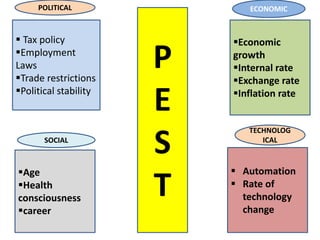
 Tax policy
Employment
Laws
Trade restrictions
Political stability
Economic
growth
Internal rate
Exchange rate
Inflation rate
POLITICAL ECONOMIC
Age
Health
consciousness
career
SOCIAL
 Automation
 Rate of
technology
change
TECHNOLOG
ICAL
P
E
S
T
ETOP
ETOP stands for Environment, Threat, Opportunity, Profile.
Steps involved in the preparation of ETOP:
1. Dividing the environment into different sectors.
2. Analyzing the impact of each sector on the organisation
3. Subdividing each environmental factor into the sub factors
for a comprehensive ETOP
4. Analyzing the impact of each subfactor on the organisation
in the form of a statement.
5. Preparing a summary to show the major factors for the sake
of simplicity.
QUEST
• QUEST stands for Quick Environmental Scanning technique
which is proposed by B. Nanus
It is a scanning procedure design to assist, executers and
planners to keep side by side of change and its implications
for the organisational strategies and plan.
It is a four step process:-
1. Observe the major events & trends in the industry.
2. Speculate on a wide range of important issue.
3. Prepare a report summarizing the major issues & their
implications.
4. Identify feasible strategic options to deal with the evolving
environment.
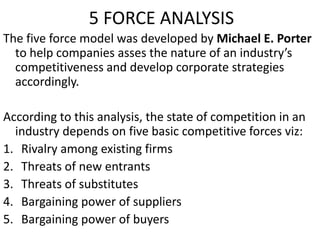
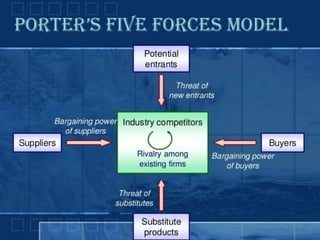
5 FORCE ANALYSIS
The five force model was developed by Michael E. Porter
to help companies asses the nature of an industry’s
competitiveness and develop corporate strategies
accordingly.
According to this analysis, the state of competition in an
industry depends on five basic competitive forces viz:
1. Rivalry among existing firms
2. Threats of new entrants
3. Threats of substitutes
4. Bargaining power of suppliers
5. Bargaining power of buyers
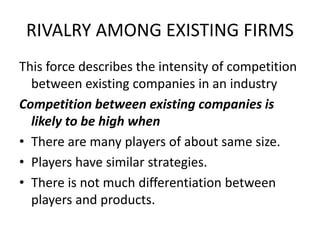
RIVALRY AMONG EXISTING FIRMS
This force describes the intensity of competition
between existing companies in an industry
Competition between existing companies is
likely to be high when
• There are many players of about same size.
• Players have similar strategies.
• There is not much differentiation between
players and products.
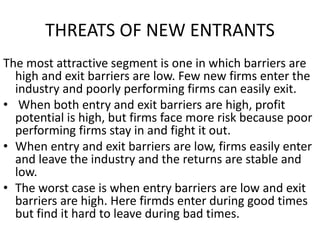
THREATS OF NEW ENTRANTS
The most attractive segment is one in which barriers are
high and exit barriers are low. Few new firms enter the
industry and poorly performing firms can easily exit.
• When both entry and exit barriers are high, profit
potential is high, but firms face more risk because poor
performing firms stay in and fight it out.
• When entry and exit barriers are low, firms easily enter
and leave the industry and the returns are stable and
low.
• The worst case is when entry barriers are low and exit
barriers are high. Here firmds enter during good times
but find it hard to leave during bad times.
THREATS OF SUBSTITUTES
• This force is easily threatening when buyers can easily
find substitute products with attractive prices or better
quality and when buyers can easily switch from one
product or service to another with little cost.
• Determining factors:-
First, if the consumer’s switching costs are low
Second,if the substitutes
Third, if the substitutes product is of equal or superior
quality compared to the industry’s product, the threat
of substitutes is high
Forth, if the functions, attributes or performance of the
substitute product are equal or superior to the
industry’s product.
BARGAINING POWER OF SUPPLIERS
• Strong bargaining power allows suppliers to sell
higher priced or low quality raw materials to their
buyers. This directly affects the buying firms profits
because it has to pay more for materials. Suppliers
have strong bargaining power when:
There are few suppliers but many buyers.
Few substitute raw materials exist.
Suppliers hold scarce resources.
Cost of switching raw materials is especially high.
BARGAINING POWER OF BUYERS
 Customers have the power to demand lower price
or higher product quality from industry producers
when their bargaining power is strong. Customers
exert strong bargaining power when:
Only few customers exist .
Switching costs to other supplier are low.
There are many substitutes.
Customers are price sensitive.
INDUSTRY ANALYSIS
• A corporation is most concerned with the
intensity of competition within its industry
• The level of this intensity is determined by
basic competitive forces
• In scanning its industry, the corporation must
assess the importance to its success of each of
the six forces
Techniques of scanning

Techniques of scanning

  • 1.
  • 2.
    ENVIRONMENT SCANNING Environment scanning isa process of gathering , analyzing and dispensing of information for tactical or strategic purposes. Careful monitoring of an organization's internal and external environments for detecting early signs of opportunities and threats that may influence its current and future plans. In comparison, surveillance is confined to a specific objective or a narrow sector.
  • 3.
    NEED TO SCANTHE BUSINESS ENVIRONMENT • Environmental analysis will help the firm to understand what is happening both inside and outside the organization and to increase the probability that the organisational strategies developed will appropriately reflect the organizational environment. • Environmental scanning is necessary because there are rapid changes taking place in the environment that has a great impact on the working of the business firm. Analysis of business environment helps to identify strength weakness, opportunities and threats. SWOT analysis is necessary for the survival and growth of every business enterprise.
  • 5.
    The following isthe need and importance of environmental scanning: 1. Identification of strength: Strength of the business firm means capacity of the firm to gain advantage over its competitors. Analysis of internal business environment helps to identify strength of the firm. After identifying the strength, the firm must try to consolidate or maximize its strength by further improvement in its existing plans, policies and resources. 2. Identification of weakness: Weakness of the firm means limitations of the firm. Monitoring internal environment helps to identify not only the strength but also the weakness of the firm. A firm may be strong in certain areas but may be weak in some other areas. For further growth and expansion, the weakness should be identified so as to correct them as soon as possible.
  • 6.
    3. Identification ofopportunities: Environmental analyses helps to identify the opportunities in the market. The firm should make every possible effort to grab the opportunities as and when they come. 4. Identification of threat: Business is subject to threat from competitors and various factors. Environmental analyses help them to identify threat from the external environment. Early identification of threat is always beneficial as it helps to diffuse off some threat. 5. Optimum use of resources: Proper environmental assessment helps to make optimum utilisation of scare human, natural and capital resources. Systematic analyses of business environment helps the firm to reduce wastage and make optimum use of available resources, without understanding the internal and external environment resources cannot be used in an effective manner.
  • 7.
    6. Survival andgrowth: Systematic analyses of business environment help the firm to maximize their strength, minimize the weakness, grab the opportunities and diffuse threats. This enables the firm to survive and grow in the competitive business world. 7. To plan long-term business strategy: A business organisation has short term and long-term objectives. Proper analyses of environmental factors help the business firm to frame plans and policies that could help in easy accomplishment of those organisational objectives. Without undertaking environmental scanning, the firm cannot develop a strategy for business success. 8. Environmental scanning aids decision-making: Decision-making is a process of selecting the best alternative from among various available alternatives. An environmental analysis is an extremely important tool in understanding and decision making in all situation of the business. Success of the firm depends upon the precise decision making ability. Study of environmental analyses enables the firm to select the best option for the success and growth of the firm.
  • 8.
    TECHNIQUES OF SCANNING SWOT analysis of a business  PEST analysis ETOP QUEST 5 force analysis Industry analysis
  • 9.
    SWOT ANALYSIS OFBUSINESS • SWOT stands for Strenghths, Weaknesses, Opportunities & Threats.  Identification of strengths and weaknesses in the internal environment and threats and opportunities in external environment are the cornerstone of business policy formulation.  It involves specifying the objective of the business venture or project and identifying the internal and external factors that are favourable and unfavourable to achieve that objective.
  • 10.
    PEST ANALYSIS • PESTstands for Political, Economical, Social & Technological analysis and describes a framework of macro-environmental factors used in the environmental scanning component of strategic management.
  • 11.
     Tax policy Employment Laws Traderestrictions Political stability Economic growth Internal rate Exchange rate Inflation rate POLITICAL ECONOMIC Age Health consciousness career SOCIAL  Automation  Rate of technology change TECHNOLOG ICAL P E S T
  • 12.
    ETOP ETOP stands forEnvironment, Threat, Opportunity, Profile. Steps involved in the preparation of ETOP: 1. Dividing the environment into different sectors. 2. Analyzing the impact of each sector on the organisation 3. Subdividing each environmental factor into the sub factors for a comprehensive ETOP 4. Analyzing the impact of each subfactor on the organisation in the form of a statement. 5. Preparing a summary to show the major factors for the sake of simplicity.
  • 13.
    QUEST • QUEST standsfor Quick Environmental Scanning technique which is proposed by B. Nanus It is a scanning procedure design to assist, executers and planners to keep side by side of change and its implications for the organisational strategies and plan. It is a four step process:- 1. Observe the major events & trends in the industry. 2. Speculate on a wide range of important issue. 3. Prepare a report summarizing the major issues & their implications. 4. Identify feasible strategic options to deal with the evolving environment.
  • 14.
    5 FORCE ANALYSIS Thefive force model was developed by Michael E. Porter to help companies asses the nature of an industry’s competitiveness and develop corporate strategies accordingly. According to this analysis, the state of competition in an industry depends on five basic competitive forces viz: 1. Rivalry among existing firms 2. Threats of new entrants 3. Threats of substitutes 4. Bargaining power of suppliers 5. Bargaining power of buyers
  • 16.
    RIVALRY AMONG EXISTINGFIRMS This force describes the intensity of competition between existing companies in an industry Competition between existing companies is likely to be high when • There are many players of about same size. • Players have similar strategies. • There is not much differentiation between players and products.
  • 17.
    THREATS OF NEWENTRANTS The most attractive segment is one in which barriers are high and exit barriers are low. Few new firms enter the industry and poorly performing firms can easily exit. • When both entry and exit barriers are high, profit potential is high, but firms face more risk because poor performing firms stay in and fight it out. • When entry and exit barriers are low, firms easily enter and leave the industry and the returns are stable and low. • The worst case is when entry barriers are low and exit barriers are high. Here firmds enter during good times but find it hard to leave during bad times.
  • 18.
    THREATS OF SUBSTITUTES •This force is easily threatening when buyers can easily find substitute products with attractive prices or better quality and when buyers can easily switch from one product or service to another with little cost. • Determining factors:- First, if the consumer’s switching costs are low Second,if the substitutes Third, if the substitutes product is of equal or superior quality compared to the industry’s product, the threat of substitutes is high Forth, if the functions, attributes or performance of the substitute product are equal or superior to the industry’s product.
  • 19.
    BARGAINING POWER OFSUPPLIERS • Strong bargaining power allows suppliers to sell higher priced or low quality raw materials to their buyers. This directly affects the buying firms profits because it has to pay more for materials. Suppliers have strong bargaining power when: There are few suppliers but many buyers. Few substitute raw materials exist. Suppliers hold scarce resources. Cost of switching raw materials is especially high.
  • 20.
    BARGAINING POWER OFBUYERS  Customers have the power to demand lower price or higher product quality from industry producers when their bargaining power is strong. Customers exert strong bargaining power when: Only few customers exist . Switching costs to other supplier are low. There are many substitutes. Customers are price sensitive.
  • 21.
    INDUSTRY ANALYSIS • Acorporation is most concerned with the intensity of competition within its industry • The level of this intensity is determined by basic competitive forces • In scanning its industry, the corporation must assess the importance to its success of each of the six forces