Forward and Futures Contract
 Presented By:
Zeshan Arshad
What are Derivatives?
 A derivative is a financial instrument whose value is derived
from the value of another asset, which is known as the
underlying.
 When the price of the underlying changes, the value of the
derivative also changes.
 A Derivative is not a product. It is a contract that derives its
value from changes in the price of the underlying.
Example :
The value of a gold futures contract is derived from the
value of the underlying asset i.e. Gold.
What is a Forward?
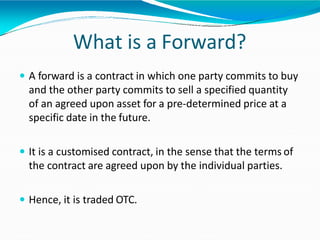
 A forward is a contract in which one party commits to buy
and the other party commits to sell a specified quantity
of an agreed upon asset for a pre-determined price at a
specific date in the future.
 It is a customised contract, in the sense that the terms of
the contract are agreed upon by the individual parties.
 Hence, it is traded OTC.
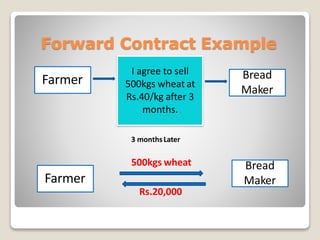
Forward Contract Example
I agree to sell
500kgs wheat at
Rs.40/kg after 3
months.
Farmer Bread
Maker
3 monthsLater
Farmer
Bread
Maker
500kgs wheat
Rs.20,000
What are Futures?
 A future is a standardised forward contract.
 It is traded on an organised exchange.
 Standardisations-
- quantity of underlying
- quality of underlying(not required in financial futures)
- delivery dates and procedure
- price quotes
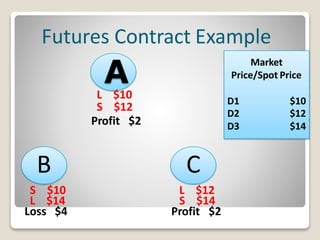
Futures Contract Example
A
B
S $10
L $14
C
L $12
S $14
L $10
S $12
Profit $2
Loss $4 Profit $2
Market
Price/Spot Price
D1 $10
D2 $12
D3 $14
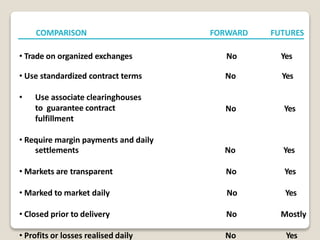
COMPARISON FORWARD FUTURES
• Trade on organized exchanges No Yes
• Use standardized contract terms No Yes
• Use associate clearinghouses
to guarantee contract
fulfillment
No Yes
• Require margin payments and daily
settlements No Yes
• Markets are transparent No Yes
• Marked to market daily No Yes
• Closed prior to delivery No Mostly
• Profits or losses realised daily No Yes
What are Options?
 Contracts that give the holder the option to buy/sell
specified quantity of the underlying assets at a
particular price on or before a specified time period.
 The word “option” means that the holder has the
right but not the obligation to buy/sell underlying
assets.
Types of Options
(cont.)
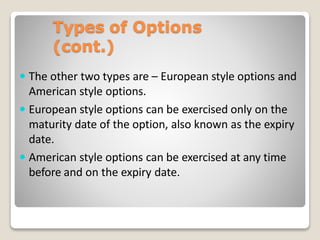
 The other two types are – European style options and
American style options.
 European style options can be exercised only on the
maturity date of the option, also known as the expiry
date.
 American style options can be exercised at any time
before and on the expiry date.
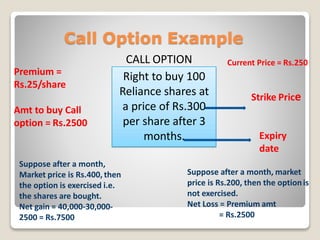
Call Option Example
Right to buy 100
Reliance shares at
a price of Rs.300
per share after 3
months.
CALL OPTION
Strike Price
Premium =
Rs.25/share
Amt to buy Call
option = Rs.2500
Current Price = Rs.250
Suppose after a month,
Market price is Rs.400, then
the option is exercised i.e.
the shares are bought.
Net gain = 40,000-30,000-
2500 = Rs.7500
Suppose after a month, market
price is Rs.200, then the optionis
not exercised.
Net Loss = Premium amt
= Rs.2500
Expiry
date
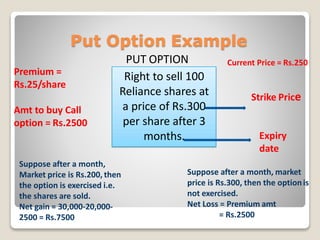
Put Option Example
Right to sell 100
Reliance shares at
a price of Rs.300
per share after 3
months.
PUT OPTION
Strike Price
Premium =
Rs.25/share
Amt to buy Call
option = Rs.2500
Current Price = Rs.250
Suppose after a month,
Market price is Rs.200, then
the option is exercised i.e.
the shares are sold.
Net gain = 30,000-20,000-
2500 = Rs.7500
Suppose after a month, market
price is Rs.300, then the optionis
not exercised.
Net Loss = Premium amt
= Rs.2500
Expiry
date
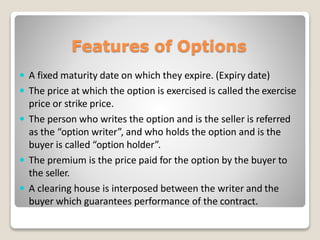
Features of Options
 A fixed maturity date on which they expire. (Expiry date)
 The price at which the option is exercised is called the exercise
price or strike price.
 The person who writes the option and is the seller is referred
as the “option writer”, and who holds the option and is the
buyer is called “option holder”.
 The premium is the price paid for the option by the buyer to
the seller.
 A clearing house is interposed between the writer and the
buyer which guarantees performance of the contract.
Options Terminology
(cont.)
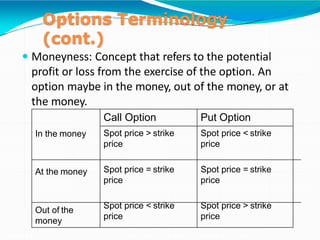
 Moneyness: Concept that refers to the potential
profit or loss from the exercise of the option. An
option maybe in the money, out of the money, or at
the money.
In the money
Call Option Put Option
Spot price > strike
price
Spot price < strike
price
At the money Spot price = strike
price
Spot price = strike
price
Out of the
money
Spot price < strike
price
Spot price > strike
price
What are SWAPS?
 In a swap, two counter parties agree to enter into a
contractual agreement wherein they agree to exchange
cash flows at periodic intervals.
 Most swaps are traded “Over The Counter”.
 Some are also traded on futures exchange market.
Types of
Swaps
There are 2 main types of swaps:
 Plain vanilla fixed for floating
swaps or simply interest rate
swaps.
 Fixed for fixed currency
swaps or simply currency
swaps.
What is an Interest Rate
Swap?
 A company agrees to pay a pre-determined fixed interest
rate on a notional principal for a fixed number of years.
 In return, it receives interest at a floating rate on the
same notional principal for the same period of time.
 The principal is not exchanged. Hence, it is called a
notional amount.
Floating Interest
Rate
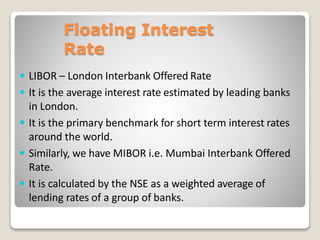
 LIBOR – London Interbank Offered Rate
 It is the average interest rate estimated by leading banks
in London.
 It is the primary benchmark for short term interest rates
around the world.
 Similarly, we have MIBOR i.e. Mumbai Interbank Offered
Rate.
 It is calculated by the NSE as a weighted average of
lending rates of a group of banks.
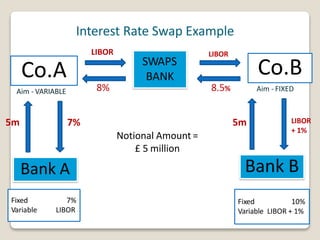
Interest Rate Swap Example
Co.A Co.BSWAPS
BANK
Bank A
Fixed
Variable
7%
LIBOR
Bank B
Fixed 10%
Variable LIBOR + 1%
Aim - VARIABLE Aim - FIXED
LIBOR LIBOR
8% 8.5%
7%5m 5m LIBOR
+ 1%
Notional Amount =
£ 5 million
What is a Currency Swap?
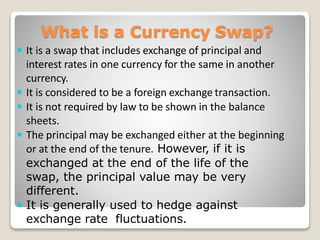
 It is a swap that includes exchange of principal and
interest rates in one currency for the same in another
currency.
 It is considered to be a foreign exchange transaction.
 It is not required by law to be shown in the balance
sheets.
 The principal may be exchanged either at the beginning
or at the end of the tenure. However, if it is
exchanged at the end of the life of the
swap, the principal value may be very
different.
 It is generally used to hedge against
exchange rate fluctuations.
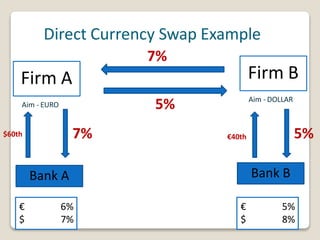
Direct Currency Swap Example
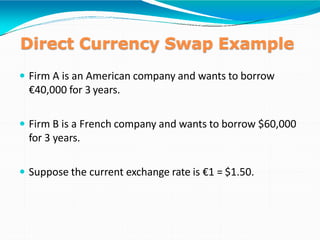
 Firm A is an American company and wants to borrow
€40,000 for 3 years.
 Firm B is a French company and wants to borrow $60,000
for 3 years.
 Suppose the current exchange rate is €1 = $1.50.
Direct Currency Swap Example
Firm A Firm B
Bank A Bank B
€ 6% € 5%
$ 7% $ 8%
Aim - EURO
Aim - DOLLAR
7%
5%
7% 5%$60th €40th
Comparative Advantage
 Firm A has a comparative advantage in borrowing
Dollars.
 Firm B has a comparative advantage in borrowing Euros.
 This comparative advantage helps in reducing borrowing
cost and hedging against exchange rate fluctuations.

Financial derivative

  • 1.
    Forward and FuturesContract  Presented By: Zeshan Arshad
  • 2.
    What are Derivatives? A derivative is a financial instrument whose value is derived from the value of another asset, which is known as the underlying.  When the price of the underlying changes, the value of the derivative also changes.  A Derivative is not a product. It is a contract that derives its value from changes in the price of the underlying. Example : The value of a gold futures contract is derived from the value of the underlying asset i.e. Gold.
  • 3.
    What is aForward?  A forward is a contract in which one party commits to buy and the other party commits to sell a specified quantity of an agreed upon asset for a pre-determined price at a specific date in the future.  It is a customised contract, in the sense that the terms of the contract are agreed upon by the individual parties.  Hence, it is traded OTC.
  • 4.
    Forward Contract Example Iagree to sell 500kgs wheat at Rs.40/kg after 3 months. Farmer Bread Maker 3 monthsLater Farmer Bread Maker 500kgs wheat Rs.20,000
  • 5.
    What are Futures? A future is a standardised forward contract.  It is traded on an organised exchange.  Standardisations- - quantity of underlying - quality of underlying(not required in financial futures) - delivery dates and procedure - price quotes
  • 6.
    Futures Contract Example A B S$10 L $14 C L $12 S $14 L $10 S $12 Profit $2 Loss $4 Profit $2 Market Price/Spot Price D1 $10 D2 $12 D3 $14
  • 7.
    COMPARISON FORWARD FUTURES •Trade on organized exchanges No Yes • Use standardized contract terms No Yes • Use associate clearinghouses to guarantee contract fulfillment No Yes • Require margin payments and daily settlements No Yes • Markets are transparent No Yes • Marked to market daily No Yes • Closed prior to delivery No Mostly • Profits or losses realised daily No Yes
  • 8.
    What are Options? Contracts that give the holder the option to buy/sell specified quantity of the underlying assets at a particular price on or before a specified time period.  The word “option” means that the holder has the right but not the obligation to buy/sell underlying assets.
  • 9.
    Types of Options (cont.) The other two types are – European style options and American style options.  European style options can be exercised only on the maturity date of the option, also known as the expiry date.  American style options can be exercised at any time before and on the expiry date.
  • 10.
    Call Option Example Rightto buy 100 Reliance shares at a price of Rs.300 per share after 3 months. CALL OPTION Strike Price Premium = Rs.25/share Amt to buy Call option = Rs.2500 Current Price = Rs.250 Suppose after a month, Market price is Rs.400, then the option is exercised i.e. the shares are bought. Net gain = 40,000-30,000- 2500 = Rs.7500 Suppose after a month, market price is Rs.200, then the optionis not exercised. Net Loss = Premium amt = Rs.2500 Expiry date
  • 11.
    Put Option Example Rightto sell 100 Reliance shares at a price of Rs.300 per share after 3 months. PUT OPTION Strike Price Premium = Rs.25/share Amt to buy Call option = Rs.2500 Current Price = Rs.250 Suppose after a month, Market price is Rs.200, then the option is exercised i.e. the shares are sold. Net gain = 30,000-20,000- 2500 = Rs.7500 Suppose after a month, market price is Rs.300, then the optionis not exercised. Net Loss = Premium amt = Rs.2500 Expiry date
  • 12.
    Features of Options A fixed maturity date on which they expire. (Expiry date)  The price at which the option is exercised is called the exercise price or strike price.  The person who writes the option and is the seller is referred as the “option writer”, and who holds the option and is the buyer is called “option holder”.  The premium is the price paid for the option by the buyer to the seller.  A clearing house is interposed between the writer and the buyer which guarantees performance of the contract.
  • 13.
    Options Terminology (cont.)  Moneyness:Concept that refers to the potential profit or loss from the exercise of the option. An option maybe in the money, out of the money, or at the money. In the money Call Option Put Option Spot price > strike price Spot price < strike price At the money Spot price = strike price Spot price = strike price Out of the money Spot price < strike price Spot price > strike price
  • 14.
    What are SWAPS? In a swap, two counter parties agree to enter into a contractual agreement wherein they agree to exchange cash flows at periodic intervals.  Most swaps are traded “Over The Counter”.  Some are also traded on futures exchange market.
  • 15.
    Types of Swaps There are2 main types of swaps:  Plain vanilla fixed for floating swaps or simply interest rate swaps.  Fixed for fixed currency swaps or simply currency swaps.
  • 16.
    What is anInterest Rate Swap?  A company agrees to pay a pre-determined fixed interest rate on a notional principal for a fixed number of years.  In return, it receives interest at a floating rate on the same notional principal for the same period of time.  The principal is not exchanged. Hence, it is called a notional amount.
  • 17.
    Floating Interest Rate  LIBOR– London Interbank Offered Rate  It is the average interest rate estimated by leading banks in London.  It is the primary benchmark for short term interest rates around the world.  Similarly, we have MIBOR i.e. Mumbai Interbank Offered Rate.  It is calculated by the NSE as a weighted average of lending rates of a group of banks.
  • 18.
    Interest Rate SwapExample Co.A Co.BSWAPS BANK Bank A Fixed Variable 7% LIBOR Bank B Fixed 10% Variable LIBOR + 1% Aim - VARIABLE Aim - FIXED LIBOR LIBOR 8% 8.5% 7%5m 5m LIBOR + 1% Notional Amount = £ 5 million
  • 19.
    What is aCurrency Swap?  It is a swap that includes exchange of principal and interest rates in one currency for the same in another currency.  It is considered to be a foreign exchange transaction.  It is not required by law to be shown in the balance sheets.  The principal may be exchanged either at the beginning or at the end of the tenure. However, if it is exchanged at the end of the life of the swap, the principal value may be very different.  It is generally used to hedge against exchange rate fluctuations.
  • 20.
    Direct Currency SwapExample  Firm A is an American company and wants to borrow €40,000 for 3 years.  Firm B is a French company and wants to borrow $60,000 for 3 years.  Suppose the current exchange rate is €1 = $1.50.
  • 21.
    Direct Currency SwapExample Firm A Firm B Bank A Bank B € 6% € 5% $ 7% $ 8% Aim - EURO Aim - DOLLAR 7% 5% 7% 5%$60th €40th
  • 22.
    Comparative Advantage  FirmA has a comparative advantage in borrowing Dollars.  Firm B has a comparative advantage in borrowing Euros.  This comparative advantage helps in reducing borrowing cost and hedging against exchange rate fluctuations.