Ectoparasites
Dr.Bimochan Poudel
NVC:1188
• Ectoparasite: A parasite that lives on or in the
skin but not inside the animal body. Fleas ,
lice, ticks etc. are ectoparasites. Infestation
with an ectoparasite is called an
ectoparasitosis.
• Arthropoda is a greek word meaning ‘arthros’-
joint; ‘podos’-foot which refers to the fact that
members of Phylum Arthropoda have jointed
limbs.
• Ticks (kirna )
• Mites ( Sulsule )
• Flea ( Upiya )
• Lice (Jumra )
• Files (jhinga )
• MORPHOLOGY
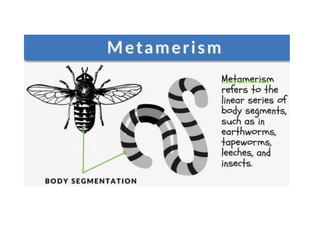
• Arthropods are metamerically-segmented
• The segments of arthropods are associated in
groups, the anterior segments form the head,
the middle ones -the thorax and the posterior
ones- the abdomen
• The hard outer covering of arthropod is made of
chitin, it forms the Exoskeleton which covers the
external surface of the body
• A complete digestive system with a mouth and
an anus.
• Most arthropods are either male or female
Ticks
INTRODUCTION
• Ticks are amongst the most important vectors of human and animal diseases
• They rank second to mosquitoes as vectors of life threatening or debilitating human and
animal diseases
• Amongst the arthropod group they transmit greater variety of infectious diseases. and
even surpass mosquitoes in the variety of pathogenic organisms (bacteria, virus,
rickettsiae, protozoa etc.) transmitted
• In addition to their vector potentiality they are important as pests-causing tick
paralysis, toxicosis, irritation, bite allergies, immune responses and economic losses due
to blood loss
• They are obligate blood sucking arthropods and nearly 850 species are known worldwide
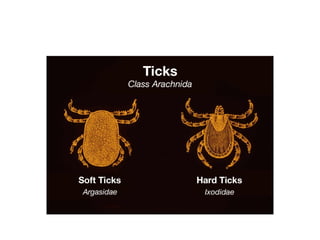
• The major families are:
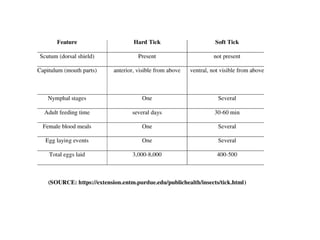
o Ixodidae or ‘Hard ticks’
o Argasidae or ‘Soft ticks’
• They infest every class of terrestrial vertebrate, mammals, birds, reptiles and even
amphibia
Life cycle : Eggs – Larvae- nymph - Adult
MORPHOLOGY
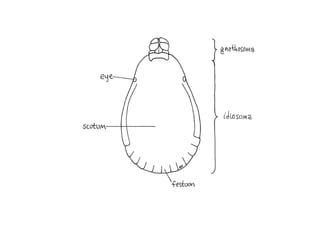
• Body is usually elongated, longer than wide.
•Size : Range from 2 mm to even 30 mm in size.
• When engorged female ticks appear swollen and
more rounded. Body consist of
• Capitulum (=Gnathosoma)
• Idiosoma
Legs : Are jointed and articulate with the body via
the coxae.
• Larva can be easily recognized because it has 3
pairs of legs, nymphs and adults have 4 pairs.
• Family : Argasidae ( Soft Ticks)
• Genus: Argas, Otobius , Ornithodoros
• Species A. persicus O. megnini O. savignyi
• IXODIDAE – HARD TICKS
• Boophilus microplus - ONE HOST TICK (TROPICAL
CATTLE TICK)
-Acts as a vector for Babesia bigemina in cattle
• Boophilus annulatus - ONE HOST TICK
Acts as vector for Babesia bigemina in cattle
• Haemaphysalis bispinosa - THREE HOST TICK
Acts as vector of Babesia gibsoni in dogs, Babesia
and Theileria of sheep
Pathogenesis
• Ticks injure animals by their direct biting process.
The bite is painful and it annoys the host especially
cattle and dogs.
• Ticks suck blood and heavy infestation results in
anaemia due to heavy loss of blood.
• Ticks damage the hide , there is inflammation,
swelling, ulceration and itching.
• Dermatitis results due to the tick bite
Mites
• Mites that infest and parasitize domestic animals cause disease and loss of
production.
• Mites are small invertebrates, most of which are free living but some are parasitic.
Mites are similar to ticks and both comprise the order Acari in the phylum
Arthropoda. Mites are highly varied and their classification is complex; a simple
grouping is used in this introductory article.
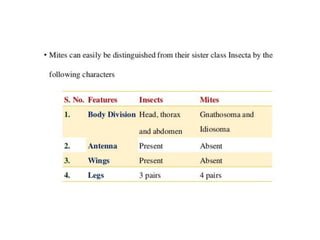
• Mites and ticks have substantially different biology from, and are classed
separately from, insects (the class Insecta). Mites of domestic animals cause
important types of skin disease, and some mites infest other organs.
• Diagnosis of mite infestations can be difficult because of the small size of most
mites, but understanding how mites are adapted to feed within the structure of
the skin is useful.
• Psoroptes ovis infests sheep worldwide and can be a serious welfare and animal
production problem, mainly for sheep, but also cattle. Psoroptes cuniculi infests
rabbits, mainly on their outer ear. Chorioptes bovis infestations are found on
cattle, sheep and horses but do not cause the severe reactions associated
with Psoroptes mites. Other common psoroptic mites are in the
genera Chorioptes and Otodectes. Otodectes cynotis infestations in the ears of
dogs are a common problem.
• Hosts : Domestic animals ( Sheep , goat , cattle
, horses , dog , cats ) , Birds and even human
Morphology
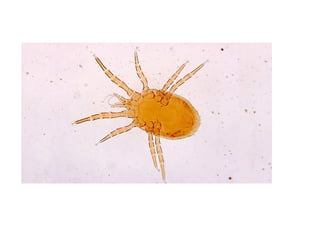
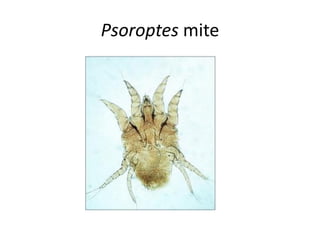
• Mites are very small sized acarines (body size
ranges from 0.5-2.0 mm in length)
• Body is divided into two parts : Gnathosoma
and Idiosoma
• It is wingless
• Legs are 4 in pair
Pathogenesis
• Itch or mange mites (Psoroptes, Sarcoptes) feed on the
surface or burrow within the skin, making very slender,
winding tunnels from 0.1 to 1 inch long.
• There is formation of nodules in the skin .
• Mites secreates toxins which causes intense irritation
and itching. Infested animals rub and scratch
continuously.
• Infestations are contagious, and treatment of all
animals in a herd is essential to achieve control.
• Hair fall
• Terms to describe diseases caused by mites include
scab, mange, and scabies.
Psoroptes mite
Life cycle of mites
• Egg- larva – nymph - adult
Fleas
• Flea, the common name for the order Siphonaptera,
includes 2,500 species of small flightless insects that survive
as external parasites of mammals and birds. Fleas live by
consuming blood, or hematophagy, from their hosts.
Morphology :
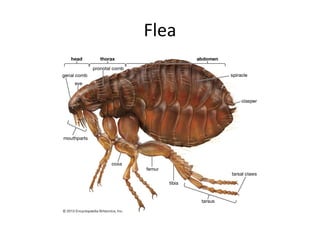
• Adult fleas grow to about 3 millimetres (1⁄8 inch) long, are
usually brown, and have bodies that are "flattened"
sideways or narrow,
• They lack wings, but have strong claws preventing them
from being dislodged, mouthparts adapted for piercing skin
and sucking blood, and hind legs extremely well adapted for
jumping.
• Abdomen : 10 segments
• Legs : 3 Pairs
Flea
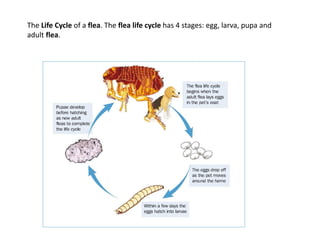
The Life Cycle of a flea. The flea life cycle has 4 stages: egg, larva, pupa and
adult flea.
Effect of Fleas in the animal body
• Local inflammation of the skin
• Bite allergy to animal
• Hypersensitivity
• Itching , Scratching and dermatitis
Lice
• Numerous species of lice parasitize domestic animals. Lice are
largely host specific, living on one species or several closely related
species.
• Lice are obligate ectoparasites and depend on the host to complete
their life cycle. Recent taxonomic changes have complicated the
orders and suborders of lice.
• In general, lice are divided into two categories: bloodsucking (or
sucking) lice and chewing (or biting) lice
• Bloodsucking lice are parasites of mammals, whereas chewing lice
infest both mammals and birds.
• Lice live within the microenvironment provided by the skin and its
hair or feathers, and are transmitted primarily by contact between
hosts.
• All life stages occur on the host, although lice may survive off the
host for a period of time
Lice
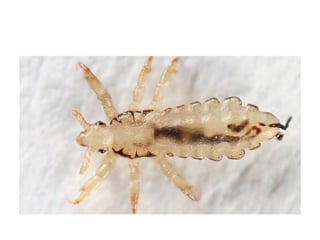
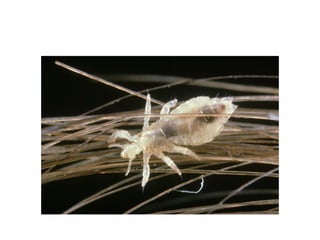
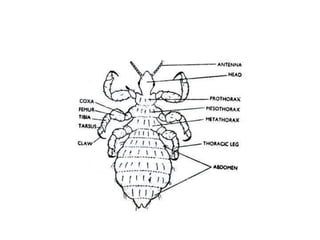
• Lice are wingless, flattened insects, usually 2–4
mm long, although the species infesting animals
may range from 1–8 mm long.
• The claws of the legs are adapted for adhering to
and moving among hairs or feathers; This
characteristic plays an important role in host
specificity.
• The mouthparts also aid in attachment to the
host. Chewing lice feed on epidermal debris,
primarily skin scales, sebaceous secretions, and
feathers, if applicable.
Life cycle
• The life cycle of the head louse has three
stages: egg, nymph, and adult.
• There can be 10-12 generations a year. A
blood meal is essential for the development
and survivorship for all sucking lice, while
chewing lice can survive several days off the
host.
Animals Attacked:
• Livestock, birds, pets, humans; young, old and sick animals
are more susceptible
Veterinary Impact:
• A small host can only support a small number of lice before
adverse effects lead to its demise but a large host
(livestock) can have more than a million lice and still be
healthy.
• A large number of lice can be debilitating to an animal.
• They can cause anemia, dermatitis, allergic responses, hair
loss and other disorders which can be costly to the livestock
industry.
• Causes restlessness, pruritus, anemia, low weight gain, low
milk yield, dermatitis, hide or fleece damage, skin crusting
or scabbing, and lameness.
Flies
• Flies belong to the order Diptera, a large, complex order of insects.
• Most members of this order have two wings (one pair) as adults.
However, there are a few wingless dipterans.
• Dipterans vary greatly in size, food source preference, and in the
developmental stage that parasitizes the animal or produces
pathology.
• As adults, flies may intermittently feed on vertebrate blood or on
saliva, tears, or mucus. These are referred to as periodic parasites
and may serve as intermediate hosts for helminth parasites or for
protozoan parasites.
• They may also alternately feed both on feces and on food and may
possibly serve as vectors for bacteria, viruses, spirochetes,
chlamydiae, etc.
• As larvae (maggots), dipterans may develop in the subcutaneous
tissues of the skin, respiratory passages, or GI tract of vertebrate
hosts and produce a condition known as myiasis.
Flies
• Infestations of Fly Maggots
• Fly maggot infestation, Myiasis, is the presence of
fly larvae in the living host. Several kinds of
maggots infest the wounds of warm-blooded
animals; however, the only one that feeds
exclusively on live flesh is the primary
screwworm. Sterile male releases have irradiated
the primary screwworm fly from the Southeast,
but there is constant danger of reinfestation.
• Biting flies feed on animal blood. This group
includes mosquitoes, black flies, sand flies, biting
midges, horse flies, deer flies, and others
• Nonbiting flies include those that do not feed on
blood and do not actually bite the host animal
while feeding. Instead, these flies feed on bodily
secretions. Examples include face flies, head flies,
filth-breeding flies (such as the common house
fly), and eye gnats.
Maggots (Myiasis, Fly Strike)
• Maggot infestation is also known as myiasis, fly strike,
or simply strike. House flies, bot flies, blow flies, bottle
flies, and flesh flies will lay eggs in skin wounds of any
animal (including a dog) that has an infected skin
wound. In newborn puppies, the healing stub of the
umbilical cord is an attractive egg-laying site for flies.
• Affected dogs often have raised, red sores at or near
the strike site. Maggots may be visible in a sore or
wound. In most cases, your pet will have to be sedated
or anesthetized for removal of the larvae.
• Diagnosis: Finding maggots in a sore or wound is the
normal method of diagnosis.
Morphology
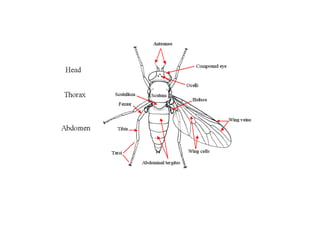
• Morphology of a fly (dorsal view): flying insect of which
there are numerous species, most of them noxious.
Compound eye: complex organ of sight.
Head: foremost part of a fly.
Arista: sensory organ composed of bristling hairs.
Antenna: organ of touch of a fly.
Prescutum: plate covering the upper front thorax.
Scutum: plate covering the upper middle thorax.
Scutellum: plate covering the upper rear thorax.
Abdominal segment: part of the abdomen.
Abdomen: rear part of a fly.
Mesothorax: central part of the thorax.
Wing: organ of aerial locomotion.
• Flies acts as vector for disease transmission
• Maggots of Flies when infested in animal ,
they feed the tissue layer around.. Damage
the organ and multiply rapidly which is painful
to the animal
• Biting flies, i.e. bloodsucking: the damaging stage is the adult fly. They suck blood, stress the animals and transmit
diseases. The most important groups are:
• Black flies, gnats, mainly Simulium spp. Ocur worldwide and can be a regional problem for grazing livestock
in endemic regions.
• Horn flies, Haematobia irritans. Occurs worldwide and is one of the most damaging external parasites of cattle.
Significant resistance problems.
• Horse and deer flies, Tabanus spp, Chrysops spp, Haematopota spp, etc. Occur worldwide and attack all kinds of
mammals.
• Horse louse flies, Hippobosca spp. Occur mainly in Africa, Asia and parts of Eastern and Mediterranean Europe.
Attack mainly horses.
• Stable flies, Stomoxys calcitrans. Occurs worldwide and is a significant parasite of cattle and pig, but will bite any
mammals, and even birds.
• Tsetse flies, Glossina spp. The most damaging parasitic fly of cattle in Africa.
• Non-biting filth & nuisance flies: they transmit diseases and stress the animals. The most important groups are:
• Face flies, Musca autumnalis. A moderate problem in cattle, mainly in the Northern Hemisphere.
• Head flies, Hydrotaea irritans. A problem in sheep in certain regions, mainlyin Europe and Asia.
• Houseflies, Musca domestica. Occurs worldwide: the most cosmopolitan fly species. Can cause
serious problems in pig, poultry and dairy and feedlot facilities. Significant resistance problems.
• Filth & nuisance flies, Fannia cannicularis, Muscina stabulans, Ophyra spp, Sarcophaga spp, etc. Can cause
moderate problems in pig, poultry and dairy and feedlot facilities.
• Myiasis causing flies: the damage is caused by the maggots (larvae) that feed on the host's tissues.
Adult flies are non-biting flies. The most important groups are:
• Blowflies, Lucilia spp, Phormia spp, etc. One of the most damaging external parasites
of sheep in Australia, New Zealand, UK, Ireland and South Africa. Significant resistance problems.
• Horse bot flies, Gasterophilus spp. A common gastrointestinal parasite of horses, donkeys and
other equids worldwide.
• Human bot flies, Dermatobia hominis. A serious parasite of livestock, pets and humans in tropical
and subtropical Latin America.
• Nasal bot flies, Oestrus ovis. A frequent parasite of sheep worldwide.
• Screwworm flies, Cochliomyia hominivorax, Chrysomya bezziana. Found worldwide mainly in
tropical and subtropical regions. The most damaging myiasis of livestock. Has been eradicated in
North America and parts of Central America.
• Warble flies, cattle grubs, Hypoderma spp. Frequent in the Northern Hemisphere on cattle.
• Wohlfahrtia magnifica. Frequent around the Mediterranean and Asia, mainly on sheep.

Ectoparasites : Ticks , Mites , Fleas , Flies

  • 1.
  • 2.
    • Ectoparasite: Aparasite that lives on or in the skin but not inside the animal body. Fleas , lice, ticks etc. are ectoparasites. Infestation with an ectoparasite is called an ectoparasitosis.
  • 3.
    • Arthropoda isa greek word meaning ‘arthros’- joint; ‘podos’-foot which refers to the fact that members of Phylum Arthropoda have jointed limbs.
  • 4.
    • Ticks (kirna) • Mites ( Sulsule ) • Flea ( Upiya ) • Lice (Jumra ) • Files (jhinga )
  • 5.
    • MORPHOLOGY • Arthropodsare metamerically-segmented • The segments of arthropods are associated in groups, the anterior segments form the head, the middle ones -the thorax and the posterior ones- the abdomen • The hard outer covering of arthropod is made of chitin, it forms the Exoskeleton which covers the external surface of the body • A complete digestive system with a mouth and an anus. • Most arthropods are either male or female
  • 7.
    Ticks INTRODUCTION • Ticks areamongst the most important vectors of human and animal diseases • They rank second to mosquitoes as vectors of life threatening or debilitating human and animal diseases • Amongst the arthropod group they transmit greater variety of infectious diseases. and even surpass mosquitoes in the variety of pathogenic organisms (bacteria, virus, rickettsiae, protozoa etc.) transmitted • In addition to their vector potentiality they are important as pests-causing tick paralysis, toxicosis, irritation, bite allergies, immune responses and economic losses due to blood loss • They are obligate blood sucking arthropods and nearly 850 species are known worldwide • The major families are: o Ixodidae or ‘Hard ticks’ o Argasidae or ‘Soft ticks’ • They infest every class of terrestrial vertebrate, mammals, birds, reptiles and even amphibia Life cycle : Eggs – Larvae- nymph - Adult
  • 11.
    MORPHOLOGY • Body isusually elongated, longer than wide. •Size : Range from 2 mm to even 30 mm in size. • When engorged female ticks appear swollen and more rounded. Body consist of • Capitulum (=Gnathosoma) • Idiosoma Legs : Are jointed and articulate with the body via the coxae. • Larva can be easily recognized because it has 3 pairs of legs, nymphs and adults have 4 pairs.
  • 12.
    • Family :Argasidae ( Soft Ticks) • Genus: Argas, Otobius , Ornithodoros • Species A. persicus O. megnini O. savignyi
  • 13.
    • IXODIDAE –HARD TICKS • Boophilus microplus - ONE HOST TICK (TROPICAL CATTLE TICK) -Acts as a vector for Babesia bigemina in cattle • Boophilus annulatus - ONE HOST TICK Acts as vector for Babesia bigemina in cattle • Haemaphysalis bispinosa - THREE HOST TICK Acts as vector of Babesia gibsoni in dogs, Babesia and Theileria of sheep
  • 14.
    Pathogenesis • Ticks injureanimals by their direct biting process. The bite is painful and it annoys the host especially cattle and dogs. • Ticks suck blood and heavy infestation results in anaemia due to heavy loss of blood. • Ticks damage the hide , there is inflammation, swelling, ulceration and itching. • Dermatitis results due to the tick bite
  • 15.
    Mites • Mites thatinfest and parasitize domestic animals cause disease and loss of production. • Mites are small invertebrates, most of which are free living but some are parasitic. Mites are similar to ticks and both comprise the order Acari in the phylum Arthropoda. Mites are highly varied and their classification is complex; a simple grouping is used in this introductory article. • Mites and ticks have substantially different biology from, and are classed separately from, insects (the class Insecta). Mites of domestic animals cause important types of skin disease, and some mites infest other organs. • Diagnosis of mite infestations can be difficult because of the small size of most mites, but understanding how mites are adapted to feed within the structure of the skin is useful. • Psoroptes ovis infests sheep worldwide and can be a serious welfare and animal production problem, mainly for sheep, but also cattle. Psoroptes cuniculi infests rabbits, mainly on their outer ear. Chorioptes bovis infestations are found on cattle, sheep and horses but do not cause the severe reactions associated with Psoroptes mites. Other common psoroptic mites are in the genera Chorioptes and Otodectes. Otodectes cynotis infestations in the ears of dogs are a common problem.
  • 17.
    • Hosts :Domestic animals ( Sheep , goat , cattle , horses , dog , cats ) , Birds and even human
  • 18.
    Morphology • Mites arevery small sized acarines (body size ranges from 0.5-2.0 mm in length) • Body is divided into two parts : Gnathosoma and Idiosoma • It is wingless • Legs are 4 in pair
  • 20.
    Pathogenesis • Itch ormange mites (Psoroptes, Sarcoptes) feed on the surface or burrow within the skin, making very slender, winding tunnels from 0.1 to 1 inch long. • There is formation of nodules in the skin . • Mites secreates toxins which causes intense irritation and itching. Infested animals rub and scratch continuously. • Infestations are contagious, and treatment of all animals in a herd is essential to achieve control. • Hair fall • Terms to describe diseases caused by mites include scab, mange, and scabies.
  • 21.
  • 22.
    Life cycle ofmites • Egg- larva – nymph - adult
  • 23.
    Fleas • Flea, thecommon name for the order Siphonaptera, includes 2,500 species of small flightless insects that survive as external parasites of mammals and birds. Fleas live by consuming blood, or hematophagy, from their hosts. Morphology : • Adult fleas grow to about 3 millimetres (1⁄8 inch) long, are usually brown, and have bodies that are "flattened" sideways or narrow, • They lack wings, but have strong claws preventing them from being dislodged, mouthparts adapted for piercing skin and sucking blood, and hind legs extremely well adapted for jumping. • Abdomen : 10 segments • Legs : 3 Pairs
  • 24.
  • 25.
    The Life Cycleof a flea. The flea life cycle has 4 stages: egg, larva, pupa and adult flea.
  • 26.
    Effect of Fleasin the animal body • Local inflammation of the skin • Bite allergy to animal • Hypersensitivity • Itching , Scratching and dermatitis
  • 27.
    Lice • Numerous speciesof lice parasitize domestic animals. Lice are largely host specific, living on one species or several closely related species. • Lice are obligate ectoparasites and depend on the host to complete their life cycle. Recent taxonomic changes have complicated the orders and suborders of lice. • In general, lice are divided into two categories: bloodsucking (or sucking) lice and chewing (or biting) lice • Bloodsucking lice are parasites of mammals, whereas chewing lice infest both mammals and birds. • Lice live within the microenvironment provided by the skin and its hair or feathers, and are transmitted primarily by contact between hosts. • All life stages occur on the host, although lice may survive off the host for a period of time
  • 28.
    Lice • Lice arewingless, flattened insects, usually 2–4 mm long, although the species infesting animals may range from 1–8 mm long. • The claws of the legs are adapted for adhering to and moving among hairs or feathers; This characteristic plays an important role in host specificity. • The mouthparts also aid in attachment to the host. Chewing lice feed on epidermal debris, primarily skin scales, sebaceous secretions, and feathers, if applicable.
  • 32.
    Life cycle • Thelife cycle of the head louse has three stages: egg, nymph, and adult.
  • 33.
    • There canbe 10-12 generations a year. A blood meal is essential for the development and survivorship for all sucking lice, while chewing lice can survive several days off the host.
  • 34.
    Animals Attacked: • Livestock,birds, pets, humans; young, old and sick animals are more susceptible Veterinary Impact: • A small host can only support a small number of lice before adverse effects lead to its demise but a large host (livestock) can have more than a million lice and still be healthy. • A large number of lice can be debilitating to an animal. • They can cause anemia, dermatitis, allergic responses, hair loss and other disorders which can be costly to the livestock industry. • Causes restlessness, pruritus, anemia, low weight gain, low milk yield, dermatitis, hide or fleece damage, skin crusting or scabbing, and lameness.
  • 35.
    Flies • Flies belongto the order Diptera, a large, complex order of insects. • Most members of this order have two wings (one pair) as adults. However, there are a few wingless dipterans. • Dipterans vary greatly in size, food source preference, and in the developmental stage that parasitizes the animal or produces pathology. • As adults, flies may intermittently feed on vertebrate blood or on saliva, tears, or mucus. These are referred to as periodic parasites and may serve as intermediate hosts for helminth parasites or for protozoan parasites. • They may also alternately feed both on feces and on food and may possibly serve as vectors for bacteria, viruses, spirochetes, chlamydiae, etc. • As larvae (maggots), dipterans may develop in the subcutaneous tissues of the skin, respiratory passages, or GI tract of vertebrate hosts and produce a condition known as myiasis.
  • 37.
    Flies • Infestations ofFly Maggots • Fly maggot infestation, Myiasis, is the presence of fly larvae in the living host. Several kinds of maggots infest the wounds of warm-blooded animals; however, the only one that feeds exclusively on live flesh is the primary screwworm. Sterile male releases have irradiated the primary screwworm fly from the Southeast, but there is constant danger of reinfestation.
  • 38.
    • Biting fliesfeed on animal blood. This group includes mosquitoes, black flies, sand flies, biting midges, horse flies, deer flies, and others • Nonbiting flies include those that do not feed on blood and do not actually bite the host animal while feeding. Instead, these flies feed on bodily secretions. Examples include face flies, head flies, filth-breeding flies (such as the common house fly), and eye gnats.
  • 39.
    Maggots (Myiasis, FlyStrike) • Maggot infestation is also known as myiasis, fly strike, or simply strike. House flies, bot flies, blow flies, bottle flies, and flesh flies will lay eggs in skin wounds of any animal (including a dog) that has an infected skin wound. In newborn puppies, the healing stub of the umbilical cord is an attractive egg-laying site for flies. • Affected dogs often have raised, red sores at or near the strike site. Maggots may be visible in a sore or wound. In most cases, your pet will have to be sedated or anesthetized for removal of the larvae. • Diagnosis: Finding maggots in a sore or wound is the normal method of diagnosis.
  • 40.
    Morphology • Morphology ofa fly (dorsal view): flying insect of which there are numerous species, most of them noxious. Compound eye: complex organ of sight. Head: foremost part of a fly. Arista: sensory organ composed of bristling hairs. Antenna: organ of touch of a fly. Prescutum: plate covering the upper front thorax. Scutum: plate covering the upper middle thorax. Scutellum: plate covering the upper rear thorax. Abdominal segment: part of the abdomen. Abdomen: rear part of a fly. Mesothorax: central part of the thorax. Wing: organ of aerial locomotion.
  • 41.
    • Flies actsas vector for disease transmission • Maggots of Flies when infested in animal , they feed the tissue layer around.. Damage the organ and multiply rapidly which is painful to the animal
  • 42.
    • Biting flies,i.e. bloodsucking: the damaging stage is the adult fly. They suck blood, stress the animals and transmit diseases. The most important groups are: • Black flies, gnats, mainly Simulium spp. Ocur worldwide and can be a regional problem for grazing livestock in endemic regions. • Horn flies, Haematobia irritans. Occurs worldwide and is one of the most damaging external parasites of cattle. Significant resistance problems. • Horse and deer flies, Tabanus spp, Chrysops spp, Haematopota spp, etc. Occur worldwide and attack all kinds of mammals. • Horse louse flies, Hippobosca spp. Occur mainly in Africa, Asia and parts of Eastern and Mediterranean Europe. Attack mainly horses. • Stable flies, Stomoxys calcitrans. Occurs worldwide and is a significant parasite of cattle and pig, but will bite any mammals, and even birds. • Tsetse flies, Glossina spp. The most damaging parasitic fly of cattle in Africa. • Non-biting filth & nuisance flies: they transmit diseases and stress the animals. The most important groups are: • Face flies, Musca autumnalis. A moderate problem in cattle, mainly in the Northern Hemisphere. • Head flies, Hydrotaea irritans. A problem in sheep in certain regions, mainlyin Europe and Asia. • Houseflies, Musca domestica. Occurs worldwide: the most cosmopolitan fly species. Can cause serious problems in pig, poultry and dairy and feedlot facilities. Significant resistance problems. • Filth & nuisance flies, Fannia cannicularis, Muscina stabulans, Ophyra spp, Sarcophaga spp, etc. Can cause moderate problems in pig, poultry and dairy and feedlot facilities.
  • 43.
    • Myiasis causingflies: the damage is caused by the maggots (larvae) that feed on the host's tissues. Adult flies are non-biting flies. The most important groups are: • Blowflies, Lucilia spp, Phormia spp, etc. One of the most damaging external parasites of sheep in Australia, New Zealand, UK, Ireland and South Africa. Significant resistance problems. • Horse bot flies, Gasterophilus spp. A common gastrointestinal parasite of horses, donkeys and other equids worldwide. • Human bot flies, Dermatobia hominis. A serious parasite of livestock, pets and humans in tropical and subtropical Latin America. • Nasal bot flies, Oestrus ovis. A frequent parasite of sheep worldwide. • Screwworm flies, Cochliomyia hominivorax, Chrysomya bezziana. Found worldwide mainly in tropical and subtropical regions. The most damaging myiasis of livestock. Has been eradicated in North America and parts of Central America. • Warble flies, cattle grubs, Hypoderma spp. Frequent in the Northern Hemisphere on cattle. • Wohlfahrtia magnifica. Frequent around the Mediterranean and Asia, mainly on sheep.