UNIT - II
 Mechanical Modification – Principles of
soil densification – Properties of
Compacted soil,Compaction control tests,
Specification of compaction
requirements, BlastingVibrocompaction,
Dynamic Tamping and Compaction piles.

By Mamidala Prudhvi
Assistant Professor
What is densification of soil
 In geotechnical
engineering, soil compaction is the
process in which stress is applied to
a soil causes densification as air is
displaced from the pores between
the soil grains. ...
Affected soils become less able to
absorb rainfall, thus increasing runoff
and erosion
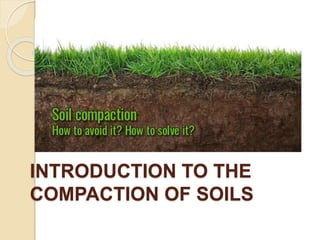
INTRODUCTION TO THE
COMPACTION OF SOILS
INTRODUCTION
Soil is used as a construction
material for constructing
embankments and
subgrades. Embankments are
constructed to raise the
ground level above the
existing level up to the
formation level to support
buildings, roads, or railways
or other structures and also to
retain water as in the case of
earth dams or canal banks
The stability and durability of the
embankments and subgrades depends on
the improvement of shear strength of the soil
as well as the restriction of settlements or
deformation within permissible limits.
The strength and deformation characteristics
of embankments and subgrades depend
directly on the density of the soil
Definition of Compaction
Compaction is the artificial and
mechanical process of decreasing
the volume of the soil rapidly by the
expulsion of air voids in the soil
resulting in the increase in density.
Densification of soil also occurs
naturally due to consolidation of
foundation soils by expulsion of pore
water due to loads from the structure.
This is a rather long-term process
compared to compaction
Principle of Compaction
.
• The principle of compaction was
developed by R. R. Proctor in 1933 during
construction of earth dams in California
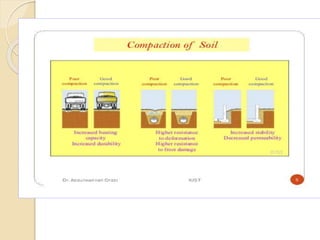
• The objective of compaction is to achieve
maximum possible dry density of the
compacted soil.
.
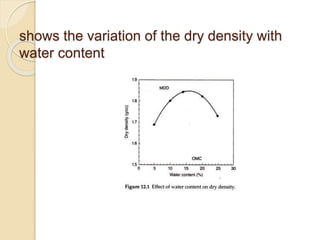
• The water content used for compaction
controls the dry density achieved
shows the variation of the dry density with
water content
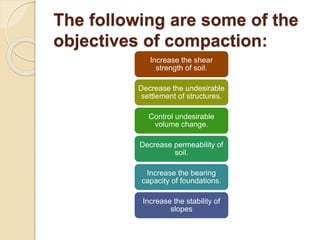
The following are some of the
objectives of compaction:
Increase the shear
strength of soil.
Decrease the undesirable
settlement of structures.
Control undesirable
volume change.
Decrease permeability of
soil.
Increase the bearing
capacity of foundations.
Increase the stability of
slopes
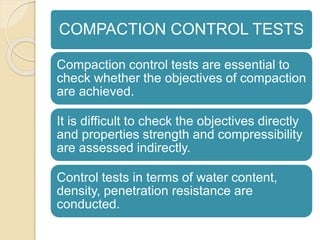
COMPACTION CONTROL TESTS
Compaction control tests are essential to
check whether the objectives of compaction
are achieved.
It is difficult to check the objectives directly
and properties strength and compressibility
are assessed indirectly.
Control tests in terms of water content,
density, penetration resistance are
conducted.
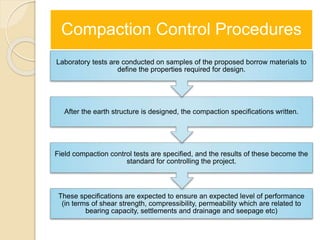
Compaction Control Procedures
These specifications are expected to ensure an expected level of performance
(in terms of shear strength, compressibility, permeability which are related to
bearing capacity, settlements and drainage and seepage etc)
Field compaction control tests are specified, and the results of these become the
standard for controlling the project.
After the earth structure is designed, the compaction specifications written.
Laboratory tests are conducted on samples of the proposed borrow materials to
define the properties required for design.
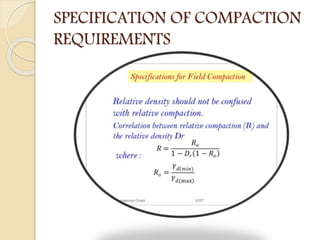
SPECIFICATION OF COMPACTION
REQUIREMENTS
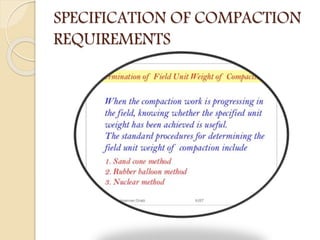
SPECIFICATION OF COMPACTION
REQUIREMENTS
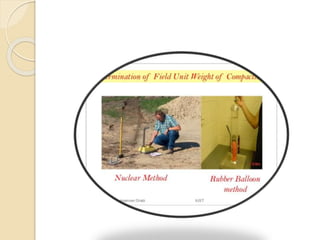
SPECIFICATION OF COMPACTION
REQUIREMENTS
SPECIFICATION OF COMPACTION
REQUIREMENTS
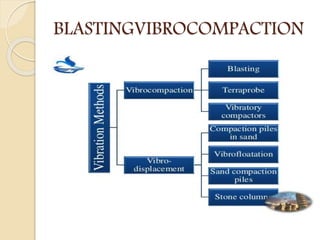
BLASTINGVIBROCOMPACTION
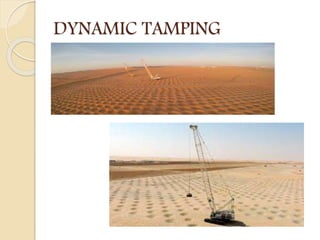
DYNAMIC TAMPING
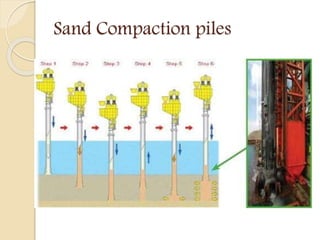
Sand Compaction piles
Unit 2 Mechanical Modification

Unit 2 Mechanical Modification

  • 1.
    UNIT - II Mechanical Modification – Principles of soil densification – Properties of Compacted soil,Compaction control tests, Specification of compaction requirements, BlastingVibrocompaction, Dynamic Tamping and Compaction piles. By Mamidala Prudhvi Assistant Professor
  • 2.
    What is densificationof soil  In geotechnical engineering, soil compaction is the process in which stress is applied to a soil causes densification as air is displaced from the pores between the soil grains. ... Affected soils become less able to absorb rainfall, thus increasing runoff and erosion
  • 3.
  • 4.
    INTRODUCTION Soil is usedas a construction material for constructing embankments and subgrades. Embankments are constructed to raise the ground level above the existing level up to the formation level to support buildings, roads, or railways or other structures and also to retain water as in the case of earth dams or canal banks
  • 5.
    The stability anddurability of the embankments and subgrades depends on the improvement of shear strength of the soil as well as the restriction of settlements or deformation within permissible limits. The strength and deformation characteristics of embankments and subgrades depend directly on the density of the soil
  • 6.
    Definition of Compaction Compactionis the artificial and mechanical process of decreasing the volume of the soil rapidly by the expulsion of air voids in the soil resulting in the increase in density. Densification of soil also occurs naturally due to consolidation of foundation soils by expulsion of pore water due to loads from the structure. This is a rather long-term process compared to compaction
  • 7.
    Principle of Compaction . •The principle of compaction was developed by R. R. Proctor in 1933 during construction of earth dams in California • The objective of compaction is to achieve maximum possible dry density of the compacted soil. . • The water content used for compaction controls the dry density achieved
  • 8.
    shows the variationof the dry density with water content
  • 9.
    The following aresome of the objectives of compaction: Increase the shear strength of soil. Decrease the undesirable settlement of structures. Control undesirable volume change. Decrease permeability of soil. Increase the bearing capacity of foundations. Increase the stability of slopes
  • 11.
    COMPACTION CONTROL TESTS Compactioncontrol tests are essential to check whether the objectives of compaction are achieved. It is difficult to check the objectives directly and properties strength and compressibility are assessed indirectly. Control tests in terms of water content, density, penetration resistance are conducted.
  • 12.
    Compaction Control Procedures Thesespecifications are expected to ensure an expected level of performance (in terms of shear strength, compressibility, permeability which are related to bearing capacity, settlements and drainage and seepage etc) Field compaction control tests are specified, and the results of these become the standard for controlling the project. After the earth structure is designed, the compaction specifications written. Laboratory tests are conducted on samples of the proposed borrow materials to define the properties required for design.
  • 14.
  • 15.
  • 16.
  • 17.
  • 19.
  • 20.
  • 22.