Flame spectrophotometry
Presented by
Mr.Karthick J.
Introduction
 Many determinations made in the clinical laboratory are based on
measurements of radiant energy
 emitted, transmitted, absorbed, scattered, or reflected under controlled
conditions.
Introduction
 Flame emission spectrophotometry
 based on the characteristic emission of light by atoms of many metallic
elements when given sufficient energy, such as that supplied by a hot flame.
 Photometry
 is defined as the measurement of light
 Spectrophotometry
 is defined as the measurement of the intensity of light at selected
wavelengths.
 For example,
 Lithium produces a red, sodium a yellow, potassium a violet, and magnesium a
blue color in a flame.
 the light intensity of the characteristic wavelength produced by each
of the atoms is directly proportional to the number of atoms that are
emitting energy, which in turn is directly proportional to the
concentration of the substance of interest in the sample.
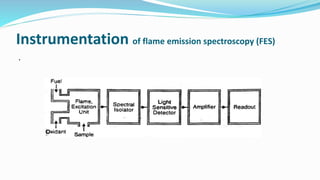
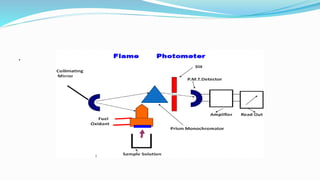
Instrumentation of flame emission spectroscopy (FES)
.
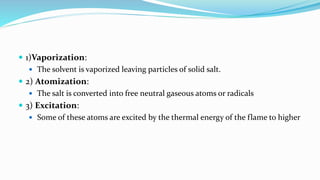
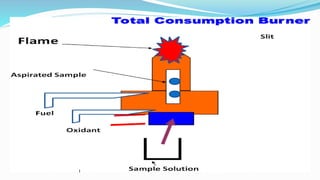
 1)Vaporization:
 The solvent is vaporized leaving particles of solid salt.
 2) Atomization:
 The salt is converted into free neutral gaseous atoms or radicals
 3) Excitation:
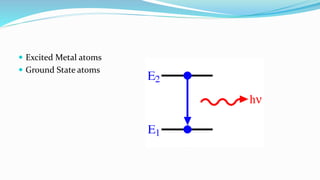
 Some of these atoms are excited by the thermal energy of the flame to higher
.
 Excited Metal atoms
 Ground State atoms
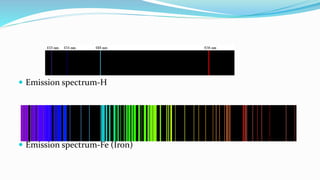
 Emission spectrum-H
 Emission spectrum-Fe (Iron)
.
Application of FES
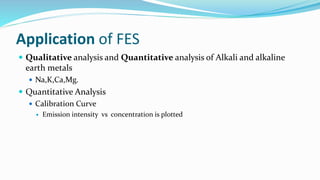
 Qualitative analysis and Quantitative analysis of Alkali and alkaline
earth metals
 Na,K,Ca,Mg.
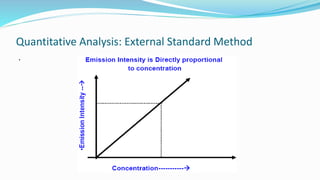
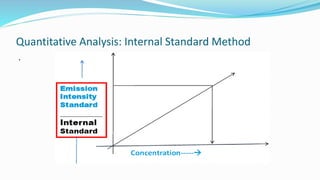
 Quantitative Analysis
 Calibration Curve
 Emission intensity vs concentration is plotted
Quantitative Analysis: External Standard Method
.
Quantitative Analysis: Internal Standard Method
.
Limitation of FES
 The number of excited atoms in flame is very small.
 It is the alkaline and alkaline earth metals that can be practically determined.
 It needs perfect control of flame temperature.
 Interference by other elements is not easy to be eliminated
 Heavy and transition metals
 the number of emission lines is enormous and the spectra are complex
 respond linearly to ion concentrations over a rather narrow concentration
range so suitable dilutions usually have to be prepared

Flame spectrophotometry.pptx

  • 1.
  • 2.
    Introduction  Many determinationsmade in the clinical laboratory are based on measurements of radiant energy  emitted, transmitted, absorbed, scattered, or reflected under controlled conditions.
  • 3.
    Introduction  Flame emissionspectrophotometry  based on the characteristic emission of light by atoms of many metallic elements when given sufficient energy, such as that supplied by a hot flame.  Photometry  is defined as the measurement of light  Spectrophotometry  is defined as the measurement of the intensity of light at selected wavelengths.  For example,  Lithium produces a red, sodium a yellow, potassium a violet, and magnesium a blue color in a flame.
  • 4.
     the lightintensity of the characteristic wavelength produced by each of the atoms is directly proportional to the number of atoms that are emitting energy, which in turn is directly proportional to the concentration of the substance of interest in the sample.
  • 5.
    Instrumentation of flameemission spectroscopy (FES) .
  • 6.
     1)Vaporization:  Thesolvent is vaporized leaving particles of solid salt.  2) Atomization:  The salt is converted into free neutral gaseous atoms or radicals  3) Excitation:  Some of these atoms are excited by the thermal energy of the flame to higher
  • 8.
  • 9.
     Excited Metalatoms  Ground State atoms
  • 10.
     Emission spectrum-H Emission spectrum-Fe (Iron)
  • 11.
  • 12.
    Application of FES Qualitative analysis and Quantitative analysis of Alkali and alkaline earth metals  Na,K,Ca,Mg.  Quantitative Analysis  Calibration Curve  Emission intensity vs concentration is plotted
  • 13.
  • 14.
  • 15.
    Limitation of FES The number of excited atoms in flame is very small.  It is the alkaline and alkaline earth metals that can be practically determined.  It needs perfect control of flame temperature.  Interference by other elements is not easy to be eliminated  Heavy and transition metals  the number of emission lines is enormous and the spectra are complex  respond linearly to ion concentrations over a rather narrow concentration range so suitable dilutions usually have to be prepared