INTRODUCTIONANDSCOPEOF
BIOINFORMATICS
PRESENTED BY
Mr.Karthick J.
INTRODUCTION
 Bioinformatics is an emerging branch of biological science that
emerged as a result of the combination of biology and
information technology.
It is a multidisciplinary subject where information technology is
incorporated by means of various computational and analytical
tools for the interpretation of biological data .
 It is a combination of various areas including Biology, Chemistry,
Mathematics, Statistics, and Computer Science. Bioinformatics is
about developing new technologies and software tools in the fields of
medicine, biological research, and biotechnology.
Bioinformatics Subfields & Related Disciplines
 The area of bioinformatics incorporates a wide range of
biotechnological sub-disciplines that are highlighted by both
scientific ethics based on biological sciences and deep
knowledge of computer science and information technology.
Bioinformatics will grow in scope and utility.
 Computational biology: The uses of data-based solutions to
the issues in bioinformatics.
Genomics: It is the branch of biomolecular biology that works
in the area of structure, function, evolution, and mapping of
genomes.
 Proteomics: The study of proteomes and their features.
 Genetics: It is the study of heredity and the gene diversity of
inherited characteristics/features.
Metagenomics: The study of genetics from the environment
and living beings and samples.
Transcriptomics: It is the study of the complete RNA and DNA
transcriptase.
Phylogenetics: The study of the relationships between groups
of animals and humans.
Metabolomics: The study of the biochemistry of metabolism
and metabolites in living beings.
Systems biology: Mathematical designing and analysis and
visualization of large sets of biodata.
Structural analysis: Modeling that determines the effects of
physical loads on physical structures.
Molecular modeling: The designing and defining of molecular
structures by way of computational chemistry.
Pathway analysis: A software description that defines related
proteins in the metabolism of the body.
The major scope and application of
bioinformatics
 To understand the function of genes
 Cell organizations and function
 Analysis of drug targets
 Examine the characteristics of various diseases
 Integration and development of various tools for the
management of biological databases.Understand life processes
in healthy and disease state
Pharmaceutical and biotech Industry
 To find (develop) new and better drugs
 Gene based or structure based drug design
Agricultural Applications
 Disease, drought resistance plants
 Higher yield crops
Management and analysis of a wide set of biological data.
 It is specially used in human genome sequencing where large
sets of data are being handled.
 Bioinformatics plays a major role in the research and
development of the biomedical field.
 Bioinformatics uses computational coding for several
applications that involve finding gene and protein functions and
sequences, developing evolutionary relationships, and
analyzing the three-dimensional shapes of proteins.
 Research works based on genetic disease and microbial
disease entirely depend on bioinformatics, where the derived
information can be vital to produce personalised medicines.
USES
 Bioinformatics is largely used in gene therapy.
This branch finds application in evolutionary concepts.
 Microbial analysis and computing.
 Understanding protein structure and modeling.
 Storage and retrieval of biotechnological data.
In the finding of new drugs.
 In agriculture to understand crop patterns, pest control,
and crop management.
 Bioinformatics is used in various fields, especially in
biomedicine where it has various applications.
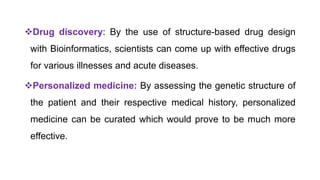
Drug discovery: By the use of structure-based drug design
with Bioinformatics, scientists can come up with effective drugs
for various illnesses and acute diseases.
Personalized medicine: By assessing the genetic structure of
the patient and their respective medical history, personalized
medicine can be curated which would prove to be much more
effective.
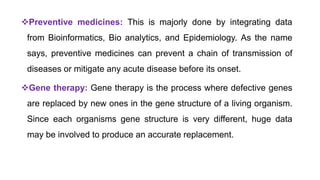
Preventive medicines: This is majorly done by integrating data
from Bioinformatics, Bio analytics, and Epidemiology. As the name
says, preventive medicines can prevent a chain of transmission of
diseases or mitigate any acute disease before its onset.
Gene therapy: Gene therapy is the process where defective genes
are replaced by new ones in the gene structure of a living organism.
Since each organisms gene structure is very different, huge data
may be involved to produce an accurate replacement.
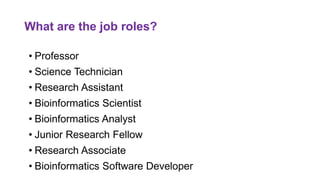
What are the job roles?
• Professor
• Science Technician
• Research Assistant
• Bioinformatics Scientist
• Bioinformatics Analyst
• Junior Research Fellow
• Research Associate
• Bioinformatics Software Developer
THANK YOU

BIOINFORMATICS.pptx

  • 1.
  • 2.
    INTRODUCTION  Bioinformatics isan emerging branch of biological science that emerged as a result of the combination of biology and information technology. It is a multidisciplinary subject where information technology is incorporated by means of various computational and analytical tools for the interpretation of biological data .
  • 3.
     It isa combination of various areas including Biology, Chemistry, Mathematics, Statistics, and Computer Science. Bioinformatics is about developing new technologies and software tools in the fields of medicine, biological research, and biotechnology.
  • 4.
    Bioinformatics Subfields &Related Disciplines  The area of bioinformatics incorporates a wide range of biotechnological sub-disciplines that are highlighted by both scientific ethics based on biological sciences and deep knowledge of computer science and information technology. Bioinformatics will grow in scope and utility.
  • 5.
     Computational biology:The uses of data-based solutions to the issues in bioinformatics. Genomics: It is the branch of biomolecular biology that works in the area of structure, function, evolution, and mapping of genomes.  Proteomics: The study of proteomes and their features.  Genetics: It is the study of heredity and the gene diversity of inherited characteristics/features. Metagenomics: The study of genetics from the environment and living beings and samples.
  • 6.
    Transcriptomics: It isthe study of the complete RNA and DNA transcriptase. Phylogenetics: The study of the relationships between groups of animals and humans. Metabolomics: The study of the biochemistry of metabolism and metabolites in living beings. Systems biology: Mathematical designing and analysis and visualization of large sets of biodata.
  • 7.
    Structural analysis: Modelingthat determines the effects of physical loads on physical structures. Molecular modeling: The designing and defining of molecular structures by way of computational chemistry. Pathway analysis: A software description that defines related proteins in the metabolism of the body.
  • 8.
    The major scopeand application of bioinformatics  To understand the function of genes  Cell organizations and function  Analysis of drug targets  Examine the characteristics of various diseases  Integration and development of various tools for the management of biological databases.Understand life processes in healthy and disease state
  • 9.
    Pharmaceutical and biotechIndustry  To find (develop) new and better drugs  Gene based or structure based drug design Agricultural Applications  Disease, drought resistance plants  Higher yield crops Management and analysis of a wide set of biological data.
  • 10.
     It isspecially used in human genome sequencing where large sets of data are being handled.  Bioinformatics plays a major role in the research and development of the biomedical field.  Bioinformatics uses computational coding for several applications that involve finding gene and protein functions and sequences, developing evolutionary relationships, and analyzing the three-dimensional shapes of proteins.  Research works based on genetic disease and microbial disease entirely depend on bioinformatics, where the derived information can be vital to produce personalised medicines.
  • 11.
    USES  Bioinformatics islargely used in gene therapy. This branch finds application in evolutionary concepts.  Microbial analysis and computing.  Understanding protein structure and modeling.  Storage and retrieval of biotechnological data.
  • 12.
    In the findingof new drugs.  In agriculture to understand crop patterns, pest control, and crop management.  Bioinformatics is used in various fields, especially in biomedicine where it has various applications.
  • 13.
    Drug discovery: Bythe use of structure-based drug design with Bioinformatics, scientists can come up with effective drugs for various illnesses and acute diseases. Personalized medicine: By assessing the genetic structure of the patient and their respective medical history, personalized medicine can be curated which would prove to be much more effective.
  • 14.
    Preventive medicines: Thisis majorly done by integrating data from Bioinformatics, Bio analytics, and Epidemiology. As the name says, preventive medicines can prevent a chain of transmission of diseases or mitigate any acute disease before its onset. Gene therapy: Gene therapy is the process where defective genes are replaced by new ones in the gene structure of a living organism. Since each organisms gene structure is very different, huge data may be involved to produce an accurate replacement.
  • 15.
    What are thejob roles? • Professor • Science Technician • Research Assistant • Bioinformatics Scientist • Bioinformatics Analyst • Junior Research Fellow • Research Associate • Bioinformatics Software Developer
  • 16.