Fixed-point arithmetic
David Barina
May 23, 2014
David Barina Fixed-point May 23, 2014 1 / 21
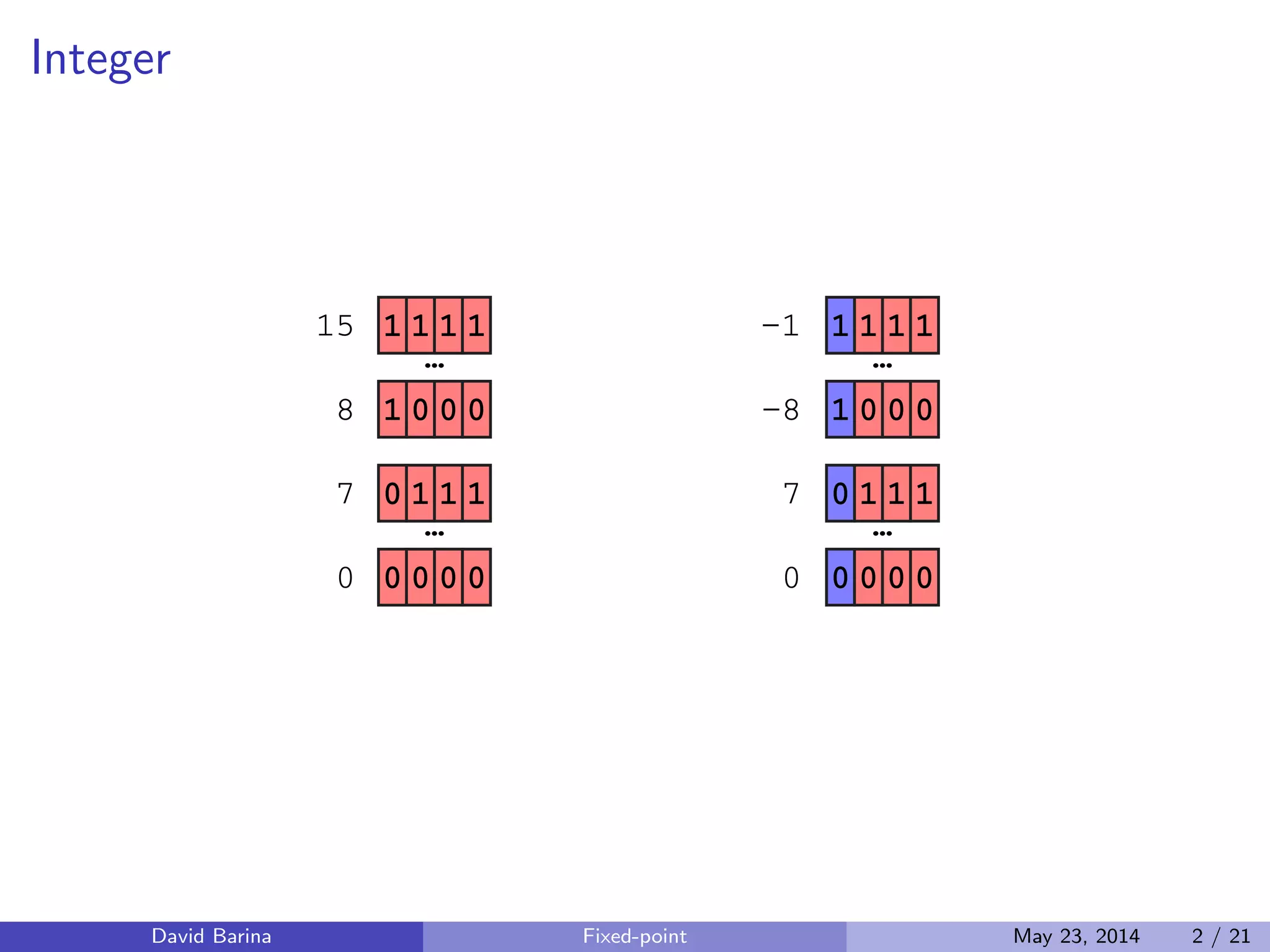
Integer
1 1 1 1
1 0 0 0
0 1 1 1
0 0 0 0
15
7
8
0
…
…
1 1 1 1
1 0 0 0
0 1 1 1
0 0 0 0
−1
7
−8
0
…
…
David Barina Fixed-point May 23, 2014 2 / 21
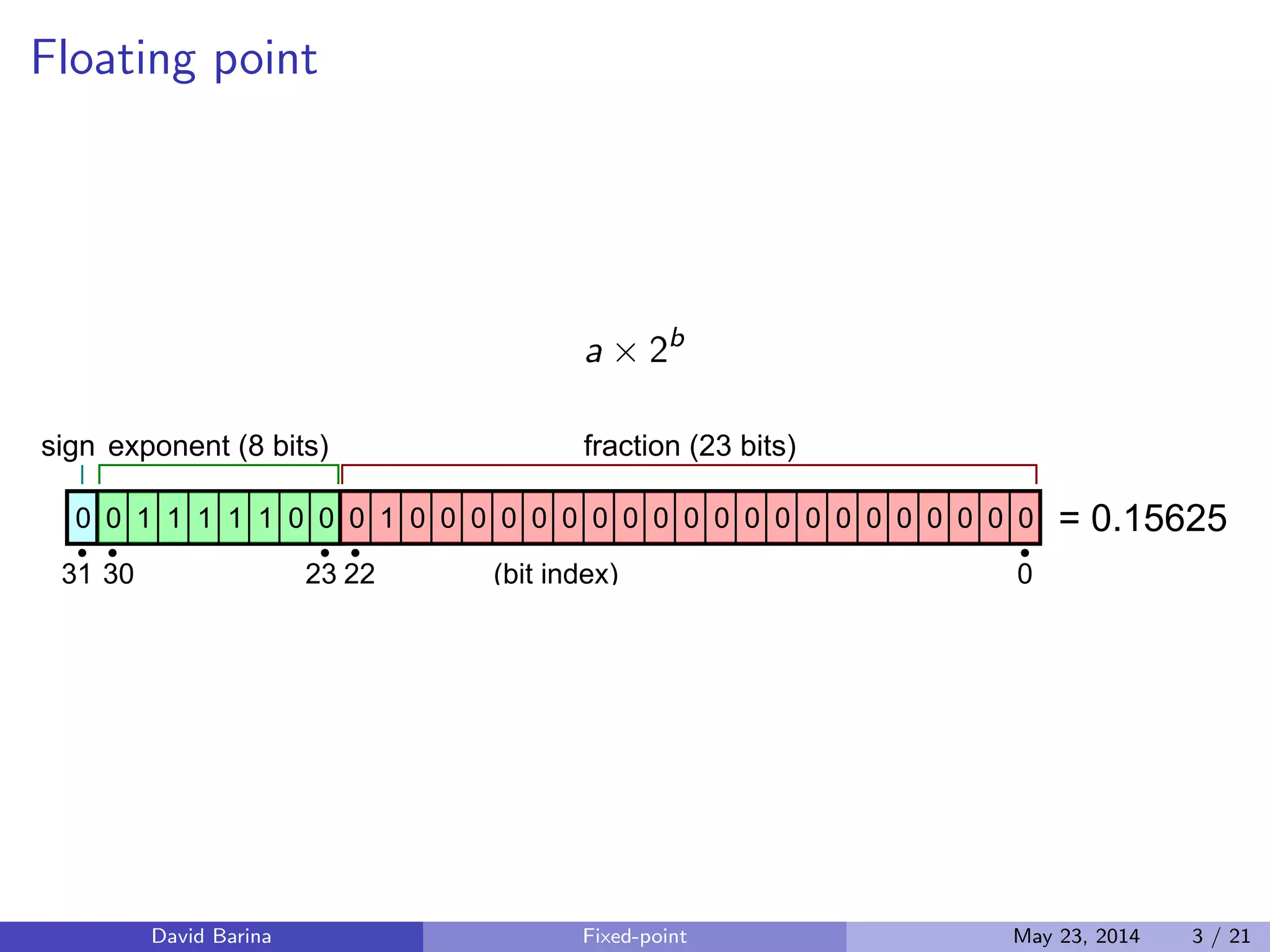
Floating point
a × 2b
sign exponent (8 bits) fraction (23 bits)
02331
0 0 1 1 1 1 1 0 0 0 1 0 0 0 0 0 0 0 0 0 0 0 0 0 0 0 0 0 0 0 0 0 = 0.15625
30 22 (bit index)
David Barina Fixed-point May 23, 2014 3 / 21
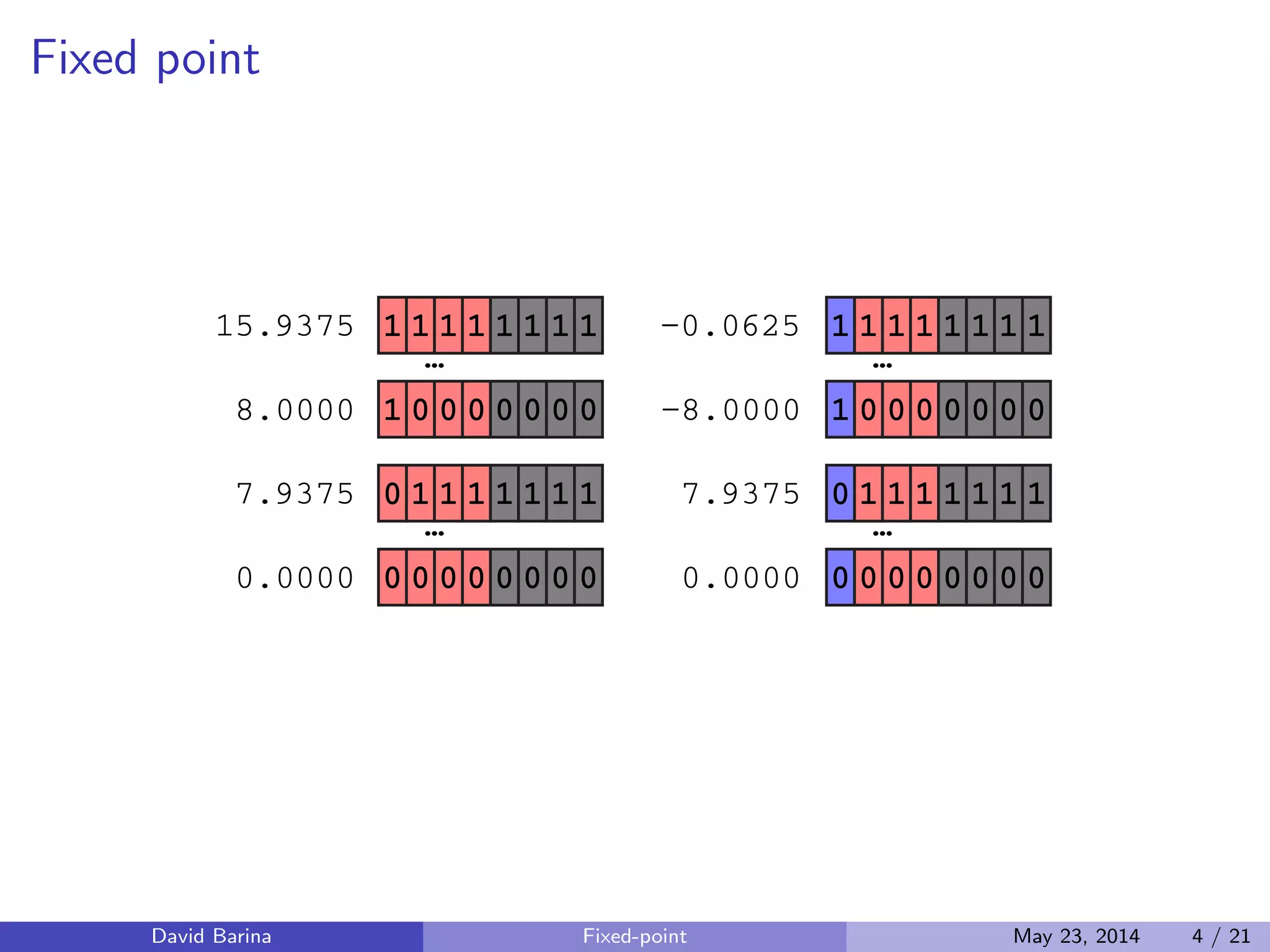
Fixed point
1 1 1 1
1 0 0 0
0 1 1 1
0 0 0 0
−0.0625
7.9375
−8.0000
0.0000
…
…
1 1 1 1
0 0 0 0
1 1 1 1
0 0 0 0
1 1 1 1
1 0 0 0
0 1 1 1
0 0 0 0
15.9375
7.9375
8.0000
0.0000
…
…
1 1 1 1
0 0 0 0
1 1 1 1
0 0 0 0
David Barina Fixed-point May 23, 2014 4 / 21
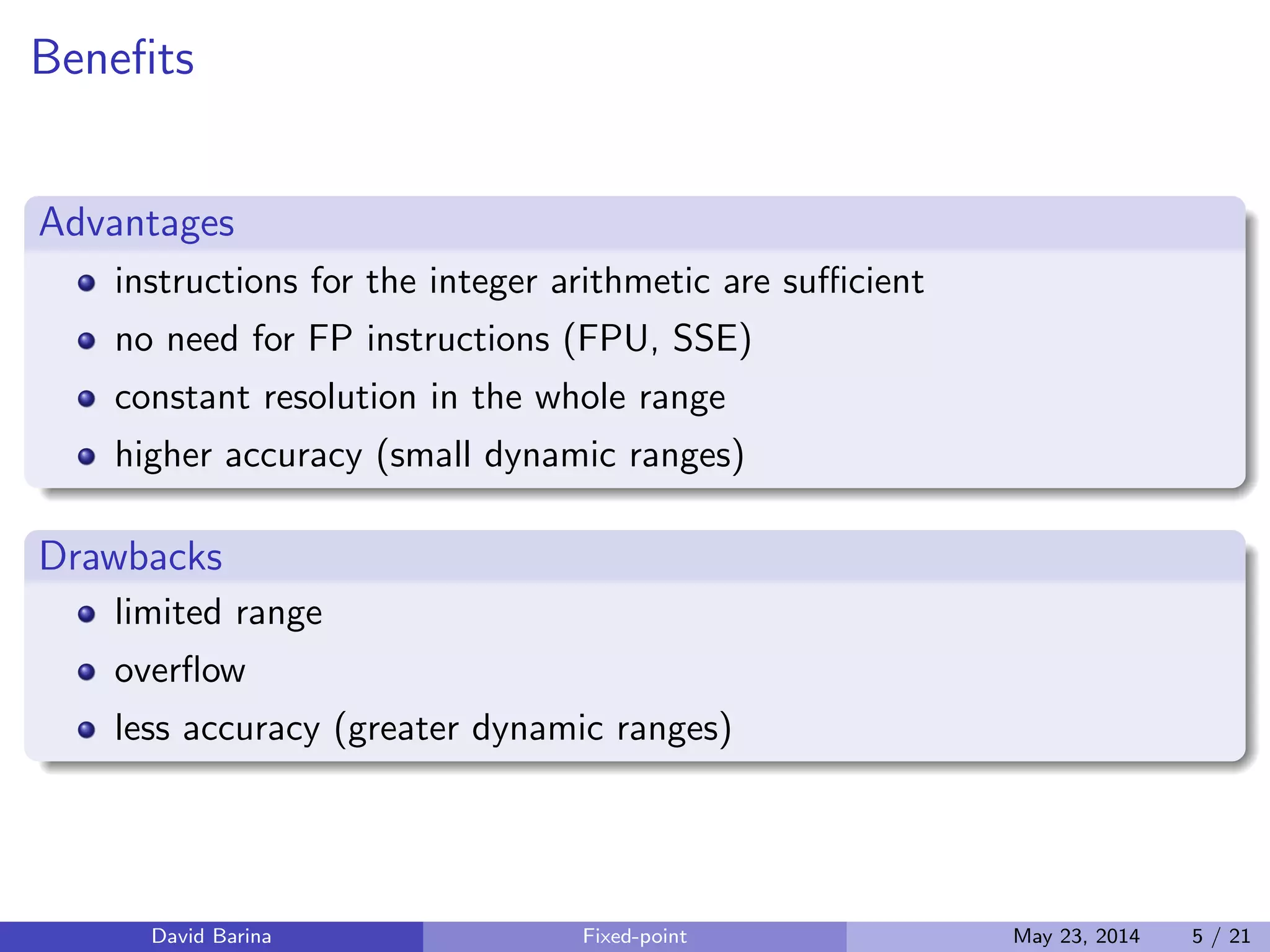
Benefits
Advantages
instructions for the integer arithmetic are sufficient
no need for FP instructions (FPU, SSE)
constant resolution in the whole range
higher accuracy (small dynamic ranges)
Drawbacks
limited range
overflow
less accuracy (greater dynamic ranges)
David Barina Fixed-point May 23, 2014 5 / 21
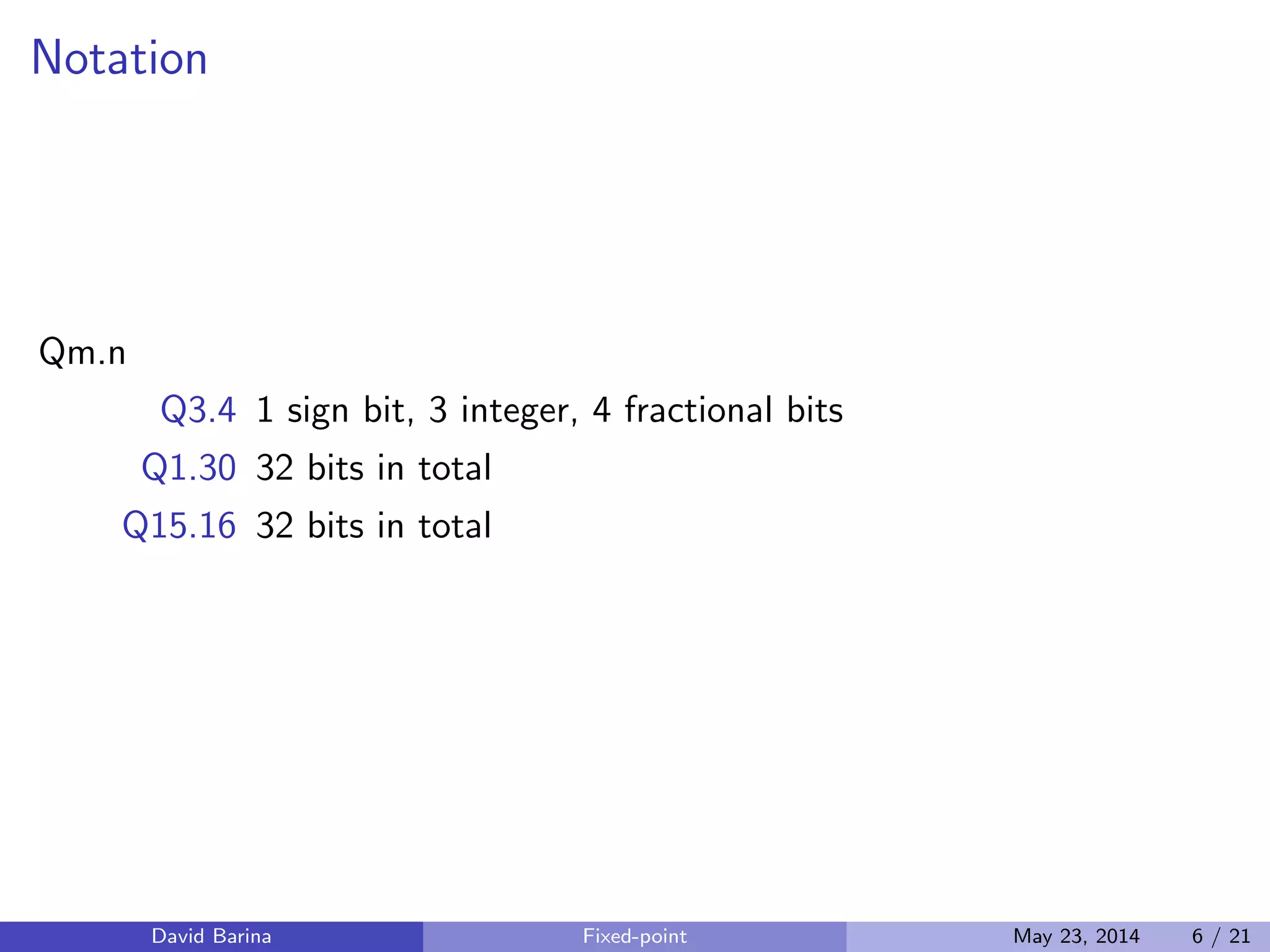
Notation
Qm.n
Q3.4 1 sign bit, 3 integer, 4 fractional bits
Q1.30 32 bits in total
Q15.16 32 bits in total
David Barina Fixed-point May 23, 2014 6 / 21
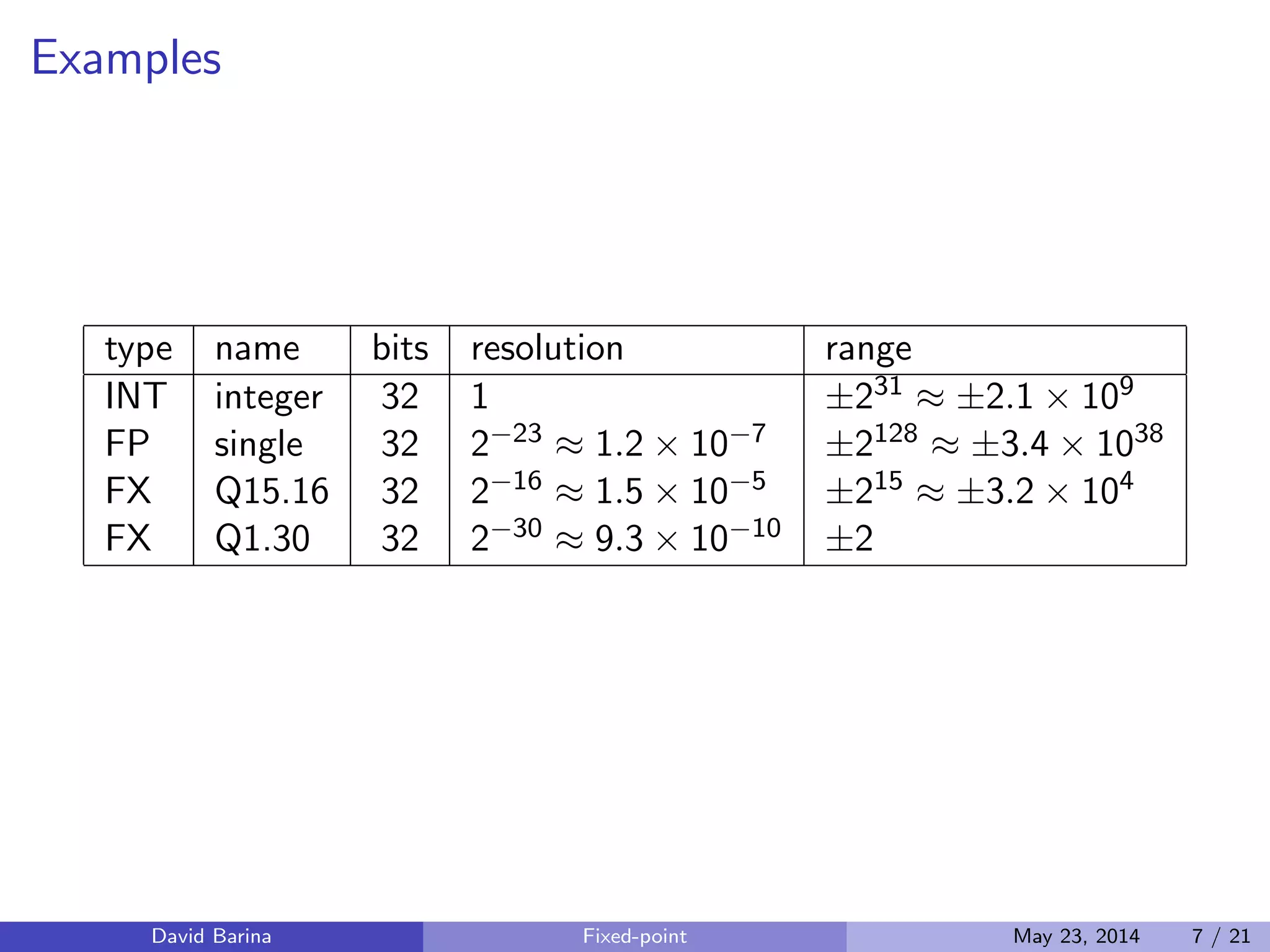
Examples
type name bits resolution range
INT integer 32 1 ±231 ≈ ±2.1 × 10⁹
FP single 32 2−23 ≈ 1.2 × 10⁻⁷ ±2128 ≈ ±3.4 × 1038
FX Q15.16 32 2−16 ≈ 1.5 × 10⁻⁵ ±215 ≈ ±3.2 × 10⁴
FX Q1.30 32 2−30 ≈ 9.3 × 10⁻¹⁰ ±2
David Barina Fixed-point May 23, 2014 7 / 21
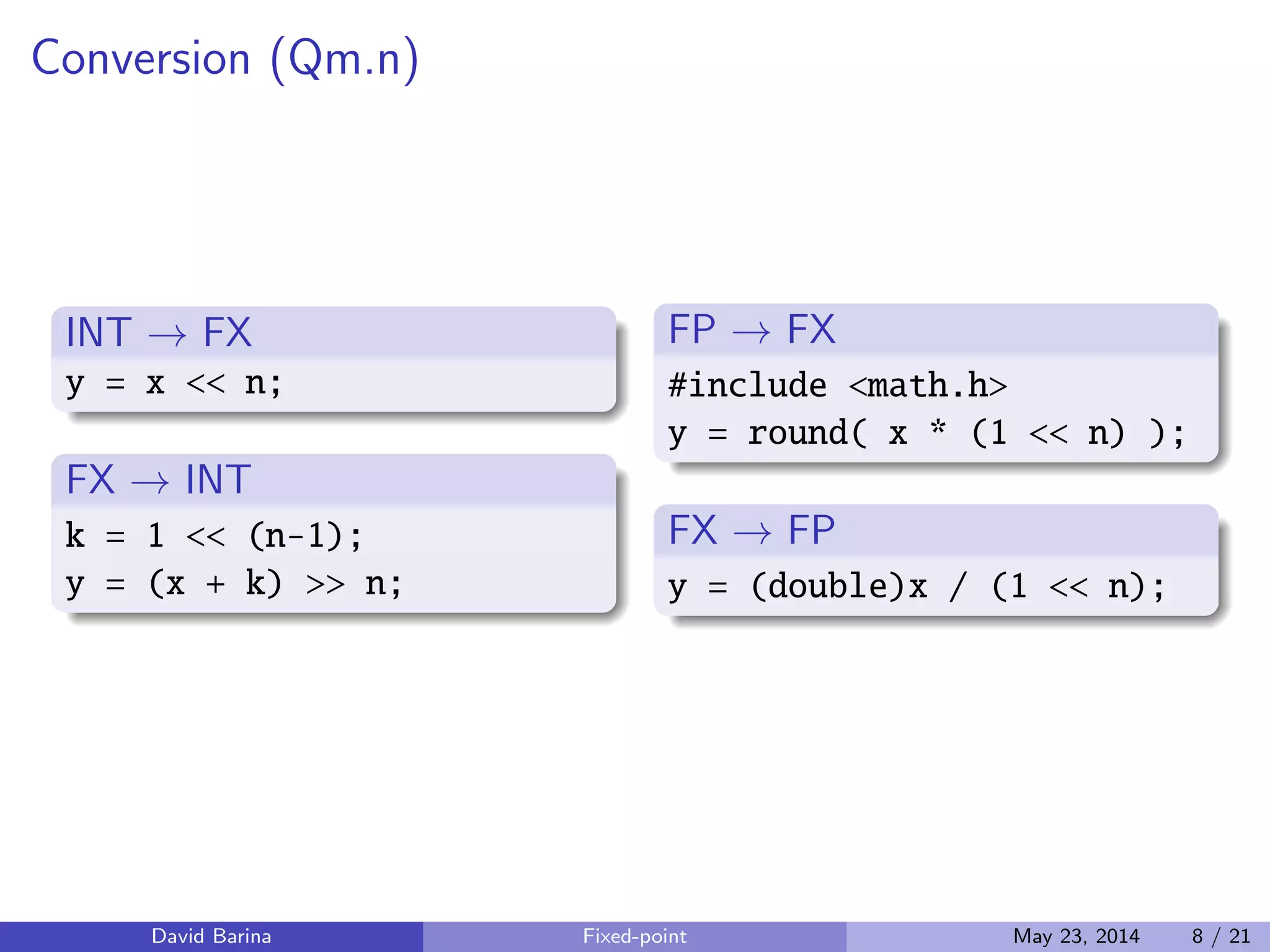
Conversion (Qm.n)
INT → FX
y = x << n;
FX → INT
k = 1 << (n-1);
y = (x + k) >> n;
FP → FX
#include <math.h>
y = round( x * (1 << n) );
FX → FP
y = (double)x / (1 << n);
David Barina Fixed-point May 23, 2014 8 / 21
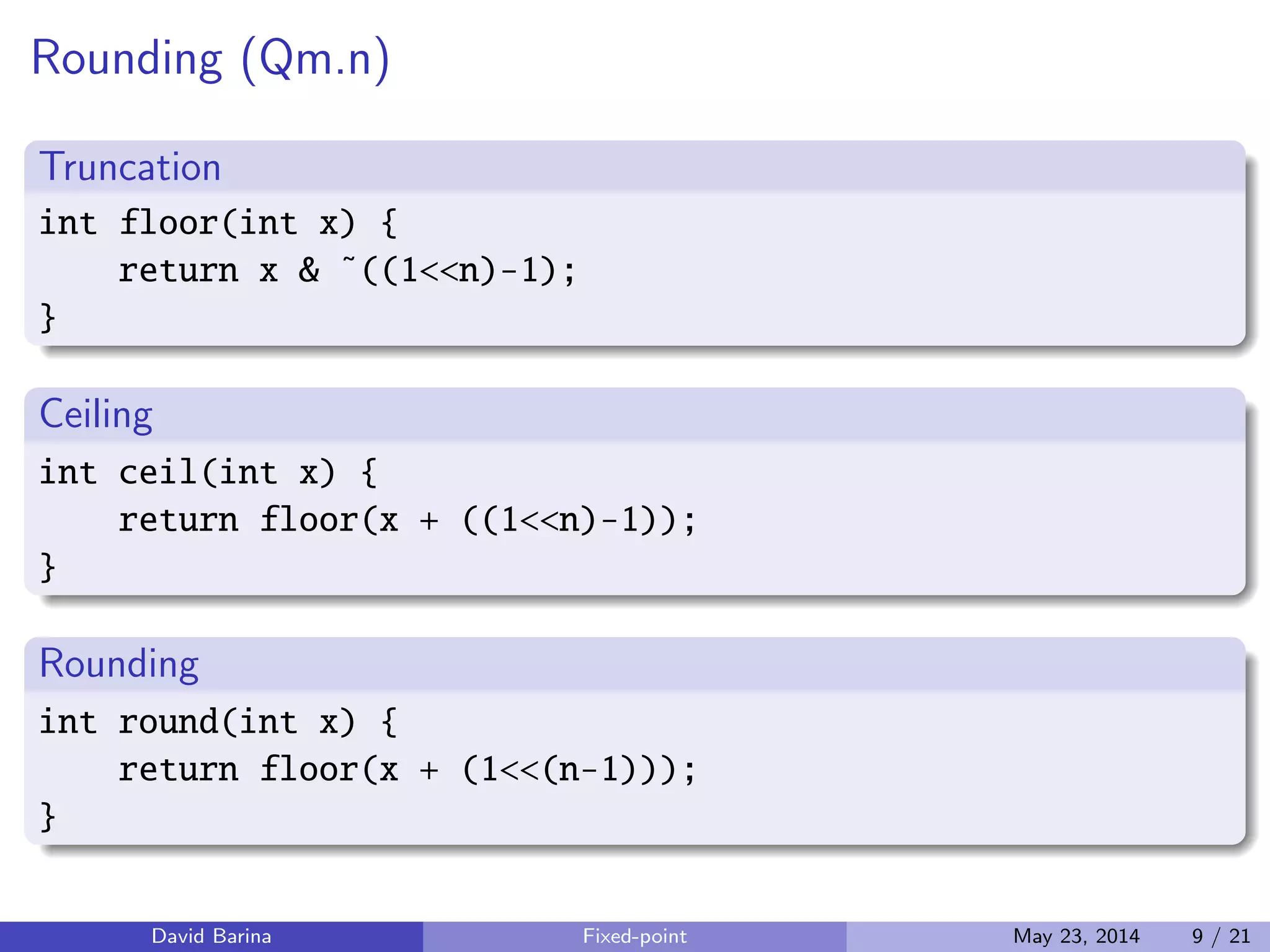
Rounding (Qm.n)
Truncation
int floor(int x) {
return x & ˜((1<<n)-1);
}
Ceiling
int ceil(int x) {
return floor(x + ((1<<n)-1));
}
Rounding
int round(int x) {
return floor(x + (1<<(n-1)));
}
David Barina Fixed-point May 23, 2014 9 / 21
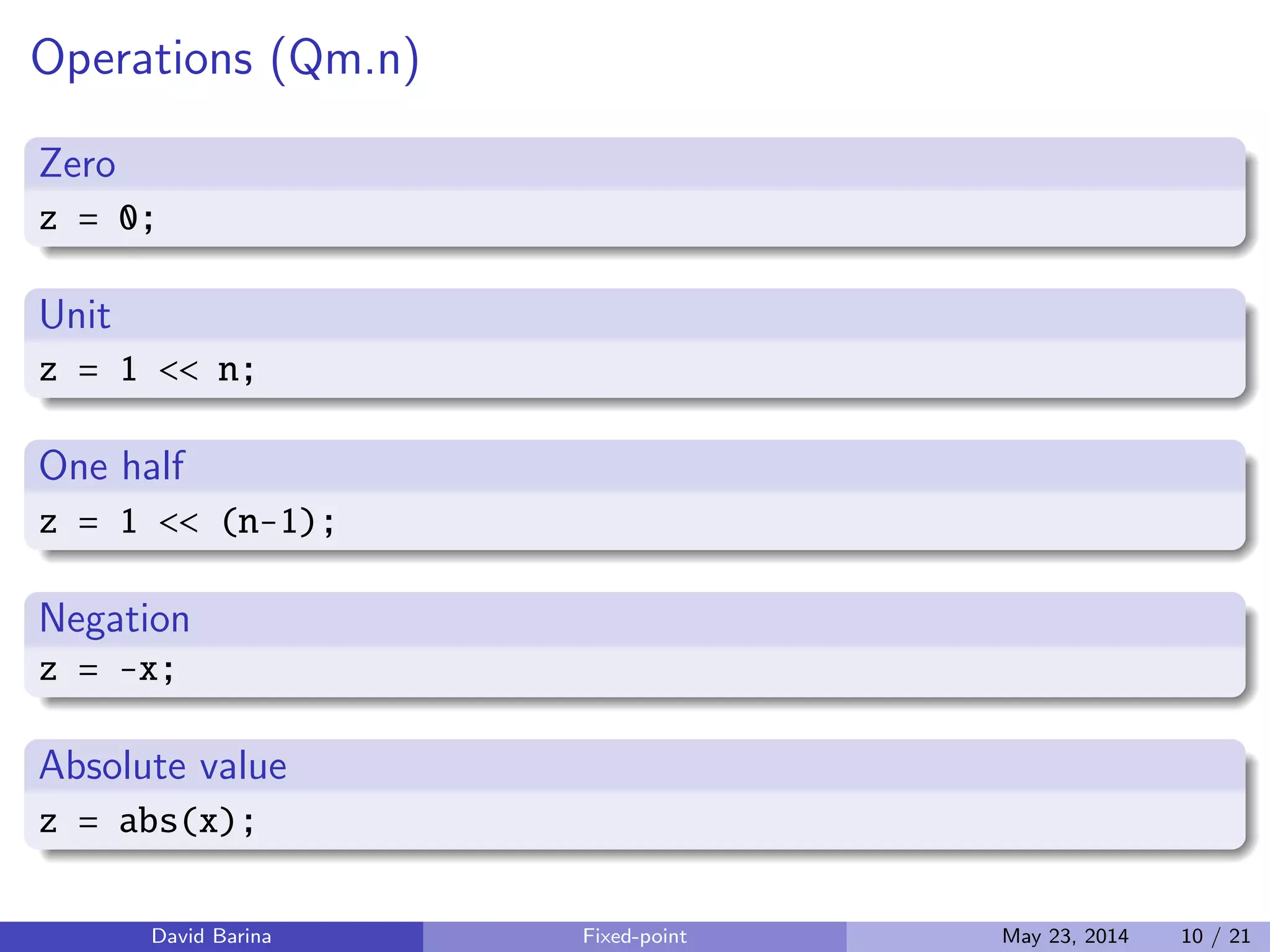
Operations (Qm.n)
Zero
z = 0;
Unit
z = 1 << n;
One half
z = 1 << (n-1);
Negation
z = -x;
Absolute value
z = abs(x);
David Barina Fixed-point May 23, 2014 10 / 21
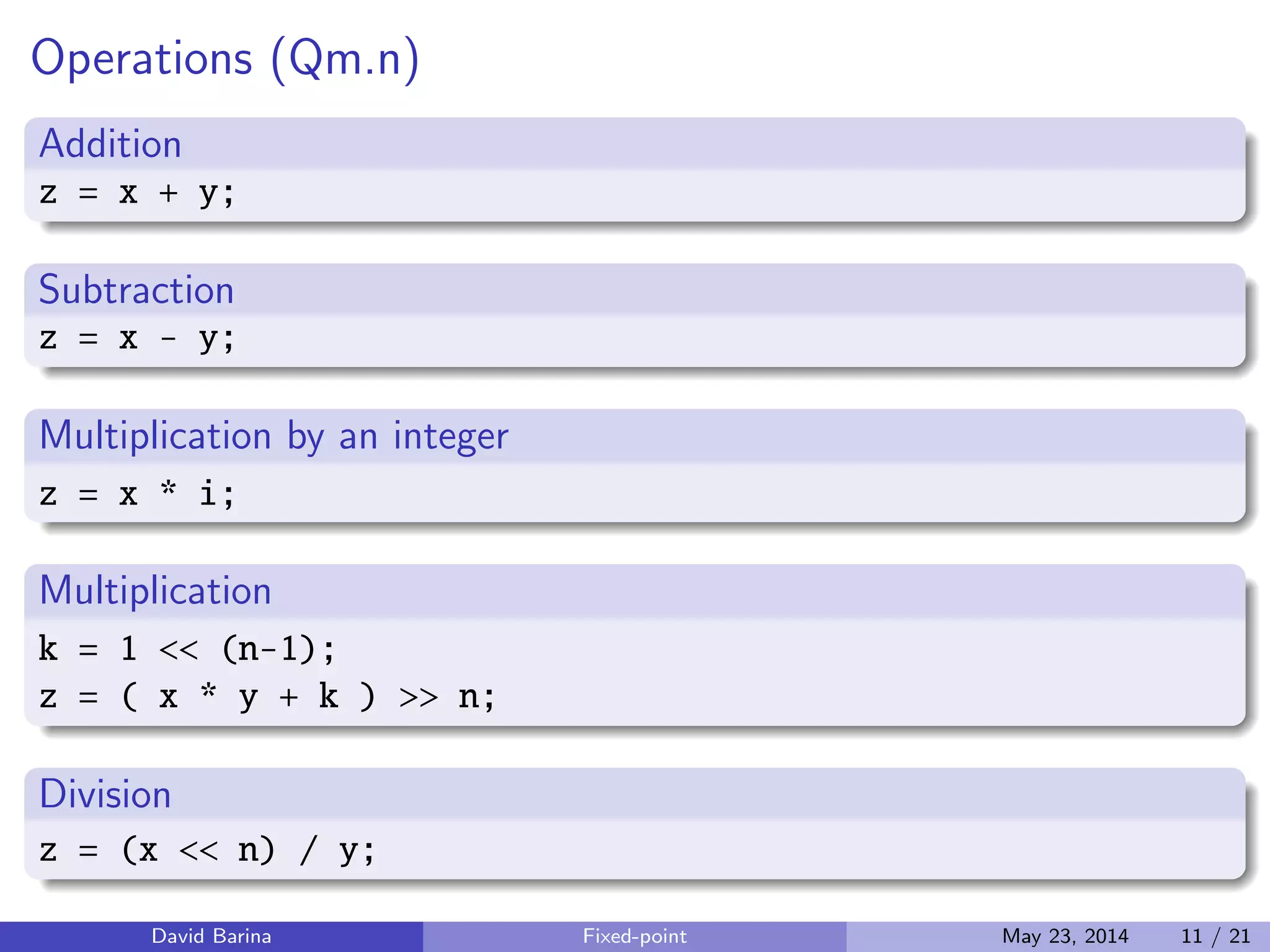
Operations (Qm.n)
Addition
z = x + y;
Subtraction
z = x - y;
Multiplication by an integer
z = x * i;
Multiplication
k = 1 << (n-1);
z = ( x * y + k ) >> n;
Division
z = (x << n) / y;
David Barina Fixed-point May 23, 2014 11 / 21
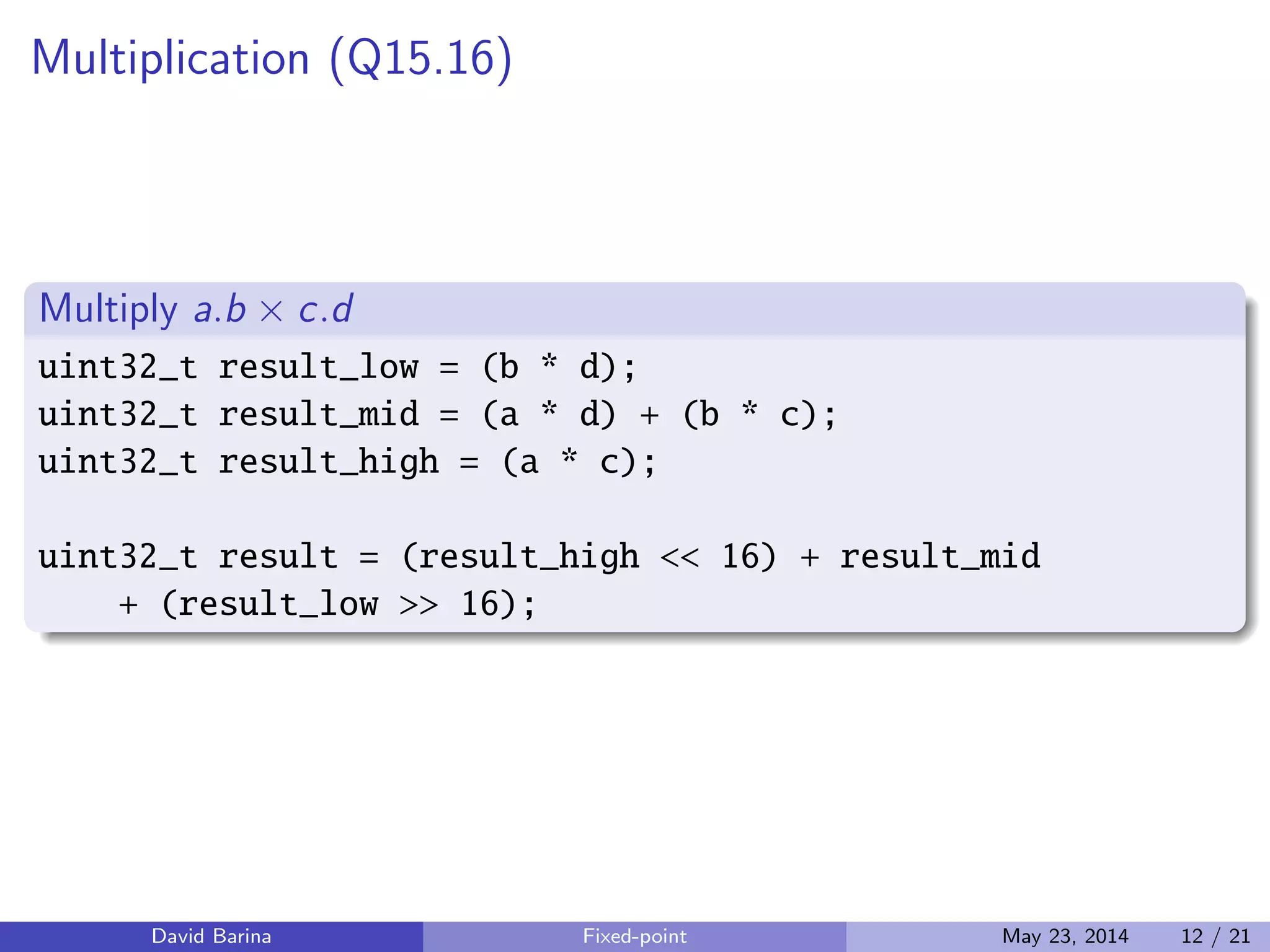
Multiplication (Q15.16)
Multiply a.b × c.d
uint32_t result_low = (b * d);
uint32_t result_mid = (a * d) + (b * c);
uint32_t result_high = (a * c);
uint32_t result = (result_high << 16) + result_mid
+ (result_low >> 16);
David Barina Fixed-point May 23, 2014 12 / 21
Trick
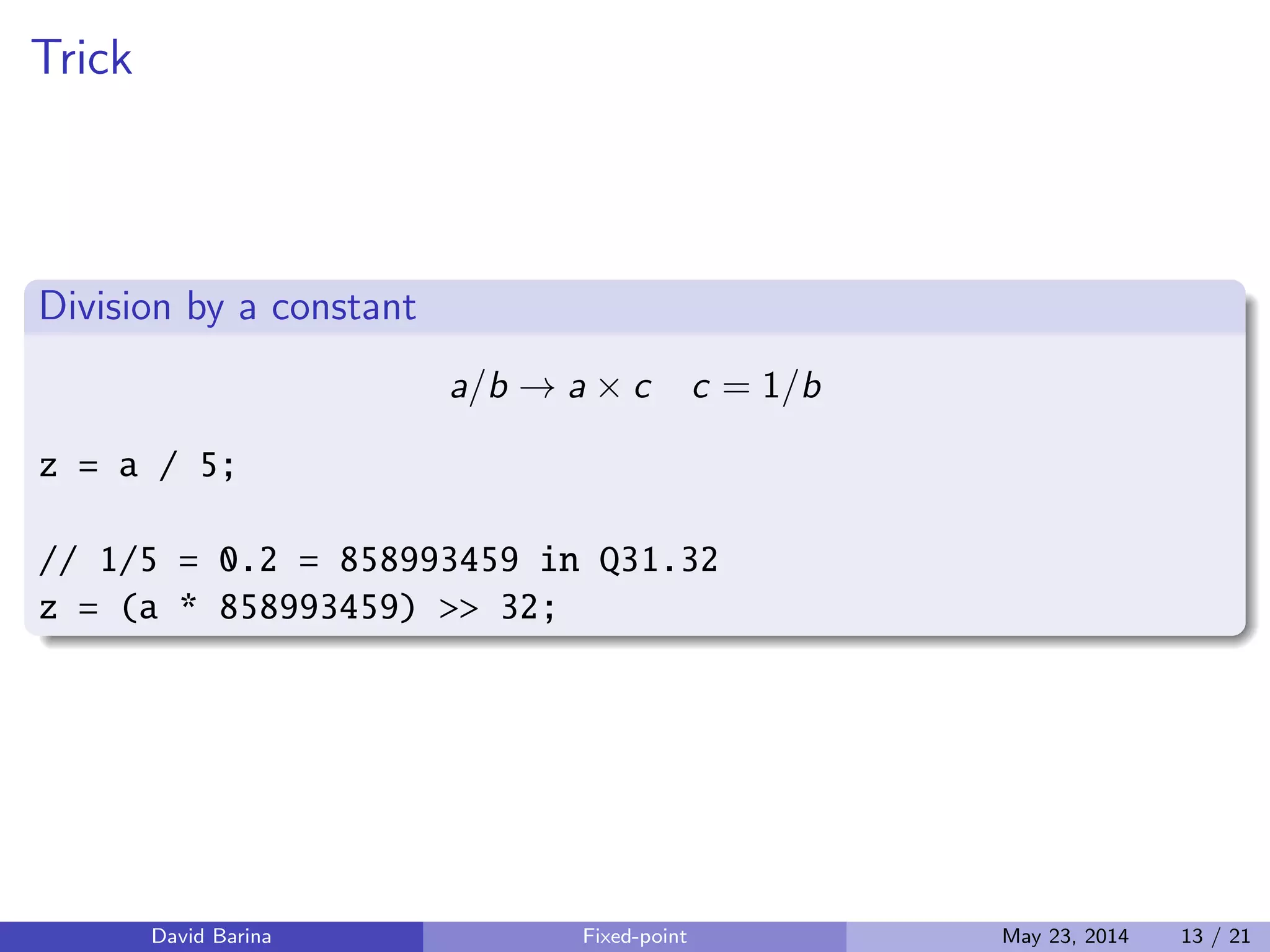
Division by a constant
a/b → a × c c = 1/b
z = a / 5;
// 1/5 = 0.2 = 858993459 in Q31.32
z = (a * 858993459) >> 32;
David Barina Fixed-point May 23, 2014 13 / 21
Functions
Sine by Taylor series [libfixmath]
sin(x) = x −
x3
3!
+
x5
5!
−
x7
!7
+
x9
!9
−
x11
11!
Sine by polynomial [Fixmath]
16 segments, polynomial of degree 4, Remez alg.
sin(x) = c0 + c1x1
+ c2x2
+ c3x3
+ c4x4
David Barina Fixed-point May 23, 2014 14 / 21
Functions
Inverse square root [Fixmath]
y = 1/
√
x
Newton’s method
x → a × 2b
y = y (3 − a y2
)/2
Square root [Fixmath]
x → a × 2b
c = 1/
√
a × a =
√
a
y ← c × 2b/2
David Barina Fixed-point May 23, 2014 15 / 21
Functions
Square root [libfixmath]
abacus algorithm
while (one != 0) {
if (x >= y + one) {
x = x - (y + one);
y = y + 2 * one;
}
y /= 2;
one /= 4;
}
David Barina Fixed-point May 23, 2014 16 / 21
Functions
Reciprocal value [Fixmath]
y = 1/x
Newton’s method
x → a × 2b
y = y (2 − ay)
Division
z = x/y =⇒ z = x × (1/y)
David Barina Fixed-point May 23, 2014 17 / 21
Functions
Exponential function [libfixmath]
x > 0 =⇒ e−x = 1/ex
ex
=
∞
n=0
xn
n!
Natural logarithm [libfixmath]
Newton’s method
y = y +
x − ey
ey
David Barina Fixed-point May 23, 2014 18 / 21
Functions
Base-2 logarithm [libfixmath]
y = log2(x) |Qm.n
y = 0;
while( x >= 2 ) {
x /= 2;
y++;
}
for_each(n) {
x *= x;
y *= 2;
if( x >= 2 ) {
x /= 2;
y++;
}
}
David Barina Fixed-point May 23, 2014 19 / 21
Functions
Base-2 logarithm [Fixmath]
y = log2(1 + x)
16 segments, polynomial of degree 4/11, Remez alg.
Base-2 exponential [Fixmath]
y = 2x
1/32 segments, polynomial of degree 7/3, Remez alg.
David Barina Fixed-point May 23, 2014 20 / 21
Libraries
libfixmath http://code.google.com/p/libfixmath/
Fixmath http://savannah.nongnu.org/projects/fixmath/
David Barina Fixed-point May 23, 2014 21 / 21

Fixed-point arithmetic

  • 1.
    Fixed-point arithmetic David Barina May23, 2014 David Barina Fixed-point May 23, 2014 1 / 21
  • 2.
    Integer 1 1 11 1 0 0 0 0 1 1 1 0 0 0 0 15 7 8 0 … … 1 1 1 1 1 0 0 0 0 1 1 1 0 0 0 0 −1 7 −8 0 … … David Barina Fixed-point May 23, 2014 2 / 21
  • 3.
    Floating point a ×2b sign exponent (8 bits) fraction (23 bits) 02331 0 0 1 1 1 1 1 0 0 0 1 0 0 0 0 0 0 0 0 0 0 0 0 0 0 0 0 0 0 0 0 0 = 0.15625 30 22 (bit index) David Barina Fixed-point May 23, 2014 3 / 21
  • 4.
    Fixed point 1 11 1 1 0 0 0 0 1 1 1 0 0 0 0 −0.0625 7.9375 −8.0000 0.0000 … … 1 1 1 1 0 0 0 0 1 1 1 1 0 0 0 0 1 1 1 1 1 0 0 0 0 1 1 1 0 0 0 0 15.9375 7.9375 8.0000 0.0000 … … 1 1 1 1 0 0 0 0 1 1 1 1 0 0 0 0 David Barina Fixed-point May 23, 2014 4 / 21
  • 5.
    Benefits Advantages instructions for theinteger arithmetic are sufficient no need for FP instructions (FPU, SSE) constant resolution in the whole range higher accuracy (small dynamic ranges) Drawbacks limited range overflow less accuracy (greater dynamic ranges) David Barina Fixed-point May 23, 2014 5 / 21
  • 6.
    Notation Qm.n Q3.4 1 signbit, 3 integer, 4 fractional bits Q1.30 32 bits in total Q15.16 32 bits in total David Barina Fixed-point May 23, 2014 6 / 21
  • 7.
    Examples type name bitsresolution range INT integer 32 1 ±231 ≈ ±2.1 × 10⁹ FP single 32 2−23 ≈ 1.2 × 10⁻⁷ ±2128 ≈ ±3.4 × 1038 FX Q15.16 32 2−16 ≈ 1.5 × 10⁻⁵ ±215 ≈ ±3.2 × 10⁴ FX Q1.30 32 2−30 ≈ 9.3 × 10⁻¹⁰ ±2 David Barina Fixed-point May 23, 2014 7 / 21
  • 8.
    Conversion (Qm.n) INT →FX y = x << n; FX → INT k = 1 << (n-1); y = (x + k) >> n; FP → FX #include <math.h> y = round( x * (1 << n) ); FX → FP y = (double)x / (1 << n); David Barina Fixed-point May 23, 2014 8 / 21
  • 9.
    Rounding (Qm.n) Truncation int floor(intx) { return x & ˜((1<<n)-1); } Ceiling int ceil(int x) { return floor(x + ((1<<n)-1)); } Rounding int round(int x) { return floor(x + (1<<(n-1))); } David Barina Fixed-point May 23, 2014 9 / 21
  • 10.
    Operations (Qm.n) Zero z =0; Unit z = 1 << n; One half z = 1 << (n-1); Negation z = -x; Absolute value z = abs(x); David Barina Fixed-point May 23, 2014 10 / 21
  • 11.
    Operations (Qm.n) Addition z =x + y; Subtraction z = x - y; Multiplication by an integer z = x * i; Multiplication k = 1 << (n-1); z = ( x * y + k ) >> n; Division z = (x << n) / y; David Barina Fixed-point May 23, 2014 11 / 21
  • 12.
    Multiplication (Q15.16) Multiply a.b× c.d uint32_t result_low = (b * d); uint32_t result_mid = (a * d) + (b * c); uint32_t result_high = (a * c); uint32_t result = (result_high << 16) + result_mid + (result_low >> 16); David Barina Fixed-point May 23, 2014 12 / 21
  • 13.
    Trick Division by aconstant a/b → a × c c = 1/b z = a / 5; // 1/5 = 0.2 = 858993459 in Q31.32 z = (a * 858993459) >> 32; David Barina Fixed-point May 23, 2014 13 / 21
  • 14.
    Functions Sine by Taylorseries [libfixmath] sin(x) = x − x3 3! + x5 5! − x7 !7 + x9 !9 − x11 11! Sine by polynomial [Fixmath] 16 segments, polynomial of degree 4, Remez alg. sin(x) = c0 + c1x1 + c2x2 + c3x3 + c4x4 David Barina Fixed-point May 23, 2014 14 / 21
  • 15.
    Functions Inverse square root[Fixmath] y = 1/ √ x Newton’s method x → a × 2b y = y (3 − a y2 )/2 Square root [Fixmath] x → a × 2b c = 1/ √ a × a = √ a y ← c × 2b/2 David Barina Fixed-point May 23, 2014 15 / 21
  • 16.
    Functions Square root [libfixmath] abacusalgorithm while (one != 0) { if (x >= y + one) { x = x - (y + one); y = y + 2 * one; } y /= 2; one /= 4; } David Barina Fixed-point May 23, 2014 16 / 21
  • 17.
    Functions Reciprocal value [Fixmath] y= 1/x Newton’s method x → a × 2b y = y (2 − ay) Division z = x/y =⇒ z = x × (1/y) David Barina Fixed-point May 23, 2014 17 / 21
  • 18.
    Functions Exponential function [libfixmath] x> 0 =⇒ e−x = 1/ex ex = ∞ n=0 xn n! Natural logarithm [libfixmath] Newton’s method y = y + x − ey ey David Barina Fixed-point May 23, 2014 18 / 21
  • 19.
    Functions Base-2 logarithm [libfixmath] y= log2(x) |Qm.n y = 0; while( x >= 2 ) { x /= 2; y++; } for_each(n) { x *= x; y *= 2; if( x >= 2 ) { x /= 2; y++; } } David Barina Fixed-point May 23, 2014 19 / 21
  • 20.
    Functions Base-2 logarithm [Fixmath] y= log2(1 + x) 16 segments, polynomial of degree 4/11, Remez alg. Base-2 exponential [Fixmath] y = 2x 1/32 segments, polynomial of degree 7/3, Remez alg. David Barina Fixed-point May 23, 2014 20 / 21
  • 21.