FIVE YEAR PLANS
Presented by,
Mrs. Rijo Lijo
Lecturer.
INTRODUCTION
Five years plan is mechanism to bring about
uniformity in policy formulation in programmes of
national importance.
SPECIFIC OBJECTIVES
 Control & eradication of major communicable diseases.
 Strengthening of basic health services through the establishment
of the PHC & sub enters.
 Population control.
 Development of health manpower resources.
PURPOSE
 Water supply & sanitation.
 Control of communicable diseases.
 Medical education, training & research.
 Medical care including hospitals, dispensaries & PHCs.
 Public health services.
 Family planning.
 Indigenous system of medicine.
FIRST FIVE YEAR PLAN (1951 – 1956)
 The first Indian Prime Minister, Jawaharlal Nehru presented the
first five-year plan to the Parliament of India on 8 December 1951.
 The first plan sought to get the country's economy out of the cycle
of poverty.
 The total planned budget of 206.8 billion was allocated to seven
broad areas:
 1) Irrigation and energy.
 2) Agriculture and community development.
 3) Transport and communications.
 4) Industry.
 5) Social services.
 6) Land rehabilitation.
 7) Other sectors and services.
THE SPECIFIC OBJECTIVES WERE;
 Provision of water supply & sanitation.
 Control of malaria.
 Preventive health care of the rural population.
 Health services for mother & children.
 Education & training in health.
 Self sufficiency in drug & equipments.
 Family planning & population control.
SECOND FIVE YEAR PLAN (1956-1961)
The second five-year plan focused on industry, especially
heavy industry. Unlike the First plan, which focused mainly on
agriculture, domestic production of industrial products was
encouraged in the Second plan, particularly in the development of
the public sector.
THE SPECIFIC OBJECTIVES WERE;
 Establishment of institutional facilities to serve as a basis from
which service could be render to the people both locally &
surrounding territory.
 Development of technical man power through appropriate
training programmes.
 Intensifying measures to control widely spread communicable
disease.
 Encouraging active campaign for environmental hygiene.
 Provision of family planning and other supporting services.
During this plan period the public sector outlay was
Rs. 4,800 crore of which Rs. 225 crore were allotted for health
programs.
THIRD FIVE YEAR PLAN (1961-1966)
 The third plan stressed on agriculture and improving production of
rice Many primary schools were started in rural areas.
 In an effort to bring democracy to the grassroots level, Panchayat
elections were started and the states were given more development
responsibilities.
 State electricity boards and state secondary education boards were
formed.
 States were made responsible for secondary and higher education.
 The specific objectives were in tuned with the 1st & 2nd five years
plan except that integration of public health with maternal & child
welfare, nutrition & health education was planned.
 During this plan period the public sector outlay was Rs. 7,500
crore of which Rs. 341.8 crores were allotted for health programs.
FOURTH FIVE YEAR PLAN (1969-1974)
 At this time Indira Gandhi was the Prime Minister.
 The Indira Gandhi government nationalized Green Revolution in
India advanced agriculture.
 Certain objectives of the Mudaliar committee were the base for
this plan in relation to health.
SPECIFIC OBJECTIVES
 To provide an effective base for health services in rural areas by
strengthening the PHCs.
 Strengthening of sub-division & district hospitals to provide
effective referral services for PHCs.
 Expansion of medical & nursing education & training of Para –
medical personnel to meet the minimum technical man power
requirements.
During this plan period the public sector outlay
was Rs. 16,774 crore of which Rs. 1,156 crore were allotted for
health programs.
FIFTH FIVE YEARS PLAN (1974-1979)
 Stress was laid on employment, poverty alleviation, and justice.
 The plan also focused on self reliance in agricultural production
and defense.
 In 1978 the newly elected Morarji Desai government rejected the
plan.
 Electricity Supply Act was enacted in 1975.
SPECIFIC OBJECTIVES
 Increase accessibility of health services to rural areas.
 Correcting regional imbalance.
 Further development of referral services.
 Integration of health, family planning & nutrition.
 Intensification of the control & eradication of communicable diseases
especially malaria & smallpox.
 Quantitative improvement in the education & training of health
personnel.
SIXTH FIVE YEARS PLAN( 1980- 1985)
 6th year five year plan is also referred to as the janata government
plan which marked a reversal of the Nehruvian model.
 Rajiv Gandhi was elected as the prime minister, he aimed for rapid
industrial development, especially in the area of information
technology.
 The sixth plan also marked the beginning of economic liberalization.
Price controls were eliminated and ration shops were closed. This led to
an increase in food prices and an increase in the cost of living.
 Family pla
 nning was also expanded in order to prevent overpopulation. In contrast
to China's strict and binding one-child policy, Indian policy did not rely
on the threat of force.
 More prosperous areas of India adopted family planning more rapidly
than less prosperous areas, which continued to have a high birth rate.
SEVENTH FIVE YEAR PLAN (1985-89)
The main objectives of the 7th five year plans were to
establish growth in the areas of increasing economic productivity,
production of food grains, and generating employment
opportunities.
The thrust areas of the 7th Five year plan have been enlisted below:
 Social Justice.
 Removal of oppression of the weak.
 Using modern technology.
 Agricultural development.
 Anti-poverty programs.
The objectives were:
 Eliminate poverty & illiteracy by 2000.
 Achieve near full employment secure satisfaction of the basic needs of
food, cloth, shelter and provide health for all.
 To provide an effective base for health services in rural areas by
strengthening the PHCs.
 universal immunization programme.
 Promotion of voluntary acceptance of contraceptives.
 During this plan period the public sector outlay was Rs. 1.80.000
crores of which Rs. 3,392 crores were allotted for health
programs.
 Period between 1989-91 P.V. Narasimha Rao was the twelfth
Prime Minister of the Republic of India and head of Congress
Party 1989-91 was a period of political instability in India and
hence no five year plan was implemented.
 Between 1990 and 1992, there were only Annual Plans.
EIGHTH FIVE YEAR PLAN (1992-97)
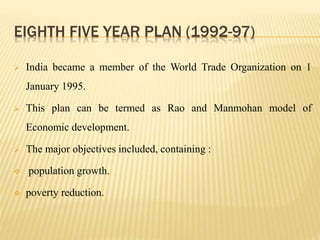
 India became a member of the World Trade Organization on 1
January 1995.
 This plan can be termed as Rao and Manmohan model of
Economic development.
 The major objectives included, containing :
 population growth.
 poverty reduction.
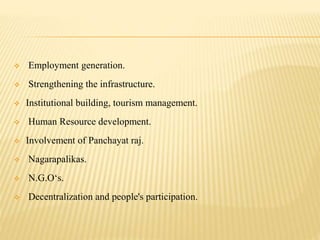
 Employment generation.
 Strengthening the infrastructure.
 Institutional building, tourism management.
 Human Resource development.
 Involvement of Panchayat raj.
 Nagarapalikas.
 N.G.O‘s.
 Decentralization and people's participation.
NINTH FIVE YEAR PLAN (1997-2002)
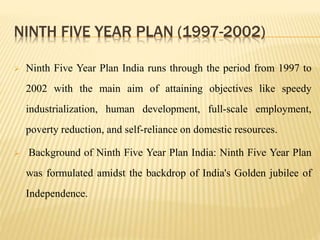
 Ninth Five Year Plan India runs through the period from 1997 to
2002 with the main aim of attaining objectives like speedy
industrialization, human development, full-scale employment,
poverty reduction, and self-reliance on domestic resources.
 Background of Ninth Five Year Plan India: Ninth Five Year Plan
was formulated amidst the backdrop of India's Golden jubilee of
Independence.
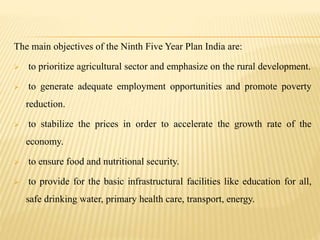
The main objectives of the Ninth Five Year Plan India are:
 to prioritize agricultural sector and emphasize on the rural development.
 to generate adequate employment opportunities and promote poverty
reduction.
 to stabilize the prices in order to accelerate the growth rate of the
economy.
 to ensure food and nutritional security.
 to provide for the basic infrastructural facilities like education for all,
safe drinking water, primary health care, transport, energy.
TENTH FIVE YEAR PLAN (2002-2007)
 Reduction of poverty ratio by 5 percentage points by 2007.
 Providing gainful and high-quality employment at least to the
addition to the labour force;*All children in India in school by
2003; all children to complete 5 years of schooling by 2007.
 Reduction in gender gaps in literacy and wage rates by at least
50% by 2007.
ELEVENTH PLAN (2007-2012)
Income & Poverty:
 Create 70 million new work opportunities.
 Reduce educated unemployment to below 5%.
 Raise real wage rate of unskilled workers by 20 percent.
Education:
 Reduce dropout rates of children from elementary school from
52.2% in 2003-04 to 20% by 2011-12.
 Develop minimum standards of educational attainment in
elementary school, and by regular testing monitor effectiveness of
education to ensure quality.
 Increase literacy rate for persons of age 7 years or above to 85%.
Health:
 Reduce infant mortality rate to 28 and maternal
mortality ratio to 1 per 1000 live births.
 Reduce Total Fertility Rate to 2.1.
 Provide clean drinking water for all by 2009 and
ensure that there are no slip backs.
 Reduce malnutrition among children of age group 0-3
to half its present level.
Women and Children:
 Raise the sex ratio for age group 0-6 to 935 by
2011-12 and to 950 by 2016-17.
 Ensure that at least 33 percent of the direct and
indirect beneficiaries of all government schemes
are women and girl children.
 Ensure that all children enjoy a safe childhood,
without any compulsion to work.
Infrastructure:
 Ensure electricity connection to all villages and BPL households
by 2009 and round-the-clock power.
 Ensure all-weather road connection to all habitation with
population 1000 and above (500 in hilly and tribal areas) by 2009,
and ensure coverage of all significant habitation by 2015.
 Connect every village by telephone by November 2007 and
provide broadband connectivity to all villages by 2012.
 Provide homestead sites to all by 2012 and step up the pace of
house construction for rural poor to cover all the poor by 2016-17.
Environment :
 Increase forest and tree.
 Attain WHO standards of air quality in all major cities
by 2011-12.
 Treat all urban waste water by 2011-12 to clean river
waters.
 Increase energy efficiency by 20 percentage points
by 2016-17.
Five year pla ns

Five year pla ns

  • 1.
    FIVE YEAR PLANS Presentedby, Mrs. Rijo Lijo Lecturer.
  • 2.
    INTRODUCTION Five years planis mechanism to bring about uniformity in policy formulation in programmes of national importance.
  • 3.
    SPECIFIC OBJECTIVES  Control& eradication of major communicable diseases.  Strengthening of basic health services through the establishment of the PHC & sub enters.  Population control.  Development of health manpower resources.
  • 4.
    PURPOSE  Water supply& sanitation.  Control of communicable diseases.  Medical education, training & research.  Medical care including hospitals, dispensaries & PHCs.
  • 5.
     Public healthservices.  Family planning.  Indigenous system of medicine.
  • 6.
    FIRST FIVE YEARPLAN (1951 – 1956)  The first Indian Prime Minister, Jawaharlal Nehru presented the first five-year plan to the Parliament of India on 8 December 1951.  The first plan sought to get the country's economy out of the cycle of poverty.
  • 7.
     The totalplanned budget of 206.8 billion was allocated to seven broad areas:  1) Irrigation and energy.  2) Agriculture and community development.  3) Transport and communications.
  • 8.
     4) Industry. 5) Social services.  6) Land rehabilitation.  7) Other sectors and services.
  • 9.
    THE SPECIFIC OBJECTIVESWERE;  Provision of water supply & sanitation.  Control of malaria.  Preventive health care of the rural population.  Health services for mother & children.  Education & training in health.  Self sufficiency in drug & equipments.  Family planning & population control.
  • 10.
    SECOND FIVE YEARPLAN (1956-1961) The second five-year plan focused on industry, especially heavy industry. Unlike the First plan, which focused mainly on agriculture, domestic production of industrial products was encouraged in the Second plan, particularly in the development of the public sector.
  • 11.
    THE SPECIFIC OBJECTIVESWERE;  Establishment of institutional facilities to serve as a basis from which service could be render to the people both locally & surrounding territory.  Development of technical man power through appropriate training programmes.  Intensifying measures to control widely spread communicable disease.
  • 12.
     Encouraging activecampaign for environmental hygiene.  Provision of family planning and other supporting services. During this plan period the public sector outlay was Rs. 4,800 crore of which Rs. 225 crore were allotted for health programs.
  • 13.
    THIRD FIVE YEARPLAN (1961-1966)  The third plan stressed on agriculture and improving production of rice Many primary schools were started in rural areas.  In an effort to bring democracy to the grassroots level, Panchayat elections were started and the states were given more development responsibilities.  State electricity boards and state secondary education boards were formed.  States were made responsible for secondary and higher education.
  • 14.
     The specificobjectives were in tuned with the 1st & 2nd five years plan except that integration of public health with maternal & child welfare, nutrition & health education was planned.  During this plan period the public sector outlay was Rs. 7,500 crore of which Rs. 341.8 crores were allotted for health programs.
  • 15.
    FOURTH FIVE YEARPLAN (1969-1974)  At this time Indira Gandhi was the Prime Minister.  The Indira Gandhi government nationalized Green Revolution in India advanced agriculture.  Certain objectives of the Mudaliar committee were the base for this plan in relation to health.
  • 16.
    SPECIFIC OBJECTIVES  Toprovide an effective base for health services in rural areas by strengthening the PHCs.  Strengthening of sub-division & district hospitals to provide effective referral services for PHCs.  Expansion of medical & nursing education & training of Para – medical personnel to meet the minimum technical man power requirements.
  • 17.
    During this planperiod the public sector outlay was Rs. 16,774 crore of which Rs. 1,156 crore were allotted for health programs.
  • 18.
    FIFTH FIVE YEARSPLAN (1974-1979)  Stress was laid on employment, poverty alleviation, and justice.  The plan also focused on self reliance in agricultural production and defense.  In 1978 the newly elected Morarji Desai government rejected the plan.  Electricity Supply Act was enacted in 1975.
  • 19.
    SPECIFIC OBJECTIVES  Increaseaccessibility of health services to rural areas.  Correcting regional imbalance.  Further development of referral services.  Integration of health, family planning & nutrition.  Intensification of the control & eradication of communicable diseases especially malaria & smallpox.  Quantitative improvement in the education & training of health personnel.
  • 20.
    SIXTH FIVE YEARSPLAN( 1980- 1985)  6th year five year plan is also referred to as the janata government plan which marked a reversal of the Nehruvian model.  Rajiv Gandhi was elected as the prime minister, he aimed for rapid industrial development, especially in the area of information technology.
  • 21.
     The sixthplan also marked the beginning of economic liberalization. Price controls were eliminated and ration shops were closed. This led to an increase in food prices and an increase in the cost of living.  Family pla  nning was also expanded in order to prevent overpopulation. In contrast to China's strict and binding one-child policy, Indian policy did not rely on the threat of force.  More prosperous areas of India adopted family planning more rapidly than less prosperous areas, which continued to have a high birth rate.
  • 22.
    SEVENTH FIVE YEARPLAN (1985-89) The main objectives of the 7th five year plans were to establish growth in the areas of increasing economic productivity, production of food grains, and generating employment opportunities.
  • 23.
    The thrust areasof the 7th Five year plan have been enlisted below:  Social Justice.  Removal of oppression of the weak.  Using modern technology.  Agricultural development.  Anti-poverty programs.
  • 24.
    The objectives were: Eliminate poverty & illiteracy by 2000.  Achieve near full employment secure satisfaction of the basic needs of food, cloth, shelter and provide health for all.  To provide an effective base for health services in rural areas by strengthening the PHCs.  universal immunization programme.  Promotion of voluntary acceptance of contraceptives.
  • 25.
     During thisplan period the public sector outlay was Rs. 1.80.000 crores of which Rs. 3,392 crores were allotted for health programs.  Period between 1989-91 P.V. Narasimha Rao was the twelfth Prime Minister of the Republic of India and head of Congress Party 1989-91 was a period of political instability in India and hence no five year plan was implemented.  Between 1990 and 1992, there were only Annual Plans.
  • 26.
    EIGHTH FIVE YEARPLAN (1992-97)  India became a member of the World Trade Organization on 1 January 1995.  This plan can be termed as Rao and Manmohan model of Economic development.  The major objectives included, containing :  population growth.  poverty reduction.
  • 27.
     Employment generation. Strengthening the infrastructure.  Institutional building, tourism management.  Human Resource development.  Involvement of Panchayat raj.  Nagarapalikas.  N.G.O‘s.  Decentralization and people's participation.
  • 28.
    NINTH FIVE YEARPLAN (1997-2002)  Ninth Five Year Plan India runs through the period from 1997 to 2002 with the main aim of attaining objectives like speedy industrialization, human development, full-scale employment, poverty reduction, and self-reliance on domestic resources.  Background of Ninth Five Year Plan India: Ninth Five Year Plan was formulated amidst the backdrop of India's Golden jubilee of Independence.
  • 29.
    The main objectivesof the Ninth Five Year Plan India are:  to prioritize agricultural sector and emphasize on the rural development.  to generate adequate employment opportunities and promote poverty reduction.  to stabilize the prices in order to accelerate the growth rate of the economy.  to ensure food and nutritional security.  to provide for the basic infrastructural facilities like education for all, safe drinking water, primary health care, transport, energy.
  • 30.
    TENTH FIVE YEARPLAN (2002-2007)  Reduction of poverty ratio by 5 percentage points by 2007.  Providing gainful and high-quality employment at least to the addition to the labour force;*All children in India in school by 2003; all children to complete 5 years of schooling by 2007.  Reduction in gender gaps in literacy and wage rates by at least 50% by 2007.
  • 31.
    ELEVENTH PLAN (2007-2012) Income& Poverty:  Create 70 million new work opportunities.  Reduce educated unemployment to below 5%.  Raise real wage rate of unskilled workers by 20 percent.
  • 32.
    Education:  Reduce dropoutrates of children from elementary school from 52.2% in 2003-04 to 20% by 2011-12.  Develop minimum standards of educational attainment in elementary school, and by regular testing monitor effectiveness of education to ensure quality.  Increase literacy rate for persons of age 7 years or above to 85%.
  • 33.
    Health:  Reduce infantmortality rate to 28 and maternal mortality ratio to 1 per 1000 live births.  Reduce Total Fertility Rate to 2.1.  Provide clean drinking water for all by 2009 and ensure that there are no slip backs.  Reduce malnutrition among children of age group 0-3 to half its present level.
  • 34.
    Women and Children: Raise the sex ratio for age group 0-6 to 935 by 2011-12 and to 950 by 2016-17.  Ensure that at least 33 percent of the direct and indirect beneficiaries of all government schemes are women and girl children.  Ensure that all children enjoy a safe childhood, without any compulsion to work.
  • 35.
    Infrastructure:  Ensure electricityconnection to all villages and BPL households by 2009 and round-the-clock power.  Ensure all-weather road connection to all habitation with population 1000 and above (500 in hilly and tribal areas) by 2009, and ensure coverage of all significant habitation by 2015.  Connect every village by telephone by November 2007 and provide broadband connectivity to all villages by 2012.  Provide homestead sites to all by 2012 and step up the pace of house construction for rural poor to cover all the poor by 2016-17.
  • 36.
    Environment :  Increaseforest and tree.  Attain WHO standards of air quality in all major cities by 2011-12.  Treat all urban waste water by 2011-12 to clean river waters.  Increase energy efficiency by 20 percentage points by 2016-17.