WELCOME
INTRODUCTION
 National population policy was formulated in
year 1993 an expert committee was
constituted under the chairmanship of MS
Swaminathan to prepare population policy
History review for population
policy
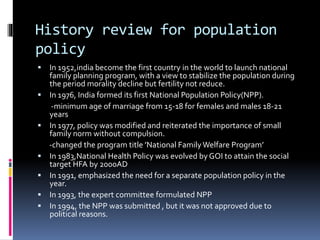
 In 1952,india become the first country in the world to launch national
family planning program, with a view to stabilize the population during
the period morality decline but fertility not reduce.
 In 1976, India formed its first National Population Policy(NPP).
-minimum age of marriage from 15-18 for females and males 18-21
years
 In 1977, policy was modified and reiterated the importance of small
family norm without compulsion.
-changed the program title ’National FamilyWelfare Program’
 In 1983,National Health Policy was evolved by GOI to attain the social
target HFA by 2000AD
 In 1991, emphasized the need for a separate population policy in the
year.
 In 1993, the expert committee formulated NPP
 In 1994, the NPP was submitted , but it was not approved due to
political reasons.
continue
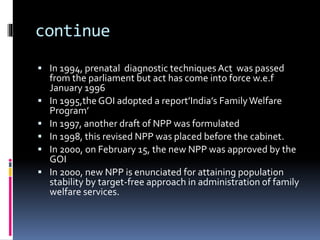
 In 1994, prenatal diagnostic techniquesAct was passed
from the parliament but act has come into force w.e.f
January 1996
 In 1995,theGOI adopted a report’India’s FamilyWelfare
Program’
 In 1997, another draft of NPP was formulated
 In 1998, this revised NPP was placed before the cabinet.
 In 2000, on February 15, the new NPP was approved by the
GOI
 In 2000, new NPP is enunciated for attaining population
stability by target-free approach in administration of family
welfare services.
Policy recognize the fact that following
measures are necessary for achieving
population stabilization
 Universal primary and secondary education
 Provision of basic sanitary facilities like protected
water supply, latrines, good housing etc
 Empowerment of women for improved health and
nutrition
 Enhancement of opportunities for their employment
 Expansion of transport and communication
networks
continue
 Decentralization of the planning and
implementation
 Increasing participation of men and NGOs in
family welfare activities
 NPP-2000 has set a time bound hierarchy of the
following objectives, referred to as immediate,
intermediate and ultimate objectives
 -immediate objectives: it is to provide basic RCH
services to the people and to satisfy the unmet
needs of the couples for contraceptives services.
continue
 -immediate objectives:
 it is to provide basic RCH services to the
people and to satisfy the unmet needs of the
couples for contraceptives services.
continue
 Intermediate objectives:
 It is to bring the total fertility rate(TFR) to
replacement level(NRR-1)by the year 2010
 Ultimate objectives:
 It is to achieve stable population by the year
2045, at a level consistent with requirements
for social development, economic growth
and environmental protection of the country.
GOAL
 The goal set by NPP are the target to be
achieved by the year 2010.
 The goal are set under the following broad
headings:
 -Reproductive health targets
 -child health targets
 -general health targets
REPRODUCTIVE HEALTH TARGETS
 Active universal access in respect of fertility
regulation services.
 Promotion of small family norm to achieve NRR-1
 Making FamilyWelfare Program a people centered
program
 Promotion of delay marriage for girls, not earlier
than 18 years and preferably after 20 years of age
 Achieve 80%institutional deliveries and
100%deliveries by trained personnel
 Reduction of MMR to less that 1 % 1000 livebirths
CHILD HEALYH TARGETS
 Universal immunization of children against
vaccine preventable diseases
 Compulsory and free primary and secondary
education
 Reduction of school dropouts to less than
20% for both boys and girls.
 Reduction of IMR,U5MR less than 30% per
1000 livebirths.
GENERAL HEALTH TARGETS
 Contain the spread of HIV/AIDS and promote
greater integration between the management of
RTIs & STDS & national AIDS control
Organization
 Address the unmet needs for basic RCH-services,
supplies and infrastructure
 Integration of Indian system of Medicine in the
provision of RCH- services
 Achieve 100% registration of births, deaths,
marriages and pregnancies.
 Prevention and control of communicable
diseases
ACHIEVEMENT
 If NPP 2000 is correctly and fully
implemented, it is anticipated that in the year
2o1o, the population will be 1107 million
instead of 1162 million, as projected by the
technical Group of Population Projections
Population policy

Population policy

  • 1.
  • 2.
    INTRODUCTION  National populationpolicy was formulated in year 1993 an expert committee was constituted under the chairmanship of MS Swaminathan to prepare population policy
  • 3.
    History review forpopulation policy  In 1952,india become the first country in the world to launch national family planning program, with a view to stabilize the population during the period morality decline but fertility not reduce.  In 1976, India formed its first National Population Policy(NPP). -minimum age of marriage from 15-18 for females and males 18-21 years  In 1977, policy was modified and reiterated the importance of small family norm without compulsion. -changed the program title ’National FamilyWelfare Program’  In 1983,National Health Policy was evolved by GOI to attain the social target HFA by 2000AD  In 1991, emphasized the need for a separate population policy in the year.  In 1993, the expert committee formulated NPP  In 1994, the NPP was submitted , but it was not approved due to political reasons.
  • 4.
    continue  In 1994,prenatal diagnostic techniquesAct was passed from the parliament but act has come into force w.e.f January 1996  In 1995,theGOI adopted a report’India’s FamilyWelfare Program’  In 1997, another draft of NPP was formulated  In 1998, this revised NPP was placed before the cabinet.  In 2000, on February 15, the new NPP was approved by the GOI  In 2000, new NPP is enunciated for attaining population stability by target-free approach in administration of family welfare services.
  • 5.
    Policy recognize thefact that following measures are necessary for achieving population stabilization  Universal primary and secondary education  Provision of basic sanitary facilities like protected water supply, latrines, good housing etc  Empowerment of women for improved health and nutrition  Enhancement of opportunities for their employment  Expansion of transport and communication networks
  • 6.
    continue  Decentralization ofthe planning and implementation  Increasing participation of men and NGOs in family welfare activities  NPP-2000 has set a time bound hierarchy of the following objectives, referred to as immediate, intermediate and ultimate objectives  -immediate objectives: it is to provide basic RCH services to the people and to satisfy the unmet needs of the couples for contraceptives services.
  • 7.
    continue  -immediate objectives: it is to provide basic RCH services to the people and to satisfy the unmet needs of the couples for contraceptives services.
  • 8.
    continue  Intermediate objectives: It is to bring the total fertility rate(TFR) to replacement level(NRR-1)by the year 2010
  • 9.
     Ultimate objectives: It is to achieve stable population by the year 2045, at a level consistent with requirements for social development, economic growth and environmental protection of the country.
  • 10.
    GOAL  The goalset by NPP are the target to be achieved by the year 2010.  The goal are set under the following broad headings:  -Reproductive health targets  -child health targets  -general health targets
  • 11.
    REPRODUCTIVE HEALTH TARGETS Active universal access in respect of fertility regulation services.  Promotion of small family norm to achieve NRR-1  Making FamilyWelfare Program a people centered program  Promotion of delay marriage for girls, not earlier than 18 years and preferably after 20 years of age  Achieve 80%institutional deliveries and 100%deliveries by trained personnel  Reduction of MMR to less that 1 % 1000 livebirths
  • 12.
    CHILD HEALYH TARGETS Universal immunization of children against vaccine preventable diseases  Compulsory and free primary and secondary education  Reduction of school dropouts to less than 20% for both boys and girls.  Reduction of IMR,U5MR less than 30% per 1000 livebirths.
  • 13.
    GENERAL HEALTH TARGETS Contain the spread of HIV/AIDS and promote greater integration between the management of RTIs & STDS & national AIDS control Organization  Address the unmet needs for basic RCH-services, supplies and infrastructure  Integration of Indian system of Medicine in the provision of RCH- services  Achieve 100% registration of births, deaths, marriages and pregnancies.  Prevention and control of communicable diseases
  • 14.
    ACHIEVEMENT  If NPP2000 is correctly and fully implemented, it is anticipated that in the year 2o1o, the population will be 1107 million instead of 1162 million, as projected by the technical Group of Population Projections