NATIONAL POULATION POLICY,
POPULATION PROGRAMME,
POPULATION CONTROL
STEPHI POULOSE
1ST YEAR MSC NURSING
GOVT.COLLEGE OF NURSING
ALAPPUZHA
NATIONAL POPULATION POLICY
Population policy in general refers to policies intended to
the reduce birth rate or growth rate.
In April 1976, India formed its first national population
policy.
In 1977, it was modified.
National population policy 2000 is the latest in this series.
NATIONAL POPULATION POLICY
The National Health Policy approved by
the parliament in 1983 had set the long
term demographic goals of achieving a
Net Reproductive Rate (NRR) of one by
the year 2000 (which was not achieved).
OBJECTIVES
The immediate objective
To address the unmet needs for contraception, health
care infrastructure, and health personnel
To provide integrated service delivery for basic
reproductive and child health care.
OBJECTIVES
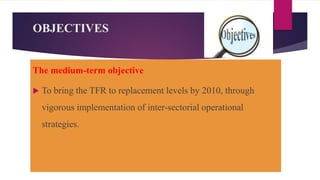
The medium-term objective
 To bring the TFR to replacement levels by 2010, through
vigorous implementation of inter-sectorial operational
strategies.
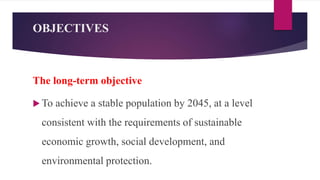
OBJECTIVES
The long-term objective
 To achieve a stable population by 2045, at a level
consistent with the requirements of sustainable
economic growth, social development, and
environmental protection.
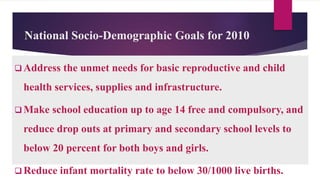
National Socio-Demographic Goals for 2010
 Address the unmet needs for basic reproductive and child
health services, supplies and infrastructure.
 Make school education up to age 14 free and compulsory, and
reduce drop outs at primary and secondary school levels to
below 20 percent for both boys and girls.
 Reduce infant mortality rate to below 30/1000 live births.
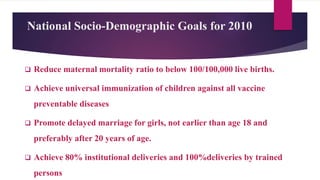
National Socio-Demographic Goals for 2010
 Reduce maternal mortality ratio to below 100/100,000 live births.
 Achieve universal immunization of children against all vaccine
preventable diseases
 Promote delayed marriage for girls, not earlier than age 18 and
preferably after 20 years of age.
 Achieve 80% institutional deliveries and 100%deliveries by trained
persons
National Socio-Demographic Goals for 2010
 Achieve universal access to information/counseling, and services for
fertility regulation and contraception with a wide basket of choices.
 Achieve 100% registration of births, deaths, marriage and pregnancy.
 Contain the spread of AIDS, and promote greater integration between the
management of RTI and STI and the National AIDS Control
Organization.
National Socio-Demographic Goals for 2010
 Prevent and control communicable diseases.
 Integrate Indian Systems of Medicine (ISM) in the provision of
reproductive and child health services, and in reaching out to
households.
 Promote vigorously the small family norm to achieve replacement
levels of TFR.
National Socio-Demographic Goals for 2010
 Bring about convergence in implementation of
related social sector programs so that family
welfare becomes a people centered programme.
STRATEGIC THEMES
 Decentralized Planning and Programme Implementation
 Convergence of Service Delivery at Village Levels
 Empowering Women for Improved Health and Nutrition
 Child Health and Survival
 Meeting the Unmet Needs for Family Welfare Services
STRATEGIC THEMES
 Under-Served Population Groups
(a) Urban Slums
(b) Tribal Communities, Hill Area Populations and Displaced and
Migrant Populations
(c) Adolescents
(d) Increased Participation of Men in Planned Parenthood
STRATEGIC THEMES
 Diverse Health Care Providers
 Collaboration With and Commitments from NGOs and the Private Sector
 Mainstreaming Indian Systems of Medicine and Homeopathy
 Contraceptive Technology and Research on Reproductive and Child Health
 Providing for the Older Population
 Information, Education, and Communication
LEGISLATION
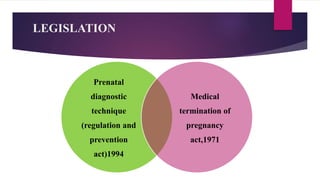
Prenatal
diagnostic
technique
(regulation and
prevention
act)1994
Medical
termination of
pregnancy
act,1971
LEGISLATION
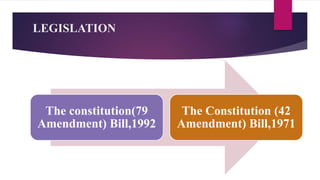
The constitution(79
Amendment) Bill,1992
The Constitution (42
Amendment) Bill,1971
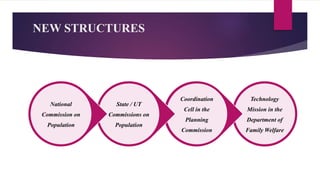
NEW STRUCTURES
Technology
Mission in the
Department of
Family Welfare
Coordination
Cell in the
Planning
Commission
State / UT
Commissions on
Population
National
Commission on
Population
FUNDING
PROMOTIONAL AND MOTIVATIONAL MEASURES FOR ADOPTION OF THE
SMALL FAMILY NORM
 Panchayats and Zila Parishads will be rewarded and honored for exemplary
performance in universalizing the small family norm, achieving reductions in infant
mortality and birth rates, and promoting literacy with completion of primary
schooling.
 The Balika Samridhi Yojana run by the Department of Women and Child
Development, to promote survival and care of the girl child, will continue.
 Maternity Benefit Scheme run by the Department of Rural Development will
continue.
PROMOTIONALAND MOTIVATIONAL MEASURES FOR
ADOPTION OF THE SMALL FAMILY NORM
 A Family Welfare-linked Health Insurance Plan will be established.
 Couples below the poverty line, who marry after the legal age of marriage,
register the marriage, have their first child after the mother reaches the age
of 21, accept the small family norm, and adopt a terminal method after the
birth of the second child, will be rewarded.
 A revolving fund will be set up for income-generating activities by village-
level self help groups, who provide community-level health care services
PROMOTIONALAND MOTIVATIONAL MEASURES FOR ADOPTION OF
THE SMALL FAMILY NORM
 Creches and child care centres will be opened in rural
areas and urban slums.
 A wider, affordable choice of contraceptives will be
made accessible at diverse delivery points.
 Facilities for safe abortion will be strengthened and
expanded.
PROMOTIONALAND MOTIVATIONAL MEASURES FOR
ADOPTION OF THE SMALL FAMILY NORM
 Products and services will be made affordable through
innovative social marketing schemes.
 Local entrepreneurs at village levels will be provided
soft loans and encouraged to run ambulance services.
 Increased vocational training schemes for girls,
PROMOTIONALAND MOTIVATIONAL MEASURES FOR ADOPTION OF
THE SMALL FAMILY NORM
 Strict enforcement of Child Marriage Restraint Act, 1976.
 Strict enforcement of the Pre-Natal Diagnostic Techniques Act,
1994.
 Soft loans to ensure mobility of the ANMs will be increased.
 The 42nd Constitutional Amendment has frozen the number of
representatives in the Lok Sabha (on the basis of population) at
1971 Census levels.
IMPLEMENTATION OF POPULATION POLICY
The emphasis of PP 2000
The PP 2000 emphasizes on
 People centered approach
 Decentralize planning and implementation through panchayats and
nagarpalikas.
 Integrated package for health. MCH and family planning.
IMPLEMENTATION OF POPULATION
POLICY
 Informed choice of contraceptives.
 Concerns for gender issues.
 Focus on undeserved population groups and
adolescents.
 Community participation with increased participation
of men in planned family and parenthood
Impact of NPP 2000
If NPP is fully implemented, it is anticipated a population of
1107 million in 2010, instead of 1162 million projected by the
Technical Group on Population Projections.
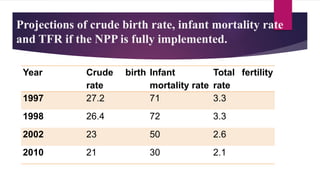
Year Crude birth
rate
Infant
mortality rate
Total fertility
rate
1997 27.2 71 3.3
1998 26.4 72 3.3
2002 23 50 2.6
2010 21 30 2.1
Projections of crude birth rate, infant mortality rate
and TFR if the NPP is fully implemented.
POPULATION
CONTROL
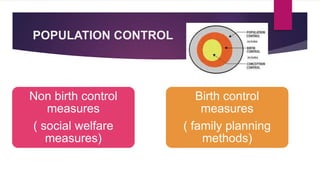
POPULATION CONTROL
Non birth control
measures
( social welfare
measures)
Birth control
measures
( family planning
methods)
NON BIRTH CONTROL MEASURES
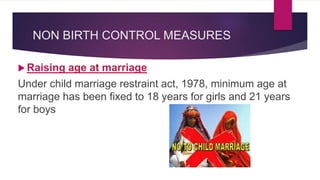
 Raising age at marriage
Under child marriage restraint act, 1978, minimum age at
marriage has been fixed to 18 years for girls and 21 years
for boys
NON BIRTH CONTROL MEASURES
 Eradicating illiteracy( raising the literacy level)
 Establishment of anganwadi and balwadi centres.
 Enrollment of all children, specially female children for primary
education.
 Retention of enrolled children.
 Reducing the drop-out rate from the schools by continuous promotion
up to SSLC.
 Establishment of primary schools at the rate of 1 for every 200 children.
 Encouraging adult literacy.
NON BIRTH CONTROL MEASURES
 Improvement of economic status
 By sanctioning loans for education, agricultural activities,
home industries etc.
 By encouraging self-employment programs.
 By encouraging job oriented training courses( Jawahar
Rozgar Yojana)
NON BIRTH CONTROL MEASURES
 Raising the housing standards
 By allotment of free site to the poor.
 By sanctioning of house- loans. ( Indira Awas Yojana)
NON BIRTH CONTROL MEASURES
 Improving the status of women.
 By giving equal opportunities and equal salary to women.
 By information, education and communication (IEC) activities.
 Adopting two child norm:
by massive educational campaign.
 Improving the quality of health services:
specially maternal and child health services.
BIRTH CONTROL MEASURES
 FAMILY PLANNING
An expert Committee (7977) of the WHO defined family planning
as "a way of thinking and living that is adopted voluntarily, upon
the basis of knowledge, attitudes and responsible decisions by
individuals and couples, in order to promote the health and
welfare of the family group and thus contribute effectively to the
social development of a country"
FAMILY PLANNING
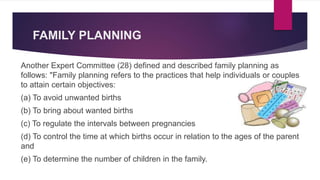
Another Expert Committee (28) defined and described family planning as
follows: "Family planning refers to the practices that help individuals or couples
to attain certain objectives:
(a) To avoid unwanted births
(b) To bring about wanted births
(c) To regulate the intervals between pregnancies
(d) To control the time at which births occur in relation to the ages of the parent
and
(e) To determine the number of children in the family.
SCOPE OF FAMILY PLANNING
SERVICES
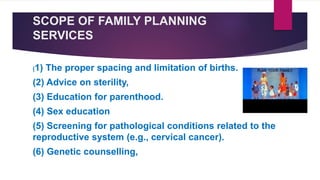
(1) The proper spacing and limitation of births.
(2) Advice on sterility,
(3) Education for parenthood.
(4) Sex education
(5) Screening for pathological conditions related to the
reproductive system (e.g., cervical cancer).
(6) Genetic counselling,
SCOPE OF FAMILY PLANNING
SERVICES
(7) Premarital consultation and examination.
(8) Carrying out pregnancy tests,
(9) Marriage counselling
(10) The preparation of couples for the arrival of their first child,
(11) Providing services for unmarried mothers.
(12) teaching home economics and nutrition.
(13) Providing adoption services.
HEALTH ASPECTS OF FAMILY
PLANNING
Women's health
 Maternal mortality, morbidity of women of child-bearing age, nutritional
status (weight changes, Hemoglobin level, etc.) preventable
complications of pregnancy and abortion.
Fetal health
 Fetal mortality (early and late fetal death); abnormal development.
Infant and child health
 Neonatal, infant and pre-school mortality, health of the infant at birth
(birth weight), Vulnerability to diseases)
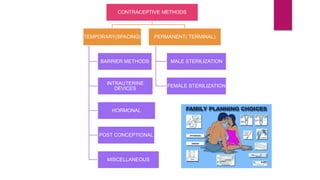
CONTRACEPTIVE METHODS
TEMPORARY(SPACING)
BARRIER METHODS
INTRAUTERINE
DEVICES
HORMONAL
POST CONCEPTIONAL
MISCELLANEOUS
PERMANENT( TERMINAL)
MALE STERILIZATION
FEMALE STERILIZATION
NATIONAL FAMILY WELFARE
PROGRAMME
 India launched a nation-wide family planning programme in
1952, making it the first country in the world to do so, though
records show that birth control clinics have been functioning
in the country since 1930.
 The early beginnings -: the programme were modest with
the establishment of a few clinics and distribution of
educational material, training and research
NATIONAL FAMILY WELFARE PROGRAMME
 During the Third Five Year Plan (1961-66). Family planning was
declared as "the very centre of planned development". The
emphasis was shifted from the purely 'clinic approach" to the more
vigorous "extension education approach" for motivating the people
for acceptance of the 'small family norm".
 The introduction of the Lippes Loop in 1965 necessitated a major
structural reorganization of the programme, leading to the creation
of a separate Department of Family Planning in 1966 in the Ministry
of Health.
NATIONAL FAMILY WELFARE
PROGRAMME
 During the years 1966-1969, the programme took firmer roots.
The family planning infrastructure (e.g., primary health centres,
subcentres, urban family planning centres, district and State
bureaus) was strengthened.
 During the Fourth Five Year Plan (1969-74), the Govt. of India
gave "top priority" to the programme. The Programme was
made an integral part of MCH activities of PHCs and their
subcentres.
NATIONAL FAMILY WELFARE
PROGRAMME
 In 1970, an All India Hospital Postpartum Programme and in
1972, the Medical Termination of Pregnancy (MTP) act were
introduced.
 During the Fifth Five Year Plan (1975-80) there have been
major changes.
 In April 1976, the country framed its first National Population
Policy". The disastrous forcible sterilization campaign of
1976 led to the Congress defeat in the I977 election.
NATIONAL FAMILY WELFARE PROGRAMME
 In June 1977, the new (Janata) Government that came into power
formulated a new population policy, ruling out compulsion and coercion
for all times to come. The Ministry of Family Planning was renamed '
Family Welfare".
 Although the performance of the programme was low during 1977-78, it
was a good year in as much as the programme moved into new
healthier directions. The 42nd Amendment of the Constitution has made
"Population control and Family Planning" a concurrent subject, and this
provision has been made effective from January 1977.
NATIONAL FAMILY WELFARE
PROGRAMME
 The launching of the Rural Health Scheme in 1977 and the
involvement of the local people (e.g., Health Guides, trained Dais.
Opinion leaders) in the family welfare programme at the grass-root
level were aimed at accelerating the pace of progress of the
programme.
 India was a signatory to the Alma Ata Declaration in 1,978. The
acceptance of the primary health care approach to the
achievement of HFA/2000 AD led to the formulation of a National
Health Policy in 1982.
NATIONAL FAMILY WELFARE
PROGRAMME
 The Sixth and Seventh Five Year Plans were accordingly
set to achieve these goals.
 The Universal Immunization Programme aimed at
reduction in mortality and morbidity among infants and
younger children due to vaccine preventable diseases was
started in the year 1985 - 86.
 The oral rehydration therapy was also started in view of
the fact that diarrhea was a leading cause of death among
children
NATIONAL FAMILY WELFARE
PROGRAMME
 Various other programmes under MCH were also
implemented during the Seventh Five Year Plan. The
objective of all these programmes were convergent and
aimed at improving the health of the mothers and young
children, and to provide them facilities for prevention and
treatment of major diseases.
 During 1992 these programmes were integrated under
Child Survival and Safe Motherhood (CSSM) Programme
NATIONAL FAMILY WELFARE
PROGRAMME
 The process of integration of related programmes initiated
was taken a step further during 1994 when the International
Conference on Population and Development in Cairo
recommended implementation of Unified Reproductive and
Child Health Programme (RCH).
 Accordingly, during Ninth Five Year Plan the RCH Programme
integrates all the related programmes of the Eighth Five Year
Plan. The concept of RCH is to provide need based, client
oriented, demand driven, high quality integrated services
NATIONAL FAMILY WELFARE
PROGRAMME
 The Government of India evolved a more detailed and
comprehensive National Population Policy 2000
 It can be seen that from a modest sum of 0.65 crores
during the first plan, the investment has reached a
colossal amount of Rs. 136,147 crores during the
Eleventh Plan period.
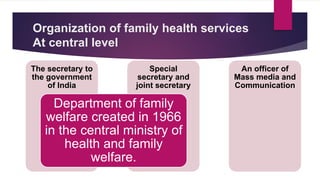
Organization of family health services
At central level
An officer of
Mass media and
Communication
Special
secretary and
joint secretary
The secretary to
the government
of India
Department of family
welfare created in 1966
in the central ministry of
health and family
welfare.
Organization of family health services
At the state level
 It consists of a Family welfare Bureau and it is
a part of State health and family welfare
Directorate.
 One Family welfare cell has been sanctioned
for each state to coordinate activities between
the central and state government
Organization of family health services
At the District level
 It consists of a district Family Welfare Bureau
headed by district family Welfare Officer, Mass
education and media division, in charge of
District Mass education and an Media officer
and an evaluation division in charge of a
statistical officer.
Organization of family health services
At the District level
1083 urban family welfare centres and 871 urban
health posts.
4 types of urban health posts.
 Type A : population less than 5000
 Type B : population between 5000 -10000
 Type C : population between 10000-25000
 Type A : population between 25000-50000
Organization of family health services
At the District level
Three types of Urban Family Welfare Centres.
 Type I : Population between 10,000-25,000.
 Type II : population between 25,000-50,000.
 Type III : population above 50,000
Organization of family health services
At the Community Health Centre level
 Four medical specialists and 21 para medical
staff.
 It provides emergency obstetric care, full
range of family planning services.
Organization of family health services
At the Primary Health Centre level
POST PARTUM PROGRAMME
An All India Hospital Postpartum Programme (AIHPP) was introduced
in 1969.
It is a hospital-based, maternity centred approach to family planning.
The primary objective of the postpartum programme is to improve the
health of the mother and children through MCH and Family Welfare
programme which includes antenatal, neonatal, and postnatal
services; immunization services to children and mothers; and
prophylaxis against anemia and blindness.

National poulation policy,

  • 1.
    NATIONAL POULATION POLICY, POPULATIONPROGRAMME, POPULATION CONTROL STEPHI POULOSE 1ST YEAR MSC NURSING GOVT.COLLEGE OF NURSING ALAPPUZHA
  • 2.
    NATIONAL POPULATION POLICY Populationpolicy in general refers to policies intended to the reduce birth rate or growth rate. In April 1976, India formed its first national population policy. In 1977, it was modified. National population policy 2000 is the latest in this series.
  • 3.
    NATIONAL POPULATION POLICY TheNational Health Policy approved by the parliament in 1983 had set the long term demographic goals of achieving a Net Reproductive Rate (NRR) of one by the year 2000 (which was not achieved).
  • 4.
    OBJECTIVES The immediate objective Toaddress the unmet needs for contraception, health care infrastructure, and health personnel To provide integrated service delivery for basic reproductive and child health care.
  • 5.
    OBJECTIVES The medium-term objective To bring the TFR to replacement levels by 2010, through vigorous implementation of inter-sectorial operational strategies.
  • 6.
    OBJECTIVES The long-term objective To achieve a stable population by 2045, at a level consistent with the requirements of sustainable economic growth, social development, and environmental protection.
  • 7.
    National Socio-Demographic Goalsfor 2010  Address the unmet needs for basic reproductive and child health services, supplies and infrastructure.  Make school education up to age 14 free and compulsory, and reduce drop outs at primary and secondary school levels to below 20 percent for both boys and girls.  Reduce infant mortality rate to below 30/1000 live births.
  • 8.
    National Socio-Demographic Goalsfor 2010  Reduce maternal mortality ratio to below 100/100,000 live births.  Achieve universal immunization of children against all vaccine preventable diseases  Promote delayed marriage for girls, not earlier than age 18 and preferably after 20 years of age.  Achieve 80% institutional deliveries and 100%deliveries by trained persons
  • 9.
    National Socio-Demographic Goalsfor 2010  Achieve universal access to information/counseling, and services for fertility regulation and contraception with a wide basket of choices.  Achieve 100% registration of births, deaths, marriage and pregnancy.  Contain the spread of AIDS, and promote greater integration between the management of RTI and STI and the National AIDS Control Organization.
  • 10.
    National Socio-Demographic Goalsfor 2010  Prevent and control communicable diseases.  Integrate Indian Systems of Medicine (ISM) in the provision of reproductive and child health services, and in reaching out to households.  Promote vigorously the small family norm to achieve replacement levels of TFR.
  • 11.
    National Socio-Demographic Goalsfor 2010  Bring about convergence in implementation of related social sector programs so that family welfare becomes a people centered programme.
  • 12.
    STRATEGIC THEMES  DecentralizedPlanning and Programme Implementation  Convergence of Service Delivery at Village Levels  Empowering Women for Improved Health and Nutrition  Child Health and Survival  Meeting the Unmet Needs for Family Welfare Services
  • 13.
    STRATEGIC THEMES  Under-ServedPopulation Groups (a) Urban Slums (b) Tribal Communities, Hill Area Populations and Displaced and Migrant Populations (c) Adolescents (d) Increased Participation of Men in Planned Parenthood
  • 14.
    STRATEGIC THEMES  DiverseHealth Care Providers  Collaboration With and Commitments from NGOs and the Private Sector  Mainstreaming Indian Systems of Medicine and Homeopathy  Contraceptive Technology and Research on Reproductive and Child Health  Providing for the Older Population  Information, Education, and Communication
  • 15.
  • 16.
    LEGISLATION The constitution(79 Amendment) Bill,1992 TheConstitution (42 Amendment) Bill,1971
  • 17.
    NEW STRUCTURES Technology Mission inthe Department of Family Welfare Coordination Cell in the Planning Commission State / UT Commissions on Population National Commission on Population
  • 18.
  • 19.
    PROMOTIONAL AND MOTIVATIONALMEASURES FOR ADOPTION OF THE SMALL FAMILY NORM  Panchayats and Zila Parishads will be rewarded and honored for exemplary performance in universalizing the small family norm, achieving reductions in infant mortality and birth rates, and promoting literacy with completion of primary schooling.  The Balika Samridhi Yojana run by the Department of Women and Child Development, to promote survival and care of the girl child, will continue.  Maternity Benefit Scheme run by the Department of Rural Development will continue.
  • 20.
    PROMOTIONALAND MOTIVATIONAL MEASURESFOR ADOPTION OF THE SMALL FAMILY NORM  A Family Welfare-linked Health Insurance Plan will be established.  Couples below the poverty line, who marry after the legal age of marriage, register the marriage, have their first child after the mother reaches the age of 21, accept the small family norm, and adopt a terminal method after the birth of the second child, will be rewarded.  A revolving fund will be set up for income-generating activities by village- level self help groups, who provide community-level health care services
  • 21.
    PROMOTIONALAND MOTIVATIONAL MEASURESFOR ADOPTION OF THE SMALL FAMILY NORM  Creches and child care centres will be opened in rural areas and urban slums.  A wider, affordable choice of contraceptives will be made accessible at diverse delivery points.  Facilities for safe abortion will be strengthened and expanded.
  • 22.
    PROMOTIONALAND MOTIVATIONAL MEASURESFOR ADOPTION OF THE SMALL FAMILY NORM  Products and services will be made affordable through innovative social marketing schemes.  Local entrepreneurs at village levels will be provided soft loans and encouraged to run ambulance services.  Increased vocational training schemes for girls,
  • 23.
    PROMOTIONALAND MOTIVATIONAL MEASURESFOR ADOPTION OF THE SMALL FAMILY NORM  Strict enforcement of Child Marriage Restraint Act, 1976.  Strict enforcement of the Pre-Natal Diagnostic Techniques Act, 1994.  Soft loans to ensure mobility of the ANMs will be increased.  The 42nd Constitutional Amendment has frozen the number of representatives in the Lok Sabha (on the basis of population) at 1971 Census levels.
  • 24.
    IMPLEMENTATION OF POPULATIONPOLICY The emphasis of PP 2000 The PP 2000 emphasizes on  People centered approach  Decentralize planning and implementation through panchayats and nagarpalikas.  Integrated package for health. MCH and family planning.
  • 25.
    IMPLEMENTATION OF POPULATION POLICY Informed choice of contraceptives.  Concerns for gender issues.  Focus on undeserved population groups and adolescents.  Community participation with increased participation of men in planned family and parenthood
  • 26.
    Impact of NPP2000 If NPP is fully implemented, it is anticipated a population of 1107 million in 2010, instead of 1162 million projected by the Technical Group on Population Projections.
  • 27.
    Year Crude birth rate Infant mortalityrate Total fertility rate 1997 27.2 71 3.3 1998 26.4 72 3.3 2002 23 50 2.6 2010 21 30 2.1 Projections of crude birth rate, infant mortality rate and TFR if the NPP is fully implemented.
  • 28.
  • 29.
    POPULATION CONTROL Non birthcontrol measures ( social welfare measures) Birth control measures ( family planning methods)
  • 30.
    NON BIRTH CONTROLMEASURES  Raising age at marriage Under child marriage restraint act, 1978, minimum age at marriage has been fixed to 18 years for girls and 21 years for boys
  • 31.
    NON BIRTH CONTROLMEASURES  Eradicating illiteracy( raising the literacy level)  Establishment of anganwadi and balwadi centres.  Enrollment of all children, specially female children for primary education.  Retention of enrolled children.  Reducing the drop-out rate from the schools by continuous promotion up to SSLC.  Establishment of primary schools at the rate of 1 for every 200 children.  Encouraging adult literacy.
  • 32.
    NON BIRTH CONTROLMEASURES  Improvement of economic status  By sanctioning loans for education, agricultural activities, home industries etc.  By encouraging self-employment programs.  By encouraging job oriented training courses( Jawahar Rozgar Yojana)
  • 33.
    NON BIRTH CONTROLMEASURES  Raising the housing standards  By allotment of free site to the poor.  By sanctioning of house- loans. ( Indira Awas Yojana)
  • 34.
    NON BIRTH CONTROLMEASURES  Improving the status of women.  By giving equal opportunities and equal salary to women.  By information, education and communication (IEC) activities.  Adopting two child norm: by massive educational campaign.  Improving the quality of health services: specially maternal and child health services.
  • 35.
    BIRTH CONTROL MEASURES FAMILY PLANNING An expert Committee (7977) of the WHO defined family planning as "a way of thinking and living that is adopted voluntarily, upon the basis of knowledge, attitudes and responsible decisions by individuals and couples, in order to promote the health and welfare of the family group and thus contribute effectively to the social development of a country"
  • 36.
    FAMILY PLANNING Another ExpertCommittee (28) defined and described family planning as follows: "Family planning refers to the practices that help individuals or couples to attain certain objectives: (a) To avoid unwanted births (b) To bring about wanted births (c) To regulate the intervals between pregnancies (d) To control the time at which births occur in relation to the ages of the parent and (e) To determine the number of children in the family.
  • 37.
    SCOPE OF FAMILYPLANNING SERVICES (1) The proper spacing and limitation of births. (2) Advice on sterility, (3) Education for parenthood. (4) Sex education (5) Screening for pathological conditions related to the reproductive system (e.g., cervical cancer). (6) Genetic counselling,
  • 38.
    SCOPE OF FAMILYPLANNING SERVICES (7) Premarital consultation and examination. (8) Carrying out pregnancy tests, (9) Marriage counselling (10) The preparation of couples for the arrival of their first child, (11) Providing services for unmarried mothers. (12) teaching home economics and nutrition. (13) Providing adoption services.
  • 39.
    HEALTH ASPECTS OFFAMILY PLANNING Women's health  Maternal mortality, morbidity of women of child-bearing age, nutritional status (weight changes, Hemoglobin level, etc.) preventable complications of pregnancy and abortion. Fetal health  Fetal mortality (early and late fetal death); abnormal development. Infant and child health  Neonatal, infant and pre-school mortality, health of the infant at birth (birth weight), Vulnerability to diseases)
  • 40.
    CONTRACEPTIVE METHODS TEMPORARY(SPACING) BARRIER METHODS INTRAUTERINE DEVICES HORMONAL POSTCONCEPTIONAL MISCELLANEOUS PERMANENT( TERMINAL) MALE STERILIZATION FEMALE STERILIZATION
  • 41.
    NATIONAL FAMILY WELFARE PROGRAMME India launched a nation-wide family planning programme in 1952, making it the first country in the world to do so, though records show that birth control clinics have been functioning in the country since 1930.  The early beginnings -: the programme were modest with the establishment of a few clinics and distribution of educational material, training and research
  • 42.
    NATIONAL FAMILY WELFAREPROGRAMME  During the Third Five Year Plan (1961-66). Family planning was declared as "the very centre of planned development". The emphasis was shifted from the purely 'clinic approach" to the more vigorous "extension education approach" for motivating the people for acceptance of the 'small family norm".  The introduction of the Lippes Loop in 1965 necessitated a major structural reorganization of the programme, leading to the creation of a separate Department of Family Planning in 1966 in the Ministry of Health.
  • 43.
    NATIONAL FAMILY WELFARE PROGRAMME During the years 1966-1969, the programme took firmer roots. The family planning infrastructure (e.g., primary health centres, subcentres, urban family planning centres, district and State bureaus) was strengthened.  During the Fourth Five Year Plan (1969-74), the Govt. of India gave "top priority" to the programme. The Programme was made an integral part of MCH activities of PHCs and their subcentres.
  • 44.
    NATIONAL FAMILY WELFARE PROGRAMME In 1970, an All India Hospital Postpartum Programme and in 1972, the Medical Termination of Pregnancy (MTP) act were introduced.  During the Fifth Five Year Plan (1975-80) there have been major changes.  In April 1976, the country framed its first National Population Policy". The disastrous forcible sterilization campaign of 1976 led to the Congress defeat in the I977 election.
  • 45.
    NATIONAL FAMILY WELFAREPROGRAMME  In June 1977, the new (Janata) Government that came into power formulated a new population policy, ruling out compulsion and coercion for all times to come. The Ministry of Family Planning was renamed ' Family Welfare".  Although the performance of the programme was low during 1977-78, it was a good year in as much as the programme moved into new healthier directions. The 42nd Amendment of the Constitution has made "Population control and Family Planning" a concurrent subject, and this provision has been made effective from January 1977.
  • 46.
    NATIONAL FAMILY WELFARE PROGRAMME The launching of the Rural Health Scheme in 1977 and the involvement of the local people (e.g., Health Guides, trained Dais. Opinion leaders) in the family welfare programme at the grass-root level were aimed at accelerating the pace of progress of the programme.  India was a signatory to the Alma Ata Declaration in 1,978. The acceptance of the primary health care approach to the achievement of HFA/2000 AD led to the formulation of a National Health Policy in 1982.
  • 47.
    NATIONAL FAMILY WELFARE PROGRAMME The Sixth and Seventh Five Year Plans were accordingly set to achieve these goals.  The Universal Immunization Programme aimed at reduction in mortality and morbidity among infants and younger children due to vaccine preventable diseases was started in the year 1985 - 86.  The oral rehydration therapy was also started in view of the fact that diarrhea was a leading cause of death among children
  • 48.
    NATIONAL FAMILY WELFARE PROGRAMME Various other programmes under MCH were also implemented during the Seventh Five Year Plan. The objective of all these programmes were convergent and aimed at improving the health of the mothers and young children, and to provide them facilities for prevention and treatment of major diseases.  During 1992 these programmes were integrated under Child Survival and Safe Motherhood (CSSM) Programme
  • 49.
    NATIONAL FAMILY WELFARE PROGRAMME The process of integration of related programmes initiated was taken a step further during 1994 when the International Conference on Population and Development in Cairo recommended implementation of Unified Reproductive and Child Health Programme (RCH).  Accordingly, during Ninth Five Year Plan the RCH Programme integrates all the related programmes of the Eighth Five Year Plan. The concept of RCH is to provide need based, client oriented, demand driven, high quality integrated services
  • 50.
    NATIONAL FAMILY WELFARE PROGRAMME The Government of India evolved a more detailed and comprehensive National Population Policy 2000  It can be seen that from a modest sum of 0.65 crores during the first plan, the investment has reached a colossal amount of Rs. 136,147 crores during the Eleventh Plan period.
  • 51.
    Organization of familyhealth services At central level An officer of Mass media and Communication Special secretary and joint secretary The secretary to the government of India Department of family welfare created in 1966 in the central ministry of health and family welfare.
  • 52.
    Organization of familyhealth services At the state level  It consists of a Family welfare Bureau and it is a part of State health and family welfare Directorate.  One Family welfare cell has been sanctioned for each state to coordinate activities between the central and state government
  • 53.
    Organization of familyhealth services At the District level  It consists of a district Family Welfare Bureau headed by district family Welfare Officer, Mass education and media division, in charge of District Mass education and an Media officer and an evaluation division in charge of a statistical officer.
  • 54.
    Organization of familyhealth services At the District level 1083 urban family welfare centres and 871 urban health posts. 4 types of urban health posts.  Type A : population less than 5000  Type B : population between 5000 -10000  Type C : population between 10000-25000  Type A : population between 25000-50000
  • 55.
    Organization of familyhealth services At the District level Three types of Urban Family Welfare Centres.  Type I : Population between 10,000-25,000.  Type II : population between 25,000-50,000.  Type III : population above 50,000
  • 56.
    Organization of familyhealth services At the Community Health Centre level  Four medical specialists and 21 para medical staff.  It provides emergency obstetric care, full range of family planning services.
  • 57.
    Organization of familyhealth services At the Primary Health Centre level
  • 58.
    POST PARTUM PROGRAMME AnAll India Hospital Postpartum Programme (AIHPP) was introduced in 1969. It is a hospital-based, maternity centred approach to family planning. The primary objective of the postpartum programme is to improve the health of the mother and children through MCH and Family Welfare programme which includes antenatal, neonatal, and postnatal services; immunization services to children and mothers; and prophylaxis against anemia and blindness.