Case Conference: Omega-3
      Polyunsaturated Fatty Acids
   Group II – Section A
ALFONSO, ALJAMA, ALUZAN,
   AMURAO, ARELLANO,
       ARROYO
Case: Omega-3 Fatty Acid
          Supplementation
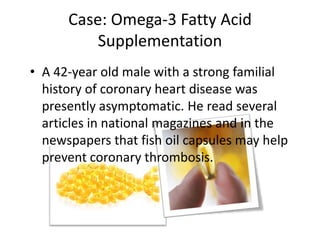
• A 42-year old male with a strong familial
  history of coronary heart disease was
  presently asymptomatic. He read several
  articles in national magazines and in the
  newspapers that fish oil capsules may help
  prevent coronary thrombosis.
Case: Omega-3 Fatty Acid
          Supplementation
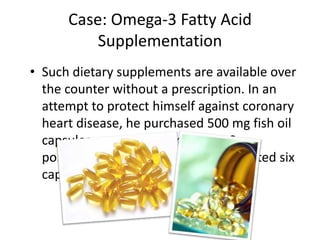
• Such dietary supplements are available over
  the counter without a prescription. In an
  attempt to protect himself against coronary
  heart disease, he purchased 500 mg fish oil
  capsules containing 50% omega-3
  polyunsaturated fatty acids and ingested six
  capsules daily.
OVERVIEW AND INTRODUCTION
Overview and Introduction
• POLYUNSATURATED FATTY ACIDS
•     Straight chain derivatives of fatty acids
  containing
• Two or more double bonds.

• ESSENTIAL FATTY ACIDS
•    Molecules that cannot be synthesized by the
  human body but are vital for normal metabolism
•
•    One of these essential fatty acids is the
• Omega-3 Polyunsaturated Fatty Acids
Omega-3 Polyunsaturated Fatty Acids
• -essential dietary fatty acids, belonging to the
  lenolenic family of PUFAs -contain a double
  bond on the third carbon from the methyl end
•
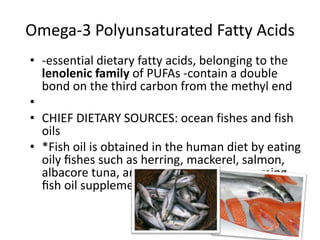
• CHIEF DIETARY SOURCES: ocean fishes and fish
  oils
• *Fish oil is obtained in the human diet by eating
  oily fishes such as herring, mackerel, salmon,
  albacore tuna, and sardines, or by consuming
  fish oil supplements or cod liver oil
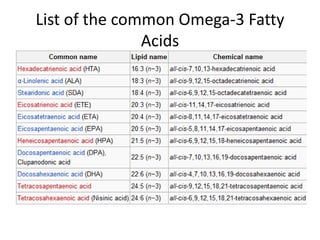
List of the common Omega-3 Fatty
               Acids
Omega-3 Polyunsaturated Fatty Acids

• Nutritionally important n−3 fatty acids
  include α-linolenic
  acid (ALA), eicosapentaenoic acid (EPA),
  and docosahexaenoic acid (DHA), all of
  which are polyunsaturated.
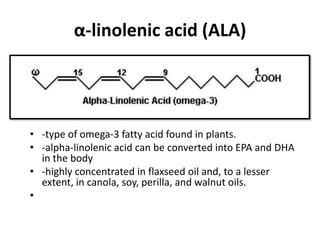
α-linolenic acid (ALA)


• -type of omega-3 fatty acid found in plants.
• -alpha-linolenic acid can be converted into EPA and DHA
  in the body
• -highly concentrated in flaxseed oil and, to a lesser
  extent, in canola, soy, perilla, and walnut oils.
•
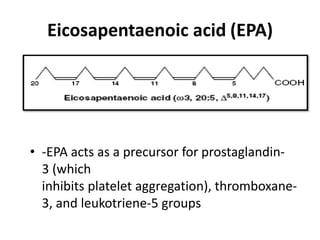
Eicosapentaenoic acid (EPA)


• -EPA acts as a precursor for prostaglandin-
  3 (which
  inhibits platelet aggregation), thromboxane-
  3, and leukotriene-5 groups
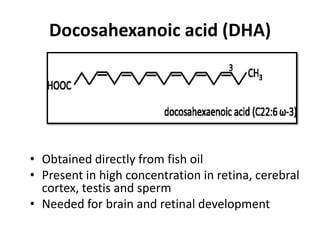
Docosahexanoic acid (DHA)


• Obtained directly from fish oil
• Present in high concentration in retina, cerebral
  cortex, testis and sperm
• Needed for brain and retinal development
FATTY ACIDS RELATED TO
MEMBRANES
Fatty Acids related to Membranes

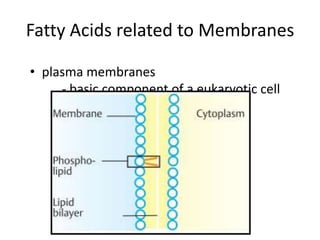
• plasma membranes
     - basic component of a eukaryotic cell
Fatty Acids related to Membranes

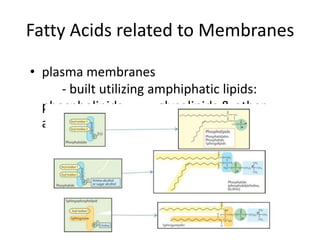
• plasma membranes
     - built utilizing amphiphatic lipids:
  phospholipids,        glycolipids & other
  amphipatic lipids
Fatty Acids related to Membranes

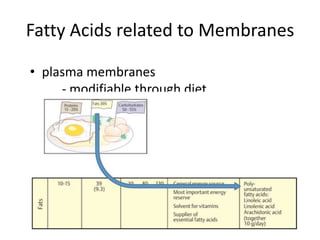
• plasma membranes
     - modifiable through diet
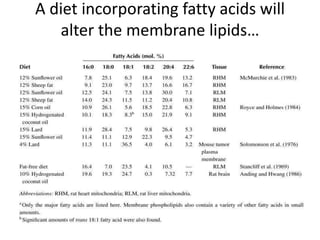
A diet incorporating fatty acids will
   alter the membrane lipids…
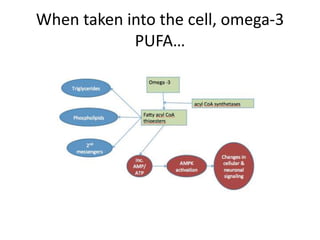
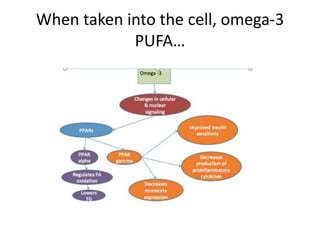
When taken into the cell, omega-3
            PUFA…
When taken into the cell, omega-3
            PUFA…
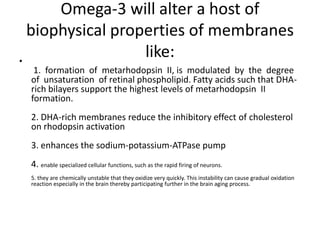
Omega-3 will alter a host of
  biophysical properties of membranes
•
                  like:
  1. formation of metarhodopsin II, is modulated by the degree
 of unsaturation of retinal phospholipid. Fatty acids such that DHA-
 rich bilayers support the highest levels of metarhodopsin II
 formation.
 2. DHA-rich membranes reduce the inhibitory effect of cholesterol
 on rhodopsin activation
 3. enhances the sodium-potassium-ATPase pump
 4. enable specialized cellular functions, such as the rapid firing of neurons.
 5. they are chemically unstable that they oxidize very quickly. This instability can cause gradual oxidation
 reaction especially in the brain thereby participating further in the brain aging process.
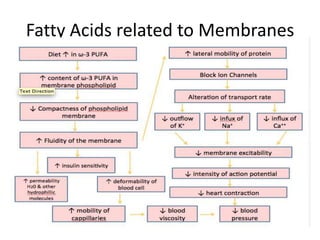
Fatty Acids related to Membranes
EICOSANOID SYNTHESIS
Eicosanoid Synthesis
• Marine plants, especially the unicellular algae
  in phytoplankton, carry out chain elongation
  and further desaturation of α-linolenic acid to
  yield the long-chain n-3 PUFAs
  eicosapentaenoic and docosahexaenoic acids

• It is the formation of these long chain n-3
  PUFAs by marine algae and their transfer
  through the food chain to fish that accounts for
  their abundance in some marine fish oils.
ω-3 Fatty Acids
• Marine plants, especially the unicellular algae
  in phytoplankton, carry out chain elongation
  and further desaturation of α-linolenic acid to
  yield the long-chain n-3 PUFAs
  eicosapentaenoic and docosahexaenoic acids

• It is the formation of these long chain n-3
  PUFAs by marine algae and their transfer
  through the food chain to fish that accounts for
  their abundance in some marine fish oils.
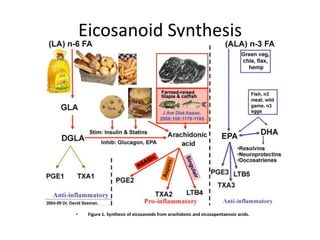
Eicosanoids
• Eicosanoids are family of oxygenated
  derivatives of arachidonic (n-6 FA) and
  eicosapentaenoic acids (n-3 FA)

• The precursor PUFA is released from membrane
  phosphatidylcholine by the action of
  phospholipase A2

• Eicosapentaenoic acids, competitively inhibit
  the oxygenation of arachidonic acid by
  cyclooxygenase and lipoxygenase
Eicosanoid Synthesis


•    Figure 1. Synthesis of eicosanoids from arachidonic and eicosapentaenoic acids.
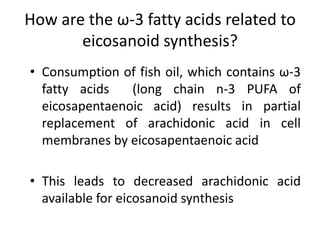
How are the ω-3 fatty acids related to
       eicosanoid synthesis?
• Consumption of fish oil, which contains ω-3
  fatty acids   (long chain n-3 PUFA of
  eicosapentaenoic acid) results in partial
  replacement of arachidonic acid in cell
  membranes by eicosapentaenoic acid

• This leads to decreased arachidonic acid
  available for eicosanoid synthesis
Eicosanoid Synthesis


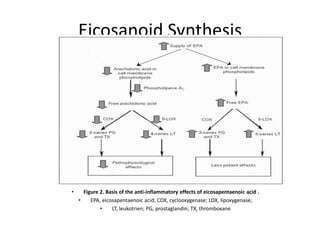
•     Figure 2. Basis of the anti-inflammatory effects of eicosapentaenoic acid .
    •    EPA, eicosapentaenoic acid; COX, cyclooxygenase; LOX, lipoxygenase;
             •    LT, leukotrien; PG, prostaglandin; TX, thromboxane
Eicosanoid Synthesis


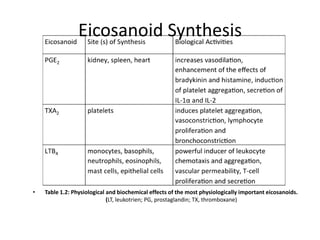
•   Table 1.2: Physiological and biochemical effects of the most physiologically important eicosanoids.
                             (LT, leukotrien; PG, prostaglandin; TX, thromboxane)
Arachidonic acid vs. Eicosapentaenoic
                 acid
 • Inhibiting metabolism of arachidonic acid,
   eicosapentaenoic acid give rise to derivatives
   which have a different structure to those
   produced from arachidonic acid (i.e., 3-series
   PG and TX and 5-series LT).

 • Thus, the eicosapentaenoic acid-induced
   suppression in the production of arachidonic
   acid-derived eicosanoids is accompanied by an
   elevation in the production of eicosapentaenoic
   acid-derived eicosanoids
Arachidonic acid vs. Eicosapentaenoic
                 acid
 • The eicosanoids produced from
   eicosapentaenoic acid are considered to be less
   biologically potent than the analogues
   synthesised from arachidonic acid

 • Thus, TXA3 has much lower potency to activate
   platelets or to induce vasoconstriction than
   TXA2 and LTB5 is much weaker in stimulation
   neutrophil activation than LTB4.
ω-3 fatty acids
• The reduction in generation of arachidonic acid-
  derived mediators which accompanies fish oil
  consumption has led to the idea that fish oil is anti-
  inflammatory.

• Clinical studies have reported that oral fish oil
  supplementation has beneficial effects in multiple
  sclerosis, asthmatics diseases and other immunity
  depending diseases.

• Supporting the idea that the n-3 PUFAs in fish oil are
  anti-inflammatory.
RESEARCH
Research Title & Authors
Background
Methods
Results
Conclusion

Fish Oil

  • 1.
    Case Conference: Omega-3 Polyunsaturated Fatty Acids Group II – Section A ALFONSO, ALJAMA, ALUZAN, AMURAO, ARELLANO, ARROYO
  • 2.
    Case: Omega-3 FattyAcid Supplementation • A 42-year old male with a strong familial history of coronary heart disease was presently asymptomatic. He read several articles in national magazines and in the newspapers that fish oil capsules may help prevent coronary thrombosis.
  • 3.
    Case: Omega-3 FattyAcid Supplementation • Such dietary supplements are available over the counter without a prescription. In an attempt to protect himself against coronary heart disease, he purchased 500 mg fish oil capsules containing 50% omega-3 polyunsaturated fatty acids and ingested six capsules daily.
  • 4.
  • 5.
    Overview and Introduction •POLYUNSATURATED FATTY ACIDS • Straight chain derivatives of fatty acids containing • Two or more double bonds. • ESSENTIAL FATTY ACIDS • Molecules that cannot be synthesized by the human body but are vital for normal metabolism • • One of these essential fatty acids is the • Omega-3 Polyunsaturated Fatty Acids
  • 6.
    Omega-3 Polyunsaturated FattyAcids • -essential dietary fatty acids, belonging to the lenolenic family of PUFAs -contain a double bond on the third carbon from the methyl end • • CHIEF DIETARY SOURCES: ocean fishes and fish oils • *Fish oil is obtained in the human diet by eating oily fishes such as herring, mackerel, salmon, albacore tuna, and sardines, or by consuming fish oil supplements or cod liver oil
  • 7.
    List of thecommon Omega-3 Fatty Acids
  • 8.
    Omega-3 Polyunsaturated FattyAcids • Nutritionally important n−3 fatty acids include α-linolenic acid (ALA), eicosapentaenoic acid (EPA), and docosahexaenoic acid (DHA), all of which are polyunsaturated.
  • 9.
    α-linolenic acid (ALA) •-type of omega-3 fatty acid found in plants. • -alpha-linolenic acid can be converted into EPA and DHA in the body • -highly concentrated in flaxseed oil and, to a lesser extent, in canola, soy, perilla, and walnut oils. •
  • 10.
    Eicosapentaenoic acid (EPA) •-EPA acts as a precursor for prostaglandin- 3 (which inhibits platelet aggregation), thromboxane- 3, and leukotriene-5 groups
  • 11.
    Docosahexanoic acid (DHA) •Obtained directly from fish oil • Present in high concentration in retina, cerebral cortex, testis and sperm • Needed for brain and retinal development
  • 12.
    FATTY ACIDS RELATEDTO MEMBRANES
  • 13.
    Fatty Acids relatedto Membranes • plasma membranes - basic component of a eukaryotic cell
  • 14.
    Fatty Acids relatedto Membranes • plasma membranes - built utilizing amphiphatic lipids: phospholipids, glycolipids & other amphipatic lipids
  • 15.
    Fatty Acids relatedto Membranes • plasma membranes - modifiable through diet
  • 16.
    A diet incorporatingfatty acids will alter the membrane lipids…
  • 17.
    When taken intothe cell, omega-3 PUFA…
  • 18.
    When taken intothe cell, omega-3 PUFA…
  • 19.
    Omega-3 will altera host of biophysical properties of membranes • like: 1. formation of metarhodopsin II, is modulated by the degree of unsaturation of retinal phospholipid. Fatty acids such that DHA- rich bilayers support the highest levels of metarhodopsin II formation. 2. DHA-rich membranes reduce the inhibitory effect of cholesterol on rhodopsin activation 3. enhances the sodium-potassium-ATPase pump 4. enable specialized cellular functions, such as the rapid firing of neurons. 5. they are chemically unstable that they oxidize very quickly. This instability can cause gradual oxidation reaction especially in the brain thereby participating further in the brain aging process.
  • 20.
    Fatty Acids relatedto Membranes
  • 21.
  • 22.
    Eicosanoid Synthesis • Marineplants, especially the unicellular algae in phytoplankton, carry out chain elongation and further desaturation of α-linolenic acid to yield the long-chain n-3 PUFAs eicosapentaenoic and docosahexaenoic acids • It is the formation of these long chain n-3 PUFAs by marine algae and their transfer through the food chain to fish that accounts for their abundance in some marine fish oils.
  • 23.
    ω-3 Fatty Acids •Marine plants, especially the unicellular algae in phytoplankton, carry out chain elongation and further desaturation of α-linolenic acid to yield the long-chain n-3 PUFAs eicosapentaenoic and docosahexaenoic acids • It is the formation of these long chain n-3 PUFAs by marine algae and their transfer through the food chain to fish that accounts for their abundance in some marine fish oils.
  • 24.
    Eicosanoids • Eicosanoids arefamily of oxygenated derivatives of arachidonic (n-6 FA) and eicosapentaenoic acids (n-3 FA) • The precursor PUFA is released from membrane phosphatidylcholine by the action of phospholipase A2 • Eicosapentaenoic acids, competitively inhibit the oxygenation of arachidonic acid by cyclooxygenase and lipoxygenase
  • 25.
    Eicosanoid Synthesis • Figure 1. Synthesis of eicosanoids from arachidonic and eicosapentaenoic acids.
  • 26.
    How are theω-3 fatty acids related to eicosanoid synthesis? • Consumption of fish oil, which contains ω-3 fatty acids (long chain n-3 PUFA of eicosapentaenoic acid) results in partial replacement of arachidonic acid in cell membranes by eicosapentaenoic acid • This leads to decreased arachidonic acid available for eicosanoid synthesis
  • 27.
    Eicosanoid Synthesis • Figure 2. Basis of the anti-inflammatory effects of eicosapentaenoic acid . • EPA, eicosapentaenoic acid; COX, cyclooxygenase; LOX, lipoxygenase; • LT, leukotrien; PG, prostaglandin; TX, thromboxane
  • 28.
    Eicosanoid Synthesis • Table 1.2: Physiological and biochemical effects of the most physiologically important eicosanoids. (LT, leukotrien; PG, prostaglandin; TX, thromboxane)
  • 29.
    Arachidonic acid vs.Eicosapentaenoic acid • Inhibiting metabolism of arachidonic acid, eicosapentaenoic acid give rise to derivatives which have a different structure to those produced from arachidonic acid (i.e., 3-series PG and TX and 5-series LT). • Thus, the eicosapentaenoic acid-induced suppression in the production of arachidonic acid-derived eicosanoids is accompanied by an elevation in the production of eicosapentaenoic acid-derived eicosanoids
  • 30.
    Arachidonic acid vs.Eicosapentaenoic acid • The eicosanoids produced from eicosapentaenoic acid are considered to be less biologically potent than the analogues synthesised from arachidonic acid • Thus, TXA3 has much lower potency to activate platelets or to induce vasoconstriction than TXA2 and LTB5 is much weaker in stimulation neutrophil activation than LTB4.
  • 31.
    ω-3 fatty acids •The reduction in generation of arachidonic acid- derived mediators which accompanies fish oil consumption has led to the idea that fish oil is anti- inflammatory. • Clinical studies have reported that oral fish oil supplementation has beneficial effects in multiple sclerosis, asthmatics diseases and other immunity depending diseases. • Supporting the idea that the n-3 PUFAs in fish oil are anti-inflammatory.
  • 32.
  • 33.
  • 34.
  • 35.
  • 36.
  • 37.