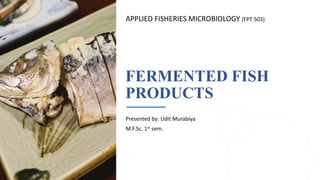
FERMENTED FISH
PRODUCTS
Presented by: Udit Murabiya
M.F.Sc. 1st sem.
APPLIED FISHERIES MICROBIOLOGY (FPT 503)
 CONTENT:
 Maintenance of stock cultures
 Fermentation introduction
 Fermentation process : Batch & continuous
 Important fermented products & production method
 Screening of microorganism
 Detection and assay of products of fermentation
 Preparation and use of fermentation media
 Starter culture
WHAT IS
FERMENTATION ?
› Fermentation - an age-old technology of preservation
of highly perishable freshwater & marine animals.
› Fermentation - process in which the complex protein
molecules in the fish are broken down by the action
of organic catalysts, enzymes or ferments, into
simpler molecules.
› However, processing of fermented fish & fishery
products is almost exclusively confined to the Asian
region.
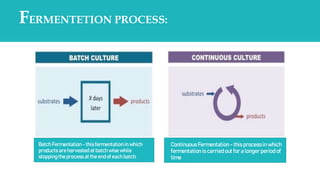
FERMENTETION PROCESS:
BatchFermentation- this fermentation in which
products are harvested at batch wise while
stopping the process at the end of each batch.
Continuous Fermentation - thisprocess in which
fermentationis carried out for a longer period of
time
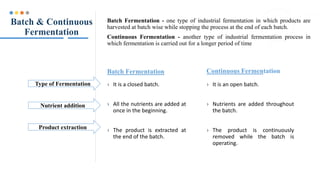
Batch & Continuous
Fermentation
Batch Fermentation
› It is a closed batch.
› All the nutrients are added at
once in the beginning.
› The product is extracted at
the end of the batch.
Continuous Fermentation
› It is an open batch.
› Nutrients are added throughout
the batch.
› The product is continuously
removed while the batch is
operating.
Type of Fermentation
Nutrient addition
Product extraction
Batch Fermentation - one type of industrial fermentation in which products are
harvested at batch wise while stopping the process at the end of each batch.
Continuous Fermentation - another type of industrial fermentation process in
which fermentation is carried out for a longer period of time
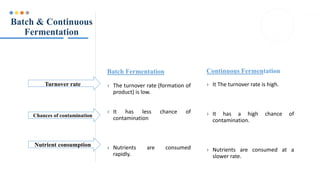
Batch & Continuous
Fermentation
Batch Fermentation
› The turnover rate (formation of
product) is low.
› It has less chance of
contamination
› Nutrients are consumed
rapidly.
Continuous Fermentation
› It The turnover rate is high.
› It has a high chance of
contamination.
› Nutrients are consumed at a
slower rate.
Turnover rate
Chances of contamination
Nutrient consumption
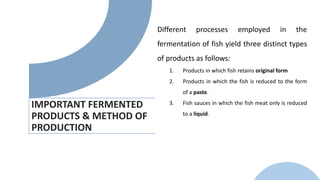
IMPORTANT FERMENTED
PRODUCTS & METHOD OF
PRODUCTION
Different processes employed in the
fermentation of fish yield three distinct types
of products as follows:
1. Products in which fish retains original form
2. Products in which the fish is reduced to the form
of a paste.
3. Fish sauces in which the fish meat only is reduced
to a liquid.
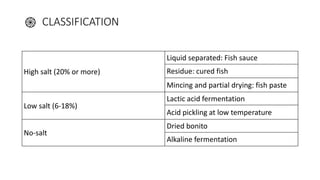
֍ CLASSIFICATION
High salt (20% or more)
Liquid separated: Fish sauce
Residue: cured fish
Mincing and partial drying: fish paste
Low salt (6-18%)
Lactic acid fermentation
Acid pickling at low temperature
No-salt
Dried bonito
Alkaline fermentation
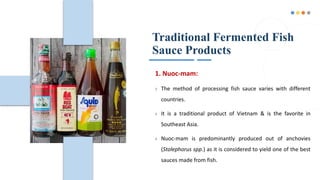
Traditional Fermented Fish
Sauce Products
1. Nuoc-mam:
› The method of processing fish sauce varies with different
countries.
› It is a traditional product of Vietnam & is the favorite in
Southeast Asia.
› Nuoc-mam is predominantly produced out of anchovies
(Stolephorus spp.) as it is considered to yield one of the best
sauces made from fish.
Raw material
Washing
Mixing with salt
(1:5-1:1 ratio)
Arrangement in
layers
Placing weight
on top
Formation of
blood pickle
(after 3-4 days)
Removal of
blood pickle
Mixing
Pouring of blood
pickle (10 cm)
Covering
Kept for 5-15
months
Formation of
clear liquid
(nuoc-mam)
Removal of clear
liquid
Filtration
Packing
Expose to
sunlight until its
ripe
PRODUCTION METHOD
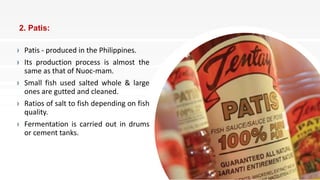
2. Patis:
› Patis - produced in the Philippines.
› Its production process is almost the
same as that of Nuoc-mam.
› Small fish used salted whole & large
ones are gutted and cleaned.
› Ratios of salt to fish depending on fish
quality.
› Fermentation is carried out in drums
or cement tanks.
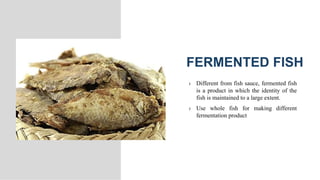
FERMENTED FISH
› Different from fish sauce, fermented fish
is a product in which the identity of the
fish is maintained to a large extent.
› Use whole fish for making different
fermentation product
12
PRODUCTION
METHOD
Pickled Herring: Clupea harengus
1
Raw Material
2
Washing
3
Dry salting (15-
36% salt)
4
Formation of self-
brine
5
Addition of brine
(if necessary)
6
Addition of sugar
7
Addition of spices
8
Add benzoic acid as
preservative
(occasionally)
9
Packing
10
Storage
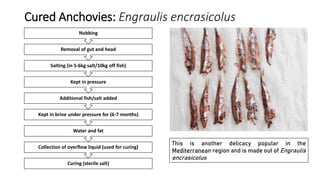
Cured Anchovies: Engraulis encrasicolus
Curing (sterile salt)
Collection of overflow liquid (used for curing)
Water and fat
Kept in brine under pressure for (6-7 months)
Additional fish/salt added
Kept in pressure
Salting (in 5-6kg salt/10kg off fish)
Removal of gut and head
Nobbing
This is another delicacy popular in the
Mediterranean region and is made out of Engraulis
encrasicolus
Colombo Curing: Rastrelliger kanagurta
• Colombo curing is a pickling process practiced in the South Canara and Malabar regions along the
West Coast of India.
• Colombo cured products used to be processed mostly out of mackerel (Rastrelliger kanagurta).
• The fish is first gutted and washed followed by rubbing with salt (fish to salt 3 : 1) and kept in
cement tanks.
• Pieces of Garcinia cambogea fruit are mixed with fish/salt mixture at about 8 kg of fruit per tonne
of fish.
• The fish remains for 3-4 months.
Fermented Paste
Fishery Products
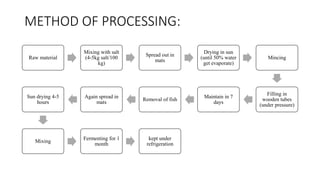
› Fish paste is another product involving fermentation
and processed in many Asian countries.
› Fish is mixed with salt and pounded to form a paste.
› The paste is sun dried for varying periods before it is
sealed in containers from which air is excluded for
maturing.
› Moisture content of the final product is in the range
30-40 per cent.
METHOD OF PROCESSING:
Raw material
Mixing with salt
(4-5kg salt/100
kg)
Spread out in
mats
Drying in sun
(until 50% water
get evaporate)
Mincing
Filling in
wooden tubes
(under pressure)
Maintain in 7
days
Removal of fish
Again spread in
mats
Sun drying 4-5
hours
Mixing
Fermenting for 1
month
kept under
refrigeration
› Fermentation with lactic acid is quicker than that with salt alone.
› Products will contain lower levels of salt in the range 6-18 per cent.
› Their processing involves mixing the fish with salt and a carbohydrate
such as cooked rice.
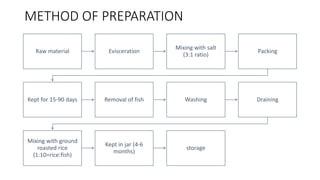
Pla-ra
› Pla-ra is a prominent lactic acid fermented product of Thailand.
› Consistency of pla-ra varies from a dark brown liquid to partly dried
fish pieces.
› It may even be eaten as the main course.
18
LACTIC ACID
FERMENTED PRODUCTS
METHOD OF PREPARATION
Raw material Evisceration
Mixing with salt
(3:1 ratio)
Packing
Kept for 15-90 days Removal of fish Washing Draining
Mixing with ground
roasted rice
(1:10=rice:fish)
Kept in jar (4-6
months)
storage
 WHAT IS SCREENING OF MICROORGANISM ?
› The primary and secondary screening of microorganisms.
› The economics of a fermentation process largely depends upon the type of
microorganism used.
› If fermentation process is to yield a product at a cheaper price the chosen
microorganism should give the desired product in a predictable and
economically adequate quantity.
1. PRIMARY SCREENING
Primary screening may be defined as detection and isolation of the
desired microorganism based on its qualitative ability to produce the
desired product like antibiotic or amino acid or an enzyme etc
Primary screening techniques:
• The crowded plate technique
• Indicator dye technique
• Enrichment culture technique etc.…
2. SECONDARY SCREENING
same as primary screening but also it gives the details of production
potential or yield of the organism. And provide broad range of information
Secondary screening techniques:
• Giant Colony Technique
• Filtration Method
• Liquid Medium Method
 DETECTION AND ASSAY OF PRODUCTS OF FERMENTATION
• An Assay is an investigative procedure for qualitatively accessing or quantitatively
measuring the presence or amount or the functional activity of process.
• Before, assaying microorganisms strain have to be selected, screened to know if
it’s the right microorganisms that are potentially valuable in producing a
commercially useful product.
• Two main categories of detection & assay:
1. Physical-chemical assay
2. Biological assay
PHYSICAL-CHEMICAL
ASSAYS :
its depends on the
selectivity of the chemical
reaction or chemical
analysis involved since the
fermentation broth contains
many compounds in
addition to those to be
determined.
Chemical &
physical assay
Gas
chromatography
Chromatographic
Partition
Spectrophotomet
ric
Turbidity analysis
and Cell Yield
Determination
Titration and
Gravimetric
Assay
BIOLOGICAL ASSAY
For biological assay, sensitive test organism or enzyme is required. The
product tested against sensitive organism, which may depress or
stimulates the growth of the sensitive test organisms.
BIOLOGICAL
ASSAY
Enzymatic
Metabolic
Response
Turbid-
metric
Diffusion
 PREPARATION AND USE OF FERMENTATION MEDIA
• To obtain a good product from fermentation, the medium in which
the microorganisms are grown must be supplied with enough energy
sources and nutrients.
• Several factors must be kept in mind before designing or choosing the
growth medium for fermentation.
• The fermentation media can either be liquid, known as broth, or it
can be a solid-state fermentation.
• A typical media requires a carbon source, a nitrogen source, salts,
water and micronutrients
• Trace salts
• Yeast extract
• Vitamins
• Macronutrients
• Trace elements
• phosphates
• carbonates
• chelating agents
• Tryptone
• Peptone
• soy meal
• corn steep liquor
• yeast extract
• glycerol
• sucrose
• glucose
• alcohols
• sugars
• carbohydrates
Carbon Nitrogen
Growth factor
Miscellaneous
WHAT IS STARTER CULTURE ?
• A fermentation starter (called simply starter within the corresponding context,
sometimes called a mother) is a preparation to assist the beginning of
the fermentation process in preparation of various foods and alcoholic drinks.
• Food groups where they are used include bread especially sourdough bread,
and cheese.
• A starter culture is a microbiological culture which actually performs fermentation.
• These starters usually consist of a cultivation medium, such as grains, seeds, or
nutrient liquids that have been well colonized by the microorganisms used for the
fermentation.
• Typical microorganisms used in starters include
various bacteria and fungi (yeasts and molds): Rhizopus, Aspergillus, Mucor, Amylom
-yces, Endomycopsis, Saccharomyces etc.
 MAINTENANCE & STORAGE:
• Culture media must be stored at the specified temperature, under
specified conditions and not longer than the shelf-life periods
appropriate to each product.
• The storage conditions and expiry date of each product are shown on
the labels or product inserts but the following general rules will help
to ensure that they are kept in an optimum environment.
• When storing products note the shelf life expiry dates on the labels
and use the products in order of their lot/batch numbers.
Light
› prepared culture media and their
components should be stored away
from light & sunlight
Humidity
› Sealed glass and plastic
containers are unaffected by
normal laboratory humidity.
Opened containers of
dehydrated powders will be
affected by high humidity.
› Hot, steamy media preparation
rooms are not suitable
› cold room or an adequate
storage cupboard are preferable
Temperature and
Time
› The temperature storage
conditions of culture media
and their components vary
widely.
› Culture Media should be
stored at room temperature
15-20°C
› Prepared Broth Media: Store
at 2-8°C
Maintenance of stock culture
Fish fermentation products.pptx

Fish fermentation products.pptx

  • 1.
    FERMENTED FISH PRODUCTS Presented by:Udit Murabiya M.F.Sc. 1st sem. APPLIED FISHERIES MICROBIOLOGY (FPT 503)
  • 2.
     CONTENT:  Maintenanceof stock cultures  Fermentation introduction  Fermentation process : Batch & continuous  Important fermented products & production method  Screening of microorganism  Detection and assay of products of fermentation  Preparation and use of fermentation media  Starter culture
  • 3.
    WHAT IS FERMENTATION ? ›Fermentation - an age-old technology of preservation of highly perishable freshwater & marine animals. › Fermentation - process in which the complex protein molecules in the fish are broken down by the action of organic catalysts, enzymes or ferments, into simpler molecules. › However, processing of fermented fish & fishery products is almost exclusively confined to the Asian region.
  • 4.
    FERMENTETION PROCESS: BatchFermentation- thisfermentation in which products are harvested at batch wise while stopping the process at the end of each batch. Continuous Fermentation - thisprocess in which fermentationis carried out for a longer period of time
  • 5.
    Batch & Continuous Fermentation BatchFermentation › It is a closed batch. › All the nutrients are added at once in the beginning. › The product is extracted at the end of the batch. Continuous Fermentation › It is an open batch. › Nutrients are added throughout the batch. › The product is continuously removed while the batch is operating. Type of Fermentation Nutrient addition Product extraction Batch Fermentation - one type of industrial fermentation in which products are harvested at batch wise while stopping the process at the end of each batch. Continuous Fermentation - another type of industrial fermentation process in which fermentation is carried out for a longer period of time
  • 6.
    Batch & Continuous Fermentation BatchFermentation › The turnover rate (formation of product) is low. › It has less chance of contamination › Nutrients are consumed rapidly. Continuous Fermentation › It The turnover rate is high. › It has a high chance of contamination. › Nutrients are consumed at a slower rate. Turnover rate Chances of contamination Nutrient consumption
  • 7.
    IMPORTANT FERMENTED PRODUCTS &METHOD OF PRODUCTION Different processes employed in the fermentation of fish yield three distinct types of products as follows: 1. Products in which fish retains original form 2. Products in which the fish is reduced to the form of a paste. 3. Fish sauces in which the fish meat only is reduced to a liquid.
  • 8.
    ֍ CLASSIFICATION High salt(20% or more) Liquid separated: Fish sauce Residue: cured fish Mincing and partial drying: fish paste Low salt (6-18%) Lactic acid fermentation Acid pickling at low temperature No-salt Dried bonito Alkaline fermentation
  • 9.
    Traditional Fermented Fish SauceProducts 1. Nuoc-mam: › The method of processing fish sauce varies with different countries. › It is a traditional product of Vietnam & is the favorite in Southeast Asia. › Nuoc-mam is predominantly produced out of anchovies (Stolephorus spp.) as it is considered to yield one of the best sauces made from fish.
  • 10.
    Raw material Washing Mixing withsalt (1:5-1:1 ratio) Arrangement in layers Placing weight on top Formation of blood pickle (after 3-4 days) Removal of blood pickle Mixing Pouring of blood pickle (10 cm) Covering Kept for 5-15 months Formation of clear liquid (nuoc-mam) Removal of clear liquid Filtration Packing Expose to sunlight until its ripe PRODUCTION METHOD
  • 11.
    2. Patis: › Patis- produced in the Philippines. › Its production process is almost the same as that of Nuoc-mam. › Small fish used salted whole & large ones are gutted and cleaned. › Ratios of salt to fish depending on fish quality. › Fermentation is carried out in drums or cement tanks.
  • 12.
    FERMENTED FISH › Differentfrom fish sauce, fermented fish is a product in which the identity of the fish is maintained to a large extent. › Use whole fish for making different fermentation product 12
  • 13.
    PRODUCTION METHOD Pickled Herring: Clupeaharengus 1 Raw Material 2 Washing 3 Dry salting (15- 36% salt) 4 Formation of self- brine 5 Addition of brine (if necessary) 6 Addition of sugar 7 Addition of spices 8 Add benzoic acid as preservative (occasionally) 9 Packing 10 Storage
  • 14.
    Cured Anchovies: Engraulisencrasicolus Curing (sterile salt) Collection of overflow liquid (used for curing) Water and fat Kept in brine under pressure for (6-7 months) Additional fish/salt added Kept in pressure Salting (in 5-6kg salt/10kg off fish) Removal of gut and head Nobbing This is another delicacy popular in the Mediterranean region and is made out of Engraulis encrasicolus
  • 15.
    Colombo Curing: Rastrelligerkanagurta • Colombo curing is a pickling process practiced in the South Canara and Malabar regions along the West Coast of India. • Colombo cured products used to be processed mostly out of mackerel (Rastrelliger kanagurta). • The fish is first gutted and washed followed by rubbing with salt (fish to salt 3 : 1) and kept in cement tanks. • Pieces of Garcinia cambogea fruit are mixed with fish/salt mixture at about 8 kg of fruit per tonne of fish. • The fish remains for 3-4 months.
  • 16.
    Fermented Paste Fishery Products ›Fish paste is another product involving fermentation and processed in many Asian countries. › Fish is mixed with salt and pounded to form a paste. › The paste is sun dried for varying periods before it is sealed in containers from which air is excluded for maturing. › Moisture content of the final product is in the range 30-40 per cent.
  • 17.
    METHOD OF PROCESSING: Rawmaterial Mixing with salt (4-5kg salt/100 kg) Spread out in mats Drying in sun (until 50% water get evaporate) Mincing Filling in wooden tubes (under pressure) Maintain in 7 days Removal of fish Again spread in mats Sun drying 4-5 hours Mixing Fermenting for 1 month kept under refrigeration
  • 18.
    › Fermentation withlactic acid is quicker than that with salt alone. › Products will contain lower levels of salt in the range 6-18 per cent. › Their processing involves mixing the fish with salt and a carbohydrate such as cooked rice. Pla-ra › Pla-ra is a prominent lactic acid fermented product of Thailand. › Consistency of pla-ra varies from a dark brown liquid to partly dried fish pieces. › It may even be eaten as the main course. 18 LACTIC ACID FERMENTED PRODUCTS
  • 19.
    METHOD OF PREPARATION Rawmaterial Evisceration Mixing with salt (3:1 ratio) Packing Kept for 15-90 days Removal of fish Washing Draining Mixing with ground roasted rice (1:10=rice:fish) Kept in jar (4-6 months) storage
  • 20.
     WHAT ISSCREENING OF MICROORGANISM ? › The primary and secondary screening of microorganisms. › The economics of a fermentation process largely depends upon the type of microorganism used. › If fermentation process is to yield a product at a cheaper price the chosen microorganism should give the desired product in a predictable and economically adequate quantity.
  • 21.
    1. PRIMARY SCREENING Primaryscreening may be defined as detection and isolation of the desired microorganism based on its qualitative ability to produce the desired product like antibiotic or amino acid or an enzyme etc Primary screening techniques: • The crowded plate technique • Indicator dye technique • Enrichment culture technique etc.…
  • 22.
    2. SECONDARY SCREENING sameas primary screening but also it gives the details of production potential or yield of the organism. And provide broad range of information Secondary screening techniques: • Giant Colony Technique • Filtration Method • Liquid Medium Method
  • 23.
     DETECTION ANDASSAY OF PRODUCTS OF FERMENTATION • An Assay is an investigative procedure for qualitatively accessing or quantitatively measuring the presence or amount or the functional activity of process. • Before, assaying microorganisms strain have to be selected, screened to know if it’s the right microorganisms that are potentially valuable in producing a commercially useful product. • Two main categories of detection & assay: 1. Physical-chemical assay 2. Biological assay
  • 24.
    PHYSICAL-CHEMICAL ASSAYS : its dependson the selectivity of the chemical reaction or chemical analysis involved since the fermentation broth contains many compounds in addition to those to be determined. Chemical & physical assay Gas chromatography Chromatographic Partition Spectrophotomet ric Turbidity analysis and Cell Yield Determination Titration and Gravimetric Assay
  • 25.
    BIOLOGICAL ASSAY For biologicalassay, sensitive test organism or enzyme is required. The product tested against sensitive organism, which may depress or stimulates the growth of the sensitive test organisms. BIOLOGICAL ASSAY Enzymatic Metabolic Response Turbid- metric Diffusion
  • 26.
     PREPARATION ANDUSE OF FERMENTATION MEDIA • To obtain a good product from fermentation, the medium in which the microorganisms are grown must be supplied with enough energy sources and nutrients. • Several factors must be kept in mind before designing or choosing the growth medium for fermentation. • The fermentation media can either be liquid, known as broth, or it can be a solid-state fermentation. • A typical media requires a carbon source, a nitrogen source, salts, water and micronutrients
  • 27.
    • Trace salts •Yeast extract • Vitamins • Macronutrients • Trace elements • phosphates • carbonates • chelating agents • Tryptone • Peptone • soy meal • corn steep liquor • yeast extract • glycerol • sucrose • glucose • alcohols • sugars • carbohydrates Carbon Nitrogen Growth factor Miscellaneous
  • 28.
    WHAT IS STARTERCULTURE ? • A fermentation starter (called simply starter within the corresponding context, sometimes called a mother) is a preparation to assist the beginning of the fermentation process in preparation of various foods and alcoholic drinks. • Food groups where they are used include bread especially sourdough bread, and cheese. • A starter culture is a microbiological culture which actually performs fermentation. • These starters usually consist of a cultivation medium, such as grains, seeds, or nutrient liquids that have been well colonized by the microorganisms used for the fermentation. • Typical microorganisms used in starters include various bacteria and fungi (yeasts and molds): Rhizopus, Aspergillus, Mucor, Amylom -yces, Endomycopsis, Saccharomyces etc.
  • 29.
     MAINTENANCE &STORAGE: • Culture media must be stored at the specified temperature, under specified conditions and not longer than the shelf-life periods appropriate to each product. • The storage conditions and expiry date of each product are shown on the labels or product inserts but the following general rules will help to ensure that they are kept in an optimum environment. • When storing products note the shelf life expiry dates on the labels and use the products in order of their lot/batch numbers.
  • 30.
    Light › prepared culturemedia and their components should be stored away from light & sunlight Humidity › Sealed glass and plastic containers are unaffected by normal laboratory humidity. Opened containers of dehydrated powders will be affected by high humidity. › Hot, steamy media preparation rooms are not suitable › cold room or an adequate storage cupboard are preferable Temperature and Time › The temperature storage conditions of culture media and their components vary widely. › Culture Media should be stored at room temperature 15-20°C › Prepared Broth Media: Store at 2-8°C Maintenance of stock culture