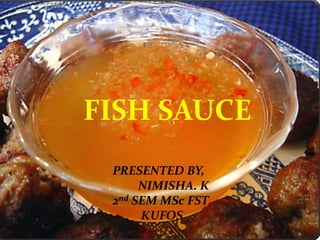

FISH SAUCE
PRESENTED BY,
NIMISHA. K
2nd SEM MSc FST
KUFOS
INTRODUCTION
 Fish sauce is an amber colored liquid
extracted from the fermentation of fish
with salt
 It is used as a condiment in various
cuisines or dipping sauce and
extensively used in the South East
Asian countries like Thailand, Malaysia,
Philippines, Vietnam, Japan, Korea etc.
 It has a translucent reddish golden
brown color
HISTORY OF FISH SAUCE
 The Chinese used fermentation before
Christian era
 Hae is fermented meat or fish made by
aging in salt, occasionally with added
wine, koji, and nuruk, alcohol
fermentation starters
 Ja is an acidic fermented fish
 Chi is a fermented fish sauce, very
similar to Hae
PRODUCTION OF FISH SAUCE
 INGREDIANTS
 1. FISH
 2. SALT
PRODUCTION CHART
FISH+SALT (3:1)
MIXING
FERMENTATION
AGITATION
RESIDUE USED FOR FISH PASTE
FISH SAUCE
PACKING IN BOTTLES
STORAGE
CURED FISH
FILTRATION
Continues…….
 Fish sauce is a heavily salted liquid
product having salt content varying
from 20-30% depending upon the
method and source of production
 Most fish sauces are made from raw
fish, some from dried fish, some from
only a single species
 Most fish sauces contain only fish and
salt others add a variety of herbs and
spices
Traditional method of production
 Fermented fishery products are
generally classified into;
High salted
Low salted
• Fermentation of fish takes place as a
result of the action of exogenic and
endogenic enzymes, the latter being
naturally present in the guts and
intestines of fish
 Fish and salt are mixed and allow it for
the hydrolysis of fish proteins to
peptides amino acids that are water
soluble
 The time of sauce fermentation varies
from 6 months to 1 year
 Aging is an important step and helps to
develop the aroma characteristic to the
sauce
Factors controlling sauce
fermentation
Lipid content and quality
 Sauce production is an anaerobic
process
 Chances of lipid oxidation and
accumulation of oxidized flavor
compounds in the medium are minimal
 Halophilic and halotolerant bacteria
can grow well in the medium and a low
pH helps to prevent the growth of
putrefying bacteria
Color
 The color of sauce produced from fresh
anchiovella under ideal conditions is a pleasing
lemon yellow to light brown
 Fish sauce produced from fatty pelagic fishes
like sardines and mackerel is deep brown to
dark red
Flavor
 Volatile fatty acids are identified as an
important agent contributing to the flavor of
fish sauce
Eg:- Ethanoic acid, Propanoic acid etc.
TYPES OF FISH SAUCES
 CHINA- yulu
 VIETNAM- nuac-mam
 MALASIA- budu
 THAILAND- nam-pla
 PHILIPINES- patis
 JAPAN- shottu suru
 KOREA- jeot-kuk
 SRI LANKA- blood pickle
 AFRICA- fossik
ROMAN FISH SAUCES
 Originally a fish sauce called GAROS was brought from
Greece to Rome
 The basic difference between Roman and Thai fish sauce
is , in Thai uses only fresh anchovies. The Romans
sometimes uses other fishes and enhanced the mix with
extra fish blood and guts.
GARUM:- a high grade fish sauce made from the gut and
blood of a single kind of fish
LIQUAMEN:- whole fish is used with added blood and guts
MURIA:- made from tuna guts
ALLEC:- this was a paste formed in the bottom
OXYGARUM:- Garum mixed with vinegar
MELIGARUM:- Garum mixed with honey
ITALIAN FISH SAUCE
 The fish sauce made in Italy called
COLATURA di ALLICI
 The name means “filtration of
anchovies” and it’s a byproduct of
salting anchovies in barrels
 Made this way the quantity is small and
it is highly concentrated and quite
expensive
ROMAN FISH SAUCE ITALIAN FISH SAUCE
CHINESE FISH
SAUCE
SOUTH EAST ASIAN FISH
SAUCE
NUOC-MAM
 It is produced in large quantities in
VIETNAM, THAILAND, KAMPUCHEA
 The species used for fish sauce
production is anchovies(Stolephorous
sp.)
Process
 Whole unwashed fish is piled into large
wooden barrels or cement tanks
 Fish and salt are mixed in the ratio of 6:4 and
arranged in layers
 After 3-4 days the liquid containing blood and
salt called, blood pickle (nuoc-boi) oozes out
 This is removed and kept aside in a bottle. The
fish is then mixed well
 The tanks are covered with coconut leaves over
which two semi-circular bamboo layers are set
 The blood pickle is poured over the system
until a 10 cm layer is formed at the top
 The fish paste remains in this condition for 6
months to 1 year
BUDU
 It is one of the best known fermented seafood
products in MALASIA
 Fish(anchovies) is washed and cleaned, mixed
with salt (3:1) and allowed to ferment anaerobically
 Some manufactures add tamarind juice or lime
and palm sugar to the mixture prior to
fermentation
 Fermentation is allowed to continue for 6 months
to 1 year
 When the product is mature, indicated by the
formation of a film of oil on top of the liquid, it is
harvested , boiled in an open cauldron, cooled,
filtered and bottled.
PATIS
 In the PHILIPINES, fish sauce is called patis
 Small fishes like anchovies are salted whole
without removing gut and gills
 Large fish are cut open and the guts are
removed and cleaned. They are chopped into
chunks or smaller pieces
 Fish and salt are mixed in the ratio of 3:1 or 4:1
 Before fermentation, fish are temporarily
stored in drums lined with polyethylene
 Harvesting is done after 8-12 months of
fermentation and aging
BUDU NUOC-MAM
NAM-PLA PATIS
BENEFITS OF FISH SAUCE
1. Fish sauce really enhances the flavor
of a dish
2. It doesn’t make it taste fishy
3. Fish sauce used as a substitute for soy
sauce
4. Fish sauce is full of vital nutrients and
minerals contained in fish and fish
organs, enhanced by fermentation
5. Budu also as a food sourced from fish
have potential as brain food
Fish sauce- Nimisha Kaikkolante

Fish sauce- Nimisha Kaikkolante

  • 1.
    FISH SAUCE PRESENTED BY, NIMISHA.K 2nd SEM MSc FST KUFOS
  • 2.
    INTRODUCTION  Fish sauceis an amber colored liquid extracted from the fermentation of fish with salt  It is used as a condiment in various cuisines or dipping sauce and extensively used in the South East Asian countries like Thailand, Malaysia, Philippines, Vietnam, Japan, Korea etc.  It has a translucent reddish golden brown color
  • 3.
    HISTORY OF FISHSAUCE  The Chinese used fermentation before Christian era  Hae is fermented meat or fish made by aging in salt, occasionally with added wine, koji, and nuruk, alcohol fermentation starters  Ja is an acidic fermented fish  Chi is a fermented fish sauce, very similar to Hae
  • 4.
    PRODUCTION OF FISHSAUCE  INGREDIANTS  1. FISH  2. SALT
  • 5.
    PRODUCTION CHART FISH+SALT (3:1) MIXING FERMENTATION AGITATION RESIDUEUSED FOR FISH PASTE FISH SAUCE PACKING IN BOTTLES STORAGE CURED FISH FILTRATION
  • 7.
    Continues…….  Fish sauceis a heavily salted liquid product having salt content varying from 20-30% depending upon the method and source of production  Most fish sauces are made from raw fish, some from dried fish, some from only a single species  Most fish sauces contain only fish and salt others add a variety of herbs and spices
  • 8.
    Traditional method ofproduction  Fermented fishery products are generally classified into; High salted Low salted • Fermentation of fish takes place as a result of the action of exogenic and endogenic enzymes, the latter being naturally present in the guts and intestines of fish
  • 9.
     Fish andsalt are mixed and allow it for the hydrolysis of fish proteins to peptides amino acids that are water soluble  The time of sauce fermentation varies from 6 months to 1 year  Aging is an important step and helps to develop the aroma characteristic to the sauce
  • 10.
    Factors controlling sauce fermentation Lipidcontent and quality  Sauce production is an anaerobic process  Chances of lipid oxidation and accumulation of oxidized flavor compounds in the medium are minimal  Halophilic and halotolerant bacteria can grow well in the medium and a low pH helps to prevent the growth of putrefying bacteria
  • 11.
    Color  The colorof sauce produced from fresh anchiovella under ideal conditions is a pleasing lemon yellow to light brown  Fish sauce produced from fatty pelagic fishes like sardines and mackerel is deep brown to dark red Flavor  Volatile fatty acids are identified as an important agent contributing to the flavor of fish sauce Eg:- Ethanoic acid, Propanoic acid etc.
  • 12.
  • 13.
     CHINA- yulu VIETNAM- nuac-mam  MALASIA- budu  THAILAND- nam-pla  PHILIPINES- patis  JAPAN- shottu suru  KOREA- jeot-kuk  SRI LANKA- blood pickle  AFRICA- fossik
  • 14.
    ROMAN FISH SAUCES Originally a fish sauce called GAROS was brought from Greece to Rome  The basic difference between Roman and Thai fish sauce is , in Thai uses only fresh anchovies. The Romans sometimes uses other fishes and enhanced the mix with extra fish blood and guts. GARUM:- a high grade fish sauce made from the gut and blood of a single kind of fish LIQUAMEN:- whole fish is used with added blood and guts MURIA:- made from tuna guts ALLEC:- this was a paste formed in the bottom OXYGARUM:- Garum mixed with vinegar MELIGARUM:- Garum mixed with honey
  • 15.
    ITALIAN FISH SAUCE The fish sauce made in Italy called COLATURA di ALLICI  The name means “filtration of anchovies” and it’s a byproduct of salting anchovies in barrels  Made this way the quantity is small and it is highly concentrated and quite expensive
  • 16.
    ROMAN FISH SAUCEITALIAN FISH SAUCE CHINESE FISH SAUCE
  • 17.
    SOUTH EAST ASIANFISH SAUCE NUOC-MAM  It is produced in large quantities in VIETNAM, THAILAND, KAMPUCHEA  The species used for fish sauce production is anchovies(Stolephorous sp.) Process  Whole unwashed fish is piled into large wooden barrels or cement tanks
  • 18.
     Fish andsalt are mixed in the ratio of 6:4 and arranged in layers  After 3-4 days the liquid containing blood and salt called, blood pickle (nuoc-boi) oozes out  This is removed and kept aside in a bottle. The fish is then mixed well  The tanks are covered with coconut leaves over which two semi-circular bamboo layers are set  The blood pickle is poured over the system until a 10 cm layer is formed at the top  The fish paste remains in this condition for 6 months to 1 year
  • 20.
    BUDU  It isone of the best known fermented seafood products in MALASIA  Fish(anchovies) is washed and cleaned, mixed with salt (3:1) and allowed to ferment anaerobically  Some manufactures add tamarind juice or lime and palm sugar to the mixture prior to fermentation  Fermentation is allowed to continue for 6 months to 1 year  When the product is mature, indicated by the formation of a film of oil on top of the liquid, it is harvested , boiled in an open cauldron, cooled, filtered and bottled.
  • 21.
    PATIS  In thePHILIPINES, fish sauce is called patis  Small fishes like anchovies are salted whole without removing gut and gills  Large fish are cut open and the guts are removed and cleaned. They are chopped into chunks or smaller pieces  Fish and salt are mixed in the ratio of 3:1 or 4:1  Before fermentation, fish are temporarily stored in drums lined with polyethylene  Harvesting is done after 8-12 months of fermentation and aging
  • 22.
  • 23.
    BENEFITS OF FISHSAUCE 1. Fish sauce really enhances the flavor of a dish 2. It doesn’t make it taste fishy 3. Fish sauce used as a substitute for soy sauce 4. Fish sauce is full of vital nutrients and minerals contained in fish and fish organs, enhanced by fermentation 5. Budu also as a food sourced from fish have potential as brain food