Presented By M Altaf
Various Writer on
World Englishes
PRESENTATION TOPIC
 This presentation is about
 World Englishes
 Various Writer on World English
 World Englishes in Future
Conclusion
World Englishes
 World Englishes is a term for emerging localized or
indigenized varieties of English, especially varieties that
have developed in territories influenced by the United
Kingdom.
World English VS World Englishes
 World English refers to the English language as
a lingua franca used in business, trade,
diplomacy and other spheres of global activity,
while World Englishes refers to the different
varieties of English and English-based creoles
developed in different regions of the world.
More About World Englishes
 Arabic, Chinese, French, Russian, English, and
Spanish are the six official languages of the
United Nations.
 In the first session of the United Nations General
Assembly in 1946, English and French were
adopted as two working languages for the United
Nations.
Various Writer on World English
Kachru
Quirk 1998
Schneider 2011
Crystal 2007
Mahboob 2009
Selinker 1972, 1992
Kachru
 According to Kachru (1992a) the global spread
of English can be explained in terms of two
diasporal transportations. • 1. The first dispersal
was within the Inner Circle where a monolingual
English-speaking population migrated on a
relatively large scale to countries like North
America, Australia and New Zealand • 2. The
second diasporas of the Outer and Expanding
circle was the result of the colonisation of Asia
and Africa by the British.
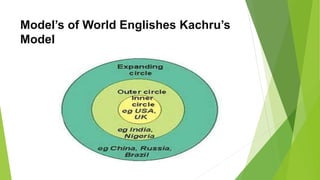
Model’s of World Englishes Kachru’s
Model
Conti…
1.Inner Circle (ENL) • The Inner Circle Englishes in the model refer
to the parentcountries of English or the colonising nations such as
Britain that spread the language to different regions of the world, for
whom English is the first language in almost all functions.
2. Outer Circle (ESL) • The Outer Circle is inhabited by the
colonised territories in which English is a second or nonnative
language and used in different functional domains, such as
government, education, law and so on.
3.Expanding Circle (EFL) • In the Expanding Circle English is
considered as a foreign language and is used • in highly restricted
domains such as for international communication
Quirk 1998
At the same time Quirk (1988, cited in
Kachru, 1990) states that language spreads
due to • demographical, econocultural and
imperial factors.
Schneider 2011
 Schneider (2011) view globalisation as an
important factor in the spread of English.
Crystal 2007
 According to Crystal (2007), when a country becomes
independent, there is a natural reaction to refrain from
using the linguistic character imposed by its colonial
past and to look for native languages to provide a
symbol for nationhood. As a result, new ways of talking
and writing develop and indigenous words become
privileged.
Mahboob 2009
in a case study of Pakistani English,
Mahboob (2009) proves that English
spoken in Pakistan reflects their cultural
and Islamic values, and it has been
modified to achieve linguistic and
pragmatic competence in a Muslim country.
Selinker 1972, 1992
 According to (Selinker, 1972, 1992), second language
learners’ competence is based on an interlanguage range
between their first (L1) and their second (L2) language.
If their output is different from Standard English
(American or British), it is regarded as an error
(interference of L1 mainly) and if they continue
producing errors (fixing), this is known as Conventions.
World Englishes in Future
The future of Worlds Englishes can be considered
from three perspectives:
Multilingualism.
Multiculturalism.
and linguistic human rights.
Conclusion
 For the world, an international language is
 A communication tool for people to notice the
championship of human rights.
 English will remain the dominant .
 Presence among international languages.
World english

World english

  • 1.
    Presented By MAltaf Various Writer on World Englishes
  • 2.
    PRESENTATION TOPIC  Thispresentation is about  World Englishes  Various Writer on World English  World Englishes in Future Conclusion
  • 3.
    World Englishes  WorldEnglishes is a term for emerging localized or indigenized varieties of English, especially varieties that have developed in territories influenced by the United Kingdom.
  • 4.
    World English VSWorld Englishes  World English refers to the English language as a lingua franca used in business, trade, diplomacy and other spheres of global activity, while World Englishes refers to the different varieties of English and English-based creoles developed in different regions of the world.
  • 5.
    More About WorldEnglishes  Arabic, Chinese, French, Russian, English, and Spanish are the six official languages of the United Nations.  In the first session of the United Nations General Assembly in 1946, English and French were adopted as two working languages for the United Nations.
  • 6.
    Various Writer onWorld English Kachru Quirk 1998 Schneider 2011 Crystal 2007 Mahboob 2009 Selinker 1972, 1992
  • 7.
    Kachru  According toKachru (1992a) the global spread of English can be explained in terms of two diasporal transportations. • 1. The first dispersal was within the Inner Circle where a monolingual English-speaking population migrated on a relatively large scale to countries like North America, Australia and New Zealand • 2. The second diasporas of the Outer and Expanding circle was the result of the colonisation of Asia and Africa by the British.
  • 8.
    Model’s of WorldEnglishes Kachru’s Model
  • 9.
    Conti… 1.Inner Circle (ENL)• The Inner Circle Englishes in the model refer to the parentcountries of English or the colonising nations such as Britain that spread the language to different regions of the world, for whom English is the first language in almost all functions. 2. Outer Circle (ESL) • The Outer Circle is inhabited by the colonised territories in which English is a second or nonnative language and used in different functional domains, such as government, education, law and so on. 3.Expanding Circle (EFL) • In the Expanding Circle English is considered as a foreign language and is used • in highly restricted domains such as for international communication
  • 10.
    Quirk 1998 At thesame time Quirk (1988, cited in Kachru, 1990) states that language spreads due to • demographical, econocultural and imperial factors.
  • 11.
    Schneider 2011  Schneider(2011) view globalisation as an important factor in the spread of English.
  • 12.
    Crystal 2007  Accordingto Crystal (2007), when a country becomes independent, there is a natural reaction to refrain from using the linguistic character imposed by its colonial past and to look for native languages to provide a symbol for nationhood. As a result, new ways of talking and writing develop and indigenous words become privileged.
  • 13.
    Mahboob 2009 in acase study of Pakistani English, Mahboob (2009) proves that English spoken in Pakistan reflects their cultural and Islamic values, and it has been modified to achieve linguistic and pragmatic competence in a Muslim country.
  • 14.
    Selinker 1972, 1992 According to (Selinker, 1972, 1992), second language learners’ competence is based on an interlanguage range between their first (L1) and their second (L2) language. If their output is different from Standard English (American or British), it is regarded as an error (interference of L1 mainly) and if they continue producing errors (fixing), this is known as Conventions.
  • 15.
    World Englishes inFuture The future of Worlds Englishes can be considered from three perspectives: Multilingualism. Multiculturalism. and linguistic human rights.
  • 16.
    Conclusion  For theworld, an international language is  A communication tool for people to notice the championship of human rights.  English will remain the dominant .  Presence among international languages.