Assignment:
Assignment name : firewalls in networking
Course code: CSE 318
Submitted to:
pranab Bandhu nath
senior Lecturer, Department of CSE
City university, Dhaka
Submitted by
Md parvez
Id: 184902610
Bsc in cse(day)
Batch :49th
What Is a Firewall?
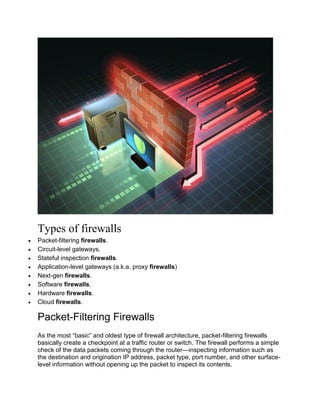
A firewall is a network security device that monitors incoming and outgoing network
traffic and decides whether to allow or block specific traffic based on a defined set of
security rules.
Firewalls have been a first line of defense in network security for over 25 years. They
establish a barrier between secured and controlled internal networks that can be trusted
and untrusted outside networks, such as the Internet.
A firewall can be hardware, software, or both
Types of firewalls
 Packet-filtering firewalls.
 Circuit-level gateways.
 Stateful inspection firewalls.
 Application-level gateways (a.k.a. proxy firewalls)
 Next-gen firewalls.
 Software firewalls.
 Hardware firewalls.
 Cloud firewalls.
Packet-Filtering Firewalls
As the most “basic” and oldest type of firewall architecture, packet-filtering firewalls
basically create a checkpoint at a traffic router or switch. The firewall performs a simple
check of the data packets coming through the router—inspecting information such as
the destination and origination IP address, packet type, port number, and other surface-
level information without opening up the packet to inspect its contents.
If the information packet doesn’t pass the inspection, it is dropped.
The good thing about these firewalls is that they aren’t very resource-intensive. This
means they don’t have a huge impact on system performance and are relatively simple.
However, they’re also relatively easy to bypass compared to firewalls with more robust
inspection capabilities.
Circuit-Level Gateways
As another simplistic firewall type that is meant to quickly and easily approve or deny
traffic without consuming significant computing resources, circuit-level gateways work
by verifying the transmission control protocol (TCP) handshake. This TCP handshake
check is designed to make sure that the session the packet is from is legitimate.
While extremely resource-efficient, these firewalls do not check the packet itself. So, if a
packet held malware, but had the right TCP handshake, it would pass right through.
This is why circuit-level gateways are not enough to protect your business by
themselves.
Stateful Inspection Firewalls
These firewalls combine both packet inspection technology and TCP handshake
verification to create a level of protection greater than either of the previous two
architectures could provide alone.
However, these firewalls do put more of a strain on computing resources as well. This
may slow down the transfer of legitimate packets compared to the other solutions
Proxy Firewalls (Application-Level Gateways/Cloud
Firewalls)
Proxy firewalls operate at the application layer to filter incoming traffic between your
network and the traffic source—hence, the name “application-level gateway.” These
firewalls are delivered via a cloud-based solution or another proxy device. Rather than
letting traffic connect directly, the proxy firewall first establishes a connection to the
source of the traffic and inspects the incoming data packet.
This check is similar to the stateful inspection firewall in that it looks at both the packet
and at the TCP handshake protocol. However, proxy firewalls may also perform deep-
layer packet inspections, checking the actual contents of the information packet to verify
that it contains no malware.
Next-Generation Firewalls
Many of the most recently-released firewall products are being touted as “next-
generation” architectures. However, there is not as much consensus on what makes a
firewall truly next-gen.
Some common features of next-generation firewall architectures include deep-packet
inspection (checking the actual contents of the data packet), TCP handshake checks,
and surface-level packet inspection. Next-generation firewalls may include other
technologies as well, such as intrusion prevention systems (IPSs) that work to
automatically stop attacks against your network.
Software Firewalls
Software firewalls include any type of firewall that is installed on a local device rather
than a separate piece of hardware (or a cloud server). The big benefit of a software
firewall is that it's highly useful for creating defense in depth by isolating individual
network endpoints from one another.
However, maintaining individual software firewalls on different devices can be difficult
and time-consuming. Furthermore, not every device on a network may be compatible
with a single software firewall, which may mean having to use several different software
firewalls to cover every asset.
Hardware Firewalls
Hardware firewalls use a physical appliance that acts in a manner similar to a traffic
router to intercept data packets and traffic requests before they're connected to the
network's servers. Physical appliance-based firewalls like this excel at perimeter
security by making sure malicious traffic from outside the network is intercepted before
the company's network endpoints are exposed to risk.
The major weakness of a hardware-based firewall, however, is that it is often easy for
insider attacks to bypass them. Also, the actual capabilities of a hardware firewall may
vary depending on the manufacturer—some may have a more limited capacity to
handle simultaneous connections than others, for example.
Cloud Firewalls
Whenever a cloud solution is used to deliver a firewall, it can be called a cloud firewall,
or firewall-as-a-service (FaaS). Cloud firewalls are considered synonymous with proxy
firewalls by many, since a cloud server is often used in a proxy firewall setup (though
the proxy doesn't necessarily have to be on the cloud, it frequently is).
The big benefit of having cloud-based firewalls is that they are very easy to scale with
your organization. As your needs grow, you can add additional capacity to the cloud
server to filter larger traffic loads. Cloud firewalls, like hardware firewalls, excel at
perimeter security.
Reference
https://www.cisco.com/c/en/us/products/security/firewalls/
what-is-a-firewall.html
https://www.compuquip.com/blog/types-firewall-
architectures
.
Firewalls in network